1

Geospatial Intelligence Analyst Jobs (NOW HIRING)

They are seeking a Mid-level Geospatial Analyst to support the Air Combat Command (ACC) Intelligence, Surveillance, and Reconnaissance (ISR) operations, focusing on the analysis and exploitation of ...

New

Position Summary Support geospatial intelligence and machine learning efforts by analyzing imagery and spatial data to identify trends, curate datasets, and provide mission-focused insights. Key ...

Geo Owl is a premier provider of geospatial intelligence services, delivering cutting-edge solutions to the Department of Defense and intelligence agencies. The Geospatial Analyst role involves ...

Minimum 10 years geospatial intelligence analyst experience in lieu of no degree; At least part of the required experience must be within the past two (2) years. Description: This position is ...

New

next page

Showing results 1-20

Geospatial Intelligence Analyst information

See salary details

$22K

$77.5K

$122K

How much do geospatial intelligence analyst jobs pay per year?

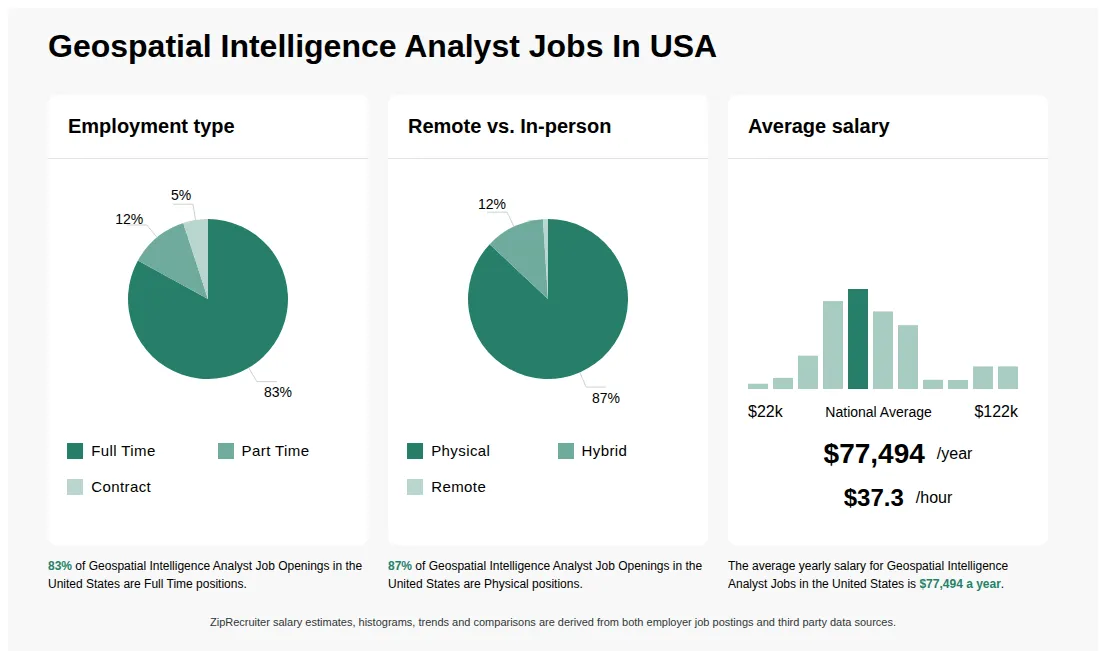
As of Jun 25, 2026, the average yearly pay for geospatial intelligence analyst in the United States is $77,494.00, according to ZipRecruiter salary data. Most workers in this role earn between $54,500.00 and $80,000.00 per year, depending on experience, location, and employer.

What does a Geospatial Intelligence analyst do?

A Geospatial Intelligence analyst collects, analyzes, and interprets geographic data to support national security, defense, or intelligence operations. They use tools like GIS software and satellite imagery to identify patterns, track movements, and provide actionable insights for decision-makers.

What are the key skills and qualifications needed to thrive as a Geospatial Intelligence Analyst, and why are they important?

To thrive as a Geospatial Intelligence Analyst, you need strong analytical skills, a background in geography or related fields, and proficiency in interpreting spatial data, usually supported by a relevant degree or military training. Familiarity with GIS software (such as ArcGIS or QGIS), remote sensing tools, and intelligence analysis systems is typically required. Attention to detail, critical thinking, and effective communication are essential soft skills for conveying complex information and collaborating with multidisciplinary teams. These skills and qualifications are crucial for producing accurate intelligence assessments that inform decision-making and national security operations.

Is Geospatial Intelligence a good career?

A career as a Geospatial Intelligence Analyst involves analyzing geographic data using tools like GIS and remote sensing technology. It offers opportunities in government, defense, and private sectors, often requiring security clearances and specialized training. The field is growing due to increased reliance on spatial data for decision-making.

What is the difference between Geospatial Intelligence Analyst vs GIS Analyst?

AspectGeospatial Intelligence AnalystGIS Analyst
Required CredentialsBachelor's in Geography, GIS, or related field; security clearance often preferredBachelor's in Geography, GIS, or related field; certifications like GISP beneficial
Work EnvironmentGovernment agencies, defense, intelligence, militaryUrban planning, environmental agencies, private sector
Employer & Industry UsagePrimarily in defense, intelligence, national securityPublic and private sectors, urban planning, environmental management

While both roles involve geospatial data, Geospatial Intelligence Analysts focus on national security and defense applications, often requiring security clearances. GIS Analysts typically work in urban planning, environmental management, and commercial sectors, emphasizing geographic data analysis for various projects.

Is a GIS analyst a good career?

A GIS analyst is a valuable role in fields such as urban planning, environmental management, and defense, involving the use of geographic information systems to analyze spatial data. The career typically requires proficiency in GIS software like ArcGIS or QGIS, and opportunities often include certifications and continuous learning. It offers stable employment with potential for advancement and specialization.

Will GIS be overtaken by AI?

As a Geospatial Intelligence Analyst, understanding how AI integrates with GIS is important. AI can automate data analysis and pattern recognition within GIS, enhancing efficiency, but it is unlikely to fully replace the need for human expertise in interpreting complex spatial data and making strategic decisions. Combining AI tools with GIS skills remains essential for effective geospatial analysis.

What Does a Geospatial Intelligence Analyst Do?

As a geospatial intelligence analyst, your job is to support national defense operations by using visual images to gather information about geography and landscapes. Many details of this job depend on the employer and their needs, but you may perform tasks like finding alternative routes for blocked roads or searching for areas that could be used to ambush convoys. Geospatial intelligence officers often work for the military or the federal government, either as full-time employees or independent contractors. However, you may also be able to find a few private security jobs. You can do this work alone, but intelligence analysts often work with local law enforcement or other organizations to research time-sensitive questions.


How does a Geospatial Intelligence Analyst typically collaborate with other teams within an organization?

Geospatial Intelligence Analysts often work closely with multidisciplinary teams, including data scientists, military personnel, and policy makers. They collaborate to interpret satellite imagery, analyze spatial data, and provide actionable intelligence for decision-making. Regular communication and coordination are essential to ensure that geospatial insights are effectively integrated into broader intelligence products and mission planning. This collaborative environment helps analysts refine their findings and ensures that their work supports overall organizational objectives.
What cities are hiring for Geospatial Intelligence Analyst jobs? Cities with the most Geospatial Intelligence Analyst job openings:
What are the most commonly searched types of Geospatial Intelligence Analyst jobs? The most popular types of Geospatial Intelligence Analyst jobs are:
Who are the top companies hiring for Geospatial Intelligence Analyst jobs? The top employers for Geospatial Intelligence Analyst jobs are:
What states have the most Geospatial Intelligence Analyst jobs? States with the most job openings for Geospatial Intelligence Analyst jobs include:
What are popular job titles related to Geospatial Intelligence Analyst jobs? For Geospatial Intelligence Analyst jobs, the most frequently searched job titles are:
Infographic showing various Geospatial Intelligence Analyst job openings in the United States as of June 2026, with employment types broken down into 37% Full Time, 38% Part Time, and 25% Contract. Highlights an 89% Physical, 2% Hybrid, and 9% Remote job distribution, with an average salary of $77,494 per year, or $37.3 per hour.
Senior Geospatial Intelligence Analyst

Senior Geospatial Intelligence Analyst

Quick Services LLC

Fayetteville, NC • On-site

Full-time

Medical, Dental, Vision, Life, Retirement, PTO

Posted 6 days ago


Job description

CLEARANCE REQUIRED: TS/SCI

This job is located in: FT Bragg, NC

Qualifications and Job Summary:

Shall be cleared at the TOP SECRET level with SCI eligibility

Shall perform advanced level geospatial, topographic, and imagery analysis in support of Special Operations missions with regional and point analysis products to support Find. Fix, Finish, Exploit, and Analyze Targeting methodology.

Have 6 years of progressive experience with operational and tactical level intelligence performing complex and timely geospatial topographic, and imagery analysis of ground feature and remotely sensed data, to include general experience in the fields of targeting, intelligence, or geospatial systems

Shall be proficient in utilizing GIS applications and intelligence related automation to support analytical efforts and product development

Shall possess a broad understanding of collection processes and management

Performs geospatial processing and develops new methodologies to solve complex

tactical intelligence problems.

Desired: Proficient in integrating with other intelligence disciplines. Demonstrates a working knowledge of how geospatial techniques are used to support the Find Fix Finish Exploit Analyze (F3EA) targeting cycle. Should possess a working knowledge of computer scripting languages such as Python, Java Script, HTML, R, or SAS.

Why work for QSL?

Our founders, Mel Wick and Bill Cronin, retired from storied careers in the Special Operations Forces (SOF) Community. Like many Americans and military veterans, they felt a strong desire to support the nation’s response to the 9/11/2001 terrorist attacks on the World Trade Center and the Pentagon in any way they could. They established QSL to do just that, Stay in the Fight! QSL is built on a SOF culture, emphasizing selfless-service and teamwork. Our employees work to ensure that warfighters have every possible resource and all necessary support to safely accomplish their missions in defense of our nation.

QSL's Benefit Package

Because we believe our employees are our most valuable asset, offering a competitive comprehensive compensation package is very important to us. It is the goal of QSL to attract and retain the highest level of experience and technical talent necessary for successful performance. In order to accomplish this, we feel that it is necessary to provide satisfying work, an excellent work environment, and we continually monitor the marketplace to ensure that our total compensation/benefit package remains competitive.

Listed below are some of our standard benefits. We combine all traditional paid time off (Federal holidays, sick time, leave time personal days, jury duty, bereavement, etc.) into one category which allows employees flexibility in how they use their leave time and enables them to better balance their career with their personal needs.

  • Combined Paid Time Off (PTO)
  • Medical, Dental, Life Insurance
  • Disability (Short-Term and Long-Term)
  • Vision Insurance (CONUS-based employees)
  • Flexible Spending Account (FSA)
  • 401(k) Retirement Plan
  • Employee Referral Bonus Program
  • Employee Discount Programs
  • Critical Illness and Accident Insurance
  • Employee Assistance Program

We are an Equal Opportunity Employer. We do not and will not discriminate in employment and personnel practices based on race, sex, age, disability, veteran status, religion, national origin or any other basis prohibited by applicable law. Hiring, transferring, and promotion practices are performed without regard to the above listed items. EEO/AAP, M, F, V, D.