1

Genealogy Research Jobs (NOW HIRING)

Job Page

Phoenix, AZ · On-site

$31/hr

... research resources. • Lead and/or participate in special statewide or national projects, such as Arizona Genealogy Day and the Law4AZ program. • Support social media outreach activities by ...

Develop scalable manufacturing data platforms for test results, yield analysis, genealogy, and ... We do not have boundaries between engineering and research, and we expect all of our technical ...

Senior Product Test Engineer

San Jose, CA · On-site

$175K - $225K/yr

Develop scalable manufacturing data platforms for test results, yield analysis, genealogy, and ... We do not have boundaries between engineering and research, and we expect all of our technical ...

Lead Product Designer

Draper, UT · On-site +1

$144K - $178K/yr

... genealogy with rich storytelling workflows, or spearheading our long-term strategy for multi ... Partner directly with user research teams and engage with members firsthand to ground design and ...

You will receive a job router from the Order Process Team, investigate the lot & lot genealogy ... Ability to research and confirm accuracy of certification package with vendor * Responsible for ...

Showing results 41-60

Genealogy Research information

See salary details

$11

$30

$61

How much do genealogy research jobs pay per hour?

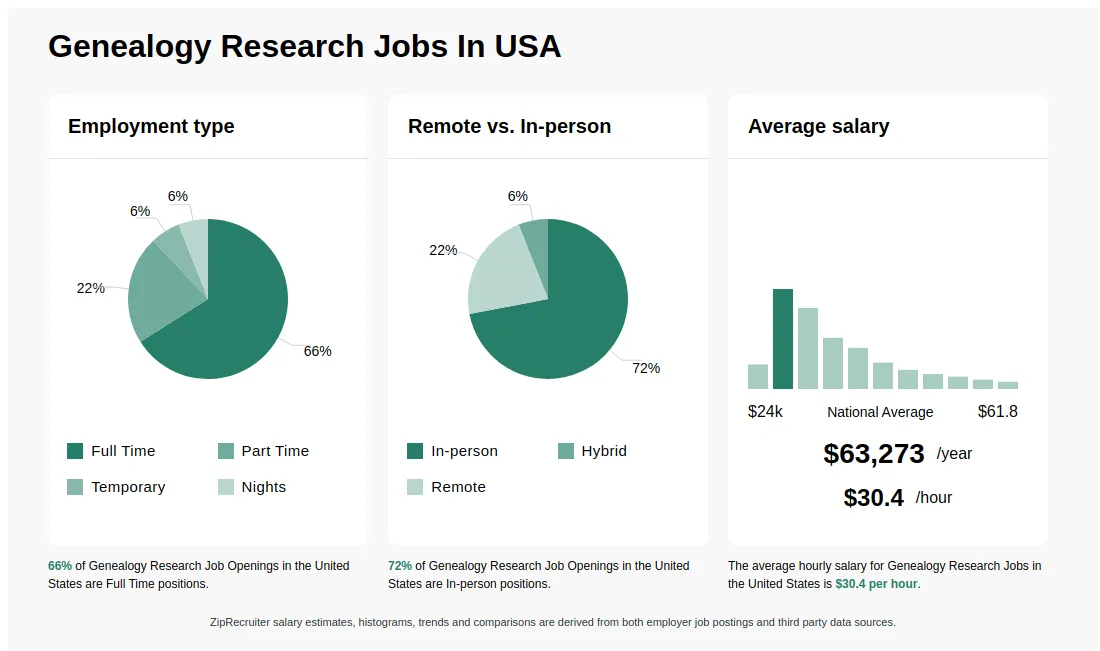
As of Aug 22, 2026, the average hourly pay for genealogy research in the United States is $30.42, according to ZipRecruiter salary data. Most workers in this role earn between $19.95 and $35.10 per hour, depending on experience, location, and employer.

What is genealogy research?

Genealogy research is the process of investigating and documenting family histories and ancestries. Genealogists use historical records, such as birth, marriage, and death certificates, census data, and other documents to trace lineages and learn about ancestors. This work may involve both online databases and visits to archives or libraries. The goal is often to create a family tree, uncover unknown relatives, or gain insights into family origins and migration patterns. Genealogy research can be pursued as a personal hobby or professionally for others.

What are genealogy research jobs?

Genealogy research jobs primarily refer to genealogy researchers. As a genealogy or genealogical researcher, you can work in libraries, for genealogical services companies, or in genomics. Your responsibilities include conducting research into a client’s family or individual background, searching social and public information records, constructing charts of family relationships and lines of descent, and preparing family history documents. Other duties include determining a client’s ancestral origins, performing an archives search, locating and compiling legal documents, conducting interviews to obtain genealogical information, exploring medical histories and census records, and helping to locate a client’s relatives.

What are the key skills and qualifications needed to thrive as a genealogy researcher, and why are they important?

To thrive as a Genealogy Researcher, you need strong analytical skills, meticulous attention to detail, and a solid understanding of historical records and research methodologies, often supported by coursework or certifications in genealogy. Familiarity with genealogy software (like Ancestry or FamilySearch), online databases, and archival systems is essential. Excellent communication, patience, and critical thinking are standout soft skills for interpreting complex information and collaborating with clients or family members. These skills ensure accurate, credible research results and effective communication of family histories.

What are the most common challenges faced by genealogy researchers, and how can they be addressed?

One of the most common challenges in genealogy research is encountering incomplete or inconsistent historical records, which can make verifying family connections difficult. Researchers often need to cross-reference multiple sources, such as census data, birth and marriage certificates, and immigration records, to build accurate family trees. Collaborating with other researchers and utilizing online databases can help overcome these hurdles. Being persistent, detail-oriented, and open to alternative spellings or name variations is essential for success in this role.

What is the difference between Genealogy Research vs Genealogical Technician?

AspectGenealogy ResearchGenealogical Technician
Required CredentialsOften requires genealogy certifications or degreesMay require similar certifications, often more technical or administrative
Work EnvironmentResearch-focused, often in archives or onlineOffice or archival settings, assisting with data organization
Employer & Industry UsageUsed by private clients, genealogical firms, historical societiesEmployed by genealogical companies, archives, or research services
Search & Comparison IntentIndividuals seeking in-depth family history researchClients needing technical support or data management in genealogy

Genealogy Research involves in-depth investigation of family histories, often requiring specialized knowledge and certifications. In contrast, Genealogical Technicians support research efforts through data management and technical tasks. Both roles are essential in the genealogy industry but differ in focus and responsibilities.

Can you get paid to do genealogy research?

Genealogy research can be a paid profession, with individuals working as genealogists or research consultants for clients, genealogical firms, or historical organizations. Payment is often based on project scope, research complexity, and experience, and professionals may use tools like genealogy databases and certification programs to enhance credibility.

How do I become a genealogy researcher?

To become a genealogy researcher, you should develop skills in historical research, data analysis, and use of genealogy software and online databases. Gaining relevant education, such as courses in history or genealogy, and obtaining certifications like those from the Board for Certification of Genealogists can enhance credibility. Experience through volunteering or internships can also help build expertise in the field.

What jobs can you get with a genealogy research degree?

A genealogy research degree can lead to roles such as genealogist, family history researcher, or archivist, often working for genealogy firms, historical societies, or government agencies. These jobs typically require strong research skills, knowledge of historical records, and proficiency with genealogy software and databases.

What cities are hiring for Genealogy Research jobs?

Cities with the most Genealogy Research job openings:

What are the most commonly searched types of Genealogy Research jobs?

The most popular types of Genealogy Research jobs are:

What states have the most Genealogy Research jobs?

States with the most job openings for Genealogy Research jobs include:

Infographic showing various Genealogy Research job openings in the United States as of August 2026, with employment types broken down into 7% Internship, 64% Full Time, and 29% Part Time. Highlights an 79% In-person, and 21% Remote job distribution, with an average salary of $63,273 per year, or $30.4 per hour.

Case Manager - Heir Location & Unclaimed Property

Lauth Investigations International Inc

Boulder, CO • On-site

Full-time

Re-posted 21 days ago


Job description

About the Role
The Return Assets Division is seeking a meticulous Case Manager specialized in forensic genealogy, heir location, and asset recovery. This is not an administrative role; it is an investigative position focused on identifying, proving, and recovering dormant assets held by State Unclaimed Property Offices.
As a Case Manager, you will take the lead on complex "decedent accounts"-cases where the original asset owner has passed away, often leaving behind substantial unclaimed funds without a clear path of succession. You will use a combination of deep-dive public records research and advanced OSINT tactics to build exhaustive family lineages. Your primary mission is to construct bulletproof heirship tables and compile the exact documentary chains required by state controllers to prove ownership and successfully release funds.
What You Will Do (The Mission)
• Architect the Lineage: Take ownership of unclaimed property files from initial data discovery through to final state payout, managing the end-to-end estate and kinship investigation.
• Construct Heirship Tables: Research, design, and draft legally binding, court-ready family trees and heirship tables mapping line of descent under varied state intestacy laws.
• Conduct Forensic Genealogy: Pore over historical and modern vital statistics-including birth, marriage, divorce, and death certificates, federal census data, probate files, and immigration manifests-to verify kinship.
• Execute Targeted OSINT & Skip-Tracing: Deploy advanced OSINT, social media intelligence (SOCMINT), and proprietary locational databases to track down missing, estranged, or unknown heirs globally and establish contact.
• Build State Claim Packages: Review strict, state-specific evidence requirements to systematically compile identification, probate orders, small estate affidavits, and continuity-of-address proofs.
• Navigate State Audits: Act as the primary liaison with State Unclaimed Property Offices,
Requirements
• Proven Investigative Background: 3+ years of professional experience in forensic genealogy, probate research, heir-finding, title abstracting, or as a paralegal specializing in estate administration.
• Lineage & Intestacy Expertise: Deep, practical familiarity with constructing line-of-descent charts and an understanding of how state intestacy laws govern property distribution.
• Advanced OSINT & Public Records Mastery: Exceptional capability utilizing specialized search engines, public county court portals, historical repositories, and public record aggregators (e.g., LexisNexis, TLO, or Ancestry/FamilySearch institutional tiers).
• Meticulous Document Gathering: A track record of tracking down physical and certified vital records from bureaucratic agencies across multiple state and local jurisdictions.
• Case Rigor: Strong organizational skills to manage dozens of active state claims simultaneously without letting critical deadlines or missing documentation fall through the cracks.
Highly Desirable "Bonus" Skills
• Experience utilizing link-analysis or mind-mapping software to visualize complex, multi-generational family trees.
• Fluency in navigating foreign vital registries for first- and second-generation immigrant asset cases.
Benefits
What We Offer
• Premium Tools & Data Access: Access to tier-one investigative databases, historical archives, public records scraping utilities, and genealogical platforms.
• Operational Autonomy: The independence to build and manage your investigative strategies on a high-volume, high-yield portfolio of claims.
• Competitive Compensation: A stable base salary with a performance-based bonus structure connected to successful claim yields and asset recovery milestones.