1

Genealogy Research Jobs (NOW HIRING)

Be Seen First

Genealogy and records research * Competitive quizzing or puzzle-hunt construction Nice to Have * Experience with LLM evaluation, red-teaming, or benchmark construction * Familiarity with JSON and ...

Case Manager

Fort Knox, KY · On-site

$19 - $24.50/hr

Request a genealogy report for Family Reference Samples in accordance with the Past Conflicts ... Research third-party data banks for potential family donors. * Make initial telephonic contact with ...

Case Manager

Fort Knox, KY · On-site

$19 - $24.50/hr

Request a genealogy report for Family Reference Samples in accordance with the Past Conflicts ... Research third-party data banks for potential family donors. * Make initial telephonic contact with ...

Genealogy and records research * Competitive quizzing or puzzle-hunt construction Nice to Have Familiarity with JSON and structured data delivery formats Offer Details: * Commitments Required: 40 ...

... Genealogy Divisions, the Librarian II: * Provides excellent reference service based on specialized ... Provides reference and research assistance. * Develops and teaches classes for the public and ...

Job Page

Phoenix, AZ · On-site

$31/hr

... research resources. • Lead and/or participate in special statewide or national projects, such as Arizona Genealogy Day and the Law4AZ program. • Support social media outreach activities by ...

Showing results 21-40

Genealogy Research information

See salary details

$11

$30

$61

How much do genealogy research jobs pay per hour?

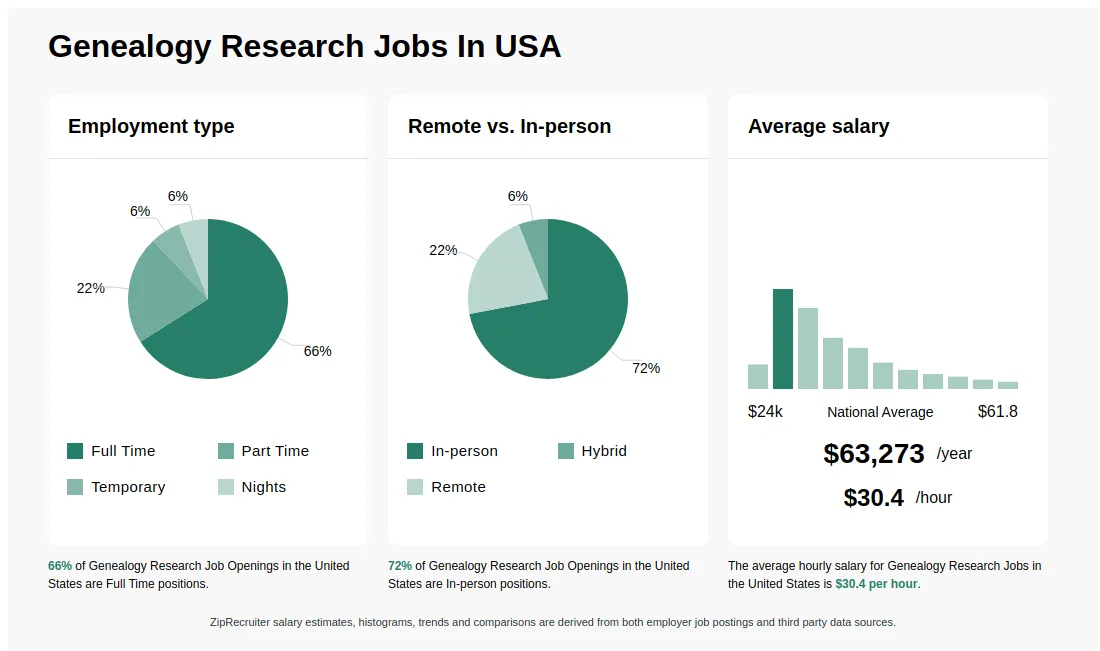
As of Sep 3, 2026, the average hourly pay for genealogy research in the United States is $30.42, according to ZipRecruiter salary data. Most workers in this role earn between $19.95 and $35.10 per hour, depending on experience, location, and employer.

What is genealogy research?

Genealogy research is the process of investigating and documenting family histories and ancestries. Genealogists use historical records, such as birth, marriage, and death certificates, census data, and other documents to trace lineages and learn about ancestors. This work may involve both online databases and visits to archives or libraries. The goal is often to create a family tree, uncover unknown relatives, or gain insights into family origins and migration patterns. Genealogy research can be pursued as a personal hobby or professionally for others.

What are genealogy research jobs?

Genealogy research jobs primarily refer to genealogy researchers. As a genealogy or genealogical researcher, you can work in libraries, for genealogical services companies, or in genomics. Your responsibilities include conducting research into a client’s family or individual background, searching social and public information records, constructing charts of family relationships and lines of descent, and preparing family history documents. Other duties include determining a client’s ancestral origins, performing an archives search, locating and compiling legal documents, conducting interviews to obtain genealogical information, exploring medical histories and census records, and helping to locate a client’s relatives.

What are the key skills and qualifications needed to thrive as a genealogy researcher, and why are they important?

To thrive as a Genealogy Researcher, you need strong analytical skills, meticulous attention to detail, and a solid understanding of historical records and research methodologies, often supported by coursework or certifications in genealogy. Familiarity with genealogy software (like Ancestry or FamilySearch), online databases, and archival systems is essential. Excellent communication, patience, and critical thinking are standout soft skills for interpreting complex information and collaborating with clients or family members. These skills ensure accurate, credible research results and effective communication of family histories.

What are the most common challenges faced by genealogy researchers, and how can they be addressed?

One of the most common challenges in genealogy research is encountering incomplete or inconsistent historical records, which can make verifying family connections difficult. Researchers often need to cross-reference multiple sources, such as census data, birth and marriage certificates, and immigration records, to build accurate family trees. Collaborating with other researchers and utilizing online databases can help overcome these hurdles. Being persistent, detail-oriented, and open to alternative spellings or name variations is essential for success in this role.

What is the difference between Genealogy Research vs Genealogical Technician?

AspectGenealogy ResearchGenealogical Technician
Required CredentialsOften requires genealogy certifications or degreesMay require similar certifications, often more technical or administrative
Work EnvironmentResearch-focused, often in archives or onlineOffice or archival settings, assisting with data organization
Employer & Industry UsageUsed by private clients, genealogical firms, historical societiesEmployed by genealogical companies, archives, or research services
Search & Comparison IntentIndividuals seeking in-depth family history researchClients needing technical support or data management in genealogy

Genealogy Research involves in-depth investigation of family histories, often requiring specialized knowledge and certifications. In contrast, Genealogical Technicians support research efforts through data management and technical tasks. Both roles are essential in the genealogy industry but differ in focus and responsibilities.

Can you get paid to do genealogy research?

Genealogy research can be a paid profession, with individuals working as genealogists or research consultants for clients, genealogical firms, or historical organizations. Payment is often based on project scope, research complexity, and experience, and professionals may use tools like genealogy databases and certification programs to enhance credibility.

How do I become a genealogy researcher?

To become a genealogy researcher, you should develop skills in historical research, data analysis, and use of genealogy software and online databases. Gaining relevant education, such as courses in history or genealogy, and obtaining certifications like those from the Board for Certification of Genealogists can enhance credibility. Experience through volunteering or internships can also help build expertise in the field.

What jobs can you get with a genealogy research degree?

A genealogy research degree can lead to roles such as genealogist, family history researcher, or archivist, often working for genealogy firms, historical societies, or government agencies. These jobs typically require strong research skills, knowledge of historical records, and proficiency with genealogy software and databases.

What cities are hiring for Genealogy Research jobs?

Cities with the most Genealogy Research job openings:

What are the most commonly searched types of Genealogy Research jobs?

The most popular types of Genealogy Research jobs are:

What states have the most Genealogy Research jobs?

States with the most job openings for Genealogy Research jobs include:

Infographic showing various Genealogy Research job openings in the United States as of August 2026, with employment types broken down into 80% Full Time, and 20% Part Time. Highlights an 80% In-person, and 20% Remote job distribution, with an average salary of $63,273 per year, or $30.4 per hour.

Web Research Specialist (Remote - USA And Canada)

Prointegrate LLC

Washington, DC • Remote

$19 - $20/hr

Contractor

Posted 7 days ago

Be Seen First

After you apply to this job, you can share why you’re interested to jump to the top of the candidate list.


Job description


Web Research Specialist

Employment Type: Contractor Assignment
Experience: 3+ years
Start Date: ASAP
Engagement Length: 8 weeks
Commitment: Full-time, 40 hours/week
Time Zone Requirement: Minimum 4 hours of PST overlap
Compensation: Pay Per Task


About Turing

Turing is one of the world’s fastest-growing AI companies, accelerating the advancement and deployment of powerful AI systems.

Turing works with leading AI labs to advance frontier model capabilities across reasoning, coding, agentic behavior, multimodality, multilingual capabilities, STEM, and frontier knowledge. Turing also applies this work to build real-world AI systems that solve mission-critical business priorities.

About the Role

We are building an evaluation benchmark for frontier AI browsing agents. In this role, you will design research problems that state-of-the-art AI systems cannot easily solve, even with full web access and multiple attempts.

This is not a traditional subject-matter expert or content-writing role. It is an investigative research role focused on finding, validating, and documenting information from difficult-to-navigate sources.

You will start with a verifiable fact and work backwards to construct a research question that makes that fact extremely difficult to locate. You will then validate your work through a complete, auditable evidence trail.

What You Will Produce:

  • Natural-language research questions with short, stable, objectively verifiable answers
  • Multiple independently checkable clues spanning different fact types, including:
    • Dates
    • People
    • Places
    • Organizations
    • Works
    • Events
    • Records
    • Quantities
  • Specific constraints designed to make the research problem challenging
  • A detailed validation record documenting the searches you conducted and the results they returned
  • Precise evidence trails supporting the final answer


Minimum Qualifications:

  • 3+ years of professional research, investigative research, or a related field
  • Demonstrated open-web research ability, including locating primary records and navigating:
    • Government databases
    • Institutional databases
    • Archives
    • Registries
    • PDF documents
    • Other hard-to-find public records
  • Strong attention to sourcing and evidence; able to cite exact pages, tables, sections, or records rather than simply linking to homepages
  • Comfortable researching unfamiliar subjects from scratch
  • Native or near-native written English
  • High tolerance for structured documentation and detailed evidence trails
  • Experience with LLM evaluation, red-teaming, or benchmark construction
  • Experience in one or more of the following areas:
    • Reference librarianship, archival research, or special collections
    • Investigative journalism or professional fact-checking
    • OSINT, due diligence, KYC, or investigative research
    • Patent, prior-art, or legal-discovery search
    • Genealogy and records research
    • Competitive quizzing or puzzle-hunt construction

Nice to Have

  • Experience with LLM evaluation, red-teaming, or benchmark construction
  • Familiarity with JSON and structured data delivery formats
  • Experience working with complex datasets, archives, public records, or research databases


The selection process includes:

  1. ICF
  2. Assessment
  3. DM Review


Work Arrangement:

  • Remote contractor assignment
  • Full-time commitment: 40 hours per week
  • Minimum 4 hours of PST overlap required
  • 8-week engagement
  • ASAP start
  • Pay-per-task compensation structure
  • Contractor assignment; no medical or paid leave benefits


Apply now if you have strong investigative web research skills and enjoy solving difficult information-retrieval problems.