1

Full Stack Python Developer Jobs (NOW HIRING)

Full Stack Python Engineer

Fairfax, VA · On-site

$120K - $160K/yr

Solution Street is seeking a Full Stack Python Engineer with 6+ years of experience. This is an ... software developer who envisioned a safe haven for software engineers who wanted to work on ...

Python Developer

Minneapolis, MN · On-site

$52.50 - $72.25/hr

Android Inc. is seeking an exceptional full stack Python Developer to work on an exciting new project. * Front-end development * Implementation of security and data protection * Design of Django ...

They are looking for a passionate Python Full Stack Developer to join their team, responsible for developing and implementing high-quality software solutions and collaborating with cross-functional ...

Python Full Stack Developer Dallas, TX (Onsite) W2 Only Highly experienced Python Full Stack Developer with strong expertise in backend, cloud, and AI/LLM-based applications. Qualifications * 15 ...

Showing results 41-60

Full Stack Python Developer information

See salary details

$59.5K

$129.8K

$183.5K

How much do full stack python developer jobs pay per year?

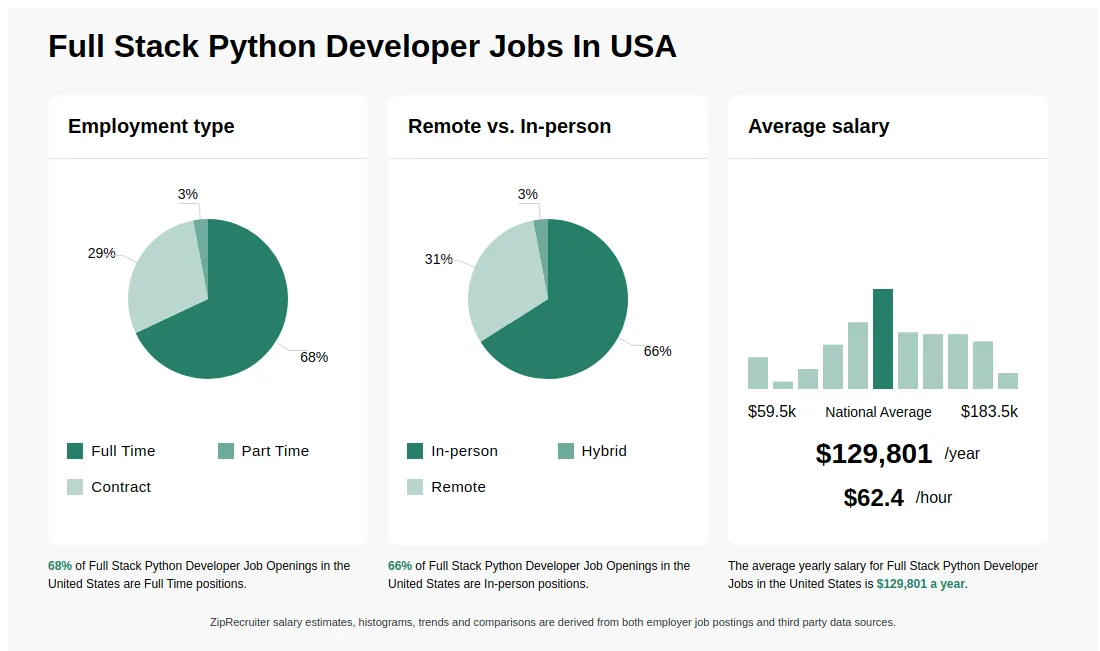
As of Sep 14, 2026, the average yearly pay for full stack python developer in the United States is $129,801.00, according to ZipRecruiter salary data. Most workers in this role earn between $109,000.00 and $151,000.00 per year, depending on experience, location, and employer.

What is a full stack Python developer?

A Full Stack Python Developer is a software engineer who is proficient in both front-end and back-end development using Python as the primary programming language for server-side logic. They are responsible for designing, building, and maintaining web applications, ensuring seamless integration between the user interface and the server. Full Stack Python Developers typically work with frameworks like Django or Flask for the backend, and use technologies like HTML, CSS, and JavaScript for the frontend. Their skill set allows them to manage databases, create APIs, and handle deployment, making them versatile contributors to software development teams.

What is a full stack Python developer?

A full stack Python developer uses the Python programming language for the development of the entire technology stack of a web application. Python is a computer programming language that has become one of the more popular for application development. In this job, your duties revolve around developing both front-end and back-end components, which are primarily interfaces and application code, respectively. As a full stack Python developer, you must understand how the entire technology stack functions and have hands-on experience with each component.

What are the key skills and qualifications needed to thrive as a full stack Python developer, and why are they important?

To thrive as a Full Stack Python Developer, you need proficiency in Python programming, front-end (HTML, CSS, JavaScript), back-end frameworks like Django or Flask, and a solid understanding of databases and RESTful APIs. Familiarity with version control systems (such as Git), cloud platforms (AWS, Azure), and containerization tools (Docker) is typically required, along with relevant certifications being an advantage. Problem-solving, adaptability, and strong communication skills help developers collaborate effectively and address complex technical challenges. These combined technical and soft skills are crucial for delivering robust, scalable applications and ensuring smooth teamwork in dynamic development environments.

What are some common challenges full stack Python developers face when managing both front-end and back-end tasks?

Full Stack Python Developers often juggle multiple responsibilities, including designing user interfaces and ensuring robust server-side logic. One frequent challenge is efficiently switching between front-end frameworks (like React or Angular) and back-end Python code, which requires staying up-to-date with technologies on both ends. Additionally, integrating APIs, troubleshooting cross-platform issues, and maintaining code consistency can be complex in fast-paced environments. Effective communication with UI/UX designers and DevOps teams is also crucial to ensure seamless deployments and user experiences.

What is the difference between Full Stack Python Developer vs Backend Python Developer?

AspectFull Stack Python DeveloperBackend Python Developer
Primary FocusDeveloping both frontend and backend applications using PythonBuilding and maintaining server-side logic and databases with Python
Skills RequiredPython, JavaScript, HTML, CSS, frameworks like Django/Flask, frontend librariesPython, database management, API development, server-side frameworks
Work EnvironmentFull-stack projects, both client and server-side tasksBackend systems, APIs, database integration
Common UsageStartups, small teams, full product developmentLarge-scale backend systems, data processing

While both roles involve Python, a Full Stack Python Developer handles both frontend and backend development, whereas a Backend Python Developer focuses solely on server-side logic and database management. The choice depends on whether you want a comprehensive development role or specialize in backend systems.

What cities are hiring for Full Stack Python Developer jobs?

Cities with the most Full Stack Python Developer job openings:

What are the most commonly searched types of Full Stack Python Developer jobs?

The most popular types of Full Stack Python Developer jobs are:

Who are the top companies hiring for Full Stack Python Developer jobs?

The top employers for Full Stack Python Developer jobs are:

What states have the most Full Stack Python Developer jobs?

States with the most job openings for Full Stack Python Developer jobs include:

What are popular job titles related to Full Stack Python Developer jobs?

For Full Stack Python Developer jobs, the most frequently searched job titles are:

Infographic showing various Full Stack Python Developer job openings in the United States as of September 2026, with employment types broken down into 3% Internship, 87% Full Time, 6% Part Time, and 4% Contract. Highlights an 73% Physical, 5% Hybrid, and 22% Remote job distribution, with an average salary of $129,801 per year, or $62.4 per hour.

Full Stack Python/DevOps Developer

Bethesda, MD • On-site

Futrend Technology, Inc.
IT Services • 51 - 200 employees

$90K - $120K/yr

Full-time

Re-posted 26 days ago


Job description

About Futrend Technology, Inc.
Futrend Technology, Inc. is an innovative provider of high-value IT solutions supporting mission-critical federal programs. Our practice areas include Healthcare IT, Federal Financial Management, and Grants Management, with an established track record in enterprise modernization and real-time system integration.
Grounded in integrity, excellence, collaboration, and continuous improvement, we invest heavily in our team’s professional growth and technical advancement. We offer competitive compensation and a comprehensive benefits package.
Position Overview
Futrend is seeking a Mid-Level Full Stack amp; DevOps Engineer to support the National Library of Medicine (NLM) in developing, modernizing, and securing enterprise web applications. This position requires strong full-stack engineering capabilities across Python/Django, Java/Spring Boot, and Node.js, paired with DevOps skills that support automated, secure, AWS-based cloud environments.
The ideal candidate thrives in complex federal IT environments, can work across multiple programming languages, and understands how to build interoperable systems for NIH stakeholders.
Key Responsibilities
  • Design, develop, and maintain backend services using Python (Django/FastAPI), Java (Spring Boot/Quarkus), and Node.js (Express/NestJS).
  • Build secure REST and GraphQL APIs supporting interoperability across NIH systems.
  • Develop modern, responsive front-end applications using React or Angular, following USWDS and Section 508 accessibility standards.
  • Implement end-to-end automated testing using Selenium/WebDriver, enabling cross-browser and regression coverage.
  • Operate and enhance AWS environments, including EC2, S3, RDS/Aurora, IAM, CloudFront, and Lambda.
  • Build, monitor, and optimize CI/CD pipelines using GitLab CI, GitHub Actions, or Jenkins.
  • Manage and optimize MongoDB clusters including schema design, indexing, performance tuning, backup strategy, and replication.
  • Support relational databases such as PostgreSQL, Oracle, or MySQL.
  • Develop Infrastructure-as-Code (IaC) solutions using Terraform or AWS CloudFormation for secure, repeatable deployments.
  • Monitor system performance and troubleshoot application issues using CloudWatch, ELK/OpenSearch, and observability tools.
  • Create and maintain technical documentation including architecture diagrams, runbooks, SOPs, and configuration standards.
  • Mentor junior developers and contribute to engineering standards, governance, and best practices.
Required Qualifications
  • Bachelor’s degree in Computer Science, Information Technology, or related field.
  • 3+ years of professional software engineering experience.
  • 5+ years full-stack development experience covering backend and frontend.
  • Strong programming capabilities in Python, Java, and Node.js.
  • Experience developing modern front-ends with React or Angular, TypeScript, HTML, CSS, and JavaScript.
  • Proficiency in Git and collaborative development workflows.
  • Strong understanding of RESTful API design and systems integration.
  • Hands-on expertise with AWS (EC2, S3, RDS/Aurora, Lambda, CloudFront, IAM).
  • Deep experience with MongoDB including schema design, indexing, and performance optimization.
  • Experience with relational databases (PostgreSQL/Oracle/MySQL).
  • Test automation experience with Selenium/WebDriver and Selenium Grid.
  • Strong DevOps experience: CI/CD pipelines, Docker, Kubernetes, artifact management.
  • Experience implementing IaC with Terraform or CloudFormation.
  • Understanding of secure authentication/authorization (OAuth 2.0, SSO), Zero Trust practices, and NIH security requirements.
  • Strong skills in Linux, networking fundamentals, observability, and performance troubleshooting.
  • Must be eligible for a Public Trust clearance and pass federal background screening.
Preferred Qualifications
  • Experience integrating with ServiceNow or similar workflow automation tools.
  • Experience with Elasticsearch/OpenSearch, Redis, or message queues (SQS, SNS, Kafka).
  • Advanced Kubernetes experience (Helm charts, operators) and/or service mesh (Istio).
  • Experience with secrets management, security automation, and compliance tooling.
  • Familiarity with NIH/NLM systems such as MedlinePlus, DOCLINE, or DiscoverWHR.
Common Technologies Used in OCCS Projects
  • Backend: Python (Django/FastAPI), Java (Spring Boot), Node.js (Express/NestJS)
  • Frontend: React, Angular, TypeScript, HTML/CSS/JavaScript
  • Cloud: AWS (EC2, Lambda, CloudFront, S3, RDS/Aurora, IAM)
  • Databases: MongoDB, PostgreSQL, Oracle, MySQL
  • DevOps: GitLab CI, GitHub Actions, Jenkins, Docker, Kubernetes, Terraform, CloudFormation
  • Testing: Selenium/WebDriver, PyTest, JUnit, Jest
  • Security amp; Compliance: OAuth2.0, SSO, Zero Trust, Section 508, NIH/FedRAMP-aligned practices