1

Forestry Jobs in Minnesota (NOW HIRING)

next page

Showing results 1-20

Forestry information

See Minnesota salary details

$28.4K

$40.7K

$52.4K

How much do forestry jobs pay per year?

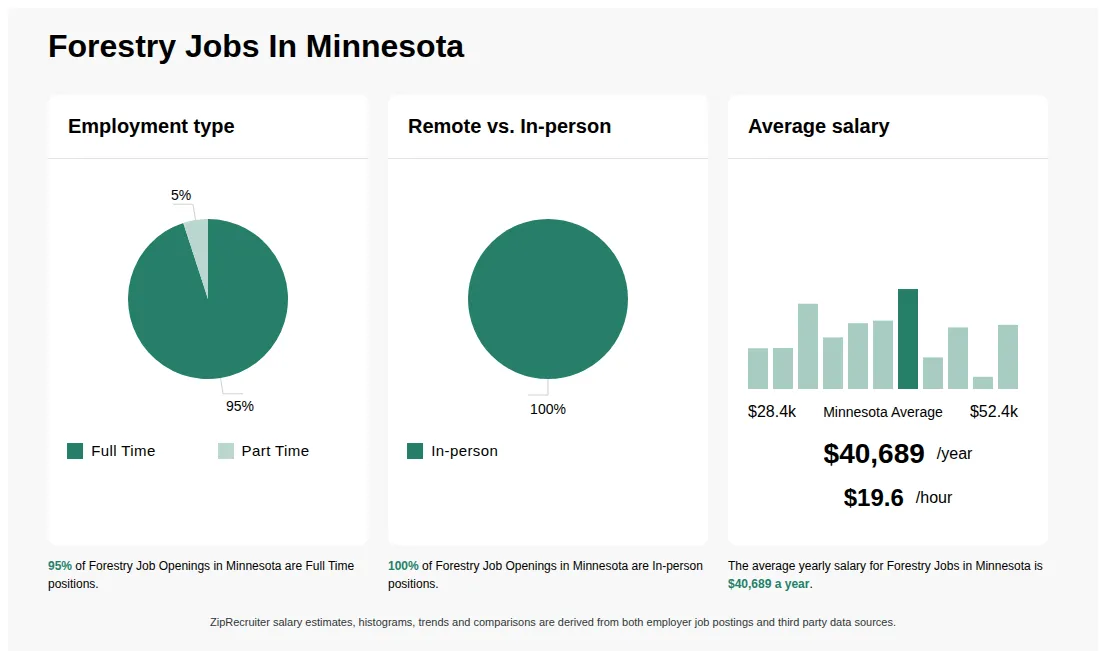
As of Sep 6, 2026, the average yearly pay for forestry in Minnesota is $40,689.00, according to ZipRecruiter salary data. Most workers in this role earn between $33,800.00 and $45,500.00 per year, depending on experience, location, and employer.

What are forestry jobs?

If you work in a forestry career, your primary duties depend on your area of specialization. Forestry professionals include foresters, loggers, firefighters, and forest rangers. If you have a degree in forestry, land management, or a related subject, you may work in conservation or forestry management or serve as a policy advisor or project manager for forest preservation and rehabilitation efforts. Arborists, naturalists specializing in the forest habitat, and botanists may also work in forestry. Colleges offer associate’s and bachelor’s degrees in forestry. These degrees give you a wide range of knowledge about different forestry subjects.


What are the key skills and qualifications needed to thrive as a forester, and why are they important?

To thrive as a Forester, you need a solid background in environmental science, forestry management, and ecology, generally with a bachelor’s degree in forestry or a related field. Familiarity with GIS mapping software, forest inventory tools, and sometimes certification from organizations like the Society of American Foresters are commonly required. Strong problem-solving, communication, and teamwork skills help foresters navigate complex land management issues and collaborate with stakeholders. These competencies are crucial for ensuring sustainable forest management, regulatory compliance, and effective conservation outcomes.

What are some common challenges forestry professionals face when working in the field, and how can they prepare for them?

Forestry professionals often encounter challenges such as navigating remote or rugged terrain, unpredictable weather conditions, and ensuring personal safety while using specialized equipment. To prepare, it's important to have proper training in outdoor survival, first aid, and equipment handling. Building strong teamwork and communication skills is also essential, as forestry work frequently involves collaborating with colleagues, landowners, and regulatory agencies to manage and conserve forest resources effectively.

What is the difference between Forestry vs Arborist?

AspectForestryArborist
CredentialsForestry degree, certifications like SAFArborist certification (ISA), horticultural knowledge
Work EnvironmentForests, land management sitesUrban and suburban trees, parks, private properties
Industry UsageNatural resource management, conservationTree care, pruning, removal services

Forestry involves managing large-scale forest ecosystems, focusing on conservation, resource management, and land use planning. Arborists specialize in the care and maintenance of individual trees, often working in urban settings. While both roles require knowledge of trees, forestry emphasizes ecosystem management, whereas arborists focus on tree health and safety in developed areas.

What are careers in forestry?

Careers in forestry include roles such as foresters, forest technicians, and conservation scientists who manage and protect forest ecosystems. These jobs often require knowledge of ecology, environmental regulations, and the use of tools like GIS software, with some positions requiring relevant certifications or degrees in forestry or environmental science.

What forestry jobs pay the most?

In forestry, senior roles such as forest managers, consulting arborists, and environmental directors tend to have the highest salaries, often exceeding $80,000 annually. Specialized positions requiring advanced certifications, technical skills, and experience in sustainable management or consulting typically offer higher pay compared to entry-level roles like field technicians or laborers.

What qualifications do I need for forestry?

Forestry professionals typically need a high school diploma or equivalent, with many positions requiring a bachelor's degree in forestry, environmental science, or a related field. Relevant skills include knowledge of ecology, use of forestry tools and equipment, and sometimes certification in safety or specific techniques; some roles may also require physical fitness and the ability to work outdoors in various weather conditions.

What are the most commonly searched types of Forestry jobs in Minnesota?

The most popular types of Forestry jobs in Minnesota are:

What are popular job titles related to Forestry jobs in Minnesota?

For Forestry jobs in Minnesota, the most frequently searched job titles are:

What job categories do people searching Forestry jobs in Minnesota look for?

The top searched job categories for Forestry jobs in Minnesota are:

What cities in Minnesota are hiring for Forestry jobs?

Cities in Minnesota with the most Forestry job openings:

Infographic showing various Forestry job openings in Minnesota as of August 2026, with employment types broken down into 91% Full Time, 7% Part Time, 1% Temporary, and 1% Contract. Highlights an 98% Physical, and 2% Remote job distribution, with an average salary of $40,689 per year, or $19.6 per hour.

Community Forestry Seasonal Technician

Tree Trust

Saint Paul, MN • On-site

$21 - $23/hr

Full-time

Retirement

This job post has expired 4 days ago. Applications are no longer accepted.


Job description

Tree Trust's mission is to transform lives and landscapes by engaging people to build skills for meaningful careers, inspiring people to plant trees, and making our community a greener, healthier place to live.
We are committed to planting trees to grow a vibrant and resilient urban forest.
JOIN US!
Job Summary: The Community Forestry Seasonal Technician is integral to the success of Tree Trust's community forestry program. This position supports all aspects of Tree Trust's Community Forestry programming including volunteer tree planting and general care of trees within Tree Trust's purview with a special emphasis on young tree care.
We are seeking a responsible and passionate person interested in nature and urban forestry. Background knowledge of trees would be preferred but not required. The successful candidate will be adaptable and able to make sound, independent decisions as situations arise. The position is physically demanding and involves early mornings, Saturdays, and some long days of up to 10 hours. Overtime is paid for hours worked over 40 hours per week.
This is a seasonal position starting as soon as possible and going through November 2026.
This position pays within the range of $21.00-23.00 per hour, depending upon qualifications and experience. Seasonal employees accrue Sick/Employee Sick & Safe Time and are eligible to enroll in our 401(k) plan
Essential Functions:
  • Assist with planting new trees and site preparation for community forestry projects.
  • Water newly planted trees under Tree Trust's purview across the seven-county metro area.
  • Perform additional maintenance on newly planted trees, including mulching, staking, and pruning.
  • Drive Tree Trust trucks and pull water tanks to job sites within the seven-county metro area.
  • Assist with the maintenance of Tree Trust's gravel-bed tree nursery. This may include watering, tracking inventory, caring for young trees, overall upkeep, weed control, and mowing.
  • Engage with volunteers and residents to educate on work being done in the community and promote tree stewardship.

Required Qualifications/Skills:
  • Interest or education in urban forestry, horticulture, biology, water resources, urban planning, or related field.
  • Ability to work flexible hours: early mornings, evenings, weekends, and travel as needed.
  • Valid driver's license, clean driving record as determined by our insurance provider, ability to safely drive and maneuver a large vehicle with a trailer.
  • Ability to pass a criminal background check and motor vehicle check as required by our insurer.
  • Ability to obtain MNDOT Medical Examiner's Certificate within 15 days of hire.
  • Ability to work independently to complete assigned tasks.
  • Working knowledge of tree identification as well as signs and symptoms of common tree issues.
  • Exceptional record keeping and organizational skills.
  • A working knowledge of common computer software including MS Word, Excel, ArcGIS is preferred but not required.
  • Leadership skills and the ability to work both as a team member and independently.
  • Ability to work on multiple projects simultaneously.
  • Ability to creatively solve problems.
  • Passion for people and trees.

Work Environment: The job will require constantly working outdoors in all types of weather conditions and exposure to elements. This can include heavy to moderate noise, proximity to moving equipment or machinery, exposure to tools and machines used in landscaping industries. We work in parks, schools, boulevards, and private property so each day looks a little different and you get to engage with a variety of people and places. The community forestry department loves to joke around, support each other, and talk trees while making sure the work is done and done correctly.
Physical demands: Physical demands require constantly moving, walking, stooping, kneeling, crouching, or crawling. Frequently operates machinery and will use hands/fingers and legs to operate, activate, use, prepare, inspect, place, detect and position materials. Frequently required to stand and walk, lift and/or move up to 60 lbs. Specific vision abilities required include close vision, depth perception and the ability to adjust focus. Constantly required to communicate with ability to talk and hear.
Tree Trust actively seeks to build a staff that reflects the diversity of the population and community it serves, and that's why we strongly encourage people of color to apply.
We are proud to be an Affirmative Action/Equal Opportunity Employer.
We do not discriminate against any qualified applicant or employee because of their race (inclusive of traits associated with race, including but not limited to hair texture and hair styles such as braids, locs, and twists), color, religion, sex, sexual orientation, gender identity, pregnancy, citizenship, national origin, age, disability, military service, veteran status, genetic information, union membership, creed, marital status, familial status, status with regards to public assistance, membership in a local human rights commission, use of lawful consumable products, or any other status protected by applicable law.
If you are unable to submit your resume due to a disability, contact hr@treetrust.org to request an accommodation or alternate application process.