1

Foreign Policy Jobs (NOW HIRING)

Showing results 41-60

Foreign Policy information

See salary details

$55.5K

$96.8K

$155K

How much do foreign policy jobs pay per year?

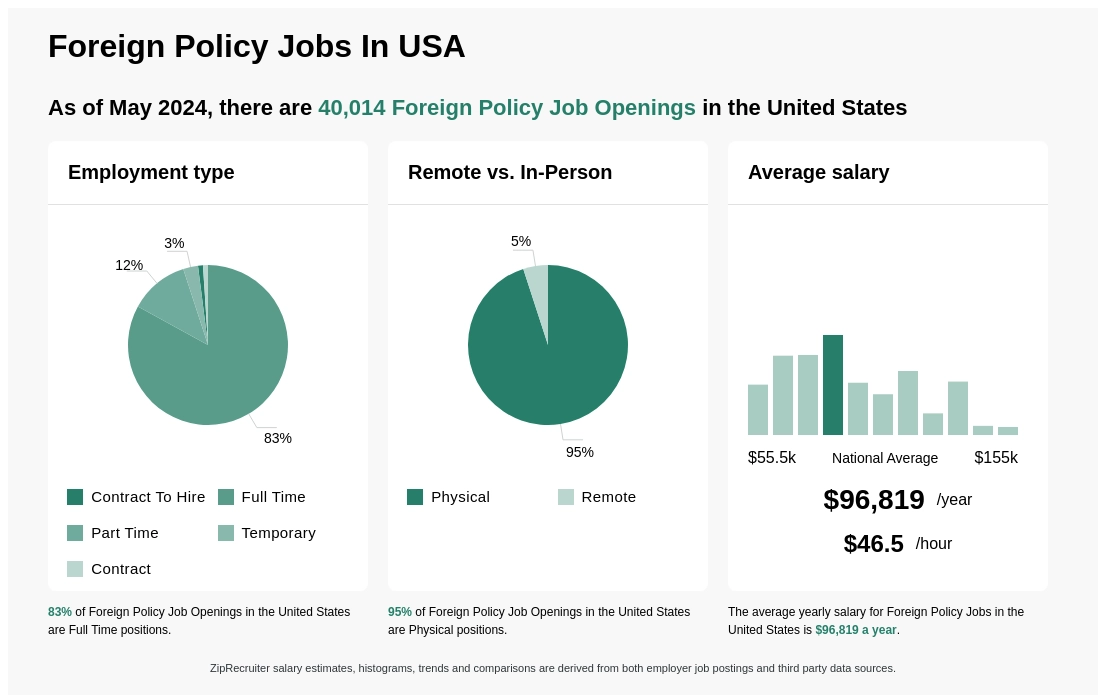
As of Sep 12, 2026, the average yearly pay for foreign policy in the United States is $96,819.00, according to ZipRecruiter salary data. Most workers in this role earn between $75,500.00 and $115,000.00 per year, depending on experience, location, and employer.

What is foreign policy?

Foreign policy refers to the strategies and decisions that a country uses to interact with other nations. This includes managing diplomatic relationships, negotiating treaties, promoting national interests, and addressing international issues such as trade, defense, and human rights. Governments develop foreign policy to protect their citizens, ensure security, and promote economic prosperity. Professionals in this field may work for government agencies, think tanks, or international organizations.

What are the key skills and qualifications needed to thrive as a foreign policy analyst?

To thrive as a Foreign Policy Analyst, a strong background in international relations, political science, and analytical research—often supported by a relevant degree—is essential. Familiarity with data analysis tools, policy databases, and foreign language proficiency is often required, along with experience using platforms like LexisNexis or government information systems. Exceptional communication, critical thinking, and cultural awareness help analysts effectively interpret complex global issues and convey recommendations to decision-makers. These skills are crucial for developing informed policy advice that shapes international relations and supports national interests.

How does a foreign policy analyst typically collaborate with government officials and international partners?

Foreign policy analysts often work closely with government officials, diplomats, and representatives from international organizations to provide research-based insights and recommendations. This collaboration may involve preparing briefing materials, participating in interagency meetings, and coordinating with embassies or foreign ministries. Strong communication and teamwork skills are essential, as analysts must present complex information clearly and ensure that policy decisions are informed by thorough analysis. These partnerships can also offer opportunities to broaden your professional network and learn from experts in the field.

What is the difference between Foreign Policy vs Diplomat?

AspectForeign PolicyDiplomat
Primary FocusDeveloping and implementing a country's international strategiesRepresenting and negotiating on behalf of their country abroad
Required CredentialsInternational relations, political science, or related fields; often advanced degreesDiplomatic training, foreign service exams, relevant experience
Work EnvironmentGovernment agencies, think tanks, international organizationsEmbassies, consulates, international conferences
Industry UsagePolicy formulation, government strategyDiplomatic missions, international negotiations

While both roles involve international relations, Foreign Policy focuses on shaping a country's overall international strategies, whereas Diplomats are the representatives executing those policies through negotiations and diplomatic activities abroad.

What jobs are there in foreign policy?

Jobs in foreign policy include roles such as foreign service officers, diplomatic diplomats, international relations analysts, policy advisors, and intelligence analysts. These positions often require strong communication skills, knowledge of international affairs, and security clearances, and may involve working for government agencies, international organizations, or think tanks.
More about Foreign Policy jobs

What cities are hiring for Foreign Policy jobs?

Cities with the most Foreign Policy job openings:

What are the most commonly searched types of Foreign Policy jobs?

The most popular types of Foreign Policy jobs are:

What states have the most Foreign Policy jobs?

States with the most job openings for Foreign Policy jobs include:

Infographic showing various Foreign Policy job openings in the United States as of September 2026, with employment types broken down into 2% As Needed, 80% Full Time, 17% Part Time, and 1% Contract. Highlights an 92% Physical, 2% Hybrid, and 6% Remote job distribution, with an average salary of $96,819 per year, or $46.5 per hour.

Global Conflict Analyst

Washington, DC • Hybrid

Council on Foreign Relations
Social Sciences and Humanities Research • 51 - 200 employees

$63K - $70K/yr

Full-time

Medical

Re-posted 3 days ago


Job description

Position Summary

CFR's David Rockefeller Studies Program is one of the country's largest foreign policy think tanks with a widely respected and influential research staff. CFR's Wachenheim Center for Peace and Security (WCPS) is seeking a global conflict analyst to help manage its award-winning Global Conflict Tracker (GCT), and contribute to other work within the Center. They will report to WCPS's director and collaborate with other WCPS staff members, including other GCT analysts and interns. 

This position is based in CFR's Washington, DC office at least three days per week. Tuesdays, Wednesdays, and Thursdays are considered institutional anchor days where all staff are required to be onsite. Effective Monday, September 14, 2026, CFR employees will be based on-site at least four days per week. CFR's remote working schedule is subject to change.

Essential Functions/Responsibilities
  • Conduct research on ongoing and emerging conflicts, with a primary focus on Africa and the Middle East.
  • Contribute to the development of new data visualization products and interactive features for the GCT.
  • Track and fact-check news related to GCT pages.
  • Edit and proofread content.
  • Create social media and newsletter content to promote the GCT.
  • Track and manage the budget for projects related to improving and updating the GCT, including monitoring grant information, drafting grant reports and proposals, creating and updating Excel spreadsheets, and preparing vouchers for reimbursement.
  • Assisting the WCPS team and other fellows within Studies with other projects as needed, including potentially coordinating events, shepherding reports, planning travel, or other logistical support.
  • Perform any other duties or tasks as assigned or required.
Minimum Qualifications

Education

  • Bachelor's degree in security studies, international relations, area studies, or a related field; Master's degree preferred, but not required. 

Experience

  • A minimum of 3 years of related work experience.
  • Knowledge/familiarity with conflict dynamics in one or more regions, preferably Africa and the Middle East.
  • Familiarity with conflict-related data sources.
  • Proficiency with data visualization tools (Datawrapper, ArcGIS, QGIS) and data analysis.
  • Experience with rigorous sourcing and fact-checking.
  • Experience with website content management.

Related Skills & Other Requirements

  • Ability to produce clear, policy-relevant analysis for non-specialist audiences.
  • Strong interpersonal and teamwork skills, including the ability to manage interns and delegate tasks.
  • Excellent time management and project management skillsCreativity and flexibility.
  • Attention to detail.
Required Application Materials

Please submit a resume and cover letter stating your interest in the position.

Compensation and Benefits
  • The full-time annual compensation range for this position is $63,000 - $70,000, depending on experience.
  • In addition to competitive salaries, the Council on Foreign Relations offers a benefits package that is among the best offered by nonprofit institutions today, including an award-winning health and wellness program, an on-site fitness center, and generous leave policies and health insurance programs.
About CFR

The Council on Foreign Relations (CFR) is committed to fostering a foreign policy community in the United States that is more representative of American society, recognizing that diverse backgrounds and perspectives contribute to broader, more informed participation in the foreign policy debate and lead to an enhanced understanding of the world and the United States' role therein. To that end, CFR is dedicated to continuing to advance diversity, equity, and inclusion throughout its work and workplace by building a more diverse membership and staff, producing and dispensing thoughtful analysis on a broad range of foreign policy issues, and developing relevant, wide-reaching programming that also serves to expand the foreign policy talent pipeline to underrepresented populations. 

Employment Type: OTHER