2

Etl Developer Remote Jobs (NOW HIRING)

ETL Lead

Greenville, SC · Remote

$60 - $64/hr

Remote (Greenville, SC preferred; onsite required first week for training) Start Date: ASAP ... Provide technical direction to onshore and offshore ETL developers for both legacy platform ...

ETL Engineer

Mclean, VA · On-site +1

$110K - $130K/yr

Contributions We are looking for a seasoned ETL Engineer to work with our team and our clients to develop enterprise grade data pipelines. We are looking for more than just an "ETL Engineer", but a ...

ETL Engineer

Mclean, VA · On-site +1

$110K - $130K/yr

Contributions We are looking for a seasoned ETL Engineer to work with our team and our clients to develop enterprise grade data pipelines. We are looking for more than just an "ETL Engineer", but a ...

ETL Engineer

$125K - $135K/yr

IV.AI is looking for a skilled ETL Engineer to join our data team, reporting to the VP of ... We're a distributed team that works collaboratively across time zones - not quite remote-first, but ...

ETL Manager

New York, NY · On-site +1

$55.75 - $73/hr

Collaborate with business analysts, data architects, developers, and reporting teams to ensure accurate and timely data delivery. * Optimize ETL processes for performance, reliability, scalability ...

Javen Technologies, Inc. is seeking a Lead ETL Developer with extensive experience in SSIS. The role involves leading teams, managing projects, and modernizing SSIS platforms while ensuring automated ...

Showing results 21-40

Etl Developer Remote information

See salary details

$31

$57

$81

How much do etl developer remote jobs pay per hour?

As of Aug 22, 2026, the average hourly pay for etl developer remote in the United States is $57.38, according to ZipRecruiter salary data. Most workers in this role earn between $49.04 and $64.18 per hour, depending on experience, location, and employer.

What is an ETL developer?

ETL Developers are IT professionals who design, implement, and maintain systems for extracting, transforming, and loading data from various sources into a centralized data warehouse or database. They work with different data formats and tools to ensure data is accurately and efficiently processed for business intelligence and analytics. Remote ETL Developers perform these tasks from a location outside the employer’s office, using collaboration tools and secure connections to manage data workflows.

How to become an ETL developer who works remotely?

The minimum qualifications for an ETL developer include a bachelor’s degree in software engineering, computer science, or a related field. Strong communication skills are important to relay issues that require attention accurately. Experience with NoSQL databases and PL/SQL development is beneficial. It is also helpful to have experience retrieving data from multiple data source types, interfacing with business users, and using dimensional modeling. You can stand out above other candidates if you have experience with Hadoop components, including HBase, Sqoop, HDFS, Hive, and Spark, experience with .NET or Java, and knowledge of SSAS, OLAP, and MDX.


What are the key skills and qualifications needed to thrive as a remote ETL developer?

To excel as a Remote ETL Developer, you need strong expertise in data warehousing, ETL processes, and proficiency in SQL, often supported by a degree in computer science or a related field. Familiarity with ETL tools like Informatica, Talend, or SSIS, as well as experience with cloud platforms and database technologies, is typically required. Attention to detail, problem-solving abilities, and effective communication are vital soft skills for collaborating with distributed teams and troubleshooting data issues. These competencies ensure accurate, efficient data integration and support critical business intelligence initiatives in a remote work environment.

How do ETL developers working remotely typically collaborate with data engineers and analysts to ensure data quality and project success?

Remote ETL Developers usually collaborate closely with data engineers and analysts through virtual meetings, shared project management tools, and version-controlled code repositories. Regular stand-ups and agile sprints help align team members on data requirements, transformation logic, and delivery timelines. Effective communication and thorough documentation are crucial to address data quality issues promptly and to ensure that business objectives are met. Most teams rely on platforms like Slack, Jira, and GitHub to maintain transparency and streamline workflow across different locations.

What cities are hiring for Etl Developer Remote jobs?

Cities with the most Etl Developer Remote job openings:

What are the most commonly searched types of Etl Developer jobs?

The most popular types of Etl Developer jobs are:

What states have the most Etl Developer Remote jobs?

States with the most job openings for Etl Developer Remote jobs include:

What job categories do people searching Etl Developer Remote jobs look for?

The top searched job categories for Etl Developer Remote jobs are:

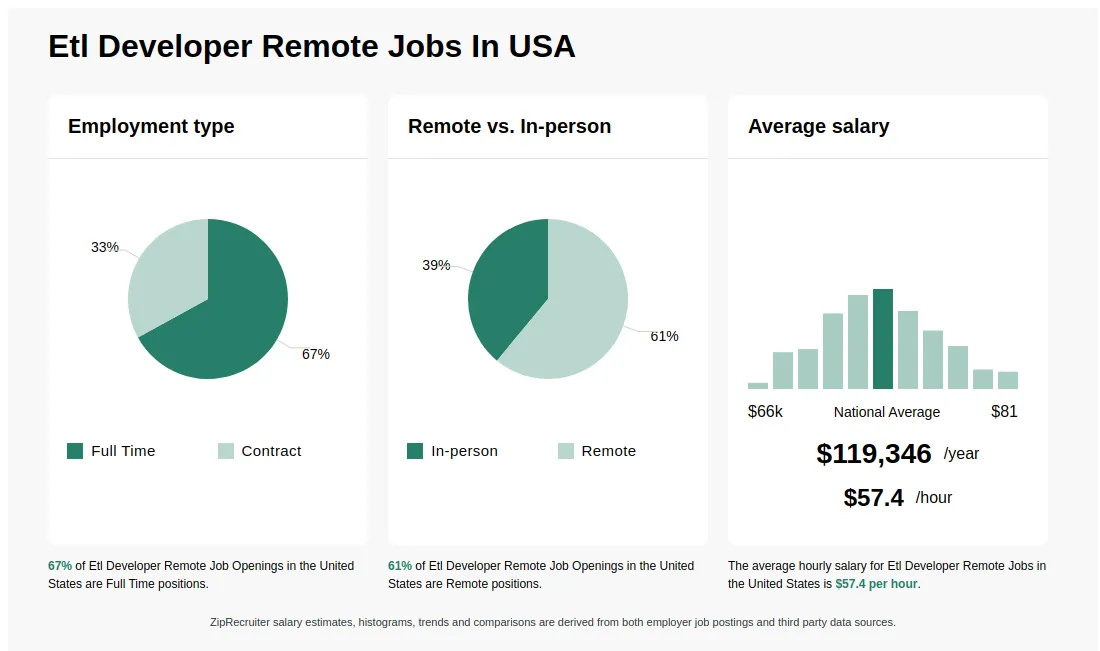
Infographic showing various Etl Developer Remote job openings in the United States as of August 2026, with employment types broken down into 66% Full Time, 17% Part Time, and 17% Contract. Highlights an 100% Remote job distribution, with an average salary of $119,346 per year, or $57.4 per hour.

ETL Lead

Mondo

Greenville, SC • Remote

$60 - $64/hr

Contractor

Medical, Dental, Vision, Retirement

Posted 16 days ago


Job description

Job Title: ETL Team Lead Location-Type: Remote (Greenville, SC preferred; onsite required first week for training) Start Date: ASAP Duration: Contract-to-Hire (duration to be confirmed) Compensation Range: $60-64/hr W2 during contract period, $120-125K bonus conversion Benefits: Eligible for Health, Dental, Vision, and 401K Visa Sponsorship: Not eligible for visa sponsorship Job Description: The ETL Team Lead serves as the primary technical owner of the organization's end-to-end data operations, leading onshore and offshore teams to maintain legacy platforms while driving modernization onto a next-generation Azure data stack. Job Summary Monitor and support daily ETL loads across SQL jobs, legacy SSIS packages, and Guidewire DataHub and InfoCenter environments, ensuring SLA adherence and on-time delivery of critical reporting datasets. Troubleshoot and resolve pipeline failures, performance issues, schema mismatches, and cloud resource failures in collaboration with the AMS team, performing root-cause analysis and implementing permanent fixes. Provide technical direction to onshore and offshore ETL developers for both legacy platform maintenance and new Azure-based development, reviewing code and enforcing best practices. Refactor or retire outdated ETL processes and maintain existing pipelines spanning SQL Server, SSIS, Oracle, PostgreSQL, SAP BODS, and PowerShell. Design and build scalable data ingestion pipelines using Azure Data Factory, Microsoft Fabric, Databricks, and Synapse Pipelines, aligned to Medallion Architecture (Bronze, Silver, Gold). Develop reusable ingestion patterns for insurance source systems including Guidewire DataHub and InfoCenter, HubSpot, and Telematics. Support production releases, coordinate deployments, validate changes, and provide coverage during month-end and quarter-end financial reporting cycles. Partner with Scrum Masters, Project Managers, Enterprise Architecture, QA Automation, Change Management, and business SMEs to minimize downtime and ensure business SLAs are met. Minimum Requirements: 8 years of ETL design and development experience, including hands-on SQL Server management, SSIS, SSRS, and T-SQL scripting. 2-4 years of experience building ETL and ELT solutions in Azure, including demonstrated experience with Microsoft Fabric. Experience working with insurance platforms and the ability to speak substantively to insurance industry data environments. Proven experience leading and coordinating onshore and offshore development teams in an ETL or data engineering context. Strong production support background including performance tuning, incident response, and root-cause analysis. Consistent, long-term engagement history on positions (candidates with a pattern of short contracting stints will not be considered). Preferred Qualifications: Experience with Guidewire DataHub and InfoCenter, or demonstrated willingness and ability to learn the platform. Familiarity with Delta Lake, Medallion Architecture, and Fabric Lakehouse modernization patterns. Experience with real-time and event-driven pipeline design using Event Hub, Databricks Structured Streaming, or KQL-based processing. Experience with Oracle PL-SQL, SAP BODS, or PostgreSQL in a data operations context. Familiarity with data governance frameworks, data quality observability tools, and enterprise data modeling practices.