A Bachelors or Masters Degree in relevant majors including Biology, Environmental Science, or related majors by Summer 2027. Why Kimley-Horn? At Kimley-Horn, we do things differently. People, clients ...
A Bachelors or Masters Degree in relevant majors including Biology, Environmental Science, or related majors by Summer 2027. Why Kimley-Horn? At Kimley-Horn, we do things differently. People, clients ...
Environmental Science Analyst
Austin, TX · On-site
A Bachelors or Masters Degree in relevant majors including Biology, Environmental Science, or related majors by Summer 2027. Why Kimley-Horn? At Kimley-Horn, we do things differently. People, clients ...
Environmental Science Analyst
Austin, TX · On-site
A Bachelors or Masters Degree in relevant majors including Biology, Environmental Science, or related majors by Summer 2027. Why Kimley-Horn? At Kimley-Horn, we do things differently. People, clients ...
A Bachelors or Masters Degree in relevant majors including Biology, Environmental Science, or related majors by Summer 2027. At Kimley-Horn, we do things differently. People, clients, and employees ...
A Bachelors or Masters Degree in relevant majors including Biology, Environmental Science, or related majors by Summer 2027. At Kimley-Horn, we do things differently. People, clients, and employees ...
Environmental Science Analyst
Austin, TX · On-site
A Bachelors or Masters Degree in relevant majors including Biology, Environmental Science, or related majors by Summer 2027. Why Kimley-Horn? At Kimley-Horn, we do things differently. People, clients ...
Environmental Science Analyst
Austin, TX · On-site
A Bachelors or Masters Degree in relevant majors including Biology, Environmental Science, or related majors by Summer 2027. Why Kimley-Horn? At Kimley-Horn, we do things differently. People, clients ...
A Bachelors or Masters Degree in relevant majors including Biology, Environmental Science, or related majors by Summer 2027. Why Kimley-Horn? At Kimley-Horn, we do things differently. People, clients ...
A Bachelors or Masters Degree in relevant majors including Biology, Environmental Science, or related majors by Summer 2027. Why Kimley-Horn? At Kimley-Horn, we do things differently. People, clients ...

Adjunct Professional Science Masters Graduate Department College of Science and Engineering ... Manage an online classroom environment and assist in creating an effective Christian learning ...
Adjunct Professional Science Masters Graduate Department College of Science and Engineering ... Manage an online classroom environment and assist in creating an effective Christian learning ...
Environmental Science Analyst
Cary, NC · On-site
A Bachelors or Masters Degree in relevant majors including Biology, Environmental Science, or related majors by Summer 2027. Why Kimley-Horn? At Kimley-Horn, we do things differently. People, clients ...
Environmental Science Analyst
Cary, NC · On-site
A Bachelors or Masters Degree in relevant majors including Biology, Environmental Science, or related majors by Summer 2027. Why Kimley-Horn? At Kimley-Horn, we do things differently. People, clients ...
Environmental Science Analyst
Cary, NC · On-site
A Bachelors or Masters Degree in relevant majors including Biology, Environmental Science, or related majors by Summer 2027. Why Kimley-Horn? At Kimley-Horn, we do things differently. People, clients ...
Environmental Science Analyst
Cary, NC · On-site
A Bachelors or Masters Degree in relevant majors including Biology, Environmental Science, or related majors by Summer 2027. Why Kimley-Horn? At Kimley-Horn, we do things differently. People, clients ...
Environmental Science Analyst
Austin, TX · On-site
A Bachelors or Masters Degree in relevant majors including Biology, Environmental Science, or related majors by Summer 2027. Why Kimley-Horn? At Kimley-Horn, we do things differently. People, clients ...
Environmental Science Analyst
Austin, TX · On-site
A Bachelors or Masters Degree in relevant majors including Biology, Environmental Science, or related majors by Summer 2027. Why Kimley-Horn? At Kimley-Horn, we do things differently. People, clients ...
A Bachelors or Masters Degree in relevant majors including Biology, Environmental Science, or related majors by Summer 2027. Why Kimley-Horn? At Kimley-Horn, we do things differently. People, clients ...
A Bachelors or Masters Degree in relevant majors including Biology, Environmental Science, or related majors by Summer 2027. Why Kimley-Horn? At Kimley-Horn, we do things differently. People, clients ...
Adjunct Professional Science Masters Graduate Department College of Science and Engineering ... Manage an online classroom environment and assist in creating an effective Christian learning ...
Adjunct Professional Science Masters Graduate Department College of Science and Engineering ... Manage an online classroom environment and assist in creating an effective Christian learning ...
A Bachelors or Masters Degree in relevant majors including Biology, Environmental Science, or related majors by Summer 2027. Why Kimley-Horn? At Kimley-Horn, we do things differently. People, clients ...
A Bachelors or Masters Degree in relevant majors including Biology, Environmental Science, or related majors by Summer 2027. Why Kimley-Horn? At Kimley-Horn, we do things differently. People, clients ...
A Bachelors or Masters Degree in relevant majors including Biology, Environmental Science, or related majors by Summer 2027. Why Kimley-Horn? At Kimley-Horn, we do things differently. People, clients ...
A Bachelors or Masters Degree in relevant majors including Biology, Environmental Science, or related majors by Summer 2027. Why Kimley-Horn? At Kimley-Horn, we do things differently. People, clients ...
A Bachelors or Masters Degree in relevant majors including Biology, Environmental Science, or related majors by Summer 2027. Why Kimley-Horn? At Kimley-Horn, we do things differently. People, clients ...
A Bachelors or Masters Degree in relevant majors including Biology, Environmental Science, or related majors by Summer 2027. Why Kimley-Horn? At Kimley-Horn, we do things differently. People, clients ...
Environmental Science Analyst
Cary, NC · On-site
A Bachelors or Masters Degree in relevant majors including Biology, Environmental Science, or related majors by Summer 2027. At Kimley-Horn, we do things differently. People, clients, and employees ...
Environmental Science Analyst
Cary, NC · On-site
A Bachelors or Masters Degree in relevant majors including Biology, Environmental Science, or related majors by Summer 2027. At Kimley-Horn, we do things differently. People, clients, and employees ...
Environmental Science Analyst
Washington, DC · On-site
$84K - $87K/yr
A Bachelors or Masters Degree in relevant majors including Environmental Science, Environmental Policy, Environmental and Sustainability or related majors by Summer 2027. Salary Range: $84,000 - $87 ...
Environmental Science Analyst
Washington, DC · On-site
$84K - $87K/yr
A Bachelors or Masters Degree in relevant majors including Environmental Science, Environmental Policy, Environmental and Sustainability or related majors by Summer 2027. Salary Range: $84,000 - $87 ...
Environmental Science Analyst
Washington, DC · On-site
$84K - $87K/yr
A Bachelors or Masters Degree in relevant majors including Environmental Science, Environmental Policy, Environmental and Sustainability or related majors by Summer 2027. Salary Range: $84,000 - $87 ...
Environmental Science Analyst
Washington, DC · On-site
$84K - $87K/yr
A Bachelors or Masters Degree in relevant majors including Environmental Science, Environmental Policy, Environmental and Sustainability or related majors by Summer 2027. Salary Range: $84,000 - $87 ...
Environmental Science Analyst
Washington, DC · On-site
$84K - $87K/yr
A Bachelors or Masters Degree in relevant majors including Environmental Science, Environmental Policy, Environmental and Sustainability or related majors by Summer 2027. Salary Range: $84,000 - $87 ...
Environmental Science Analyst
Washington, DC · On-site
$84K - $87K/yr
A Bachelors or Masters Degree in relevant majors including Environmental Science, Environmental Policy, Environmental and Sustainability or related majors by Summer 2027. Salary Range: $84,000 - $87 ...
Environmental Science Adjunct Instructor Key Relationships * i. Students * ii. Program Chair * iii. ... A minimum of a masters degree with 18 semester credits or 24 quarter credits in the area of the ...
Environmental Science Adjunct Instructor Key Relationships * i. Students * ii. Program Chair * iii. ... A minimum of a masters degree with 18 semester credits or 24 quarter credits in the area of the ...
Environmental Science Adjunct Instructor Key Relationships * i. Students * ii. Program Chair * iii. ... A minimum of a masters degree with 18 semester credits or 24 quarter credits in the area of the ...
Environmental Science Adjunct Instructor Key Relationships * i. Students * ii. Program Chair * iii. ... A minimum of a masters degree with 18 semester credits or 24 quarter credits in the area of the ...
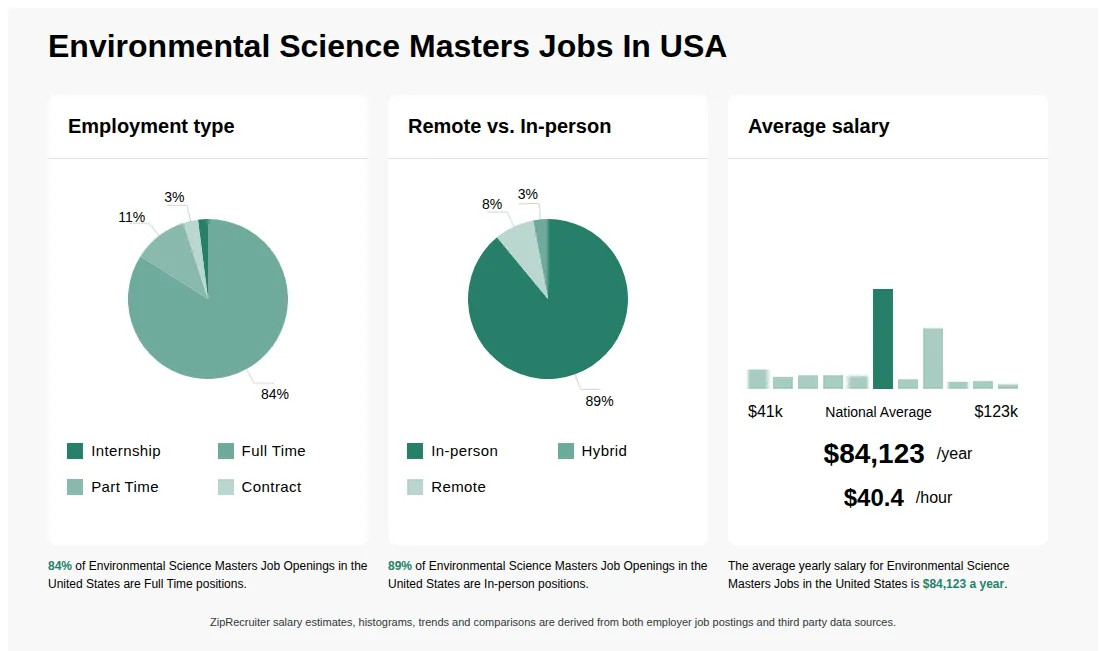
Environmental Science Masters information
See salary details
$41K - $48.5K
7% of jobs
$48.5K - $55.9K
4% of jobs
$55.9K - $63.4K
5% of jobs
$63.4K - $70.8K
5% of jobs
$75.5K is the 25th percentile. Wages below this are outliers.
$70.8K - $78.3K
4% of jobs
The median wage is $82.6K / yr.
$78.3K - $85.7K
40% of jobs
$85.7K - $93.2K
3% of jobs
$94.6K is the 75th percentile. Wages above this are outliers.
$93.2K - $100.6K
24% of jobs
$100.6K - $108.1K
2% of jobs
$108.1K - $115.5K
2% of jobs
$115.5K - $123K
1% of jobs
$41K
$84.1K
$123K
How much do environmental science masters jobs pay per year?
As of Sep 8, 2026, the average yearly pay for environmental science masters in the United States is $84,123.00, according to ZipRecruiter salary data. Most workers in this role earn between $75,000.00 and $98,500.00 per year, depending on experience, location, and employer.
What is an Environmental Science Masters degree?
An Environmental Science Masters is a graduate-level program focused on the study of the environment and the solutions to environmental challenges. This interdisciplinary degree covers topics such as ecology, environmental policy, chemistry, geology, and sustainability. Graduates gain advanced knowledge and research skills necessary for careers in environmental consulting, conservation, policy-making, or further academic research. Completing a master's in this field can open doors to leadership roles and specialized positions in both public and private sectors.
What types of collaborative projects can someone with a master's in Environmental Science expect to work on in a typical organization?
Professionals with a Master's in Environmental Science often engage in interdisciplinary projects that require collaboration with engineers, policy analysts, urban planners, and community stakeholders. These projects might include environmental impact assessments, sustainability initiatives, or field-based research studies. Collaboration is key, as teams frequently exchange data, coordinate fieldwork, and jointly develop solutions to complex environmental challenges. This team-oriented environment fosters both professional growth and the opportunity to contribute meaningfully to real-world environmental outcomes.
What are the key skills and qualifications needed to thrive as an Environmental Science masters graduate, and why are they important?
To thrive as an Environmental Science Master's graduate, you need advanced knowledge in environmental systems, data analysis, and research methodologies, typically supported by a relevant master's degree. Familiarity with GIS software, statistical analysis tools like R or Python, and field sampling techniques is commonly required. Strong communication, critical thinking, and teamwork skills help you effectively interpret findings and collaborate with diverse stakeholders. These skills are crucial for addressing complex environmental challenges and driving sustainable solutions in research, policy, or industry roles.
What is the difference between Environmental Science Masters vs Environmental Scientist?
| Aspect | Environmental Science Masters | Environmental Scientist |
|---|---|---|
| Required Credentials | Master's degree in environmental science or related field | Bachelor's degree often required; advanced roles may need a master's or higher |
| Work Environment | Research labs, universities, environmental consulting firms | Fieldwork, laboratories, government agencies, consulting firms |
| Employer & Industry Usage | Academic institutions, research organizations, environmental consultancies | Government agencies, private firms, NGOs, research institutions |
The Environmental Science Masters is an academic degree focusing on advanced knowledge and research skills, often leading to roles in research or academia. An Environmental Scientist is a professional working in the field, applying scientific principles to solve environmental issues. While the degree provides foundational and specialized knowledge, the role involves practical application in various work environments.
Is a master's in environmental science worth it?
A master's in environmental science can enhance job prospects in fields such as environmental consulting, research, and policy analysis, often leading to higher salaries and advanced roles. It provides specialized knowledge, skills in data analysis and environmental tools, and may require internships or certifications to improve employability.
What can I do with a master's in environmental science?
A master's in environmental science prepares individuals for roles such as environmental analyst, conservation scientist, environmental consultant, or sustainability coordinator. These positions often require skills in data analysis, environmental regulations, and fieldwork, and may involve working for government agencies, consulting firms, or non-profit organizations.
What careers can you do with an environmental science master's?
An environmental science master's degree prepares individuals for careers such as environmental scientist, conservation scientist, environmental consultant, or sustainability manager. These roles often involve data analysis, fieldwork, and knowledge of environmental regulations, and may require certifications or specialized skills in GIS, environmental modeling, or policy analysis.
More about Environmental Science Masters jobs
What cities are hiring for Environmental Science Masters jobs?
Cities with the most Environmental Science Masters job openings:
What are the most commonly searched types of Environmental Science Masters jobs?
The most popular types of Environmental Science Masters jobs are:
What states have the most Environmental Science Masters jobs?
States with the most job openings for Environmental Science Masters jobs include:
What job categories do people searching Environmental Science Masters jobs look for?
The top searched job categories for Environmental Science Masters jobs are:

Environmental Science Analyst
Charleston, SC • On-site
Kimley-Horn •
Specialized Design Services • 5 - 10K employees5,001 - 10,000 employees
Full-time
Medical, Dental, Vision, Retirement
Posted 13 days ago
Kimley-Horn rating

8.8
Based on 87 frontline employees who took The Breakroom Quiz
66th of 454 rated engineering
Job description
Overview
Kimley-Horn is looking for Environmental Science graduates to join our Charleston, South Carolina (SC), office! This is not a remote position.
Responsibilities
Qualifications
Why Kimley-Horn?
At Kimley-Horn, we do things differently. People, clients, and employees are at the forefront of who we are. Clients know we prioritize achieving their goals and growing their success. Employees know our culture and approach to business are built on a desire to provide an environment for everyone to flourish. Our commitment to quality is only as good as the people behind it- that's why we welcome and develop passionate, hardworking, and proactive employees. We take pride in how our employee retention, robust benefits package, and company values have led to Kimley-Horn's placement on the Fortune "100 Best Companies to Work" list for 19 years!
Key Benefits at Kimley-Horn
Kimley-Horn is looking for Environmental Science graduates to join our Charleston, South Carolina (SC), office! This is not a remote position.
Responsibilities
- Solve complex problems, assist project managers, and collaborate across disciplines to produce our clients' visions for the future built environment.
- Develop familiarity with the federal, state, and local regulations, as well as Kimley-Horn's and our client's practices, procedures, and standards.
- The opportunity to gain knowledge in one or more of the following: natural resource regulations, water quality regulatory programs, wetlands identification including knowledge of botany and soil science and experience in ecology, wildlife biology, water resources, geographic information systems and environmental science.
- Some travel and fieldwork may be required (approximately 10-30%).
Qualifications
- A Bachelors or Masters Degree in relevant majors including Biology, Environmental Science, or related majors by Summer 2027.
Why Kimley-Horn?
At Kimley-Horn, we do things differently. People, clients, and employees are at the forefront of who we are. Clients know we prioritize achieving their goals and growing their success. Employees know our culture and approach to business are built on a desire to provide an environment for everyone to flourish. Our commitment to quality is only as good as the people behind it- that's why we welcome and develop passionate, hardworking, and proactive employees. We take pride in how our employee retention, robust benefits package, and company values have led to Kimley-Horn's placement on the Fortune "100 Best Companies to Work" list for 19 years!
Key Benefits at Kimley-Horn
- Exceptional Retirement Plan: 2-to1- company match on up to 4% of eligible compensation (salary + bonus) and additional profit-sharing contribution.
- Comprehensive Health Coverage: Low-cost medical, dental, and vision insurance options.
- Time Off: Personal leave, flexible scheduling, floating holidays, and half-day Fridays.
- Financial Wellness: Student loan matching in our 401(k), and performance-based bonuses.
- Professional Development: Tuition reimbursement and extensive internal training programs.
- Family-Friendly Benefits: New Parent Leave, family building benefits, and childcare resources.
What Kimley-Horn employees say
Pay
Benefits
Hours and flexibility
Workplace
Get the full story on Breakroom

About Kimley-Horn
Sourced by ZipRecruiter
We are a full-service consulting firm that provides a wide range of infrastructure and land development planning and engineering services to both public and private clients. Though we have more than 6,000 employees in 100+ offices, we pride ourselves on our small company feel. At Kimley-Horn, we do things differently. People--clients and employees--are at the forefront of our business. Clients know we are laser-focused on their success. Employees know our culture and approach to business are built on a desire to see our staff flourish, one and all. Both groups know that with Kimley-Horn, they can expect more and experience better.
Industry
Specialized design services
Company size
5,001 - 10,000 Employees
Headquarters location
Raleigh, NC, US
Year founded
1967