Environmental Engineer
Parsippany, NJ · Hybrid
Langan provides expert land development engineering and environmental consulting services for major developers, renewable energy producers, energy companies, corporations, healthcare systems ...
Parsippany, NJ · Hybrid
Langan provides expert land development engineering and environmental consulting services for major developers, renewable energy producers, energy companies, corporations, healthcare systems ...
Parsippany, NJ · Hybrid
Langan provides expert land development engineering and environmental consulting services for major developers, renewable energy producers, energy companies, corporations, healthcare systems ...
Manages and provides technical support and oversight for a variety of environmental projects, specializing in environmental engineering and regulatory compliance. Position Responsibilities: Manage ...
Quick apply
Manages and provides technical support and oversight for a variety of environmental projects, specializing in environmental engineering and regulatory compliance. Position Responsibilities: Manage ...
CT · On-site
Environmental Engineer We are seeking a dedicated and experienced Environmental Engineer to join our team. The ideal candidate will play a key role in designing, implementing, and monitoring ...
CT · On-site
Environmental Engineer We are seeking a dedicated and experienced Environmental Engineer to join our team. The ideal candidate will play a key role in designing, implementing, and monitoring ...
Johnson City, TN · On-site
Environmental Engineer Job Locations US-TN-Johnson City Category Environmental Type Full-Time Overview As an Environmental Engineer with Civil & Environmental Consultants, Inc. (CEC) in our Johnson ...
Johnson City, TN · On-site
Environmental Engineer Job Locations US-TN-Johnson City Category Environmental Type Full-Time Overview As an Environmental Engineer with Civil & Environmental Consultants, Inc. (CEC) in our Johnson ...
Washington, DC · Remote
The Environmental Engineer | Compliance / Risk / Regulatory: Risk, Compliance & Independent Certification Support [DOE0015015] is aligned with GSA Labor Category: Senior Consultant. We seek ...
Washington, DC · Remote
The Environmental Engineer | Compliance / Risk / Regulatory: Risk, Compliance & Independent Certification Support [DOE0015015] is aligned with GSA Labor Category: Senior Consultant. We seek ...
Knoxville, TN · On-site
Overview As an Environmental Engineer with Civil & Environmental Consultants, Inc. (CEC) in our Knoxville, TN office, you'll be involved with environmental projects and provide client-focused ...
Knoxville, TN · On-site
Overview As an Environmental Engineer with Civil & Environmental Consultants, Inc. (CEC) in our Knoxville, TN office, you'll be involved with environmental projects and provide client-focused ...
Knoxville, TN · On-site
Overview As an Environmental Engineer with Civil & Environmental Consultants, Inc. (CEC) in our Knoxville, TN office, you'll be involved with environmental projects and provide client-focused ...
Knoxville, TN · On-site
Overview As an Environmental Engineer with Civil & Environmental Consultants, Inc. (CEC) in our Knoxville, TN office, you'll be involved with environmental projects and provide client-focused ...
San Diego, CA · On-site
Job Summary The Environmental Engineering role performs a broader range of environmental engineering tasks related to the analysis, planning, and development of solutions that promote environmental ...
San Diego, CA · On-site
Job Summary The Environmental Engineering role performs a broader range of environmental engineering tasks related to the analysis, planning, and development of solutions that promote environmental ...
Tyler, TX · On-site
$90K - $110K/yr
Environmental Engineer The Environmental Engineer will work under the direction of the Environmental Manager and ensure compliance with all federal, state, and local environmental laws and ...
Quick apply
Tyler, TX · On-site
$90K - $110K/yr
Environmental Engineer The Environmental Engineer will work under the direction of the Environmental Manager and ensure compliance with all federal, state, and local environmental laws and ...
Georgetown, KY · On-site
$40 - $45/hr
Environmental Engineer Location: Georgetown, Kentucky Job Type: Contract Schedule: Monday-Friday | 40 hours per week (1511135) Position Overview We are seeking an Environmental Engineer to support ...
Georgetown, KY · On-site
$40 - $45/hr
Environmental Engineer Location: Georgetown, Kentucky Job Type: Contract Schedule: Monday-Friday | 40 hours per week (1511135) Position Overview We are seeking an Environmental Engineer to support ...
Kenosha, WI · On-site +1
Ocean Spray is hiring for a(n) Environmental Engineer! We're a team of farmers, thinkers, creators, and doers. Whatever your title, whatever your role - it always comes back to this: we're a farmer ...
Kenosha, WI · On-site +1
Ocean Spray is hiring for a(n) Environmental Engineer! We're a team of farmers, thinkers, creators, and doers. Whatever your title, whatever your role - it always comes back to this: we're a farmer ...
Indianapolis, IN · On-site
Job ID: (773208) Environmental Engineer Location: 100% Remote Job Duration: 12+ Months Client: IN-IDOH * The Environmental Engineer conducts plan reviews and related work to determine compliance with ...
Quick apply
Indianapolis, IN · On-site
Job ID: (773208) Environmental Engineer Location: 100% Remote Job Duration: 12+ Months Client: IN-IDOH * The Environmental Engineer conducts plan reviews and related work to determine compliance with ...
Charlotte, NC · On-site
Environmental Engineer Requisition Number: 2026-1350-03 S&ME is seeking an environmental engineer to join one of our highest-performing offices of Charlotte, NC with offering significant growth ...
Charlotte, NC · On-site
Environmental Engineer Requisition Number: 2026-1350-03 S&ME is seeking an environmental engineer to join one of our highest-performing offices of Charlotte, NC with offering significant growth ...
Houston, TX · On-site +1
Ocean Spray is hiring for a(n) Environmental Engineer! We're a team of farmers, thinkers, creators, and doers. Whatever your title, whatever your role - it always comes back to this: we're a farmer ...
Houston, TX · On-site +1
Ocean Spray is hiring for a(n) Environmental Engineer! We're a team of farmers, thinkers, creators, and doers. Whatever your title, whatever your role - it always comes back to this: we're a farmer ...
Chicago, IL · On-site +1
Ocean Spray is hiring for a(n) Environmental Engineer! We're a team of farmers, thinkers, creators, and doers. Whatever your title, whatever your role - it always comes back to this: we're a farmer ...
Chicago, IL · On-site +1
Ocean Spray is hiring for a(n) Environmental Engineer! We're a team of farmers, thinkers, creators, and doers. Whatever your title, whatever your role - it always comes back to this: we're a farmer ...
Charlotte, NC · On-site
Environmental Engineer Requisition Number: 2026-1350-03 Are you a seasoned Environmental Engineer seeking an opportunity to lead, mentor, support, drive, and grow a team? Our Charlotte team is ...
Charlotte, NC · On-site
Environmental Engineer Requisition Number: 2026-1350-03 Are you a seasoned Environmental Engineer seeking an opportunity to lead, mentor, support, drive, and grow a team? Our Charlotte team is ...
Ticonderoga, NY · On-site
$94K - $120K/yr
Environmental Engineer We are the only fully integrated pulp & paper mill operating within the boundaries of a state park. We have regulatory oversight from NYS DEC, Region 2 EPA, Adirondack Park ...
Ticonderoga, NY · On-site
$94K - $120K/yr
Environmental Engineer We are the only fully integrated pulp & paper mill operating within the boundaries of a state park. We have regulatory oversight from NYS DEC, Region 2 EPA, Adirondack Park ...
Ticonderoga, NY · On-site
$94K - $120K/yr
Environmental Engineer We are the only fully integrated pulp & paper mill operating within the boundaries of a state park. We have regulatory oversight from NYS DEC, Region 2 EPA, Adirondack Park ...
Ticonderoga, NY · On-site
$94K - $120K/yr
Environmental Engineer We are the only fully integrated pulp & paper mill operating within the boundaries of a state park. We have regulatory oversight from NYS DEC, Region 2 EPA, Adirondack Park ...
Brookfield, WI · On-site
Environmental Engineer Silgan is hiring an Environmental Engineer to work in our brand-new office in Waukesha, WI. Join a team where your expertise in air compliance and environmental engineering ...
Brookfield, WI · On-site
Environmental Engineer Silgan is hiring an Environmental Engineer to work in our brand-new office in Waukesha, WI. Join a team where your expertise in air compliance and environmental engineering ...
Las Vegas, NV · On-site +1
Ocean Spray is hiring for a(n) Environmental Engineer! We're a team of farmers, thinkers, creators, and doers. Whatever your title, whatever your role - it always comes back to this: we're a farmer ...
Las Vegas, NV · On-site +1
Ocean Spray is hiring for a(n) Environmental Engineer! We're a team of farmers, thinkers, creators, and doers. Whatever your title, whatever your role - it always comes back to this: we're a farmer ...
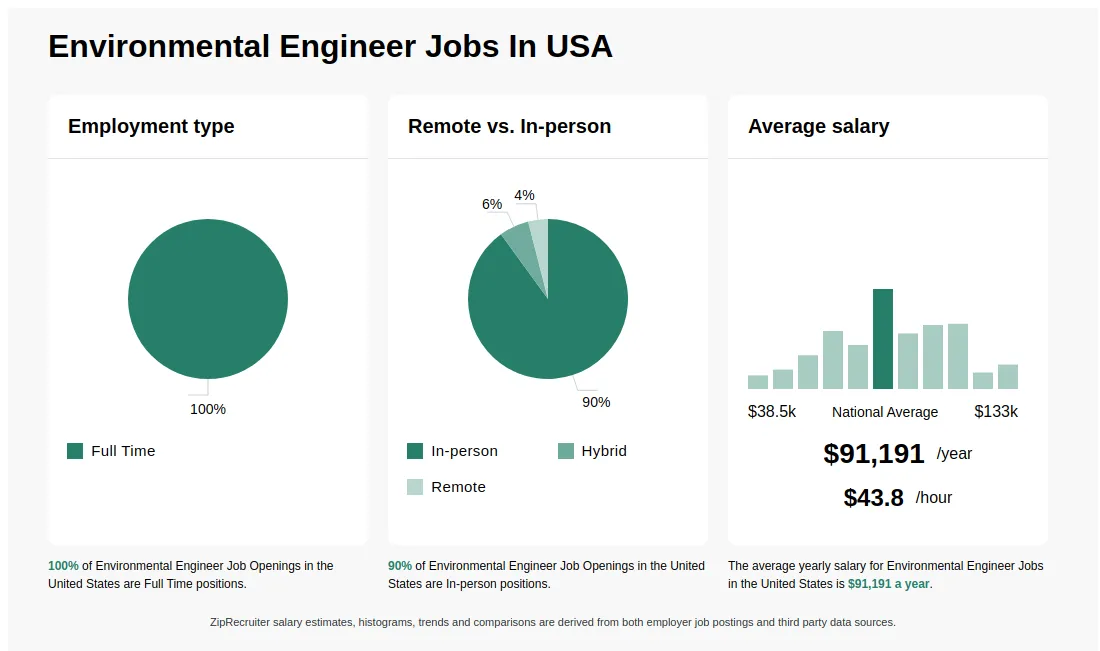
$38.5K - $47.1K
2% of jobs
$47.1K - $55.7K
3% of jobs
$55.7K - $64.3K
6% of jobs
$64.3K - $72.9K
12% of jobs
$74.2K is the 25th percentile. Wages below this are outliers.
$72.9K - $81.5K
9% of jobs
The median wage is $88.5K / yr.
$81.5K - $90K
22% of jobs
$90K - $98.6K
12% of jobs
$104.9K is the 75th percentile. Wages above this are outliers.
$98.6K - $107.2K
13% of jobs
$107.2K - $115.8K
14% of jobs
$115.8K - $124.4K
3% of jobs
$124.4K - $133K
4% of jobs
$38.5K
$91.2K
$133K
Environmental engineers research and develop systems and solutions to environmental problems. They have backgrounds in soil science, chemistry, biology, and engineering, which they apply to the production of architectural systems that address air pollution, water conservation, recycling, sustainability, and public health.
| Aspect | Environmental Engineer | Environmental Scientist |
|---|---|---|
| Required Credentials | Bachelor's in environmental engineering or related field; often licensed as Professional Engineer (PE) | Bachelor's or master's in environmental science or related field; no licensing required |
| Work Environment | Designing solutions, working on projects, often in field and lab settings | Research and data analysis, primarily in labs or offices |
| Employer & Industry Usage | Consulting firms, government agencies, manufacturing industries | Research institutions, government agencies, environmental consulting |
Environmental Engineers focus on designing and implementing solutions to environmental problems, often working on projects that require engineering design and compliance. Environmental Scientists primarily conduct research, analyze data, and assess environmental conditions. While both roles require a background in environmental studies, Engineers typically need engineering credentials and licensing, whereas Scientists focus on research and data analysis. Both roles are vital in environmental protection but serve different functions within the industry.
Cities with the most Environmental Engineer job openings:
The most popular types of Environmental Engineer jobs are:
The top employers for Environmental Engineer jobs are:
States with the most job openings for Environmental Engineer jobs include:
For Environmental Engineer jobs, the most frequently searched job titles are:

Parsippany, NJ • Hybrid
Full-time
Medical, Dental, Vision, Life, Retirement, PTO
Posted 20 days ago
9.3
Based on 8 frontline employees who took The Breakroom Quiz
Langan provides expert land development engineering and environmental consulting services for major developers, renewable energy producers, energy companies, corporations, healthcare systems, colleges/universities, and large infrastructure programs throughout the U.S. and around the world. Our employees collaborate seamlessly among 50+ offices and gain valuable hands-on experience that fosters career growth. Langan culture is entrepreneurial from advancing innovative technical solutions, to participating in robust training and knowledge sharing, to making progressive change within the communities we live and work.
Consistently ranked among the top ten "Best Firms to Work For" and Engineering News-Record's top 50 firms worldwide, Langan attracts and retains the best talent in the industry. Employees thrive at Langan, a firm that fosters an inclusive and supportive work environment for all; prioritizes wellbeing, health, and safety; encourages volunteerism and philanthropy; offers workplace flexibility, along with carbon-neutral office spaces; and empowers individuals to contribute their skills and knowledge to make impactful contributions.
Job SummaryLangan Engineering and Environmental Services, LLC seeks an Environmental Engineer (REF# NP0826) in Parsippany, NJ. Partial telecommuting permitted up to 3 days per week.
Job title: Environmental Engineer (REF# NP0826)
Hours: Full Time
Company name: Langan Engineering and Environmental Services LLC
Job Site Address: 300 Kimball Dr., Parsippany, NJ 07054. Partial telecommuting is permitted up to 3 days/ week.
To apply: Send resume and cover letter to careers@langan.com with REF# NP0826 in RE line or click "Apply Now" and complete the online application.
Salary Range: $97,000 - $110,000. Certain US jurisdictions require Langan to include an estimate of salary or hourly ranges. The rage provided for this role is an estimate. Actual compensation may vary based on factors such as related work experience, location, market conditions, education/training, certifications and other credentials, as well as applicable knowledge and skills. Certain roles may be eligible for overtime and participation in the firm's annual bonus and performance review program. Bonuses are discretionary and based on individual job performance and the profitability of the firm. Employees are also eligible to receive up to 20 days of paid vacation time, 10 days of paid sick time and 10 paid holidays throughout the year. Eligibility and actual paid time off may vary based on local law and factors such as hours worked, related work experience and level.
Employee Referral Program: Referring employee eligible for $5000 bonus following successful referral and hire. Please submit questions and referrals to careers@langan.com.
Langan provides a rich array of programs and benefits to help its employees advance their careers and enhance the quality of their lives. Our comprehensive compensation package includes: full-time employment company paid medical, dental, and vision coverage; life insurance, short- and long-term disability insurance, and paid pregnancy disability leave; 401(k)/Roth with company match; paid time off including parental and military leave; employee referral and professional license bonuses; and educational reimbursement.
Langan offers employee resource groups; flexible work schedules; extensive training; wellness programs; buddy and mentoring programs; and much more!
Langan is committed to providing equal employment opportunities to all qualified applicants and employees, including individuals with disabilities and protected veterans. We believe that an inclusive workplace is essential for the well-being and success of our employees.

Sourced by ZipRecruiter