2

Entry Level Forensic Science Jobs (NOW HIRING)

Entry Level - Associate Bioassay Scientist

Columbia, MO · On-site

  • Medical

  • Dental

  • Vision

  • Life

  • Retirement

  • PTO

... forensics, advanced material sciences and in the support of clinical studies, as well as having an ... The Associate Scientist position is an entry level professional position involved in day-to-day ...

Entry-Level In Vivo Scientist

New Brunswick, NJ · On-site

$21 - $25/hr

  • Medical

  • Dental

  • Vision

  • Life

  • Retirement

  • PTO

... forensics, advanced material sciences and in the support of clinical studies, as well as having an ... We are searching for an Entry-Level Scientist to support our growing team. Scientist ...

Investigator

Floral Park, NY · On-site

$50K - $60K/yr

... motivated entry-level Investigator interested in developing a career in investigations ... forensic science and security, or in a major operational area of the agency in which the ...

... motivated entry-level Investigator interested in developing a career in investigations ... forensic science and security, or in a major operational area of the agency in which the ...

... motivated entry-level Investigator interested in developing a career in investigations ... forensic science and security, or in a major operational area of the agency in which the ...

Entry Level Chemist

Lancaster, PA

$21.50 - $28.75/hr

  • Medical

  • Dental

  • Vision

  • Life

  • Retirement

  • PTO

... forensics, advanced material sciences and in the support of clinical studies, as well as having an emerging global presence in Contract Development and Manufacturing Organisations. It also has a ...

Showing results 21-40

Entry Level Forensic Science information

See salary details

$21.5K

$52.5K

$104K

How much do entry level forensic science jobs pay per year?

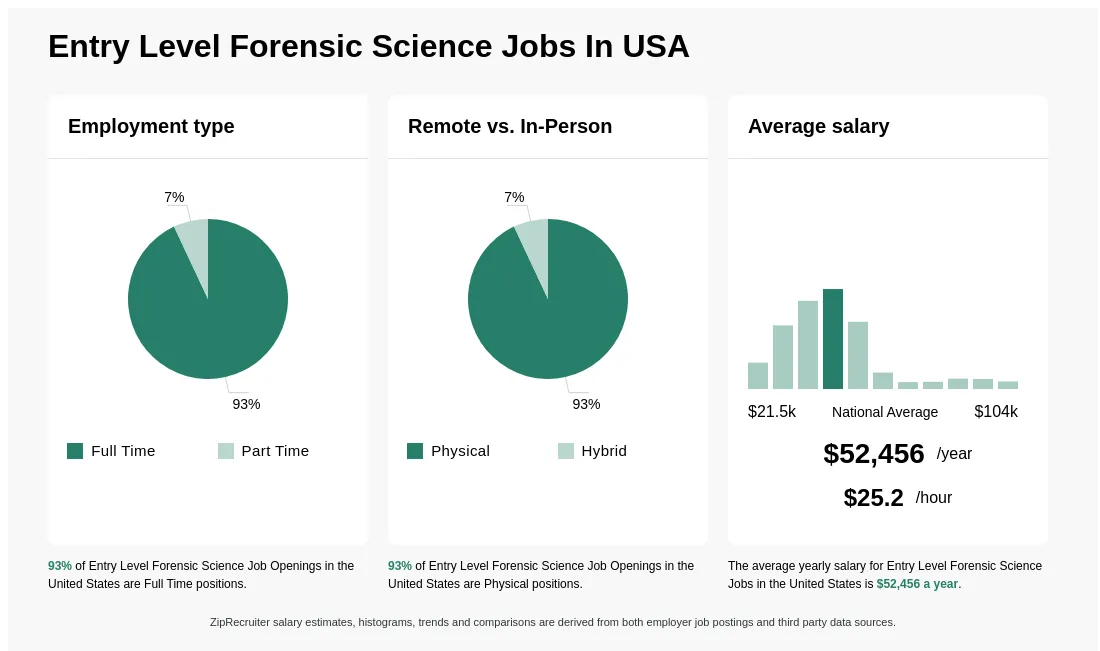
As of Aug 15, 2026, the average yearly pay for entry level forensic science in the United States is $52,456.00, according to ZipRecruiter salary data. Most workers in this role earn between $37,500.00 and $56,500.00 per year, depending on experience, location, and employer.

What types of cases or evidence might an entry level forensic scientist typically work with, and how is workload usually managed?

As an entry-level forensic scientist, you may primarily handle routine evidence such as biological samples (like blood or hair), trace materials, or fingerprints from property crimes and less complex cases. Workload is generally managed through a structured case assignment system, with more experienced analysts overseeing your progress. You'll likely work as part of a team, collaborating closely with law enforcement officers, senior scientists, and laboratory technicians. This collaborative environment helps ensure evidence is processed accurately and in a timely manner, while also providing valuable opportunities for on-the-job learning and mentorship.

What are the key skills and qualifications needed to thrive as an entry level forensic scientist?

To thrive as an Entry Level Forensic Scientist, you need a strong background in chemistry, biology, or a related science, typically supported by a bachelor's degree in forensic science or a similar field. Familiarity with laboratory equipment, evidence analysis techniques, and software such as chromatography and DNA analysis tools is essential. Attention to detail, critical thinking, and strong written communication skills help you excel in documenting findings and collaborating with law enforcement. These competencies ensure accurate, reliable evidence analysis that is crucial for supporting criminal investigations and judicial processes.

How do I start a career in entry level forensic science?

To start a career in entry level forensic science, obtain a bachelor's degree in forensic science, biology, chemistry, or a related field. Gaining laboratory skills, understanding criminal justice procedures, and earning relevant certifications can improve job prospects; internships or volunteer work in forensic labs also provide valuable experience.

What is the difference between Entry Level Forensic Science vs Entry Level Crime Scene Technician?

AspectEntry Level Forensic ScienceEntry Level Crime Scene Technician
Required CredentialsBachelor's in forensic science, biology, or chemistryBachelor's in criminal justice, forensic science, or related field
Work EnvironmentLaboratories, crime labs, forensic labsCrime scenes, outdoor and indoor locations
Employer & Industry UsageLaw enforcement agencies, forensic labsPolice departments, crime scene units
Common Search & ComparisonYesYes

Entry Level Forensic Science professionals typically work in laboratories analyzing evidence, requiring degrees in forensic science or related fields. Entry Level Crime Scene Technicians often work at crime scenes, collecting evidence and documenting the scene, with similar educational backgrounds. Both roles support law enforcement but differ mainly in work environment and specific duties.


What is an entry level forensic science job?

Entry level forensic science jobs are positions designed for individuals new to the forensic field, often recent graduates with a bachelor's degree in forensic science, biology, chemistry, or a related field. These roles typically include laboratory technicians, evidence technicians, or assistant forensic analysts, and involve tasks such as collecting, preserving, and analyzing physical evidence from crime scenes. Entry level positions provide hands-on training and experience, serving as a foundation for advancing to more specialized or senior forensic roles.

How to become an entry level forensic science with no experience?

To become an entry-level forensic scientist with no experience, obtain a relevant bachelor's degree in forensic science, biology, chemistry, or a related field. Gaining skills in laboratory techniques, evidence analysis, and familiarity with forensic tools like microscopes or DNA analysis software can help; internships or volunteering can also provide practical experience. Certifications such as the American Board of Criminalistics (ABC) can enhance your qualifications for entry-level positions.

What cities are hiring for Entry Level Forensic Science jobs?

Cities with the most Entry Level Forensic Science job openings:

What are the most commonly searched types of Forensic Science jobs?

The most popular types of Forensic Science jobs are:

What states have the most Entry Level Forensic Science jobs?

States with the most job openings for Entry Level Forensic Science jobs include:

Infographic showing various Entry Level Forensic Science job openings in the United States as of August 2026, with employment types broken down into 100% Full Time. Highlights an 100% In-person job distribution, with an average salary of $52,456 per year, or $25.2 per hour.

CIVILIAN CRIME SCENE TECHNICIAN I

City of Thomasville, GA

Thomasville, GA • On-site

$22.39/hr

Full-time

This job post has expired 1 day ago. Applications are no longer accepted.


City Of Thomasville (Georgia) rating

8.1

Company rating: 8.1 out of 10

Based on 5 frontline employees who took The Breakroom Quiz

343rd of 846 rated public administrative organizations


Job description

Job Type
Full-time
Description
The Civilian Crime Scene Technician (Non-Certified) is a non-sworn, entry-level technical position that supports criminal investigations by objectively documenting crime scenes and recognizing, collecting, packaging, preserving, and transporting physical and digital evidence. The employee performs duties within established policies, procedures, completed training, and demonstrated proficiency. This position has no authority to arrest or other police powers and does not independently conduct criminal investigations. The position receives direct supervision from the Detective Sergeant and indirect supervision from the Criminal Investigation Division Commander.
Requirements
ESSENTIAL JOB FUNCTIONS (examples, not all inclusive)
  • Responds to crime scenes only after the scene has been secured or entry has been authorized by sworn personnel; conducts a systematic and objective examination within the scope of assigned duties.
  • Photographs and digitally images scenes and evidence from multiple perspectives and prepares accurate notes, measurements, sketches, diagrams, and other visual documentation.
  • Recognizes, collects, packages, labels, seals, preserves, and transports physical evidence while maintaining evidence integrity and a complete chain of custody.
  • Processes latent fingerprints, impression evidence, trace evidence, biological evidence, and other evidentiary materials using approved methods and only within the scope of completed training and demonstrated proficiency.
  • Assists with documenting bloodstain patterns, shooting scenes, and scene reconstruction under the direction of qualified personnel and when trained and authorized.
  • Documents, collects, packages, and preserves digital devices and digital evidence; performs basic processing only when trained, legally authorized, and assigned.
  • Prepares clear and accurate crime scene reports, evidence logs, laboratory submission forms, property documentation, exhibits, and other case records.
  • Maintains crime scene equipment, cameras, evidence-processing supplies, vehicles, and work areas in a clean, secure, organized, and serviceable condition.
  • Coordinates with sworn investigators, prosecutors, court personnel, crime laboratories, medical examiners, and other agencies regarding evidence collection, transfer, examination, and presentation.
  • Prepares evidence and findings for legal proceedings and provides factual testimony regarding scene documentation, evidence handling, methods used, and chain of custody.
  • Provides technical assistance on scene protection and preliminary evidence handling. As a civilian employee, does not make arrests, conduct custodial interviews or interrogations, apply for or execute warrants, perform suspect searches, or exercise other police powers.

QUALIFICATIONS
Education and Experience:
  • Must possess an associate's or bachelor's degree from an accredited institution in forensic science, biology, chemistry, criminal justice with a forensic emphasis, or a closely related field. An equivalent combination of relevant education, specialized training, certifications, and progressively responsible experience in crime-scene processing, forensic services, evidence collection, or a closely related field may be considered in lieu of the degree requirement.
  • This is a civilian, non-certified position; GPSTC/POST Crime Scene Technician certification is not required at the time of appointment.
  • Must successfully complete department orientation, field training, safety instruction, and required competency or proficiency assessments before independently performing assigned crime scene techniques.
  • To pursue GPSTC Crime Scene Technician certification, the employee must first obtain at least one year of qualifying experience as a crime scene technician, consistent with current program eligibility requirements.
  • Must obtain GPSTC/POST Crime Scene Technician certification if eligible under then-current GPSTC and POST requirements and directed by the department. If not eligible, must complete equivalent department-approved training and proficiency requirements within the timeframe established by the department.
  • Must possess or be able to obtain a valid Georgia driver's license and maintain an acceptable driving record.
  • Must maintain confidentiality, integrity, impartiality, and professional conduct on and off duty and avoid conduct that brings discredit to the Police Department or the City.

Knowledge, Skills, and Abilities:
  • Ability to exercise meticulous attention to detail and follow a consistent, methodical process when examining scenes, handling evidence, and preparing documentation.
  • Ability to observe and document conditions analytically, objectively, accurately, and completely without interpreting motive or drawing investigative conclusions beyond the assigned technical role.
  • Knowledge of crime scene protection, contamination prevention, evidence recognition, collection, packaging, sealing, preservation, transportation, and chain-of-custody procedures.
  • Knowledge of, or ability to develop proficiency in, crime scene photography, digital imaging, measurements, sketching, mapping, and visual documentation.
  • Knowledge of, or ability to develop proficiency in, latent print development, fingerprint classification, friction ridge comparison, impression evidence, trace evidence, biological evidence, and bloodstain documentation.
  • Knowledge of occupational safety practices, personal protective equipment, and procedures for working around biological hazards, chemicals, controlled substances, sharp objects, firearms, and other scene hazards.
  • Strong oral and written communication skills, including the ability to prepare detailed reports and provide clear, factual, and professional courtroom testimony.
  • Ability to use computers, cameras, digital evidence systems, records-management systems, and other technical equipment while maintaining confidentiality and data security.
  • Ability to work independently within established authority and collaboratively with sworn personnel and partner agencies while remaining calm and professional in stressful, sensitive, or disturbing environments.

PHYSICAL/MENTAL DEMANDS
This position requires work at secured crime scenes in indoor and outdoor environments, including extreme heat, cold, rain, wind, confined spaces, elevated locations, and other unusual settings. The employee may be exposed to blood and bodily fluids, controlled substances, hazardous chemicals and fumes, firearms, sharp objects, biological hazards, and disturbing scenes. Duties require frequent standing, walking, bending, stooping, kneeling, climbing stairs, lifting and carrying evidence and equipment, fine-motor manipulation, close visual examination, photography, and extensive typing and report preparation. Appropriate personal protective equipment and established safety procedures must be used. As a civilian employee, the incumbent is not expected to pursue, restrain, arrest, or physically control suspects or enter a scene that has not been secured by sworn personnel.
LIMITATIONS AND DISCLAIMERS
To perform this job successfully, an individual must be able to perform the essential job functions satisfactorily. Reasonable accommodations may be made to enable individuals with disabilities to perform the primary job functions herein described. Some requirements may exclude individuals who pose a direct threat or significant risk to the health and safety of themselves or other employees.
Since every duty associated with this position may not be described herein, employees may be required to perform duties not specifically spelled out in the job description, but which may be reasonably considered to be incidental in the performing of their duties just as though they were actually written out in this job description.
Requirements are representative of minimum levels of knowledge, skills and/or abilities. To perform this job successfully, the employee must possess the abilities or aptitudes to perform each duty proficiently. Continued employment remains on an "at-will" basis.
Salary Description
$22.39/hour, $46,575.14 per year

What City Of Thomasville (Georgia) employees say

Pay

Hours and flexibility

Workplace

Get the full story on Breakroom