Job Summary Langan is seeking an Entry-Level Environmental Engineer, Scientist or Geologist to join ... Bachelor's degree in Environmental Engineering, Environmental Science, or Geology; * Minimum GPA of ...
Job Summary Langan is seeking an Entry-Level Environmental Engineer, Scientist or Geologist to join ... Bachelor's degree in Environmental Engineering, Environmental Science, or Geology; * Minimum GPA of ...
Job Summary Langan is seeking an Entry-Level Environmental Engineer, Scientist or Geologist to join ... Bachelor's degree in Environmental Engineering, Environmental Science, or Geology; * Minimum GPA of ...
Job Summary Langan is seeking an Entry-Level Environmental Engineer, Scientist or Geologist to join ... Bachelor's degree in Environmental Engineering, Environmental Science, or Geology; * Minimum GPA of ...
Job Summary Langan is seeking an Entry-Level Environmental Engineer, Scientist or Geologist to join ... Bachelor's degree in Environmental Engineering, Environmental Science, or Geology; * Minimum GPA of ...
Job Summary Langan is seeking an Entry-Level Environmental Engineer, Scientist or Geologist to join ... Bachelor's degree in Environmental Engineering, Environmental Science, or Geology; * Minimum GPA of ...
Job Summary Langan is seeking an Entry-Level Environmental Engineer, Scientist or Geologist to join ... Bachelor's degree in Environmental Engineering, Environmental Science, or Geology; * Minimum GPA of ...
Job Summary Langan is seeking an Entry-Level Environmental Engineer, Scientist or Geologist to join ... Bachelor's degree in Environmental Engineering, Environmental Science, or Geology; * Minimum GPA of ...

AFLAC In this full-time entry-level Environmental Engineering Technician role, you will * Assist ... science, engineering technology, civil engineering technology, or a related field; relevant ...
AFLAC In this full-time entry-level Environmental Engineering Technician role, you will * Assist ... science, engineering technology, civil engineering technology, or a related field; relevant ...

Environmental Scientist
Richmond, VA · On-site
$74K - $97K/yr
Overview The Entry Level Environmental Scientist provides technical support for environmental consulting projects involving site investigations, regulatory compliance, environmental monitoring ...
Environmental Scientist
Richmond, VA · On-site
$74K - $97K/yr
Overview The Entry Level Environmental Scientist provides technical support for environmental consulting projects involving site investigations, regulatory compliance, environmental monitoring ...

Arcadis is seeking an Entry-Level Environmental Scientist or Geologist to join our team in the New ... BA or BS in Environmental Science, Geology or related field Preferred Qualifications: Current OSHA ...
Arcadis is seeking an Entry-Level Environmental Scientist or Geologist to join our team in the New ... BA or BS in Environmental Science, Geology or related field Preferred Qualifications: Current OSHA ...
Arcadis is seeking an Entry-Level Environmental Scientist or Geologist to join our team in the New ... BA or BS in Environmental Science, Geology or related field Preferred Qualifications: * Current ...
Arcadis is seeking an Entry-Level Environmental Scientist or Geologist to join our team in the New ... BA or BS in Environmental Science, Geology or related field Preferred Qualifications: * Current ...
Arcadis is seeking an Entry-Level Environmental Scientist or Geologist to join our team in the New ... BA or BS in Environmental Science, Geology or related field Preferred Qualifications: Current OSHA ...
Arcadis is seeking an Entry-Level Environmental Scientist or Geologist to join our team in the New ... BA or BS in Environmental Science, Geology or related field Preferred Qualifications: Current OSHA ...
Arcadis is seeking an Entry-Level Environmental Scientist or Geologist to join our team in the New ... BA or BS in Environmental Science, Geology or related field Preferred Qualifications: * Current ...
Arcadis is seeking an Entry-Level Environmental Scientist or Geologist to join our team in the New ... BA or BS in Environmental Science, Geology or related field Preferred Qualifications: * Current ...
Arcadis is seeking an Entry-Level Environmental Scientist or Geologist to join our team in the New ... BA or BS in Environmental Science, Geology or related field Preferred Qualifications: Current OSHA ...
Arcadis is seeking an Entry-Level Environmental Scientist or Geologist to join our team in the New ... BA or BS in Environmental Science, Geology or related field Preferred Qualifications: Current OSHA ...
Arcadis is seeking an Entry-Level Environmental Scientist or Geologist to join our team in the New ... BA or BS in Environmental Science, Geology or related field Preferred Qualifications: * Current ...
Arcadis is seeking an Entry-Level Environmental Scientist or Geologist to join our team in the New ... BA or BS in Environmental Science, Geology or related field Preferred Qualifications: * Current ...
Job Summary Langan is seeking an Entry-Level Environmental Engineer, Scientist or Geologist to join ... Bachelor's degree in Environmental Engineering, Environmental Science, or Geology; * Minimum GPA of ...
Job Summary Langan is seeking an Entry-Level Environmental Engineer, Scientist or Geologist to join ... Bachelor's degree in Environmental Engineering, Environmental Science, or Geology; * Minimum GPA of ...
AFLAC In this full-time entry-level Environmental Engineering Technician role, you will * Assist ... science, engineering technology, civil engineering technology, or a related field; relevant ...
AFLAC In this full-time entry-level Environmental Engineering Technician role, you will * Assist ... science, engineering technology, civil engineering technology, or a related field; relevant ...
Job Summary Langan is seeking an Entry-Level Environmental Engineer, Scientist or Geologist to join ... Bachelor's degree in Environmental Engineering, Environmental Science, or Geology; * Minimum GPA of ...
Job Summary Langan is seeking an Entry-Level Environmental Engineer, Scientist or Geologist to join ... Bachelor's degree in Environmental Engineering, Environmental Science, or Geology; * Minimum GPA of ...
Environmental Scientist
Richmond, VA · On-site
$55K - $65K/yr
Overview The Entry Level Environmental Scientist provides technical support for environmental consulting projects involving site investigations, regulatory compliance, environmental monitoring ...
Environmental Scientist
Richmond, VA · On-site
$55K - $65K/yr
Overview The Entry Level Environmental Scientist provides technical support for environmental consulting projects involving site investigations, regulatory compliance, environmental monitoring ...

Environmental Scientist
Lenexa, KS · On-site
$69K - $91K/yr
APTIM Environmental & Infrastructure, LLC is seeking an entry-level Environmental Scientist on a full-time basis in our Lenexa, KS office to participate in a variety of environmental compliance tasks ...
Environmental Scientist
Lenexa, KS · On-site
$69K - $91K/yr
APTIM Environmental & Infrastructure, LLC is seeking an entry-level Environmental Scientist on a full-time basis in our Lenexa, KS office to participate in a variety of environmental compliance tasks ...

Entry-Level Environmental Technician
Borger, TX · On-site
$18 - $24/hr
Entry-Level Environmental Field Tech- Borger, TX There's no pledge more important than the one we ... Become part of our global network of skilled engineers, scientists, auditors, planners, and ...
Entry-Level Environmental Technician
Borger, TX · On-site
$18 - $24/hr
Entry-Level Environmental Field Tech- Borger, TX There's no pledge more important than the one we ... Become part of our global network of skilled engineers, scientists, auditors, planners, and ...
Entry-Level Environmental Technician
Borger, TX · On-site
$18 - $24/hr
Entry-Level Environmental Field Tech- Borger, TX There's no pledge more important than the one we ... Become part of our global network of skilled engineers, scientists, auditors, planners, and ...
Entry-Level Environmental Technician
Borger, TX · On-site
$18 - $24/hr
Entry-Level Environmental Field Tech- Borger, TX There's no pledge more important than the one we ... Become part of our global network of skilled engineers, scientists, auditors, planners, and ...

Environmental Engineer-Scientist (Entry-Level)
Saint Louis, MO · On-site
$70K - $92K/yr
... science practices in all our work. Position Overview: Our St. Louis office is looking for an ... needs, an Entry-Level Environmental Engineer typically would be placed at a Shannon & Wilson ...
Environmental Engineer-Scientist (Entry-Level)
Saint Louis, MO · On-site
$70K - $92K/yr
... science practices in all our work. Position Overview: Our St. Louis office is looking for an ... needs, an Entry-Level Environmental Engineer typically would be placed at a Shannon & Wilson ...
Entry Level Environmental Science information
See salary details
$12.74 - $14.75
3% of jobs
$14.75 - $16.76
18% of jobs
$17.20 is the 25th percentile. Wages below this are outliers.
$16.76 - $18.77
18% of jobs
The median wage is $20.01 / hr.
$18.77 - $20.78
18% of jobs
$20.78 - $22.79
11% of jobs
$24.25 is the 75th percentile. Wages above this are outliers.
$22.79 - $24.80
11% of jobs
$24.80 - $26.81
6% of jobs
$26.81 - $28.82
4% of jobs
$28.82 - $30.83
4% of jobs
$30.83 - $32.85
5% of jobs
$32.85 - $34.86
2% of jobs
$12
$22
$34
How much do entry level environmental science jobs pay per hour?
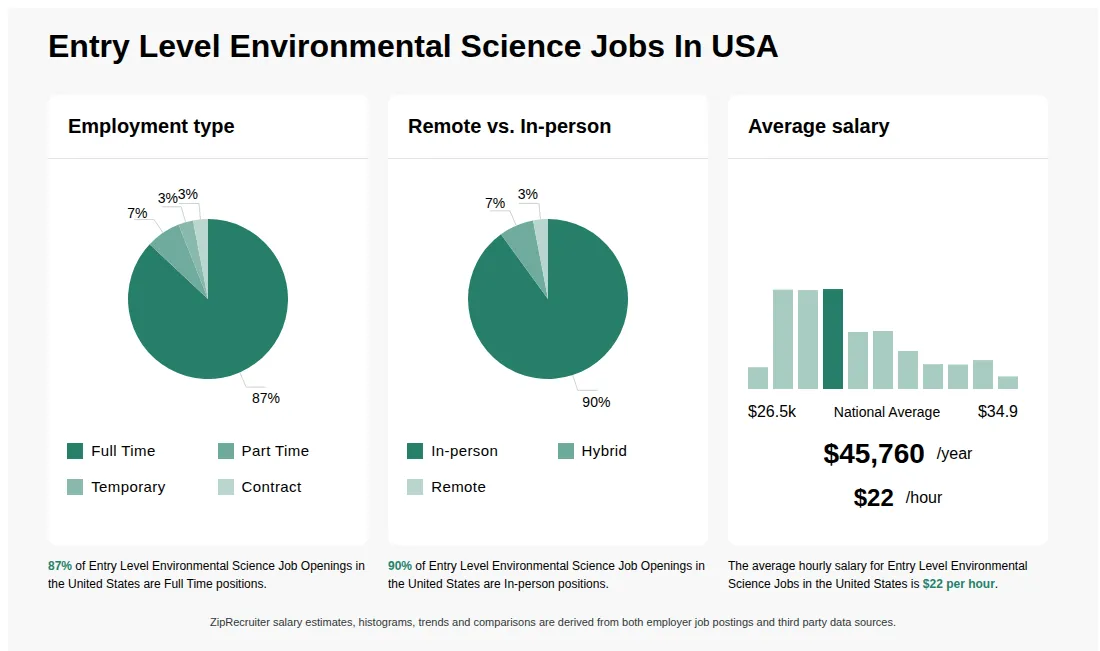
As of Sep 15, 2026, the average hourly pay for entry level environmental science in the United States is $22.00, according to ZipRecruiter salary data. Most workers in this role earn between $17.31 and $25.24 per hour, depending on experience, location, and employer.
What are entry level environmental science jobs?
Entry level environmental science jobs are positions designed for individuals who are new to the environmental science field, typically recent graduates with a bachelor's degree in environmental science or a related discipline. These roles may include titles such as environmental technician, field assistant, laboratory analyst, or environmental consultant. Responsibilities often involve collecting and analyzing environmental data, assisting with fieldwork, preparing reports, and supporting environmental monitoring or remediation projects. These positions provide valuable hands-on experience and are a stepping stone to more advanced roles in environmental science.
What types of projects do entry-level environmental scientists typically work on, and how much fieldwork is involved?
Entry-level environmental scientists often assist with site assessments, environmental monitoring, data collection, and report preparation for projects such as pollution investigations, habitat restoration, or regulatory compliance. The amount of fieldwork varies by employer and project, but you can expect a mix of office-based analysis and on-site sampling or observation, sometimes requiring travel or outdoor work in various weather conditions. These projects offer valuable hands-on experience and opportunities to collaborate with engineers, senior scientists, and regulatory agencies, helping you build both technical and teamwork skills early in your career.
What is the difference between Entry Level Environmental Science vs Environmental Technician?
| Aspect | Entry Level Environmental Science | Environmental Technician |
|---|---|---|
| Required Credentials | Bachelor's degree in environmental science or related field | Associate's degree or relevant certification, some roles may require a bachelor's |
| Work Environment | Research labs, field sites, government agencies, consulting firms | Fieldwork, sampling, data collection, laboratory analysis |
| Employer & Industry Usage | Universities, government agencies, environmental consulting firms | Environmental consulting, government agencies, industrial sites |
| Common Search & Comparison | Yes | Yes |
Entry Level Environmental Science roles typically require a bachelor's degree and involve research, analysis, and project planning in various environmental settings. Environmental Technicians often focus on field sampling and data collection, sometimes with an associate's degree or certification. Both roles are essential in environmental work, but they differ mainly in educational requirements and daily tasks.
How to start a career in entry level environmental science?
To start a career in entry level environmental science, obtain a relevant bachelor's degree such as environmental science, biology, or chemistry. Gaining practical experience through internships, volunteering, or research projects and developing skills in data analysis, GIS, and environmental monitoring can improve job prospects. Certifications like the EPA's Environmental Professional Certification or OSHA safety training can also be beneficial.
Is it hard to get a job in entry level environmental science right now?
Entry level environmental science jobs are competitive but accessible for recent graduates with relevant skills such as data analysis, fieldwork, and knowledge of environmental regulations. Job availability depends on location, industry demand, and individual qualifications, with opportunities often found in government agencies, consulting firms, and non-profit organizations.
More about Entry Level Environmental Science jobs
What cities are hiring for Entry Level Environmental Science jobs?
Cities with the most Entry Level Environmental Science job openings:
What are the most commonly searched types of Environmental Science jobs?
The most popular types of Environmental Science jobs are:
What states have the most Entry Level Environmental Science jobs?
States with the most job openings for Entry Level Environmental Science jobs include:
What job categories do people searching Entry Level Environmental Science jobs look for?
The top searched job categories for Entry Level Environmental Science jobs are:
- Entry Level Coastal Environmental Science
- Entry Level Computer Science Environmental
- Entry Level Freelance Environmental Science
- Entry Level Environmental Science Gis
- Entry Level Environmental Data Scientist
- Entry Level Environmental Studies
- Entry Level Environmental Geology
- Environmental Science
- Environmental Science Degree
- Environmental Science Training

Entry-Level Environmental Engineer, Scientist, or Geologist
Syracuse, NY
Langan Engineering & Environmental Services
• Civil Engineering Construction
Full-time
Medical, Dental, Vision, Life, Retirement, PTO
Re-posted 4 days ago
Langan rating

9.3
Based on 8 frontline employees who took The Breakroom Quiz
Job description
Langan provides expert land development engineering and environmental consulting services for major developers, renewable energy producers, energy companies, corporations, healthcare systems, colleges/universities, and large infrastructure programs throughout the U.S. and around the world. Our employees collaborate seamlessly among 50+ offices and gain valuable hands-on experience that fosters career growth. Langan culture is entrepreneurial from advancing innovative technical solutions, to participating in robust training and knowledge sharing, to making progressive change within the communities we live and work.
Consistently ranked among the top ten "Best Firms to Work For" and Engineering News-Record's top 50 firms worldwide, Langan attracts and retains the best talent in the industry. Employees thrive at Langan, a firm that fosters an inclusive and supportive work environment for all; prioritizes wellbeing, health, and safety; encourages volunteerism and philanthropy; offers workplace flexibility, along with carbon-neutral office spaces; and empowers individuals to contribute their skills and knowledge to make impactful contributions.
Job SummaryLangan is seeking an Entry-Level Environmental Engineer, Scientist or Geologist to join its collaborative team in Syracuse, NY. This individual will serve a key function in providing site exploration activities including, but not limited to contaminated site investigation and remediation work; soil and groundwater sampling; vapor intrusion investigation; remedial investigation, design, implementation, and monitoring; pilot tests; data management, processing, and evaluation; and report preparation. In this role, you will have the opportunity to work with top industry leadership on a complex and diverse portfolio of environmental projects in a continuous learning environment.
Job Responsibilities- Perform field inspections and environmental investigations;
- Perform air, soil, gas, groundwater sampling and remediation of contaminated properties;
- Assist with the planning and execution of field investigations by logging borings, collecting samples, performing field tests, and collecting and recording data. Perform routine and special calculations;
- Field oversight of remediation activities and subcontractors, ensuring compliance with job specifications;
- Identify and implement solutions to both routine and more complex field and/or laboratory problems and accurately document results; Communicate with supervisor on any problems encountered on project sites;
- Assist with the preparation of technical reports, specifications, and plans; data management and evaluation; and environmental assessment and remediation; and
- Perform other duties as requested.
- Bachelor's degree in Environmental Engineering, Environmental Science, or Geology;
- Minimum GPA of 3.0;
- 0-2 years of work-related experience;
- Prior relevant internship or professional work experience preferred;
- Applicants with an engineering degree are preferred to have EIT Certification, or current registration for FE exam;
- Strong technical education, professional demeanor, and desire to learn;
- Excellent written and verbal communication skills;
- Strong attention to detail with excellent analytical, multitasking, and judgment capabilities;
- Ability to effectively work independently and in a team environment; and
- Availability to work overtime as needed.
Travel may be required based on business needs and project assignments. Travel requirements may vary by position and may change based on business needs.
Langan provides a rich array of programs and benefits to help its employees advance their careers and enhance the quality of their lives. Our comprehensive compensation package includes: full-time employment company paid medical, dental, and vision coverage; life insurance, short- and long-term disability insurance, and paid pregnancy disability leave; 401(k)/Roth with company match; paid time off including parental and military leave; employee referral and professional license bonuses; and educational reimbursement.
Langan offers employee resource groups; flexible work schedules; extensive training; wellness programs; buddy and mentoring programs; and much more!
Langan is committed to providing equal employment opportunities to all qualified applicants and employees, including individuals with disabilities and protected veterans. We believe that an inclusive workplace is essential for the well-being and success of our employees.

About Langan
Sourced by ZipRecruiter