2

Entry Level Electrical Engineer Jobs in Chicago, IL

Overview Kimley-Horn is looking for Electrical Engineering graduates to join our Warrenville, Illinois (IL) office! This is not a remote position. Responsibilities * Utilize technical software ...

Kimley-Horn is looking for Electrical Engineering graduates to join our Warrenville, Illinois (IL) office! This is not a remote position. * Utilize technical software programs on a regular basis to ...

Engineer II

Oak Brook, IL ยท On-site

$99K/yr

Determine customer needs/facility requirements for electrical engineering projects. Prepare feasibility studies, to include conceptual design and preliminary cost estimate. Develop final design, cost ...

Determine customer needs/facility requirements for electrical engineering projects. Prepare feasibility studies, to include conceptual design and preliminary cost estimate. Develop final design, cost ...

Showing results 21-40

Entry Level Electrical Engineer information

See Chicago, IL salary details

$41.8K

$89.1K

$146.9K

How much do entry level electrical engineer jobs pay per year?

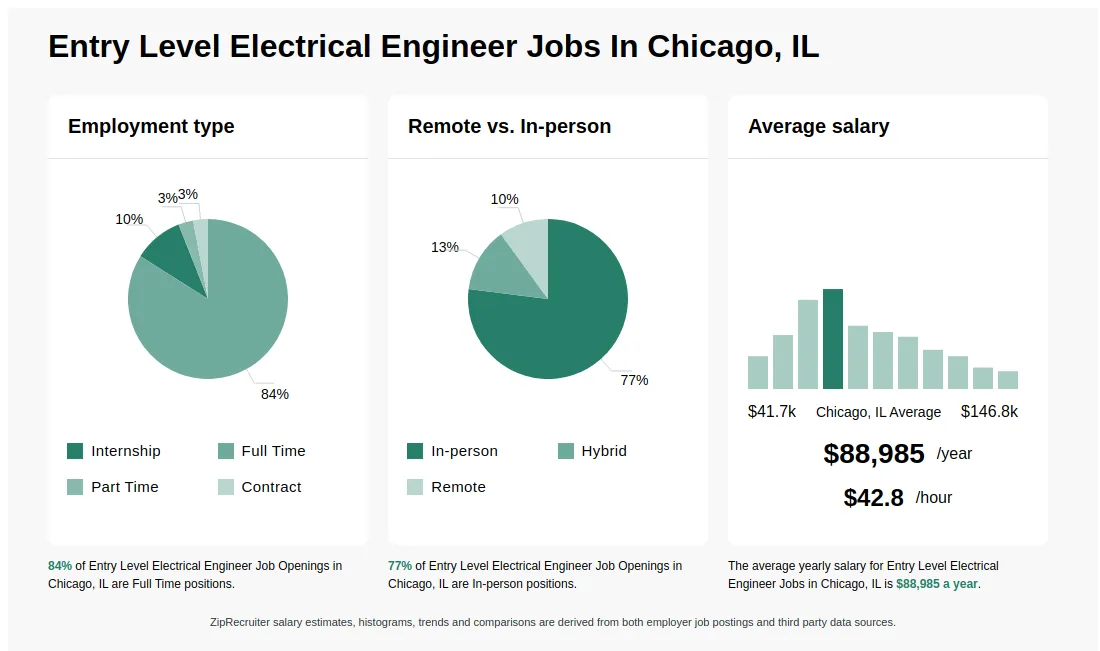
As of Aug 8, 2026, the average yearly pay for entry level electrical engineer in Chicago, IL is $89,055.00, according to ZipRecruiter salary data. Most workers in this role earn between $67,000.00 and $106,700.00 per year, depending on experience, location, and employer.

What does an entry level electrical engineer do?

An entry-level engineer performs a variety of tasks as part of their job. In this career, your main duties are to design, build, and test electronics, electrical systems, and electrical equipment, such as electric motors or navigation systems. Some electrical engineers design new industrial products, while others work on improving existing systems of products. You are responsible for creating all the standards and specifications, such as manufacturing blueprints, which the production staff reads and carries out. You also ensure that all systems or products meet safety and design standards.


What types of projects and responsibilities can an entry level electrical engineer expect during their first year on the job?

As an Entry Level Electrical Engineer, you'll often assist with designing electrical systems, drafting technical documents, and conducting tests under the supervision of senior engineers. You'll likely work on project teams, contributing to tasks such as circuit design, schematic reviews, and troubleshooting. Early responsibilities typically include supporting senior staff, learning company standards, and participating in client meetings or site visits. This hands-on experience helps new engineers develop practical skills and gain exposure to various aspects of electrical engineering projects.

What is the difference between Entry Level Electrical Engineer vs Electrical Technician?

AspectEntry Level Electrical EngineerElectrical Technician
Required CredentialsBachelor's degree in electrical engineeringAssociate degree or technical certification
Work EnvironmentDesign, development, and testing of electrical systemsInstallation, maintenance, and troubleshooting of electrical equipment
Employer & Industry UsageEngineering firms, manufacturing, power generationConstruction, maintenance, and repair services

While both roles involve electrical systems, Entry Level Electrical Engineers focus on designing and analyzing electrical projects, often requiring a bachelor's degree. Electrical Technicians typically handle installation and maintenance tasks with technical certifications. Understanding these differences helps job seekers identify the right career path based on their skills and credentials.

What are the key skills and qualifications needed to thrive as an entry level electrical engineer, and why are they important?

To thrive as an Entry Level Electrical Engineer, you need a solid grasp of electrical engineering fundamentals, problem-solving skills, and a relevant bachelor's degree. Familiarity with technical tools such as CAD software (e.g., AutoCAD), circuit simulation programs, and industry standards, as well as an EIT (Engineer-in-Training) certification, is often expected. Strong teamwork, attention to detail, and effective communication skills help you contribute effectively to projects and collaborate with diverse teams. These abilities are crucial for delivering accurate engineering solutions, meeting project requirements, and supporting professional growth within the field.
What are the most commonly searched types of Electrical Engineer jobs in Chicago, IL? The most popular types of Electrical Engineer jobs in Chicago, IL are:
What cities near Chicago, IL are hiring for Entry Level Electrical Engineer jobs? Cities near Chicago, IL with the most Entry Level Electrical Engineer job openings:
Infographic showing various Entry Level Electrical Engineer job openings in Chicago, IL as of August 2026, with employment types broken down into 90% Full Time, 7% Part Time, 2% Contract, and 1% Nights. Highlights an 96% Physical, 1% Hybrid, and 3% Remote job distribution, with an average salary of $89,055 per year, or $42.8 per hour.

Electrical Worker (Entry Level - Tier 3)

CRRC Sifang America, Inc.

Chicago, IL โ€ข On-site

Full-time

Medical, Dental, Vision, Retirement

Re-posted yesterday


Job description

RRC SIFANG AMERICA INCORPORATED ("CRRC") is a passenger railcar manufacturer in Chicago, Illinois. The passenger railcar manufacturing process includes 2 bargained-for work disciplines: assembly and electrical
The instant job description relates specifically to electrical work during the production of passenger railcars
Summary
Electrical Workers are separated into 4 classifications/categories, namely Entry Level, Tier 1, Tier 2, and Tier 3. As specified below, said classifications are separated by, among other considerations, skill sets, experience, and proficiency.
In general, Electrical Workers are responsible for wiring, assembling, connecting, and testing (specifically not including testing required during the commissioning process) electrical components on railcars under varying levels of supervision (depending on classification) while following drawings, schematics, procedures, and other written documentation, instructions, directives, and protocols. Electrical Workers will also participate in the testing/commissioning portion of the production process by providing support to Commissioning and Functional Engineers, and other high-level engineering and/or technical personnel, as directed, by specifically assisting with wiring for the continuity test, insulation test, and high voltage/potential (hipot) test.
Essential Duties and Responsibilities
  • Interpreting and using electrical schematics, drawings, process procedures, and other written documentation to prepare materials and tools, and to complete assembly of components;
  • Sorting, routing, crimping, and terminating wires to electrical components;
  • Using basic diagnostics tools such as multimeters to test, and trouble-shoot wire connections (not related to commissioning work), as required;
  • Disassembling and recovering components for testing and commissioning, during the continuity, insulation, and high voltage/potential tests, as directed by Commissioning Engineers and other such specially-skilled personnel;
  • Trimming and insulating stripped wiring utilizing heat shrink tubing;
  • Disconnecting and restoring cable shunts and relevant tooling;
  • Completing paperwork, such as quality confirmation forms, as required in the process;
  • Following all safety protocols, and company policies and procedures;
  • Complete work documentation;
  • Maintaining a neat, clean, and organized work area; and
  • Performing other tasks, as assigned.

Reasonable accommodations may be made to enable individuals with disabilities to perform the essential functions of the job.
Competencies and Characteristics
To perform the job successfully, an individual should demonstrate the following competencies and have the following characteristics:
  • Have the ability to work in a safe fashion
  • Have the ability to produce a quality product
  • Have great hand-eye coordination
  • Have a technical aptitude (of varying degrees, depending on classification)
  • Have the ability to bring value to the assigned project and to CRRC, as a whole
  • Have the ability to troubleshoot, as necessary
  • Have the ability to collaborate and coordinate with co-workers, supervisors, managers, and executive personnel in the Production Department and in other CRRC Departments
  • Have the ability to communicate well with others
  • Have the ability to draft documents of varying types
  • Have the ability to meet work, task, and project deadlines
  • Have the ability to multitask
  • Have the ability to follow instructions properly and accurately
  • Have flexibility with respect to the work schedule as warranted by operational/production needs and as permitted by the applicable Collective Bargaining Agreement
  • Have excellent time management skills
  • Have credibility and be trustworthy

Work Environment
Passenger railcar production facility with mobile equipment, heavy machinery, and high voltages
Physical Demands
โ€ข Ability to lift 40 lbs.
  • Ability to climb, bend, stoop, kneel
  • Ability to stand for an 8-hour shift
  • Ability to step up and bend down inside or under a railcar
  • Ability to remain in one position for a long period of time
  • Ability to perform work in tight spaces with difficult access

Required Education and Experience
โ€ข Required of all candidates:
  • Ability to read and interpret blueprints or ability to efficiently and effectively learn this part of the job if applying for an Entry Level Electrical Worker position
  • Ability to use basic electrical work-related hand tools, such as screwdrivers, wrench and socket sets, wire strippers, cutters, and crimpers
  • Ability to use basic pneumatic and power tools
  • Ability to follow oral and written instructions
  • Ability to read, write, and communicate in English
  • High School Diploma or GED highly recommended

โ€ข Depending on job classification, varying levels of electrical work experience, preferably in a fast-paced manufacturing setting:
โ€ข Entry Level classification: entry level with no prior relevant work experience required
โ€ข For Entry Level candidates: basic knowledge and hands-on skills with willingness and ability to be trained to do electrical work on and related to passenger railcars with regular supervision
โ€ข Tier 1 classification: some relevant prior work experience and proficiency required
โ€ข For Tier 1 candidates: working knowledge and hands-on skills with some relevant job experience in order to be able to complete basic tasks and undertake intermediate tasks with supervision and additional training OR having the foregoing knowledge and skills with work experience as an Electrical Worker (Entry Level) during Phase I and/or Phase II production at CRRC
โ€ข Tier 2 classification: more advanced relevant prior work experience and proficiency required
โ€ข For Tier 2 candidates: intermediate level knowledge, hands-on skills, proficiency, and experience to start and complete tasks without supervision, to direct and guide less skilled or experienced workers, and to assist Tier 3 workers, Foremen and Team Leads; demonstrated ability to produce a quality product with minimal abnormalities or reworks OR having the foregoing knowledge and skills with work experience as an Electrical Worker (either Entry Level and/or Tier 1) during Phase I and/or Phase II production at CRRC
โ€ข Tier 3 classification: very advanced technical skills, proficiency, and some supervisory experience/skills/capabilities
โ€ข For Tier 3 candidates: high level knowledge, hands-on skills, proficiency, and experience to start and complete tasks, to train less skilled and experienced workers with relevant tasks, and to provide significant assistance to Foremen and Team Leads including oversight of others' work; demonstrated ability to consistently produce a high-quality product; actual experience with or demonstrated capability to supervise less senior electricians OR having the foregoing knowledge and skills with work experience as an Electrical Worker (either Entry Level and/or Tier 1 and/or Tier 2) during Phase I and/or Phase II production at CRRC
CRRC is an equal opportunity employer and all qualified applicants will receive consideration for employment without regard to race, color, religion, sex, national origin, disability status, protected veteran status, or any other characteristic protected by law.
Salary Range: $19.82 - $30.55/hour
Benefits Include: Medical, Dental, Vision, and Union Pension
We are an equal opportunity employer and all qualified applicants will receive consideration for employment without regard to race, color, religion, sex, national origin, disability status, protected veteran status, or any other characteristic protected by law.
CRRC Sifang America
CRRC Sifang America is an Illinois-based subsidiary of CRRC Corporation Limited. CRRC Corporation Limited, the parent company, is a world leader in the designing, engineering and manufacturing of advanced passenger rail vehicles and high-speed trains. Headquartered in Beijing, China, CRRC Corporation Limited has 46 wholly-owned & majority-owned subsidiaries. They are a global innovator in rail car and locomotive construction and maintenance
In 2016, CRRC Sifang America was awarded a contract by the Chicago Transit Authority to supply 846 new railcars
CRRC Sifang America recently constructed a state-of-the-art production facility on the city's southeast side, returning railcar manufacturing to Chicago after a 50-year absence
Company Website: