1

Electrical Engineering Internships Jobs (NOW HIRING)

Our interns gain exposure to real projects while working side by side with senior staff. Through ... Our kW Team is seeking a full-time Electrical Engineering Intern - Fall 2026 to work out of our ...

Our interns gain exposure to real projects while working side by side with senior staff. Through ... Our kW Team is seeking a full-time Electrical Engineering Intern - Fall 2026 to work out of our ...

Electrical Engineering Intern (PT)

Austin, TX · On-site

$18.75 - $24.75/hr

This internship is ideal for an electrical engineering student interested in gaining practical experience working with engineering documentation, production processes, and engineering software tools.

next page

Showing results 1-20

Electrical Engineering Internships information

See salary details

$50.5K

$111.1K

$168K

How much do electrical engineering internships jobs pay per year?

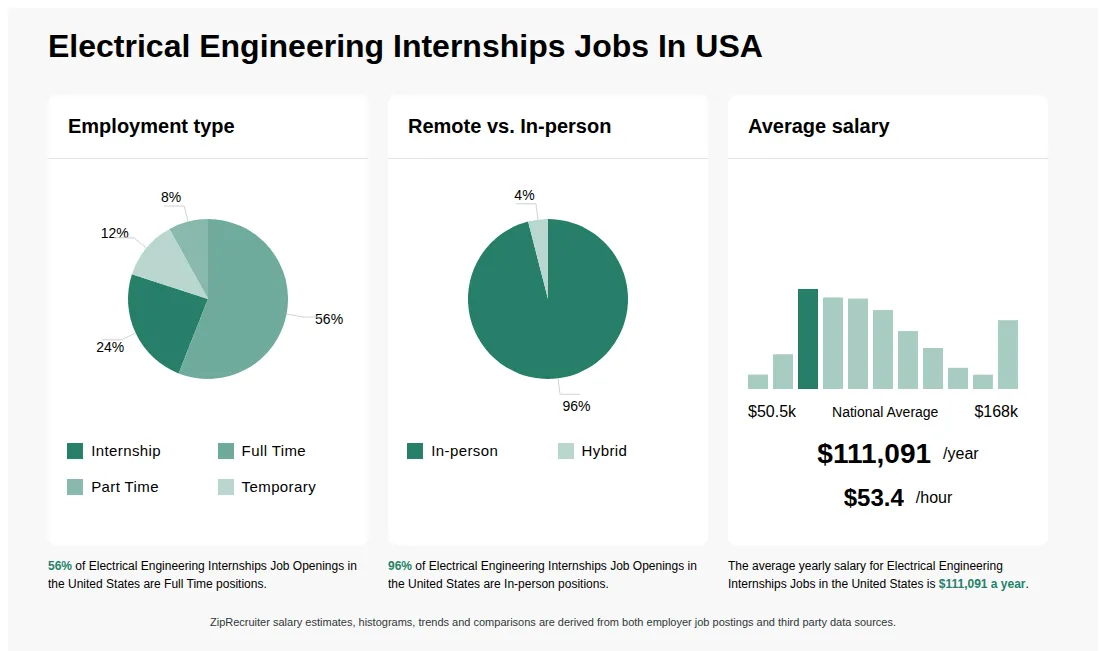
As of Jun 30, 2026, the average yearly pay for electrical engineering internships in the United States is $111,091.00, according to ZipRecruiter salary data. Most workers in this role earn between $83,000.00 and $132,000.00 per year, depending on experience, location, and employer.

What are Electrical Engineering Internships?

Electrical engineering internships are short-term work experiences offered to students or recent graduates who are studying electrical engineering or a related field. These internships allow individuals to gain practical, hands-on experience in areas such as circuit design, power systems, electronics, and automation. Interns often work under the supervision of experienced engineers, assisting with real-world projects, testing prototypes, and learning industry-standard tools and software. Completing an internship can help students apply classroom knowledge, build professional skills, and enhance their resumes for future job opportunities.

What types of projects do electrical engineering interns typically work on during their internship?

Electrical engineering interns often assist with real-world projects such as circuit design, prototype testing, data analysis, or supporting the development of electrical systems. Interns frequently collaborate with engineers and technicians, contributing to both hardware and software aspects of ongoing projects. This hands-on involvement provides valuable experience in applying theoretical knowledge, troubleshooting technical issues, and understanding industry standards, all within a supportive team environment.

What are the key skills and qualifications needed to thrive as an Electrical Engineering Intern, and why are they important?

To thrive as an Electrical Engineering Intern, you need a solid understanding of circuit theory, electronics, and basic programming, usually supported by progress toward a bachelor’s degree in electrical engineering or a related field. Familiarity with simulation tools like MATLAB, SPICE, and CAD software, as well as exposure to laboratory instruments, is often required. Strong problem-solving abilities, eagerness to learn, and effective teamwork and communication skills help interns excel in collaborative and fast-paced environments. These skills ensure that interns can contribute meaningfully to projects, adapt quickly, and lay a strong foundation for a successful engineering career.

What do you do as an electrical engineering intern?

An electrical engineering intern assists with designing, testing, and analyzing electrical systems and components. They may work on circuit design, troubleshooting, and documentation using tools like CAD software and oscilloscopes, gaining practical experience under supervision. The internship often involves learning industry standards and developing technical skills relevant to electrical engineering projects.

What is the difference between Electrical Engineering Internships vs Electrical Engineering Co-op?

AspectElectrical Engineering InternshipsElectrical Engineering Co-op
CredentialsTypically students pursuing a bachelor's degree in electrical engineeringUsually students in undergraduate programs, sometimes recent graduates
Work EnvironmentShort-term, project-based, often seasonal or summer rolesLonger-term, integrated with academic schedule, often alternating semesters
Employer & Industry UsageCommon in tech firms, manufacturing, and consulting companiesPopular in large engineering firms, utilities, and industrial sectors

Electrical Engineering Internships and Co-ops both provide hands-on experience for students, but internships are typically shorter and seasonal, while co-ops are longer-term, integrated with academic programs. Internships are ideal for exploring careers, whereas co-ops offer more in-depth industry exposure and often lead to full-time opportunities.

Is a 3.0 GPA good for internships?

For electrical engineering internships, a 3.0 GPA is generally considered acceptable, especially if complemented by relevant skills, coursework, and project experience. Many employers value practical knowledge and technical skills such as circuit design or programming alongside GPA when evaluating candidates.

Which internship is best for electrical engineering students?

The best electrical engineering internships are those offered by leading technology, manufacturing, or energy companies that provide hands-on experience with circuit design, power systems, or embedded systems. Internships that include mentorship, exposure to industry-standard tools like MATLAB or AutoCAD, and opportunities to work on real projects are highly valuable for skill development and career growth.

Can you make $500,000 as an electrical engineer?

Electrical engineering internships typically do not pay $500,000, as internships are entry-level positions with lower compensation. Experienced electrical engineers in specialized fields or leadership roles can earn high salaries, sometimes exceeding that amount, especially with advanced skills, certifications, and in high-demand industries. However, reaching a $500,000 annual salary usually requires several years of experience and senior-level responsibilities.
More about Electrical Engineering Internships jobs
What cities are hiring for Electrical Engineering Internships jobs? Cities with the most Electrical Engineering Internships job openings:
What states have the most Electrical Engineering Internships jobs? States with the most job openings for Electrical Engineering Internships jobs include:
Infographic showing various Electrical Engineering Internships job openings in the United States as of June 2026, with employment types broken down into 92% Full Time, 7% Part Time, and 1% Contract. Highlights an 88% Physical, 3% Hybrid, and 9% Remote job distribution, with an average salary of $111,091 per year, or $53.4 per hour.
Electrical Engineering Intern

Electrical Engineering Intern

Applied Optimization

Fairborn, OH • On-site

$18 - $23.50/hr

Part-time

Posted 14 days ago


Key responsibilities

  • Assist with the design, simulation, and prototyping of electro-optical systems under the guidance of senior engineers.

  • Support the setup and execution of testing procedures for electro-optical systems and analyze test data.

  • Document work progress, test results, and system configurations as part of technical reporting.


Job description

Responsive recruiter
Applied Optimization (AO) Job Description
Job Title: Electrical Engineering Intern Reports to: Principal Scientist
FLSA Status: Part-Time (Non-Exempt) Department: Space Science
Position Objective:
  • Assist in the design, testing, and analysis of advanced electro-optical systems. This internship will provide exposure to both electrical and optical engineering disciplines, allowing you to develop your skills in designing and testing imaging, sensing, and optical communication systems.

Essential Functions:
  • Assist with the design, simulation, and prototyping of electro-optical systems under the guidance of senior engineers.
  • Help develop electrical components and interfaces for optical systems.
  • Develop basic control algorithms for electrical or electro-optical subsystems, such as sensors, lasers, or actuators.
  • Help design electrical components and control systems that interface with optical elements, telescopes, and imaging or communication systems.
  • Support the setup and execution of testing procedures for electro-optical systems.
  • Assist in analyzing test data and troubleshooting issues with electrical control systems, imaging sensors, lasers, telescope systems, and detectors.
  • Help design and improve test setups and protocols.
  • Help design and refine control systems that regulate and monitor electro-optical systems, ensuring they meet performance targets and specifications.
  • Document work progress, test results, and system configurations as part of technical reporting.
  • Maintain positive customer relations, to include projects status updates.
  • Ensure accuracy and follow documentation procedures for all work; maintain notebook of daily activities and provide weekly report of work.
  • Other duties as assigned.

Required Qualifications:
  • Undergraduate student enrolled in a program in Electrical Engineering
  • Basic understanding of electrical circuits, signal processing, controls systems, or optics.
  • Strong interest in learning about electro-optical systems, sensors, communication, and imaging technologies.
  • Attention to detail and effective time and schedule management skills.
  • Effective organizing, planning, debugging, and problem-solving skills.
  • Ability to execute instructions and communication in written, oral, and diagram form.
  • Demonstrated strong writing, fact-gathering, and analytical skills.
  • Basic computer and software skills including but not necessarily limited to Microsoft Office products (e.g., Outlook, Word, Excel, and Power Point).

Preferred Qualifications:
  • College freshman, sophomore, or junior with a cumulative GPA (Grade Point Average) of 3.5 or higher.
  • Specific focus or highly interested in Electro-Optics.
  • Hands-on experience with lab equipment (oscilloscopes, multimeters, etc.).
  • Experience with electronics lab work, including circuit assembly and testing.
  • Familiarity with circuit design software (e.g., Altium, OrCAD) and/or optical design software (e.g., Zemax, MATLAB, Python).

Employment Structure:
• In-office attendance is required; remote work is not available at this time.
Citizenship/Security Clearance Requirements:
  • U.S. Citizen or Green Card Holder
  • May be required to obtain and maintain U.S. Government Security Clearance

About Our Internships:
  • Hours: The internship is a part-time, year-round position that requires a minimum of sixteen hours per week of work. The hours are flexible and they can change from one semester to another based on the student's class schedule. The weekly hours can be adjusted to balance for the examinations, tests and project submissions.

About Us: Applied Optimization is a growing organization located in Fairborn, OH. We are an equal opportunity employer offering a competitive salary that is commensurate with qualifications and a comprehensive benefits package. All qualified applicants will receive consideration for employment without regard to race, color, religion, sex, sexual orientation, gender identity, national origin, physical or mental disability, protected veteran status, or any other characteristic protected by applicable law. Find out more about us at www.appliedo.com.
This job description is subject to change.
We are an equal opportunity employer. All qualified applicants will receive consideration for employment without regard to race, color, religion, sex, sexual orientation, gender identity, national origin, physical or mental disability, protected veteran status, or any other characteristic protected by applicable law.
Applied Optimization
About Us
Since 1995, Applied Optimization, Inc. (AO) has been collaboratively discovering innovative solutions in material science and space science to address the technical challenges of our clients and partners in industry and government. Offering the right balance between critical thinking and non-conformity, our team of scientists, engineers, mathematicians, and software developers strive to further the understanding and state-of-the-art of additive manufacturing (AM), materials processing, space situational awareness, and space object characterization. Our software products' capabilities include optimizing AM process parameters, mitigating defects in build parts, and processing and exploiting photometry data from Earth's space domain.
Our Focus
We focus on interdisciplinary research and development of space science and materials science. From analyzing brightness data from man-made space objects in earth's orbit to mathematical modeling in AM processes, Applied Optimization's team is adept at assessing, researching, and developing optimized solutions for today's technological problems. We customize our technical solutions to customer needs to ensure specific answers for specific problems Our innovative solutions are designed to provide results when utilized in a client's day-to-day processes.
Company Website: