1

Decluttering Jobs (NOW HIRING)

Home Making

Newport, MN · On-site

$18/hr

For Armando, the focus will be on deep cleaning and decluttering due to safety concerns related to hoarding tendencies. Objective of Care: * To restore and maintain a safe, sanitary, and functional ...

Apply Early

Home Making

Newport, MN · On-site

$18/hr

For Armando, the focus will be on deep cleaning and decluttering due to safety concerns related to hoarding tendencies. Objective of Care: * To restore and maintain a safe, sanitary, and functional ...

Apply Early

Conducting deep cleaning and decluttering as needed to address accumulated items and improve overall home organization. * Assisting with laundry and linens , including washing, drying, folding, and ...

Apply Early

Be Seen First

Handyman / Crew Leader

Westwood, MA · On-site

$28 - $30/hr

Moving, decluttering, cleanouts, and junk haul away * Seasonal yard cleanup, light landscaping, and snow removal * Gutter cleaning, pressure washing, and other exterior cleaning * Doing home safety ...

Apply Early

Be Seen First

Handyman / Crew Leader

Westwood, MA · On-site

$28 - $30/hr

Moving, decluttering, cleanouts, and junk haul away * Seasonal yard cleanup, light landscaping, and snow removal * Gutter cleaning, pressure washing, and other exterior cleaning * Doing home safety ...

Help hang pictures and mount TVs (training provided) Downsizing & Decluttering * Support clients as they decide what to keep, donate, or sell * Organize spaces to fit smaller homes Estate & Cleanouts

Apply Early

next page

Showing results 1-20

Decluttering information

See salary details

$24.5K

$55.7K

$83K

How much do decluttering jobs pay per year?

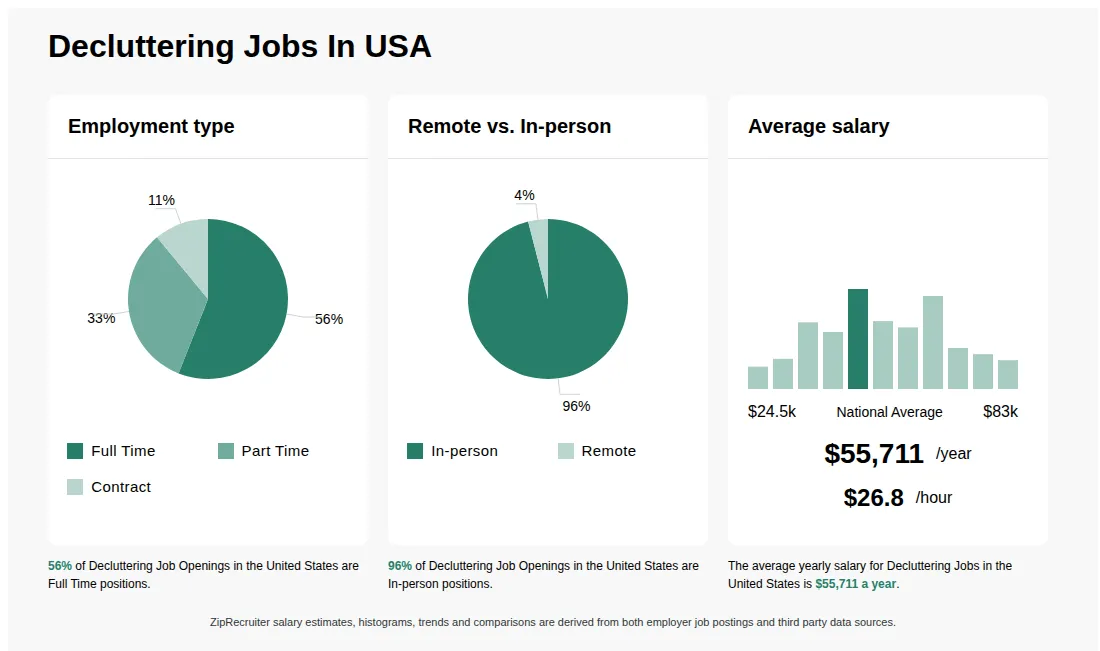
As of Jul 5, 2026, the average yearly pay for decluttering in the United States is $55,711.00, according to ZipRecruiter salary data. Most workers in this role earn between $44,500.00 and $65,000.00 per year, depending on experience, location, and employer.

What are the key skills and qualifications needed to thrive in the Decluttering position, and why are they important?

To thrive in decluttering, you need strong organizational skills, attention to detail, and the ability to assess, sort, and manage various types of belongings. Familiarity with decluttering methodologies, digital inventory apps, and, in some cases, relevant certifications such as professional organizing credentials can be beneficial. Excellent communication, empathy, and problem-solving skills help build client trust and tailor solutions to individual needs. These abilities are crucial for efficiently transforming spaces, reducing client stress, and ensuring high client satisfaction.

What jobs can I do if I like organizing?

Jobs related to organizing include professional organizer, administrative assistant, warehouse clerk, event planner, and filing specialist. These roles require strong attention to detail, good communication skills, and often involve using organizational tools or software. They can be found in various industries such as retail, corporate, or personal services.

What does a typical day look like for a decluttering professional?

On a typical day, a decluttering professional will meet with clients to assess their spaces and goals, create actionable plans, and work hands-on to sort, categorize, and organize items. Tasks may include recommending storage solutions, facilitating donations or disposals, and offering follow-up support to help clients maintain organization. Collaboration with other service providers, such as movers or cleaning teams, is sometimes necessary. The role often involves both independent work and direct client interaction, requiring adaptability and strong customer service skills. This variety ensures each day offers new challenges and opportunities to make a meaningful impact.

What is a Decluttering job?

A decluttering job involves helping individuals or businesses organize and remove excess items to create a more functional and tidy space. Decluttering professionals assess cluttered areas, categorize belongings, and assist in deciding what to keep, donate, recycle, or discard. They may also provide storage solutions and organizational strategies to maintain a clutter-free environment. This job requires strong organizational skills, patience, and a non-judgmental approach to help clients achieve their desired space.

How to make money from decluttering?

Decluttering as a job involves selling or donating unwanted items, organizing spaces for clients, or offering professional decluttering services. Skills in sorting, marketing, and customer service can help increase income, and platforms like online marketplaces or social media can be used to reach potential clients.

How to get into decluttering?

To get into decluttering as a job, start by developing organizational skills and understanding different storage methods. Gaining experience through volunteering or certification in organization can help, and familiarity with tools like labels and storage containers is beneficial. Building a portfolio or gaining client references can also support entry into the field.

How much do declutterers make?

Decluttering professionals typically earn between $15 and $50 per hour, depending on experience, location, and the complexity of the job. Some may charge flat rates for specific projects or offer package deals, with annual earnings varying based on workload and client demand.
More about Decluttering jobs
What cities are hiring for Decluttering jobs? Cities with the most Decluttering job openings:
What are the most commonly searched types of Decluttering jobs? The most popular types of Decluttering jobs are:
What states have the most Decluttering jobs? States with the most job openings for Decluttering jobs include:
What job categories do people searching Decluttering jobs look for? The top searched job categories for Decluttering jobs are:

Home Making

OPTIMAL HOME CARE SERVICES

Newport, MN • On-site

$18/hr

Part-time

PTO

Posted 20 days ago

Be an early applicant


Job description

Benefits:
  • Flexible schedule
  • Paid time off
  • Training & development

Service Description:

Home-making services are designed to assist the client in maintaining a clean, safe, and livable home environment. Services include light and heavy housekeeping duties, organization, and home upkeep tasks. For Armando, the focus will be on deep cleaning and decluttering due to safety concerns related to hoarding tendencies.
Objective of Care:

  • To restore and maintain a safe, sanitary, and functional living space
  • To support Armandos independence and improve his quality of life
  • To reduce environmental risks associated with hoarding behavior
  • To promote a sustainable routine for ongoing home maintenance
Client Needs / Support Areas:

Armando has been assessed as requiring assistance in the following areas:
  • Light Housekeeping:

    • Dusting, sweeping, vacuuming
    • Kitchen and bathroom cleaning
    • Laundry and surface cleaning
  • Heavy Housekeeping:

    • Deep cleaning (including under furniture/appliances if safe to do so)
    • Removal of accumulated clutter
    • Garbage removal and odor control
  • Organizational Support:

    • Decluttering and organizing personal items
    • Identifying and removing unsafe or unsanitary materials
    • Encouragement and participation in maintaining an orderly space
Expected Outcomes:

  • Home environment is significantly cleaner, safer, and more functional
  • Reduction in hoarding-related clutter and associated risks
  • Client actively participates in cleaning and maintenance as able
  • Improved mental and physical well-being due to cleaner living space
  • Sustainable routines are introduced to maintain cleanliness
Notes:

  • Services will be delivered with flexible scheduling, tailored weekly in collaboration with Armando and the assigned homecare worker.
  • The provider should approach decluttering tasks with sensitivity, using non-judgmental language and promoting client choice wherever possible.
  • High-risk areas (e.g., blocked exits, unsanitary items) should be prioritized.
  • Coordination with case manager and/or mental health support staff is encouraged if concerns arise.
  • Progress should be documented weekly, noting challenges, completed tasks, and changes in environment or client participation.