Join Esquire as a Freelance Court Reporter / Stenographer - a critical role where you'll capture the official record of depositions and other legal proceedings, supporting exceptional client delivery ...
Join Esquire as a Freelance Court Reporter / Stenographer - a critical role where you'll capture the official record of depositions and other legal proceedings, supporting exceptional client delivery ...
Join Esquire as a Freelance Court Reporter / Stenographer - a critical role where you'll capture the official record of depositions and other legal proceedings, supporting exceptional client delivery ...
Join Esquire as a Freelance Court Reporter / Stenographer - a critical role where you'll capture the official record of depositions and other legal proceedings, supporting exceptional client delivery ...
Join Esquire as a Freelance Court Reporter / Stenographer -- a critical role where you'll capture the official record of depositions and other legal proceedings, supporting exceptional client ...
Join Esquire as a Freelance Court Reporter / Stenographer -- a critical role where you'll capture the official record of depositions and other legal proceedings, supporting exceptional client ...
Join Esquire as a Freelance Court Reporter / Stenographer -- a critical role where you'll capture the official record of depositions and other legal proceedings, supporting exceptional client ...
Join Esquire as a Freelance Court Reporter / Stenographer -- a critical role where you'll capture the official record of depositions and other legal proceedings, supporting exceptional client ...
Join Esquire as a Freelance Court Reporter / Stenographer -- a critical role where you'll capture the official record of depositions and other legal proceedings, supporting exceptional client ...
Join Esquire as a Freelance Court Reporter / Stenographer -- a critical role where you'll capture the official record of depositions and other legal proceedings, supporting exceptional client ...
Join Esquire as a Freelance Court Reporter / Stenographer -- a critical role where you'll capture the official record of depositions and other legal proceedings, supporting exceptional client ...
Join Esquire as a Freelance Court Reporter / Stenographer -- a critical role where you'll capture the official record of depositions and other legal proceedings, supporting exceptional client ...
Join Esquire as a Freelance Court Reporter / Stenographer -- a critical role where you'll capture the official record of depositions and other legal proceedings, supporting exceptional client ...
Join Esquire as a Freelance Court Reporter / Stenographer -- a critical role where you'll capture the official record of depositions and other legal proceedings, supporting exceptional client ...
Join Esquire as a Freelance Court Reporter / Stenographer - a critical role where you'll capture the official record of depositions and other legal proceedings, supporting exceptional client delivery ...
Join Esquire as a Freelance Court Reporter / Stenographer - a critical role where you'll capture the official record of depositions and other legal proceedings, supporting exceptional client delivery ...
Join Esquire as a Freelance Court Reporter / Stenographer -- a critical role where you'll capture the official record of depositions and other legal proceedings, supporting exceptional client ...
Join Esquire as a Freelance Court Reporter / Stenographer -- a critical role where you'll capture the official record of depositions and other legal proceedings, supporting exceptional client ...
MD · On-site
Join Esquire as a Freelance Court Reporter / Stenographer -- a critical role where you'll capture the official record of depositions and other legal proceedings, supporting exceptional client ...
MD · On-site
Join Esquire as a Freelance Court Reporter / Stenographer -- a critical role where you'll capture the official record of depositions and other legal proceedings, supporting exceptional client ...

Court Reporter/Stenographer - Contractor position eScribers is looking for stenographic court reporters. **CANDIDATES MUST HAVE TRAINING OR RELEVANT EXPERIENCE AS A STENO REPORTER TO APPLY FOR THIS ...
Court Reporter/Stenographer - Contractor position eScribers is looking for stenographic court reporters. **CANDIDATES MUST HAVE TRAINING OR RELEVANT EXPERIENCE AS A STENO REPORTER TO APPLY FOR THIS ...
Court Reporter/Stenographer - Contractor position eScribers is looking for stenographic court reporters. **CANDIDATES MUST HAVE TRAINING OR RELEVANT EXPERIENCE AS A STENO REPORTER TO APPLY FOR THIS ...
Quick apply
Court Reporter/Stenographer - Contractor position eScribers is looking for stenographic court reporters. **CANDIDATES MUST HAVE TRAINING OR RELEVANT EXPERIENCE AS A STENO REPORTER TO APPLY FOR THIS ...
Court Reporter/Stenographer - Contractor position eScribers is looking for stenographic court reporters. **CANDIDATES MUST HAVE TRAINING OR RELEVANT EXPERIENCE AS A STENO REPORTER TO APPLY FOR THIS ...
Court Reporter/Stenographer - Contractor position eScribers is looking for stenographic court reporters. **CANDIDATES MUST HAVE TRAINING OR RELEVANT EXPERIENCE AS A STENO REPORTER TO APPLY FOR THIS ...
Court Reporter/Stenographer - Contractor position eScribers is looking for stenographic court reporters. **CANDIDATES MUST HAVE TRAINING OR RELEVANT EXPERIENCE AS A STENO REPORTER TO APPLY FOR THIS ...
Quick apply
Court Reporter/Stenographer - Contractor position eScribers is looking for stenographic court reporters. **CANDIDATES MUST HAVE TRAINING OR RELEVANT EXPERIENCE AS A STENO REPORTER TO APPLY FOR THIS ...
Court Reporter/Stenographer - Contractor position eScribers is looking for stenographic court reporters. **CANDIDATES MUST HAVE TRAINING OR RELEVANT EXPERIENCE AS A STENO REPORTER TO APPLY FOR THIS ...
Court Reporter/Stenographer - Contractor position eScribers is looking for stenographic court reporters. **CANDIDATES MUST HAVE TRAINING OR RELEVANT EXPERIENCE AS A STENO REPORTER TO APPLY FOR THIS ...
Court Reporter/Stenographer - Contractor position eScribers is looking for stenographic court reporters. **CANDIDATES MUST HAVE TRAINING OR RELEVANT EXPERIENCE AS A STENO REPORTER TO APPLY FOR THIS ...
Court Reporter/Stenographer - Contractor position eScribers is looking for stenographic court reporters. **CANDIDATES MUST HAVE TRAINING OR RELEVANT EXPERIENCE AS A STENO REPORTER TO APPLY FOR THIS ...
Court Reporter/Stenographer - Contractor position eScribers is looking for stenographic court reporters. **CANDIDATES MUST HAVE TRAINING OR RELEVANT EXPERIENCE AS A STENO REPORTER TO APPLY FOR THIS ...
Quick apply
Court Reporter/Stenographer - Contractor position eScribers is looking for stenographic court reporters. **CANDIDATES MUST HAVE TRAINING OR RELEVANT EXPERIENCE AS A STENO REPORTER TO APPLY FOR THIS ...

Grand Jury Stenographer, prov.
Rochester, NY · On-site
$68K - $95K/yr
Grand Jury Stenographer, prov. Deadline: Until Filled Salary: $68,569 - $95,556 annual salary, plus ... court reporting (ex. Registered Professional Reporter [RPR], Registered Merit Reporter [RMR ...
Grand Jury Stenographer, prov.
Rochester, NY · On-site
$68K - $95K/yr
Grand Jury Stenographer, prov. Deadline: Until Filled Salary: $68,569 - $95,556 annual salary, plus ... court reporting (ex. Registered Professional Reporter [RPR], Registered Merit Reporter [RMR ...
Court Reporter/Stenographer - Contractor position eScribers is looking for stenographic court reporters. **CANDIDATES MUST HAVE TRAINING OR RELEVANT EXPERIENCE AS A STENO REPORTER TO APPLY FOR THIS ...
Quick apply
Court Reporter/Stenographer - Contractor position eScribers is looking for stenographic court reporters. **CANDIDATES MUST HAVE TRAINING OR RELEVANT EXPERIENCE AS A STENO REPORTER TO APPLY FOR THIS ...
Court Reporter/Stenographer - Contractor position eScribers is looking for stenographic court reporters. **CANDIDATES MUST HAVE TRAINING OR RELEVANT EXPERIENCE AS A STENO REPORTER TO APPLY FOR THIS ...
Court Reporter/Stenographer - Contractor position eScribers is looking for stenographic court reporters. **CANDIDATES MUST HAVE TRAINING OR RELEVANT EXPERIENCE AS A STENO REPORTER TO APPLY FOR THIS ...
Court Stenographer information
See salary details
$5.29 - $10.29
0% of jobs
$10.29 - $15.30
0% of jobs
$15.30 - $20.30
0% of jobs
$20.30 - $25.31
0% of jobs
$28.12 is the 25th percentile. Wages below this are outliers.
$25.31 - $30.31
44% of jobs
The median wage is $31.76 / hr.
$30.31 - $35.31
19% of jobs
$39.65 is the 75th percentile. Wages above this are outliers.
$35.31 - $40.32
13% of jobs
$40.32 - $45.32
0% of jobs
$45.32 - $50.33
0% of jobs
$50.33 - $55.33
0% of jobs
$55.33 - $60.34
23% of jobs
$5
$40
$60
How much do court stenographer jobs pay per hour?
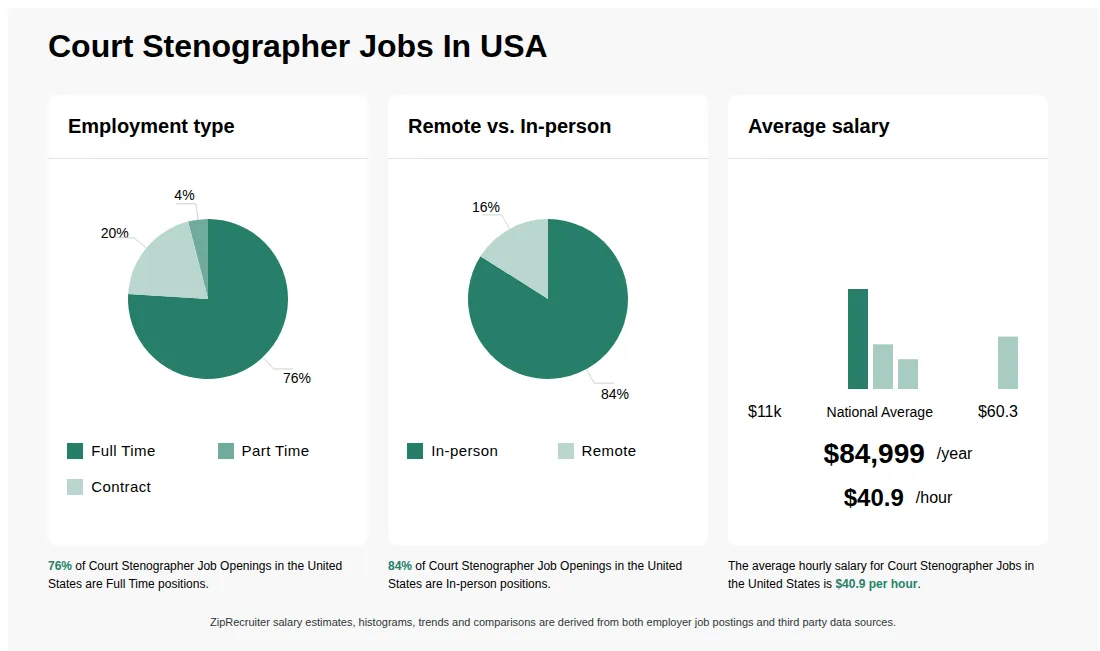
As of Sep 7, 2026, the average hourly pay for court stenographer in the United States is $40.86, according to ZipRecruiter salary data. Most workers in this role earn between $28.85 and $60.10 per hour, depending on experience, location, and employer.
What is a court stenographer?
A Court Stenographer, also known as a court reporter, is responsible for transcribing spoken or recorded speech into written text during legal proceedings, depositions, and meetings. They use specialized stenographic equipment or voice writing technology to ensure an accurate and official record. Court stenographers must have excellent listening skills, attention to detail, and proficiency in shorthand or stenography. Their transcripts serve as legal records and may be referenced in court cases or appeals.
What does a court stenographer do?
A typical day for a Court Stenographer involves attending court sessions, hearings, or depositions and capturing every spoken word using specialized transcription equipment. Stenographers regularly interact with judges, attorneys, court clerks, and witnesses to clarify statements or confirm information as needed. In addition to live transcription, they often spend time editing and producing official transcripts after proceedings. Collaboration and communication with legal professionals are frequent, as the accuracy and timeliness of transcripts are crucial to the judicial process. The work environment is generally formal and may require periods of intense focus in fast-paced legal settings.
What are the key skills and qualifications needed to thrive as a court stenographer?
To thrive as a Court Stenographer, you need excellent typing speed and accuracy, strong command of grammar and legal terminology, often with completion of a court reporting program and relevant state certification. Familiarity with stenotype machines, real-time transcription software, and digital recording systems is essential. Attention to detail, discretion, and the ability to concentrate for extended periods are key soft skills. These abilities ensure precise, confidential transcription of legal proceedings, which is critical for maintaining accurate legal records.
Are court stenographers still in demand?
Court stenographers, also known as court reporters, continue to be in demand due to the need for accurate legal transcripts and proceedings. They often require specialized stenography skills and certification, and employment opportunities are available in courts, law firms, and transcription services, with job stability supported by ongoing legal and governmental needs.
How much do court stenographers make in the US?
Court stenographers in the US typically earn a median annual salary of around $50,000 to $70,000, with experienced professionals and those working in high-demand areas earning higher wages. Salaries can vary based on location, experience, certifications, and the complexity of the cases they transcribe.
Is it hard to be a court stenographer?
Becoming a court stenographer requires passing a certification exam and developing fast, accurate shorthand transcription skills, which can take significant training and practice. The job involves working in a courtroom environment, often with irregular hours, and maintaining high levels of concentration and attention to detail.
More about Court Stenographer jobs
What cities are hiring for Court Stenographer jobs?
Cities with the most Court Stenographer job openings:
What are the most commonly searched types of Court Stenographer jobs?
The most popular types of Court Stenographer jobs are:
What states have the most Court Stenographer jobs?
States with the most job openings for Court Stenographer jobs include:
What job categories do people searching Court Stenographer jobs look for?
The top searched job categories for Court Stenographer jobs are:
- Superior Court Commissioner
- Fulltime Court Reporter Scopist
- La County Courthouse
- Commission Bexar County Court Reporter
- Full Time Verbatim Transcription
- Realtime Court Reporter
- Independent Court Reporter
- Per Diem International Court Reporter
- Part Time Genesee County Court
- Commission Superior Court Commissioner

Contractor
Re-posted 25 days ago
Key responsibilities
Attend and record depositions, arbitrations, hearings, and other legal proceedings
Use stenographic equipment and CAT software to capture verbatim records
Prepare, edit, and deliver certified transcripts within required timeframes
Job description
Join Esquire as a Freelance Court Reporter / Stenographer - a critical role where you'll capture the official record of depositions and other legal proceedings, supporting exceptional client delivery and legal accuracy.
Why Choose Esquire?
Esquire is a nationally recognized leader in legal support services, connecting you with a steady flow of high-quality assignments, flexible scheduling, and the tools you need to grow your freelance practice. You'll be part of a supportive network that values your expertise and empowers you to deliver your best work.
About the Role
As a Freelance Court Reporter, you will capture and transcribe spoken testimony using stenographic equipment, ensuring a complete, accurate, and timely legal record. You'll work with attorneys, witnesses, and legal professionals in a variety of settings-on-site, remote, or hybrid-delivering transcripts that meet the highest standards of quality and professionalism.
Key Responsibilities
This role involves a combination of on-site, remote, or hybrid assignments. Success comes from strong time management, proactive communication, and maintaining professional relationships with attorneys, witnesses, and clients.
Ready for what's next in your career?
Join a network that values your expertise and flexibility-apply now to become a Freelance Court Reporter with Esquire!
Don't meet every single requirement?
We know that a truly inclusive workplace values potential just as much as experience. If you're excited about this role but don't match every qualification, we still encourage you to apply. You may be exactly who we're looking for.
Equal Opportunity & Accommodations:
Esquire Deposition Solutions policy is to provide equal employment opportunities to all applicants and employees without regard to race, color, religion, creed, gender, gender identity or expression, age, national origin or ancestry, citizenship, disability, sexual orientation, marital status, pregnancy, veteran status, membership in the uniformed services, genetic information, or any other basis protected by applicable law.
Esquire Deposition Solutions is committed to fair hiring practices. Qualified applicants with criminal histories will be considered for employment in a manner consistent with applicable laws, including but not limited to the California Fair Chance Act, the Los Angeles Fair Chance Initiative for Hiring Ordinance, and the Los Angeles County Fair Chance Ordinance. We also comply with similar laws in other jurisdictions where we operate.
If you are a qualified individual with a disability or a disabled veteran and require support throughout the application and/or recruitment process as a result of your disability, you have the right to request reasonable accommodation. You can submit your request to talent.acquisition@esquiresolutions.com.
Why Choose Esquire?
Esquire is a nationally recognized leader in legal support services, connecting you with a steady flow of high-quality assignments, flexible scheduling, and the tools you need to grow your freelance practice. You'll be part of a supportive network that values your expertise and empowers you to deliver your best work.
About the Role
As a Freelance Court Reporter, you will capture and transcribe spoken testimony using stenographic equipment, ensuring a complete, accurate, and timely legal record. You'll work with attorneys, witnesses, and legal professionals in a variety of settings-on-site, remote, or hybrid-delivering transcripts that meet the highest standards of quality and professionalism.
Key Responsibilities
- Attend and record depositions, arbitrations, hearings, and other legal proceedings
- Use stenographic equipment and CAT software to capture verbatim records
- Prepare, edit, and deliver certified transcripts within required timeframes
- Collaborate professionally with attorneys, legal teams, and clients
- Manage case-related materials, exhibits, and documentation
- Stay current with legal terminology and court reporting standards
- Certification: State and/or nationally recognized court reporting certification (e.g., CSR, RPR)
- Equipment: Reliable stenographic machine, CAT software, and transcription tools
- Experience: 1+ years of experience preferred; new graduates encouraged to apply
- Professionalism: Exceptional accuracy, confidentiality, and time management
- Adaptability: Ability to work in-person, remote, or hybrid settings
- High percentage of accurate and on-time transcript delivery
- Strong professional reputation among attorneys and legal teams
- Effective management of case materials and documentation
- Reliable and consistent use of CAT software and stenographic tools
- Positive engagement with Esquire support teams and colleagues
This role involves a combination of on-site, remote, or hybrid assignments. Success comes from strong time management, proactive communication, and maintaining professional relationships with attorneys, witnesses, and clients.
Ready for what's next in your career?
Join a network that values your expertise and flexibility-apply now to become a Freelance Court Reporter with Esquire!
Don't meet every single requirement?
We know that a truly inclusive workplace values potential just as much as experience. If you're excited about this role but don't match every qualification, we still encourage you to apply. You may be exactly who we're looking for.
Equal Opportunity & Accommodations:
Esquire Deposition Solutions policy is to provide equal employment opportunities to all applicants and employees without regard to race, color, religion, creed, gender, gender identity or expression, age, national origin or ancestry, citizenship, disability, sexual orientation, marital status, pregnancy, veteran status, membership in the uniformed services, genetic information, or any other basis protected by applicable law.
Esquire Deposition Solutions is committed to fair hiring practices. Qualified applicants with criminal histories will be considered for employment in a manner consistent with applicable laws, including but not limited to the California Fair Chance Act, the Los Angeles Fair Chance Initiative for Hiring Ordinance, and the Los Angeles County Fair Chance Ordinance. We also comply with similar laws in other jurisdictions where we operate.
If you are a qualified individual with a disability or a disabled veteran and require support throughout the application and/or recruitment process as a result of your disability, you have the right to request reasonable accommodation. You can submit your request to talent.acquisition@esquiresolutions.com.

About Esquire Deposition Solutions
Sourced by ZipRecruiter
Industry
Legal services
Company size
501 - 1,000 Employees
Headquarters location
Atlanta, GA, US
Year founded
1978