
... Control Tower ... Dimensions of Position Works under the general supervision of the Tower Manager who relies on the ...
... Control Tower ... Dimensions of Position Works under the general supervision of the Tower Manager who relies on the ...
Responsible for the safe, orderly, and expeditious flow of air traffic control duties in a Visual Flight Rules (VFR) Airport Traffic Control Tower. DIMENSIONS OF POSITION: Works under the general ...
Responsible for the safe, orderly, and expeditious flow of air traffic control duties in a Visual Flight Rules (VFR) Airport Traffic Control Tower. DIMENSIONS OF POSITION: Works under the general ...
Air Traffic Control Specialist
Moss Point, MS · On-site
$34.99/hr
... Control Tower ... Dimensions of Position Works under the general supervision of the Tower Manager who relies on the ...
Air Traffic Control Specialist
Moss Point, MS · On-site
$34.99/hr
... Control Tower ... Dimensions of Position Works under the general supervision of the Tower Manager who relies on the ...

Air Traffic Control Specialist (Part Time)
Millington, TN · On-site
$45 - $55/hr
The Air Traffic Control Specialist is responsible for providing air traffic control services during locally staffed operational hours at the Millington-Memphis Airport Non-Federal Control Tower. The ...
Air Traffic Control Specialist (Part Time)
Millington, TN · On-site
$45 - $55/hr
The Air Traffic Control Specialist is responsible for providing air traffic control services during locally staffed operational hours at the Millington-Memphis Airport Non-Federal Control Tower. The ...
Air Traffic Control Specialist
Wainscott, NY · On-site
$44.50/hr
... Control Tower ... Dimensions of Position Works under the general supervision of the Tower Manager who relies on the ...
Air Traffic Control Specialist
Wainscott, NY · On-site
$44.50/hr
... Control Tower ... Dimensions of Position Works under the general supervision of the Tower Manager who relies on the ...
Responsible for the safe, orderly, and expeditious flow of air traffic control duties in a Visual Flight Rules (VFR) Airport Traffic Control Tower. DIMENSIONS OF POSITION: Works under the general ...
Responsible for the safe, orderly, and expeditious flow of air traffic control duties in a Visual Flight Rules (VFR) Airport Traffic Control Tower. DIMENSIONS OF POSITION: Works under the general ...
Responsible for the safe, orderly, and expeditious flow of air traffic control duties in a Visual Flight Rules (VFR) Airport Traffic Control Tower. DIMENSIONS OF POSITION: Works under the general ...
Responsible for the safe, orderly, and expeditious flow of air traffic control duties in a Visual Flight Rules (VFR) Airport Traffic Control Tower. DIMENSIONS OF POSITION: Works under the general ...
Air Traffic Control Specialist
Jacksonville, FL · On-site
$42.19/hr
... Control Tower ... Dimensions of Position Works under the general supervision of the Tower Manager who relies on the ...
Air Traffic Control Specialist
Jacksonville, FL · On-site
$42.19/hr
... Control Tower ... Dimensions of Position Works under the general supervision of the Tower Manager who relies on the ...
Air Traffic Control Specialist
Burns Flat, OK · On-site
$37.58/hr
... Control Tower ... Dimensions of Position Works under the general supervision of the Tower Manager who relies on the ...
Air Traffic Control Specialist
Burns Flat, OK · On-site
$37.58/hr
... Control Tower ... Dimensions of Position Works under the general supervision of the Tower Manager who relies on the ...
Responsible for the safe, orderly, and expeditious flow of air traffic control duties in a Visual Flight Rules (VFR) Airport Traffic Control Tower. DIMENSIONS OF POSITION: Works under the general ...
Responsible for the safe, orderly, and expeditious flow of air traffic control duties in a Visual Flight Rules (VFR) Airport Traffic Control Tower. DIMENSIONS OF POSITION: Works under the general ...
Responsible for the safe, orderly, and expeditious flow of air traffic control duties in a Visual Flight Rules (VFR) Airport Traffic Control Tower. DIMENSIONS OF POSITION: Works under the general ...
Quick apply
Responsible for the safe, orderly, and expeditious flow of air traffic control duties in a Visual Flight Rules (VFR) Airport Traffic Control Tower. DIMENSIONS OF POSITION: Works under the general ...
Responsible for the safe, orderly, and expeditious flow of air traffic control duties in a Visual Flight Rules (VFR) Airport Traffic Control Tower. DIMENSIONS OF POSITION: Works under the general ...
Responsible for the safe, orderly, and expeditious flow of air traffic control duties in a Visual Flight Rules (VFR) Airport Traffic Control Tower. DIMENSIONS OF POSITION: Works under the general ...
Responsible for the safe, orderly, and expeditious flow of air traffic control duties in a Visual Flight Rules (VFR) Airport Traffic Control Tower. DIMENSIONS OF POSITION: Works under the general ...
Responsible for the safe, orderly, and expeditious flow of air traffic control duties in a Visual Flight Rules (VFR) Airport Traffic Control Tower. DIMENSIONS OF POSITION: Works under the general ...
Responsible for the safe, orderly, and expeditious flow of air traffic control duties in a Visual Flight Rules (VFR) Airport Traffic Control Tower. DIMENSIONS OF POSITION: Works under the general ...
Quick apply
Responsible for the safe, orderly, and expeditious flow of air traffic control duties in a Visual Flight Rules (VFR) Airport Traffic Control Tower. DIMENSIONS OF POSITION: Works under the general ...
Responsible for the safe, orderly, and expeditious flow of air traffic control duties in a Visual Flight Rules (VFR) Airport Traffic Control Tower. DIMENSIONS OF POSITION: Works under the general ...
Quick apply
Responsible for the safe, orderly, and expeditious flow of air traffic control duties in a Visual Flight Rules (VFR) Airport Traffic Control Tower. DIMENSIONS OF POSITION: Works under the general ...
Key Account Specilaist - LTL (Control Tower)
Wood Dale, IL · On-site
$19 - $26/hr
You have experience managing strategic customer accounts, Control Tower operations, or complex transportation programs. * Proven ability to build relationships and communicate effectively with ...
Key Account Specilaist - LTL (Control Tower)
Wood Dale, IL · On-site
$19 - $26/hr
You have experience managing strategic customer accounts, Control Tower operations, or complex transportation programs. * Proven ability to build relationships and communicate effectively with ...
Air Traffic Control Specialist
Brooksville, FL · On-site
$34.34/hr
... Control Tower ... Dimensions of Position Works under the general supervision of the Tower Manager who relies on the ...
Air Traffic Control Specialist
Brooksville, FL · On-site
$34.34/hr
... Control Tower ... Dimensions of Position Works under the general supervision of the Tower Manager who relies on the ...
Air Traffic Control Specialist
Shreveport, LA · On-site
$41.65/hr
... Control Tower ... Dimensions of Position Works under the general supervision of the Tower Manager who relies on the ...
Air Traffic Control Specialist
Shreveport, LA · On-site
$41.65/hr
... Control Tower ... Dimensions of Position Works under the general supervision of the Tower Manager who relies on the ...
Air Traffic Control Specialist
Sacramento, CA · On-site
$37.96/hr
... Control Tower ... Dimensions of Position Works under the general supervision of the Tower Manager who relies on the ...
Air Traffic Control Specialist
Sacramento, CA · On-site
$37.96/hr
... Control Tower ... Dimensions of Position Works under the general supervision of the Tower Manager who relies on the ...
Air Traffic Control Specialist
Henderson, NV · On-site
$38.99/hr
... Control Tower ... Dimensions of Position Works under the general supervision of the Tower Manager who relies on the ...
Air Traffic Control Specialist
Henderson, NV · On-site
$38.99/hr
... Control Tower ... Dimensions of Position Works under the general supervision of the Tower Manager who relies on the ...
Control Tower information
See salary details
$14.90 - $15.60
3% of jobs
$15.60 - $16.30
9% of jobs
$16.30 - $17
10% of jobs
$17.18 is the 25th percentile. Wages below this are outliers.
$17 - $17.70
10% of jobs
$17.70 - $18.40
10% of jobs
$18.40 - $19.10
6% of jobs
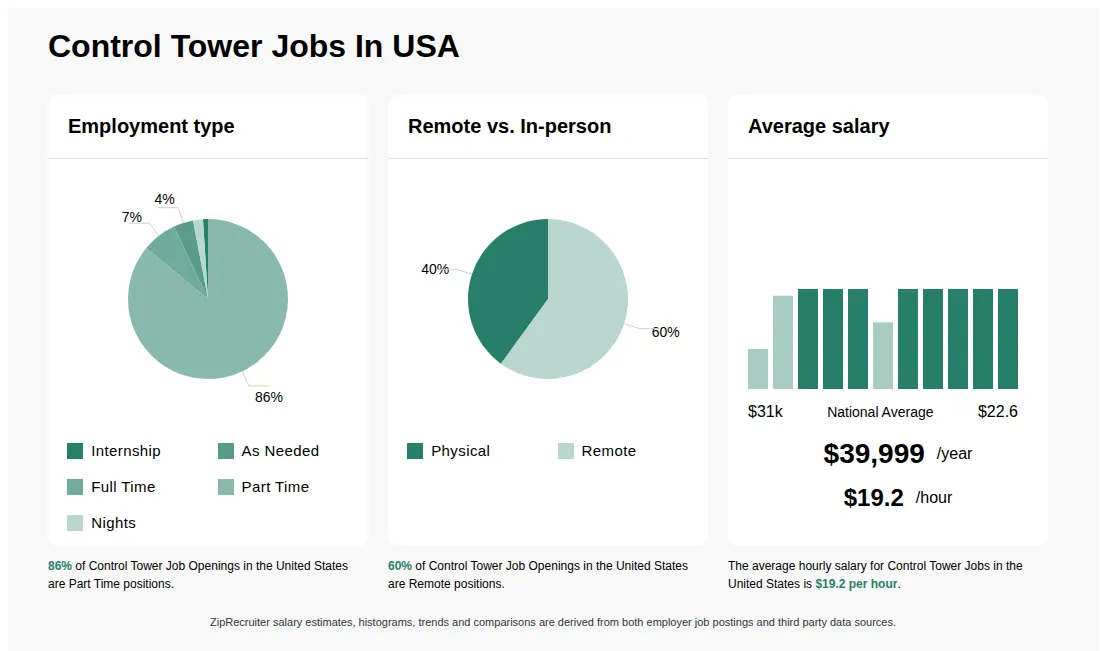
The median wage is $19.17 / hr.
$19.10 - $19.80
10% of jobs
$19.80 - $20.50
10% of jobs
$20.88 is the 75th percentile. Wages above this are outliers.
$20.50 - $21.20
10% of jobs
$21.20 - $21.90
10% of jobs
$21.90 - $22.60
10% of jobs
$14
$19
$22
How much do control tower jobs pay per hour?
As of Jul 14, 2026, the average hourly pay for control tower in the United States is $19.23, according to ZipRecruiter salary data. Most workers in this role earn between $17.31 and $21.15 per hour, depending on experience, location, and employer.
Did air traffic controllers get paid $10,000?
Air traffic controllers typically earn salaries well above $10,000 per month, with the median annual wage around $130,000 according to industry data. Their compensation depends on experience, location, and certification levels, and they often work in high-pressure environments requiring specialized training and certification.
What is the difference between Control Tower vs Supply Chain Analyst?
| Aspect | Control Tower | Supply Chain Analyst |
|---|---|---|
| Credentials | Typically requires supply chain certifications, logistics experience | Requires analytical skills, often a degree in supply chain, logistics, or business |
| Work Environment | Centralized, often in logistics or supply chain departments, real-time monitoring | Office-based, data analysis, reporting, and process improvement |
| Industry Usage | Common in logistics, manufacturing, retail | Widespread across industries including retail, manufacturing, and consulting |
| Search & Comparison Intent | Understanding roles in supply chain management, logistics coordination | Analyzing supply chain data, improving processes |
The Control Tower role focuses on real-time supply chain oversight and coordination, often requiring logistics certifications. In contrast, a Supply Chain Analyst primarily analyzes data to optimize supply chain processes. Both roles are vital in supply chain management but differ in scope and daily responsibilities.
How does a Control Tower professional typically collaborate with other departments to resolve supply chain disruptions?
Control Tower professionals play a central role in coordinating responses to supply chain disruptions by acting as a hub for cross-functional communication. They regularly interact with teams such as procurement, logistics, customer service, and IT to gather real-time data, identify bottlenecks, and implement corrective actions. This collaboration often involves leading status meetings, sharing insights via dashboards, and ensuring all stakeholders have the latest information to make informed decisions. By fostering strong interdepartmental relationships, Control Tower professionals help maintain supply chain continuity and improve overall efficiency.
How much do tower controllers make?
Tower controllers, also known as air traffic control tower operators, typically earn a median annual salary of around $130,000. Salaries can vary based on experience, location, and certification level, with some earning over $180,000 annually in high-demand areas. The role requires strong communication skills and certification from the Federal Aviation Administration or relevant authority.
Is ATC a hard job to get?
Control Tower positions are competitive and require specific qualifications, including FAA certification and training. Candidates often need a strong understanding of air traffic control procedures, good communication skills, and the ability to handle high-pressure situations, making the job challenging to enter but attainable with proper preparation.
What are control tower jobs?
Control tower jobs typically refer to roles within logistics, supply chain management, or air traffic control where professionals oversee, coordinate, and optimize the flow of goods or information. In a supply chain context, control tower teams use technology and data analytics to monitor shipments, manage disruptions, and ensure efficient operations across multiple stakeholders. In aviation, a control tower job involves managing air traffic and ensuring safe takeoffs, landings, and ground movements. These roles require strong problem-solving, communication, and analytical skills to respond quickly to dynamic situations.
How to get a job in control tower?
To get a job as a control tower operator, candidates typically need a high school diploma or equivalent, along with relevant certifications such as air traffic control or logistics certifications. Strong organizational, communication, and problem-solving skills are essential, and experience in supply chain management or transportation can be advantageous. Some positions may require security clearances or specialized training provided by employers or regulatory agencies.
What are the key skills and qualifications needed to thrive as a Control Tower Operator, and why are they important?
To thrive as a Control Tower Operator, you need strong situational awareness, decision-making skills, and typically an air traffic control certification or equivalent aviation training. Familiarity with radar systems, radio communication equipment, and air traffic management software is essential. Exceptional communication, stress management, and teamwork are critical soft skills for this high-pressure environment. These abilities ensure the safe, efficient, and coordinated movement of aircraft, which is vital for aviation safety and operational efficiency.
More about Control Tower jobs
What cities are hiring for Control Tower jobs? Cities with the most Control Tower job openings:
What states have the most Control Tower jobs? States with the most job openings for Control Tower jobs include:
What job categories do people searching Control Tower jobs look for? The top searched job categories for Control Tower jobs are:
Job description
Summary
Responsible for the safe, orderly, and expeditious flow of air traffic control duties in a Visual Flight Rules (VFR) Air Traffic Control Tower.
Dimensions of Position
Works under the general supervision of the Tower Manager who relies on the incumbent to perform established duties independently. On new or revised procedures, the manager gives detailed instructions and observes, and checks work during or immediately after completion according to complexity of the task or until satisfied the incumbent can perform it independently.
Accountability
1. Makes decisions involving:
- The order of departures that will assure all aircraft equitable treatment and will assure that departing IFR flights operate at the fix, altitude, and the time designated by the center or approach control clearances.
- The times and direction of takeoff and any turns necessary for departure.
- Whether inbound aircraft are to land immediately or circle and whether distances are lengthened to control the arrival of an aircraft at a given point.
- The active runway and possible simultaneous use of other runways.
- The time and methods by which arrivals and departures can be interspersed with the least delay to traffic.
- When landing and departing aircraft are cleared to use the runways to assure standard separation between aircraft on the runways.
- The sequence of arriving traffic, before it enters the traffic pattern, to assure a safe, orderly flow of aircraft on final approach to the landing runway.
- That IFR separation standards are applied, as delegated by approach control of the center, in limited areas around the airport to provide initial separation between
IFR arrivals and IFR departures and between successive IFR departures.
- The sequence of VFR and IFR traffic, using radar equipment as an aid and, when delegated, separating IFR traffic.
- When VFR flights through the airport traffic area can be authorized.
2. Determines the usability of communications frequencies available to him/her as other navigational aids used to control air traffic. Monitors navigational aids and monitors control panels, including BRITE display to determine acceptability of its alignment and display presentation. Instructs pilots to change radio frequencies/radar beacon codes.
3. When appropriate, coordinates with the other controllers on movements of both arrival and departure aircraft.
4. When traffic conditions warrant, controllers in non-approach terminals are responsible for:
- Preplanning traffic sequencing and separation over an area which may reach out to a radius of 5 miles or more.
- Preplanning and setting up check points required to ensure the maintenance of necessary traffic separation.
- Maintaining a continuous mental picture and evaluation of a constantly changing traffic complex frequency dispersed over an equivalent geographic area.
- Maintaining continuous radio watch with aircraft which have previously contacted the facility.
- Accepting responsibility to handle IFR traffic at his/her airport.
5. Studies weather bureau reports and forecasts, obtains LAWRS/SAWRS weather certification, observes weather from the tower and records pilot reports to determine the effect of present and anticipated weather on traffic; furnishes aircraft with information such as field conditions, altimeter settings, weather conditions, operating status of navigational aids, and observed malfunctioning of aircraft, forwards to the weather bureau and the appropriate center, pilot weather reports and reports based upon personal observation of weather conditions; operates light guns, runway lights, field lighting, jet barriers etc.
6. Orients pilots of aircraft lost or in difficulty; determines whether a given situation may operations offices, airport management offices, and fire and ambulance services.
7. Performs lower grade level duties as necessary to meet operational requirements and for proficiency maintenance.
8. Provides OJT training to others.
Requirements
Individual must have a CTO Certificate and a current Class II Medical Certificate. Position is subject to drug and/or alcohol testing per the DOT/FAA requirements (pre-employment, random, reasonable cause/suspicion, post-accident). Individual must have held a Control Tower Operator Certificate (CTO) with a facility rating or have held an FAA Credential with a tower rating, for a minimum of six months in an Air Traffic Control Tower.