1

Control Systems Engineer Jobs in Ontario (NOW HIRING)

Systems engineers receive direct input from customers and other project teammates. We offer ... Able to create innovative designs for vehicle control, communication, safety, and power system ...

As a Systems Engineer in the group this role will focus on requirements analysis and management. Reporting to the manager of Systems Engineering your focus will be on ensuring requirements are ...

POSITION SUMMARY Here at Canpar Express Inc. the Package & Courier Shared Infrastructure team is seeking a highly motivated IT Systems Engineer to join our high-performance Infrastructure Core Team ...

Senior Systems Engineer/Specialist

Ottawa, ON · Hybrid

CA$105K - CA$150K/yr

Senior Combat and Systems Engineer or Specialist Location: Halifax, NS, Ottawa, ON, or Victoria, BC Employment Type: Permanent, Full-Time Annual Salary: $105,000-150,000 The Senior Systems Engineer ...

next page

Showing results 1-20

Control Systems Engineer information

See Ontario salary details

$56K

$100.6K

$155K

How much do control systems engineer jobs pay per year?

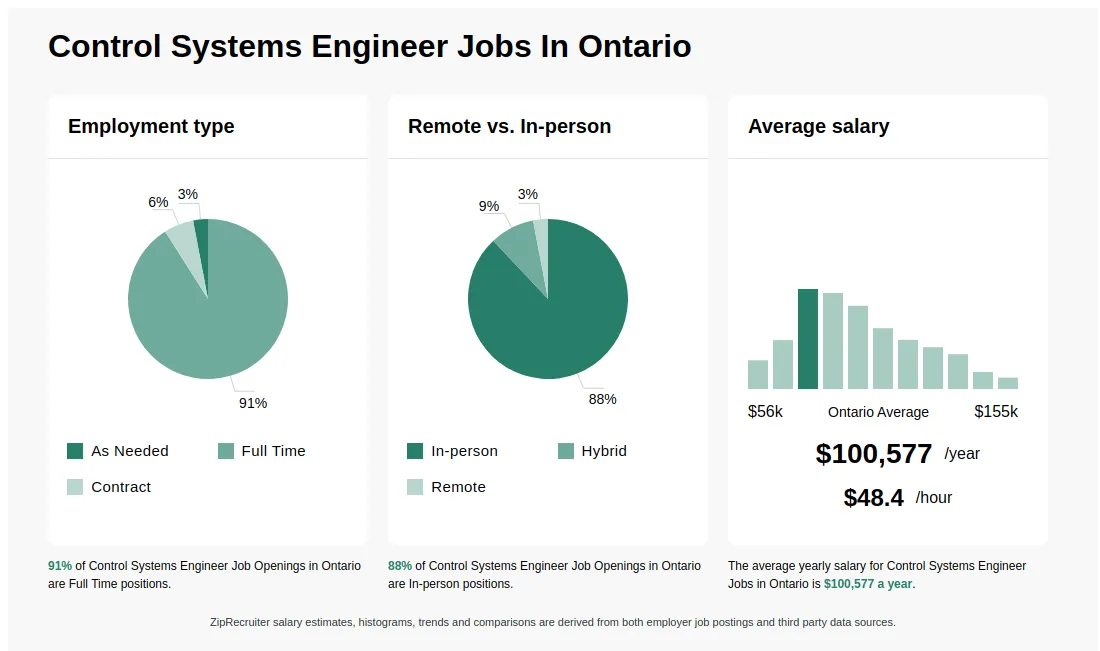
As of Jun 14, 2026, the average yearly pay for control systems engineer in Ontario is $100,577.00, according to ZipRecruiter salary data. Most workers in this role earn between $80,000.00 and $115,000.00 per year, depending on experience, location, and employer.

What engineering jobs pay $500,000?

Control Systems Engineers in senior or specialized roles, especially in industries like aerospace, defense, or oil and gas, can earn $500,000 or more annually with experience, bonuses, and stock options. High-level positions often require advanced skills in automation, programming, and certifications such as PE or PMP, along with extensive industry experience.

What are some common challenges faced by Control Systems Engineers in fast-paced industrial environments?

Control Systems Engineers often encounter challenges such as troubleshooting unexpected system faults under tight deadlines, integrating new automation technologies with legacy equipment, and ensuring minimal downtime during system upgrades. Collaboration with multidisciplinary teams—including process engineers, IT specialists, and maintenance staff—is essential to address these issues efficiently. Staying current with evolving industry standards and cybersecurity practices also plays a critical role in maintaining reliable and safe control systems.

What does a Control Systems Engineer do?

A Control Systems Engineer designs, develops, and maintains control systems that manage machinery and processes in industries such as manufacturing, aerospace, and energy. They analyze system requirements, create control algorithms, and use tools like MATLAB or PLCs to ensure systems operate efficiently and safely. Strong problem-solving skills and knowledge of automation are essential for this role.

What is the difference between Control Systems Engineer vs Electrical Engineer?

AspectControl Systems EngineerElectrical Engineer
CredentialsBachelor's in Control Engineering, Electrical Engineering, or related fields; certifications like Certified Control Systems Technician (CCST)Bachelor's in Electrical Engineering; Professional Engineer (PE) license often preferred
Work EnvironmentDesign, develop, and test control systems in manufacturing, automation, or robotics industriesDesign, develop, and test electrical systems in power, electronics, or communication sectors
Industry UsageCommon in automation, robotics, manufacturing, and process controlWidespread across power generation, electronics, telecommunications, and industrial sectors

Control Systems Engineers focus on designing and maintaining automated control systems, while Electrical Engineers work on broader electrical systems. Both roles require similar technical skills and certifications, but their industry applications and daily tasks differ.

Is QC engineer a good career?

A QC (Quality Control) engineer focuses on inspecting and testing products to ensure they meet quality standards, often working in manufacturing or production environments. It can be a stable career with opportunities for advancement, especially with skills in testing methods, quality management systems, and relevant certifications like Six Sigma. Job satisfaction depends on interest in quality assurance and attention to detail.

What are the key skills and qualifications needed to thrive as a Control Systems Engineer, and why are they important?

To thrive as a Control Systems Engineer, you need a strong background in electrical, mechanical, or automation engineering along with expertise in control theory and system dynamics. Familiarity with PLCs, SCADA systems, industrial networking, and programming languages such as ladder logic or MATLAB/Simulink is typically required, and certifications like Certified Automation Professional (CAP) can be advantageous. Analytical thinking, problem-solving, and effective communication are standout soft skills in this role. These skills ensure the design, implementation, and optimization of safe, efficient, and reliable automated systems in industrial environments.

What engineers make $300,000 a year?

Control Systems Engineers can earn $300,000 or more annually, especially with extensive experience, advanced certifications, and leadership roles in industries like aerospace, defense, or high-tech manufacturing. High salaries often involve specialized skills in automation, programming, and system integration, along with working in senior or managerial positions.

What are control systems engineers?

Control systems engineers are professionals who design, develop, and maintain systems that control and automate the operation of equipment or processes. They use principles from engineering, mathematics, and computer science to ensure that machinery and processes operate efficiently, safely, and reliably. Control systems engineers work in industries such as manufacturing, aerospace, energy, and automotive, where automated control and precision are essential. Their responsibilities often include creating and testing control algorithms, integrating sensors and actuators, and troubleshooting system issues.

What Is a Control Systems Engineer?

A control systems engineer’s duties include designing, building and maintaining instrumentation, monitors, and other equipment used to control complex systems. Some examples of these control systems include navigation networks, production machinery gauges, and computer system monitors. It is the control systems engineer’s job to maintain safe and efficient field operation of the equipment and to ensure the safety of those utilizing the equipment. These skilled engineers are typically well versed in mechanical, chemical, and electrical engineering concepts and design.

What are the most commonly searched types of Control Systems Engineer jobs in Ontario? The most popular types of Control Systems Engineer jobs in Ontario are:
What are popular job titles related to Control Systems Engineer jobs in Ontario? For Control Systems Engineer jobs in Ontario, the most frequently searched job titles are:
What job categories do people searching Control Systems Engineer jobs in Ontario look for? The top searched job categories for Control Systems Engineer jobs in Ontario are:
Infographic showing various Control Systems Engineer job openings in Ontario as of June 2026, with employment types broken down into 100% Full Time. Highlights an 100% In-person job distribution, with an average salary of $100,577 per year, or $48.4 per hour.

AMR Systems Engineer

Kiongroup

Mississauga, ON

CA$73K - CA$92K/yr

Other

Posted 25 days ago


Job description

The Autonomous Mobile Robot (AMR) Systems Engineer develops the design and implementation of systems that integrate AMR hardware and associated software. The role involves working closely with colleagues across the globe to implement optimal, customer-centric solutions. Customer focus and problem solving are to be your strongest areas. Systems engineers receive direct input from customers and other project teammates.We offer:
  • Career Development
  • Competitive Compensation and Benefits
  • Pay Transparency
  • Global Opportunities

Learn More Here: https://www.dematic.com/en-us/about/careers/what-we-offer/

Dematic provides equal employment opportunities to all employees and applicants for employment and prohibits discrimination and harassment of any type without regard to race, color, religion, age, sex, national origin, disability status, genetics, protected veteran status, sexual orientation, gender identity or expression, or any other characteristic protected by federal, state, or local laws.

This policy applies to all terms and conditions of employment, including recruiting, hiring, placement, promotion, termination, layoff, recall, transfer, leaves of absence, compensation, and training.

The base pay range for this role is estimated to be between $ $73,600-$92,000 CAD at the time of posting. Final compensation will be determined by various factors such as work location, education, experience, knowledge, and skills.

Tasks and Qualifications:

What You Will do in This Role:
Primary equipment focus will be to help manage and coordinate the design of AMR equipment incorporating various types of material handling system applications.
Another main responsibility is the configuration of AMR fleet management software, and then commissioning of the hardware and sleet management software at the customer's facility.
You define mid and top-level behavior of the AMRs, thereby shaping much of the overall behavior of the system.
Provide detailed new equipment and acceptance testing specifications.
Drive all activities related to ensuring new equipment is built to specification.
Thoroughly characterize and document the base line performance and capability of each system and drive actions to maintain system performance to the documented base line.
You are often the first point of contact for the customers during the implementation phase on site. During the implementation phase on site, you are an important contact person for the customer and enable a successful transition to live operation.
In addition, you will collaborate with others through the creation of a training program for the corresponding users on site.

Fluent in English

Chinese is an advantage,

French Canadian is an advantage.

What We Are Looking For:
You are interested in the application of high-tech solutions in industrial environments.
You have a good understanding of the principles of automated handling tools, electronics, equipment function, test equipment, operation, maintenance and repair.
Able to create innovative designs for vehicle control, communication, safety, and power system schematics and troubleshoot to component level.
Strong "hands-on" capability in the installation and commissioning of AMR or other Mobile Automation systems in a production environment.
2 to 4 years' experience with Autonomous Mobile Robot or other Mobile Automation (AGV) integration.
PLC design (ladder logic and structured text) or similar control logic (Allen-Bradley, Siemens) is a plus.
Provide support for Customer Service and issue resolution.
Communication skills, strong ability to work in a team, goal and result oriented, as well as a strongly structured way of working.

Special Skills:
Identify necessary tasks, identify possible hazards, determine risk reduction requirements, reason possible solutions to reduce risk, validate proposed solutions and document the risk assessment per ANSI/RIA R15.06:2012 Robot Safety Standard, ISO 10218-1:2011, and ISO 10218-2:2011
Direct and coordinate manufacturing, installation, support, documentation, and testing activities to ensure compliance with specifications, codes, and customer requirements.
Perform and supervise installation and commissioning including oversight of contractors and partners.
Inspect completed installations and observe operations, to ensure conformance to design and equipment specifications and compliance with operational and safety standards. During the implementation phase on site, you are an important contact person for the customer and enable a successful transition to live operation
In some instances, you will conduct informal hands-on training for users on site.
Networking design and commissioning experience with Ethernet (including EthernetIP), DeviceNet, ProfiNet and Profibus. Wireless network experience is a plus.

Education and Minimum Requirements:
Bachelors Degree in Electrical Engineering.
Must have the ability to solve complex design and software problems and implement effective and cost-efficient solutions.
Proficient in using CAD software AutoCAD (E-Plan a plus).
Good communications skills, flexibility and willingness to work as part of a team of solution-oriented professionals.
Excellent organizational, analytical, reasoning and problem-solving skills; ability to maintain accurate and detailed records; ability to understand and follow directions.
Ability to work under pressure, meet inflexible deadlines, and deal with difficult individuals while maintaining composure.
Must be able to manage personal schedule to accommodate work demands.
Must be willing to follow organizational software standards.
Ability to travel globally up to 25%.