Outstanding U of A benefits include health, dental, and vision insurance plans; life insurance and ... Technological knowledge base in graphic design, computer programming and/or user interface design.
Outstanding U of A benefits include health, dental, and vision insurance plans; life insurance and ... Technological knowledge base in graphic design, computer programming and/or user interface design.
Postdoc position at Brookhaven National Laboratory's National Synchrotron Light Source II
Upton, NY · On-site
$71K - $119K/yr
... Postdoctoral Research Associate for AI-driven Lab Automation for Life Sciences for an on-site ... Design and deploy computer vision methods to detect and track crystal growth. * Develop closed-loop ...
Postdoc position at Brookhaven National Laboratory's National Synchrotron Light Source II
Upton, NY · On-site
$71K - $119K/yr
... Postdoctoral Research Associate for AI-driven Lab Automation for Life Sciences for an on-site ... Design and deploy computer vision methods to detect and track crystal growth. * Develop closed-loop ...

Postdoctoral Research Associate - AI-driven Lab Automation for Life Sciences
Manhattan, NY · On-site
$71K - $119K/yr
## Postdoctoral Research Associate - AI-driven Lab Automation for Life SciencesApplylocations: Upton ... Design and deploy computer vision methods to detect and track crystal growth.* Develop closed-loop ...
Postdoctoral Research Associate - AI-driven Lab Automation for Life Sciences
Manhattan, NY · On-site
$71K - $119K/yr
## Postdoctoral Research Associate - AI-driven Lab Automation for Life SciencesApplylocations: Upton ... Design and deploy computer vision methods to detect and track crystal growth.* Develop closed-loop ...

... computer vision, and/or scientific data analysis. Preferred Experience with one or more of the ... For Postdoctoral benefits, please see our Postdoctoral Benefits page.) CAMPUS SECURITY CRIME ...
... computer vision, and/or scientific data analysis. Preferred Experience with one or more of the ... For Postdoctoral benefits, please see our Postdoctoral Benefits page.) CAMPUS SECURITY CRIME ...

Postdoctoral Scholar - Reinhart Group - Materials Science and Engineering
State College, PA · On-site
... computer vision, and/or scientific data analysis. Preferred Experience with one or more of the ... For Postdoctoral benefits, please see our Postdoctoral Benefits page.) CAMPUS SECURITY CRIME ...
Postdoctoral Scholar - Reinhart Group - Materials Science and Engineering
State College, PA · On-site
... computer vision, and/or scientific data analysis. Preferred Experience with one or more of the ... For Postdoctoral benefits, please see our Postdoctoral Benefits page.) CAMPUS SECURITY CRIME ...

POSTDOCTORAL ASSOCIATE
New York, NY · On-site
$75K/yr
Familiarity with data/video coding tools and computer vision (e.g., OpenCV, scikit-learn). We welcome applicants with recent PhDs and individuals seeking additional postdoctoral training. Candidates ...
POSTDOCTORAL ASSOCIATE
New York, NY · On-site
$75K/yr
Familiarity with data/video coding tools and computer vision (e.g., OpenCV, scikit-learn). We welcome applicants with recent PhDs and individuals seeking additional postdoctoral training. Candidates ...

Postdoctoral Researcher - Visual Localization & Navigation | Amazon Last Mile
Santa Cruz, CA · On-site
We are looking for Postdoctoral Scientists to work at the intersection of computer vision, SLAM, and scene understanding-supporting innovations that will be deployed to real systems at global scale.
Postdoctoral Researcher - Visual Localization & Navigation | Amazon Last Mile
Santa Cruz, CA · On-site
We are looking for Postdoctoral Scientists to work at the intersection of computer vision, SLAM, and scene understanding-supporting innovations that will be deployed to real systems at global scale.
... computer vision, and/or scientific data analysis. Preferred Experience with one or more of the ... For Postdoctoral benefits, please see our Postdoctoral Benefits page.) CAMPUS SECURITY CRIME ...
... computer vision, and/or scientific data analysis. Preferred Experience with one or more of the ... For Postdoctoral benefits, please see our Postdoctoral Benefits page.) CAMPUS SECURITY CRIME ...
Postdoctoral Scholar - Reinhart Group - Materials Science and Engineering
University Park, PA · On-site
... computer vision, and/or scientific data analysis. Preferred Experience with one or more of the ... For Postdoctoral benefits, please see our Postdoctoral Benefits page.) CAMPUS SECURITY CRIME ...
Postdoctoral Scholar - Reinhart Group - Materials Science and Engineering
University Park, PA · On-site
... computer vision, and/or scientific data analysis. Preferred Experience with one or more of the ... For Postdoctoral benefits, please see our Postdoctoral Benefits page.) CAMPUS SECURITY CRIME ...

Postdoctoral appointments are initially for 12 months with opportunities for renewal based on ... Practical experience with computer vision * Evidence of scholarly productivity (peer-reviewed ...
Postdoctoral appointments are initially for 12 months with opportunities for renewal based on ... Practical experience with computer vision * Evidence of scholarly productivity (peer-reviewed ...
Postdoctoral appointments are initially for 12 months with opportunities for renewal based on ... Practical experience with computer vision * Evidence of scholarly productivity (peer-reviewed ...
Postdoctoral appointments are initially for 12 months with opportunities for renewal based on ... Practical experience with computer vision * Evidence of scholarly productivity (peer-reviewed ...
Job Title Postdoctoral Research Associate Agency Texas A&M Agrilife Research Department Dallas ... The candidate will primarily work in one or more of the following areas: computer vision, AI-driven ...
Job Title Postdoctoral Research Associate Agency Texas A&M Agrilife Research Department Dallas ... The candidate will primarily work in one or more of the following areas: computer vision, AI-driven ...

Job Title Postdoctoral Research Associate Agency Texas A&M Agrilife Research Department Dallas ... The candidate will primarily work in one or more of the following areas: computer vision, AI-driven ...
Job Title Postdoctoral Research Associate Agency Texas A&M Agrilife Research Department Dallas ... The candidate will primarily work in one or more of the following areas: computer vision, AI-driven ...

Job Title Postdoctoral Research Associate Agency Texas A&M Agrilife Research Department Dallas ... The candidate will primarily work in one or more of the following areas: computer vision, AI-driven ...
Job Title Postdoctoral Research Associate Agency Texas A&M Agrilife Research Department Dallas ... The candidate will primarily work in one or more of the following areas: computer vision, AI-driven ...
Job Title Postdoctoral Research Associate Agency Texas A&M Agrilife Research Department Dallas ... The candidate will primarily work in one or more of the following areas: computer vision, AI-driven ...
Job Title Postdoctoral Research Associate Agency Texas A&M Agrilife Research Department Dallas ... The candidate will primarily work in one or more of the following areas: computer vision, AI-driven ...

Postdoctoral Research Fellow
Boston, MA · On-site
The Postdoctoral Researcher will be based out of either the Boston, MA or Portland, ME campus and ... computer vision, mental health, data fusion, computational medicine, predictive analytics, big data ...
Postdoctoral Research Fellow
Boston, MA · On-site
The Postdoctoral Researcher will be based out of either the Boston, MA or Portland, ME campus and ... computer vision, mental health, data fusion, computational medicine, predictive analytics, big data ...

Subsurface Geoscience Postdoc
Los Alamos, NM · On-site
$44K - $60K/yr
... computer science, physics, or other related fields. For a postdoctoral appointment the candidate ... network § Dental and vision insurance § Free basic life and disability insurance § Paid ...
Subsurface Geoscience Postdoc
Los Alamos, NM · On-site
$44K - $60K/yr
... computer science, physics, or other related fields. For a postdoctoral appointment the candidate ... network § Dental and vision insurance § Free basic life and disability insurance § Paid ...

Postdoctoral Research Fellow
Boston, MA · On-site +1
The Postdoctoral Researcher will be based out of either the Boston, MA or Portland, ME campus and ... computer vision, mental health, data fusion, computational medicine, predictive analytics, big data ...
Postdoctoral Research Fellow
Boston, MA · On-site +1
The Postdoctoral Researcher will be based out of either the Boston, MA or Portland, ME campus and ... computer vision, mental health, data fusion, computational medicine, predictive analytics, big data ...
The postdoc will have the opportunity to develop scalable solutions that democratize and accelerate ... Proven publication record in Machine Learning, Robotics, Computer Vision, AI, Computer Science ...
The postdoc will have the opportunity to develop scalable solutions that democratize and accelerate ... Proven publication record in Machine Learning, Robotics, Computer Vision, AI, Computer Science ...

Postdoctoral Researcher - Autonomous Experimentation for Semiconductor Materials
Golden, CO · On-site
Postdoc (Fixed Term). Hours Per Week: 40. Working at NLR: NLR is located at the foothills of the ... Deploy the developed computer vision, robotics, and artificial intelligence methods to solve ...
Postdoctoral Researcher - Autonomous Experimentation for Semiconductor Materials
Golden, CO · On-site
Postdoc (Fixed Term). Hours Per Week: 40. Working at NLR: NLR is located at the foothills of the ... Deploy the developed computer vision, robotics, and artificial intelligence methods to solve ...
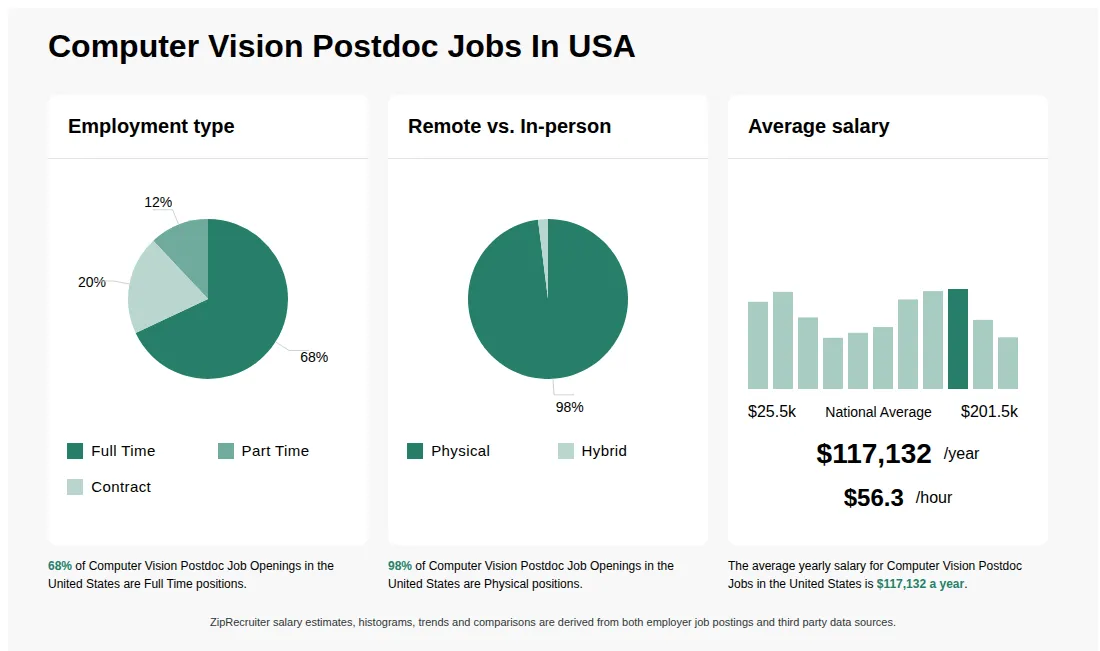
Computer Vision Postdoc information
See salary details
$25.5K - $41.5K
11% of jobs
$41.5K - $57.5K
12% of jobs
$62.5K is the 25th percentile. Wages below this are outliers.
$57.5K - $73.5K
9% of jobs
$73.5K - $89.5K
6% of jobs
$89.5K - $105.5K
6% of jobs
The median wage is $119.2K / yr.
$105.5K - $121.5K
7% of jobs
$121.5K - $137.5K
11% of jobs
$137.5K - $153.5K
12% of jobs
$155.7K is the 75th percentile. Wages above this are outliers.
$153.5K - $169.5K
12% of jobs
$169.5K - $185.5K
9% of jobs
$185.5K - $201.5K
6% of jobs
$25.5K
$117.1K
$201.5K
How much do computer vision postdoc jobs pay per year?
As of Sep 14, 2026, the average yearly pay for computer vision postdoc in the United States is $117,132.00, according to ZipRecruiter salary data. Most workers in this role earn between $63,000.00 and $160,000.00 per year, depending on experience, location, and employer.
What is a computer vision postdoc?
A Computer Vision Postdoc is a research-focused position typically held after completing a Ph.D. in computer vision, machine learning, or a related field. The role involves conducting advanced research, developing algorithms, publishing papers, and collaborating with academic or industry partners. Responsibilities may include working on deep learning models, image processing techniques, and real-world applications like autonomous driving or medical imaging. This position is usually temporary, lasting one to three years, and serves as a stepping stone to academic or industry research roles.
What are typical research activities and collaborations for a computer vision postdoc?
As a Computer Vision Postdoc, your day-to-day work often involves designing and running experiments, developing new algorithms, and publishing research findings in academic journals or at conferences. You will closely collaborate with a multidisciplinary team of faculty members, graduate students, and sometimes industry partners to solve complex visual perception problems. Many postdocs also mentor junior researchers and may participate in grant writing or lab meetings. This collaborative environment provides valuable opportunities for expanding your professional network and honing your research leadership skills.
What are the key skills and qualifications needed to thrive in a computer vision postdoc position?
A Computer Vision Postdoc typically requires a PhD in computer science, electrical engineering, or a related field, with strong expertise in machine learning, image processing, and algorithm development. Familiarity with programming languages such as Python or C++, and experience using frameworks like TensorFlow, PyTorch, or OpenCV is often essential. Strong analytical thinking, effective communication, and project management skills help distinguish successful candidates. Mastery of these skills enables impactful research, effective collaboration, and the ability to translate complex concepts into practical results.
More about Computer Vision Postdoc jobs
What cities are hiring for Computer Vision Postdoc jobs?
Cities with the most Computer Vision Postdoc job openings:
What are the most commonly searched types of Computer Vision Postdoc jobs?
The most popular types of Computer Vision Postdoc jobs are:
What states have the most Computer Vision Postdoc jobs?
States with the most job openings for Computer Vision Postdoc jobs include:
What are popular job titles related to Computer Vision Postdoc jobs?
For Computer Vision Postdoc jobs, the most frequently searched job titles are:
Postdoctoral Research Associate The University of Arizona
Tucson, AZ • On-site
VS-Postdoc
Other
Medical, Dental, Vision, Life, PTO
Posted 13 days ago
Key responsibilities
Collaborate with the research team to lead a study on the efficacy and refinement of an online emotional intelligence training program.
Oversee study coordination activities including subject recruitment, training research technicians, and managing research protocols.
Administer assessments related to emotional, personality, and psychophysiological measures, and analyze behavioral, neuroimaging, and psychophysiological data.
Job description
Postdoctoral Research Associate
#J-18808-LjbffrTucson, AZ
Type: Full-Time
Location: Tucson Campus
Address: Tucson, AZ USA
Position HighlightsThe College of Medicine Department of Psychiatry is now considering applications for a Post-Doctoral level associate. We are leading the effort to understand, diagnose, treat, and prevent psychiatric disorders, prepare future clinicians, provide state-of-the-art care, and give direction to community efforts to improve behavioral health. William "Scott" Killgore, PhD, is a Professor of Psychiatry, Psychology, and Neuroscience that joined the University of Arizona July 1, 2014. He brings an active research program from Harvard Medical School and McLean Hospital, including his Social, Cognitive, and Affective Neuroscience (SCAN) Laboratory. The Lab is devoted to the study of emotional intelligence, PTSD, mTBI, stress and related conditions. Dr. Killgore’s innovative work is funded by the Department of Defense, and recent research focuses on effects of prolonged sleep deprivation, chronic sleep restriction, and the use of stimulant countermeasures on the cognitive‑affective systems within the brain. A Postdoctoral Research Associate position is available within the Social, Cognitive, and Affective Neuroscience Laboratory directed by William "Scott" Killgore, PhD. https://scanlab.arizona.edu/ This position is focused on the area of emotional intelligence training and will work alongside Dr. Killgore to lead a study on the efficacy and refinement of an online emotional intelligence training program. The Postdoctoral Research Associate will work collaboratively with the Study Coordinator, Lab Manager, and Principal Investigator to play an integral role in all aspects of this research project.
Outstanding U of A benefits include health, dental, and vision insurance plans; life insurance and disability programs; paid vacation, sick leave, and holidays; U of A/ASU/NAU tuition reduction for the employee and qualified family members; retirement plans; access to U of A recreation and cultural activities; and more! The University of Arizona has been recognized for our innovative work‑life programs. Duties & Responsibilities- Write protocols, reports, and grants.
- Oversee overall study coordination including subject recruitment, research technician training and education.
- Administer emotional, personality, and psychophysiological assessments.
- Conduct statistical analysis of behavioral, psychophysiological, and neuroimaging data.
- Publish findings in peer‑reviewed journals, conference proceedings, and other venues.
- Travel and assist with aspects of the project that are conducted at remote sites, as necessary, and various other duties or projects as assigned.
- Technological knowledge base in graphic design, computer programming and/or user interface design.
- Skilled in developing web‑based intervention platforms.
- Background in computational methods used in neuroimaging (e.g., Matlab, UNIX, LINUX, C/C++, SPM, AFNI, Freesurfer, FSL, TrackVis, CONN).
- Exceptional skills in experimental design, quantitative methods, and statistical analysis, and the ability to carry out independent data manipulation and sophisticated statistical analyses using standard software packages (e.g., SPSS, R, STATA, BMDP, JMP, SAS).
Ph.D. in psychology, affective neuroscience, cognitive/social neuroscience, and/or other related field.
Preferred Qualifications- Background in studying emotional/social processes using psychophysiological (e.g., EEG, skin conductance, heart rate variability, biomarkers) or neuroimaging (e.g., fMRI, DTI, VBM, PET, connectivity) methods.
- Background in computational methods used in neuroimaging (e.g., Matlab, UNIX, LINUX, C/C++, SPM, AFNI, Freesurfer, FSL, TrackVis, CONN).
- Strong peer‑reviewed publication record in the area of emotional intelligence, social cognition, or affective neuroscience.
- History of work on projects relating to emotional intelligence, emotional/social cognition, and/or affective neuroscience.
- Demonstrated solid mastery of written English.
- Interest in sleep research.
- Experience in neuroimaging and/or psychophysiological data collection and analysis.
Exempt
Full Time/Part TimeFull Time
Number of Hours Worked per Week40
Job FTE1.0
Work CalendarFiscal
Job CategoryResearch
Benefits EligibleYes - Full Benefits
Rate of PayNIH salary guidelines, Depends on Experience
Compensation Typesalary at 1.0 full-time equivalency (FTE)
Type of criminal background check requiredName-based criminal background check (non-security sensitive)
Number of Vacancies1
Contact Information for CandidatesSarah Green | srgreen1@arizona.edu
Documents Needed to ApplyCurriculum Vitae (CV) and Cover Letter
The University of Arizona is a committed Equal Opportunity/Affirmative Action Institution. Women, minorities, veterans and individuals with disabilities are encouraged to apply.