
Be at least 21 years of age Hold a Commercial Pilot Certificate with Multi-Engine and Instrument Ratings English Proficiency Endorsement (EPE) on Airman Certificate Hold a current FAA First Class ...
Be at least 21 years of age Hold a Commercial Pilot Certificate with Multi-Engine and Instrument Ratings English Proficiency Endorsement (EPE) on Airman Certificate Hold a current FAA First Class ...
First Officer Pilot
Tacoma, WA · On-site
Be at least 21 years of age Hold a Commercial Pilot Certificate with Multi-Engine and Instrument Ratings English Proficiency Endorsement (EPE) on Airman Certificate Hold a current FAA First Class ...
First Officer Pilot
Tacoma, WA · On-site
Be at least 21 years of age Hold a Commercial Pilot Certificate with Multi-Engine and Instrument Ratings English Proficiency Endorsement (EPE) on Airman Certificate Hold a current FAA First Class ...
First Officer Pilot
Salt Lake City, UT · On-site
Be at least 21 years of age Hold a Commercial Pilot Certificate with Multi-Engine and Instrument Ratings English Proficiency Endorsement (EPE) on Airman Certificate Hold a current FAA First Class ...
First Officer Pilot
Salt Lake City, UT · On-site
Be at least 21 years of age Hold a Commercial Pilot Certificate with Multi-Engine and Instrument Ratings English Proficiency Endorsement (EPE) on Airman Certificate Hold a current FAA First Class ...
Minimum of 1,000 hours Total Time, 500 hours of multi-engine time, Commercial Multi-engine Land, Previous Commercial Pilot Experience Preferred, MEI Highly Preferred. Must Be Current and Proficient ...
Minimum of 1,000 hours Total Time, 500 hours of multi-engine time, Commercial Multi-engine Land, Previous Commercial Pilot Experience Preferred, MEI Highly Preferred. Must Be Current and Proficient ...

Other certificates that meet or exceed the requirements of the Commercial Pilot Certificate are also acceptable, e.g., an Airline Transport Pilot Certificate. Minimum Eligibility Requirements Minimum ...
Other certificates that meet or exceed the requirements of the Commercial Pilot Certificate are also acceptable, e.g., an Airline Transport Pilot Certificate. Minimum Eligibility Requirements Minimum ...
FAA Part 91 (Non-Commercial) Employment Type: Full-Time Location: Pittsburgh, PA; extensive travel ... Serve as Pilot in Command (PIC) or Second in Command (SIC) on Cessna Citation Sovereign aircraft ...
FAA Part 91 (Non-Commercial) Employment Type: Full-Time Location: Pittsburgh, PA; extensive travel ... Serve as Pilot in Command (PIC) or Second in Command (SIC) on Cessna Citation Sovereign aircraft ...
Be at least 21 years of age Hold a Commercial Pilot Certificate with Multi-Engine and Instrument Ratings English Proficiency Endorsement (EPE) on Airman Certificate Hold a current FAA First Class ...
Be at least 21 years of age Hold a Commercial Pilot Certificate with Multi-Engine and Instrument Ratings English Proficiency Endorsement (EPE) on Airman Certificate Hold a current FAA First Class ...
First Officer Pilot
Phoenix, AZ · On-site
Be at least 21 years of age Hold a Commercial Pilot Certificate with Multi-Engine and Instrument Ratings English Proficiency Endorsement (EPE) on Airman Certificate Hold a current FAA First Class ...
First Officer Pilot
Phoenix, AZ · On-site
Be at least 21 years of age Hold a Commercial Pilot Certificate with Multi-Engine and Instrument Ratings English Proficiency Endorsement (EPE) on Airman Certificate Hold a current FAA First Class ...
Be at least 21 years of age Hold a Commercial Pilot Certificate with Multi-Engine and Instrument Ratings English Proficiency Endorsement (EPE) on Airman Certificate Hold a current FAA First Class ...
Be at least 21 years of age Hold a Commercial Pilot Certificate with Multi-Engine and Instrument Ratings English Proficiency Endorsement (EPE) on Airman Certificate Hold a current FAA First Class ...
First Officer Pilot
Denver, CO · On-site
Be at least 21 years of age Hold a Commercial Pilot Certificate with Multi-Engine and Instrument Ratings English Proficiency Endorsement (EPE) on Airman Certificate Hold a current FAA First Class ...
First Officer Pilot
Denver, CO · On-site
Be at least 21 years of age Hold a Commercial Pilot Certificate with Multi-Engine and Instrument Ratings English Proficiency Endorsement (EPE) on Airman Certificate Hold a current FAA First Class ...
Be at least 21 years of age Hold a Commercial Pilot Certificate with Multi-Engine and Instrument Ratings English Proficiency Endorsement (EPE) on Airman Certificate Hold a current FAA First Class ...
Be at least 21 years of age Hold a Commercial Pilot Certificate with Multi-Engine and Instrument Ratings English Proficiency Endorsement (EPE) on Airman Certificate Hold a current FAA First Class ...
First Officer Pilot
San Francisco, CA · On-site
Be at least 21 years of age Hold a Commercial Pilot Certificate with Multi-Engine and Instrument Ratings English Proficiency Endorsement (EPE) on Airman Certificate Hold a current FAA First Class ...
First Officer Pilot
San Francisco, CA · On-site
Be at least 21 years of age Hold a Commercial Pilot Certificate with Multi-Engine and Instrument Ratings English Proficiency Endorsement (EPE) on Airman Certificate Hold a current FAA First Class ...
First Officer Pilot
Portland, OR · On-site
Be at least 21 years of age Hold a Commercial Pilot Certificate with Multi-Engine and Instrument Ratings English Proficiency Endorsement (EPE) on Airman Certificate Hold a current FAA First Class ...
First Officer Pilot
Portland, OR · On-site
Be at least 21 years of age Hold a Commercial Pilot Certificate with Multi-Engine and Instrument Ratings English Proficiency Endorsement (EPE) on Airman Certificate Hold a current FAA First Class ...

NASA Research Pilot -- High-Impact Flight Ops & Generous PTO (Edwards Air Force Base)
Edwards, CA · On-site
$170K - $190K/yr
The role requires a Bachelor's degree and an FAA commercial pilot license with a minimum of 1,500 hours as pilot in command. Candidates must demonstrate aeronautical proficiency and pass relevant ...
NASA Research Pilot -- High-Impact Flight Ops & Generous PTO (Edwards Air Force Base)
Edwards, CA · On-site
$170K - $190K/yr
The role requires a Bachelor's degree and an FAA commercial pilot license with a minimum of 1,500 hours as pilot in command. Candidates must demonstrate aeronautical proficiency and pass relevant ...
FAA Part 91 (Non-Commercial) Employment Type: Full-Time Location: Pittsburgh, PA; extensive travel ... Serve as Pilot in Command (PIC) or Second in Command (SIC) on Cessna Citation Sovereign aircraft ...
FAA Part 91 (Non-Commercial) Employment Type: Full-Time Location: Pittsburgh, PA; extensive travel ... Serve as Pilot in Command (PIC) or Second in Command (SIC) on Cessna Citation Sovereign aircraft ...
Be at least 21 years of age Hold a Commercial Pilot Certificate with Multi-Engine and Instrument Ratings English Proficiency Endorsement (EPE) on Airman Certificate Hold a current FAA First Class ...
Be at least 21 years of age Hold a Commercial Pilot Certificate with Multi-Engine and Instrument Ratings English Proficiency Endorsement (EPE) on Airman Certificate Hold a current FAA First Class ...
First Officer Pilot
Houston, TX · On-site
Be at least 21 years of age Hold a Commercial Pilot Certificate with Multi-Engine and Instrument Ratings English Proficiency Endorsement (EPE) on Airman Certificate Hold a current FAA First Class ...
First Officer Pilot
Houston, TX · On-site
Be at least 21 years of age Hold a Commercial Pilot Certificate with Multi-Engine and Instrument Ratings English Proficiency Endorsement (EPE) on Airman Certificate Hold a current FAA First Class ...

Offshore Helicopter Pilot -- 5x2 Schedule (New Iberia)
New Iberia, LA · On-site
$69K - $86K/yr
Candidates must hold a 1st class medical and an FAA Commercial Pilot Certificate with Helicopter Instrument rating, plus substantial offshore flight hours. Strong communication and teamwork are ...
Offshore Helicopter Pilot -- 5x2 Schedule (New Iberia)
New Iberia, LA · On-site
$69K - $86K/yr
Candidates must hold a 1st class medical and an FAA Commercial Pilot Certificate with Helicopter Instrument rating, plus substantial offshore flight hours. Strong communication and teamwork are ...

Test Pilot Flight Instructor
Patuxent River, MD · On-site +1
$143K - $197K/yr
Candidates must possess a current Commercial Pilot Certificate or the appropriate military rating; both meet the intent of the requirement. If an agency decides, for example, not to accept the ...
Test Pilot Flight Instructor
Patuxent River, MD · On-site +1
$143K - $197K/yr
Candidates must possess a current Commercial Pilot Certificate or the appropriate military rating; both meet the intent of the requirement. If an agency decides, for example, not to accept the ...

We do collect resumes to have on hand if a position comes open. • Must possess an FAA commercial pilot certificate with a.
We do collect resumes to have on hand if a position comes open. • Must possess an FAA commercial pilot certificate with a.
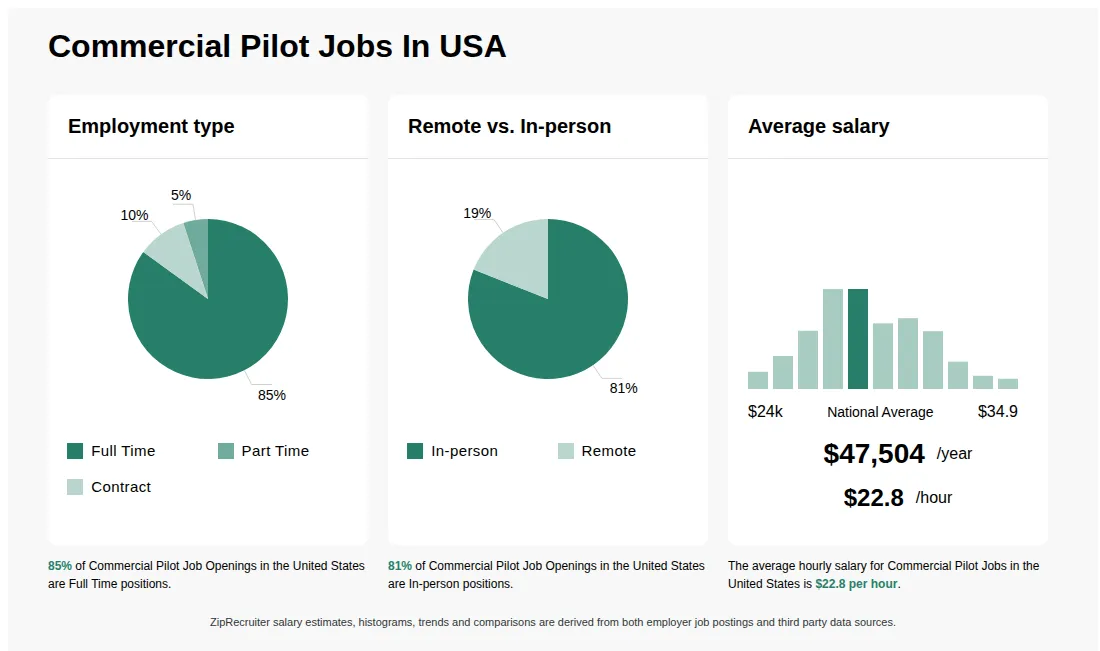
Commercial Pilot information
See salary details
$11.54 - $13.66
3% of jobs
$13.66 - $15.78
5% of jobs
$15.78 - $17.90
11% of jobs
$18.55 is the 25th percentile. Wages below this are outliers.
$17.90 - $20.02
19% of jobs
The median wage is $21.31 / hr.
$20.02 - $22.14
19% of jobs
$22.14 - $24.26
12% of jobs
$25.23 is the 75th percentile. Wages above this are outliers.
$24.26 - $26.38
13% of jobs
$26.38 - $28.50
11% of jobs
$28.50 - $30.62
4% of jobs
$30.62 - $32.74
2% of jobs
$32.74 - $34.86
1% of jobs
$11
$22
$34
How much do commercial pilot jobs pay per hour?
As of Sep 7, 2026, the average hourly pay for commercial pilot in the United States is $22.84, according to ZipRecruiter salary data. Most workers in this role earn between $18.51 and $26.20 per hour, depending on experience, location, and employer.
What is a commercial pilot?
Commercial pilots are licensed professionals who are authorized to operate aircraft for compensation or hire. They typically fly passenger airlines, cargo planes, charter flights, or perform aerial tasks such as crop dusting, aerial photography, and rescue operations. Unlike private pilots, commercial pilots must meet higher training standards, pass rigorous exams, and hold a commercial pilot license issued by aviation authorities. Their responsibilities include ensuring passenger safety, conducting pre-flight checks, navigating flights, and managing emergency situations. Commercial pilots often work for airlines, corporations, or specialized aviation companies.
What does a commercial pilot do?
The duties of a commercial pilot involve flying an airplane or helicopter for commercial purposes. Your responsibilities in this career may involve operating aircraft flights that carry passengers or cargo. As a commercial pilot, you can work for a commercial airline, a charter service, or another type of company that offers commercial airplane services. You are responsible for ensuring the plane is safe, fueled, and supplied before takeoff. You must also submit a flight plan and ensure you have the proper clearance.
What are the key skills and qualifications needed to thrive as a commercial pilot, and why are they important?
To thrive as a Commercial Pilot, you need a commercial pilot license, strong flight training, and in-depth knowledge of aviation regulations and navigation. Familiarity with advanced avionics systems, flight management software, and simulator training is essential. Excellent decision-making, communication, and situational awareness set outstanding pilots apart. These competencies ensure passenger safety, regulatory compliance, and effective management of challenging flight conditions.
What are some common challenges commercial pilots face during irregular schedules and how can they manage them?
Commercial pilots often deal with irregular schedules, including overnight flights and frequent time zone changes, which can disrupt sleep patterns and personal routines. Managing fatigue, staying alert, and maintaining a healthy work-life balance are essential for success in this role. Pilots use strategies like adhering to regulated rest periods, practicing good sleep hygiene, and leveraging support from their crewmates to mitigate these challenges. Airlines also provide resources and training to help pilots adapt to demanding schedules and ensure safety and well-being.
What is the difference between Commercial Pilot vs Private Pilot?
| Aspect | Commercial Pilot | Private Pilot |
|---|---|---|
| Certifications | Commercial Pilot Certificate | Private Pilot Certificate |
| Work Environment | Paid flights, charter services, aerial work | Personal flying, recreational use |
| Employer & Industry | Airlines, charter companies, aerial services | Individuals, hobbyists, personal travel |
| Flight Hours Required | 250 hours minimum | 40 hours minimum |
The main difference between a Commercial Pilot and a Private Pilot lies in their certifications, work environment, and flight hours. Commercial Pilots are licensed to be paid for flying and often work in professional settings like charter services or aerial work. Private Pilots fly primarily for personal or recreational purposes and cannot be paid for their flights. The certification requirements also differ, with Commercial Pilots needing more flight hours and advanced training.
How much money do commercial pilots make?
Commercial pilots typically earn a median annual salary of around $100,000, but this can vary based on experience, airline, and flight hours. Pilots with more seniority or specialized certifications can earn significantly higher wages, often exceeding $200,000 annually in some cases.
Is there a demand for commercial pilots?
The demand for commercial pilots remains strong due to growth in air travel and the need for experienced pilots in passenger and cargo airlines. Factors such as industry expansion, retirements, and the requirement for FAA certification contribute to ongoing job opportunities for qualified commercial pilots. However, competition can be high, and pilots typically need significant flight hours and training to qualify for employment.
More about Commercial Pilot jobs
What cities are hiring for Commercial Pilot jobs?
Cities with the most Commercial Pilot job openings:
What are the most commonly searched types of Commercial Pilot jobs?
The most popular types of Commercial Pilot jobs are:
Who are the top companies hiring for Commercial Pilot jobs?
The top employers for Commercial Pilot jobs are:
What states have the most Commercial Pilot jobs?
States with the most job openings for Commercial Pilot jobs include:
What job categories do people searching Commercial Pilot jobs look for?
The top searched job categories for Commercial Pilot jobs are:
What are popular job titles related to Commercial Pilot jobs?
For Commercial Pilot jobs, the most frequently searched job titles are:
SkyWest Airlines rating

7.1
Based on 80 frontline employees who took The Breakroom Quiz
14th of 26 rated airlines
Job description
Primary Job Duties
To be considered for a pilot position, you must:
Be at least 21 years of age
Hold a Commercial Pilot Certificate with Multi-Engine and Instrument Ratings
English Proficiency Endorsement (EPE) on Airman Certificate
Hold a current FAA First Class Medical Certificate
Be a U.S. citizen or able to show proof of right to work in the U.S.
Hold FCC Radiotelephone Operator's Permit.
Have a current Passport --or other travel documents enabling the bearer to freely exit and re-enter the U.S. (multiple reentry status) and be legally eligible to work in the U.S. (possess proper working documents).
Must be available to work on any day, seven days a week, including nights, weekends and holidays.
Be within three months of the minimum hour requirements detailed below
ATP Written Requirement:
SkyWest will provide the means to complete a SkyWest-approved CTP course for those who complete an application and successfully pass the pilot interview.
Pilot applicants must meet the experience requirements of FAR 61.159 prior to employment.
SkyWest Minimum Requirements When Counting Helicopter or Glider Time
SkyWest Airlines recognizes the skills common to helicopter and glider flying. SkyWest will accept helo/glider time as part of an applicant's total time as long as they have a minimum of 250 PIC hours of fixed wing.
Domiciles
Arizona: Phoenix, Tucson
California: Fresno, Los Angeles, Palm Springs, San Diego, San Francisco
Colorado: Colorado Springs, Denver
Georgia: Atlanta
Idaho: Boise
Illinois: Chicago
Minnesota: Minneapolis/St. Paul
Michigan: Detroit
Oregon: Portland
Texas: Austin, Dallas, Houston
Utah: Salt Lake City
Washington: Seattle
Wisconsin: Milwaukee
Minimum Requirements
- Assist the Pilot- in- Command (PIC) in conducting the flight safely and efficiently
- Assist the PIC and/or passenger service personnel as needed to ensure a prompt departure
- Assist or relieve the PIC in manipulation of the flight controls of an aircraft while underway, including taxiing, takeoff and landing of such aircraft
Physical and Other Requirements
- Must have a First Class Medical
- Must be willing to fly assigned schedule based on pilot bidding seniority; including days, nights, weekends, and holidays
- To apply, please complete the on-line application (qualified applicants will be contacted)
To be considered for a pilot position, you must:
Be at least 21 years of age
Hold a Commercial Pilot Certificate with Multi-Engine and Instrument Ratings
English Proficiency Endorsement (EPE) on Airman Certificate
Hold a current FAA First Class Medical Certificate
Be a U.S. citizen or able to show proof of right to work in the U.S.
Hold FCC Radiotelephone Operator's Permit.
Have a current Passport --or other travel documents enabling the bearer to freely exit and re-enter the U.S. (multiple reentry status) and be legally eligible to work in the U.S. (possess proper working documents).
Must be available to work on any day, seven days a week, including nights, weekends and holidays.
Be within three months of the minimum hour requirements detailed below
ATP Written Requirement:
SkyWest will provide the means to complete a SkyWest-approved CTP course for those who complete an application and successfully pass the pilot interview.
Pilot applicants must meet the experience requirements of FAR 61.159 prior to employment.
SkyWest Minimum Requirements When Counting Helicopter or Glider Time
SkyWest Airlines recognizes the skills common to helicopter and glider flying. SkyWest will accept helo/glider time as part of an applicant's total time as long as they have a minimum of 250 PIC hours of fixed wing.
Domiciles
Arizona: Phoenix, Tucson
California: Fresno, Los Angeles, Palm Springs, San Diego, San Francisco
Colorado: Colorado Springs, Denver
Georgia: Atlanta
Idaho: Boise
Illinois: Chicago
Minnesota: Minneapolis/St. Paul
Michigan: Detroit
Oregon: Portland
Texas: Austin, Dallas, Houston
Utah: Salt Lake City
Washington: Seattle
Wisconsin: Milwaukee
Education:UNAVAILABLEEmployment Type: FULL_TIMEWhat SkyWest Airlines employees say
Pay
Benefits
Hours and flexibility
Workplace
Get the full story on Breakroom

About Skywest Airlines
Sourced by ZipRecruiter
Industry
Aviation
Company size
10,000+ Employees
Headquarters location
Saint George, UT, US