NACE Coating Inspector
Houston, TX · On-site
POSITION SUMMARY CANEIL is seeking NACE/AMPP Coating Inspectors for an upcoming pipeline atmospheric coating inspection program throughout the United States. Work will be concentrated primarily in ...
Houston, TX · On-site
POSITION SUMMARY CANEIL is seeking NACE/AMPP Coating Inspectors for an upcoming pipeline atmospheric coating inspection program throughout the United States. Work will be concentrated primarily in ...
Houston, TX · On-site
POSITION SUMMARY CANEIL is seeking NACE/AMPP Coating Inspectors for an upcoming pipeline atmospheric coating inspection program throughout the United States. Work will be concentrated primarily in ...
Hays, KS · On-site
Coating Inspector Job Grade: 15 FLSA Status: Non-Exempt Reports To: QMS Manager Appraisal Type: Employee Job Purpose: The Coating Inspector is responsible for coating and painting preparation, in ...
Quick apply
Hays, KS · On-site
Coating Inspector Job Grade: 15 FLSA Status: Non-Exempt Reports To: QMS Manager Appraisal Type: Employee Job Purpose: The Coating Inspector is responsible for coating and painting preparation, in ...
$25 - $40/hr
We are looking for a skilled and motivated Coating Inspector to join our team. In this role, you will be responsible for ensuring the quality and integrity of coatings applied on construction ...
$25 - $40/hr
We are looking for a skilled and motivated Coating Inspector to join our team. In this role, you will be responsible for ensuring the quality and integrity of coatings applied on construction ...
Gainesville, GA · On-site
The NACE Coating Inspector monitors and inspects the coating process and provides documentation of the work. This individual has the overall responsibility for performing, and the documentation of ...
Gainesville, GA · On-site
The NACE Coating Inspector monitors and inspects the coating process and provides documentation of the work. This individual has the overall responsibility for performing, and the documentation of ...
Gainesville, GA · On-site
The NACE Coating Inspector monitors and inspects the coating process and provides documentation of the work. This individual has the overall responsibility for performing, and the documentation of ...
Gainesville, GA · On-site
The NACE Coating Inspector monitors and inspects the coating process and provides documentation of the work. This individual has the overall responsibility for performing, and the documentation of ...
New York, NY · On-site
$35/hr
We are looking for a skilled and motivated Coating Inspector to join our team. In this role, you will be responsible for ensuring the quality and integrity of coatings applied on construction ...
New York, NY · On-site
$35/hr
We are looking for a skilled and motivated Coating Inspector to join our team. In this role, you will be responsible for ensuring the quality and integrity of coatings applied on construction ...
Hays, KS · On-site
Coating Inspector Job Grade: 15 FLSA Status: Non-Exempt Reports To: QMS Manager Appraisal Type: Employee Job Purpose: The Coating Inspector is responsible for coating and painting preparation, in ...
Hays, KS · On-site
Coating Inspector Job Grade: 15 FLSA Status: Non-Exempt Reports To: QMS Manager Appraisal Type: Employee Job Purpose: The Coating Inspector is responsible for coating and painting preparation, in ...
Hays, KS · On-site
Coating Inspector Job Grade: 15 FLSA Status: Non-Exempt Reports To: QMS Manager Appraisal Type: Employee Job Purpose: The Coating Inspector is responsible for coating and painting preparation, in ...
Hays, KS · On-site
Coating Inspector Job Grade: 15 FLSA Status: Non-Exempt Reports To: QMS Manager Appraisal Type: Employee Job Purpose: The Coating Inspector is responsible for coating and painting preparation, in ...
Coating Inspector (as needed) ID: 175CI Department: CI Location: Northeast, Southeast, Mid-West USA Description HRV Conformance Verification Associates, Inc. supplies a highly integrated series of ...
Coating Inspector (as needed) ID: 175CI Department: CI Location: Northeast, Southeast, Mid-West USA Description HRV Conformance Verification Associates, Inc. supplies a highly integrated series of ...
Saint Albans, NY · On-site
$25 - $40/hr
We are looking for a skilled and motivated Coating Inspector to join our team. In this role, you will be responsible for ensuring the quality and integrity of coatings applied on construction ...
Quick apply
Saint Albans, NY · On-site
$25 - $40/hr
We are looking for a skilled and motivated Coating Inspector to join our team. In this role, you will be responsible for ensuring the quality and integrity of coatings applied on construction ...
Houston, TX · On-site
The Coating Inspectors shall possess knowledge and skills relating to the application of protective coatings to pipelines, fabricated piping, and storage tanks. The inspector should be familiar with ...
Houston, TX · On-site
The Coating Inspectors shall possess knowledge and skills relating to the application of protective coatings to pipelines, fabricated piping, and storage tanks. The inspector should be familiar with ...
Coating Inspector (as needed) ID: 175CI Department: CI Location: Northeast, Southeast, Mid-West USA Description HRV Conformance Verification Associates, Inc. supplies a highly integrated series of ...
Coating Inspector (as needed) ID: 175CI Department: CI Location: Northeast, Southeast, Mid-West USA Description HRV Conformance Verification Associates, Inc. supplies a highly integrated series of ...
Middletown, PA · On-site
Job Title: Sr. Coating Inspector Location: Middletown, PA (Surrounding Areas) Duration: 03/01/2024-12/31/2024 The Sr. Coating Inspector is responsible for the completion of all activities in his area ...
Middletown, PA · On-site
Job Title: Sr. Coating Inspector Location: Middletown, PA (Surrounding Areas) Duration: 03/01/2024-12/31/2024 The Sr. Coating Inspector is responsible for the completion of all activities in his area ...
Houston, TX · On-site
The Coating Inspectors shall possess knowledge and skills relating to the application of protective coatings to pipelines, fabricated piping, and storage tanks. The inspector should be familiar with ...
Quick apply
Houston, TX · On-site
The Coating Inspectors shall possess knowledge and skills relating to the application of protective coatings to pipelines, fabricated piping, and storage tanks. The inspector should be familiar with ...
Houston, TX · On-site
The Coating Inspectors shall possess knowledge and skills relating to the application of protective coatings to pipelines, fabricated piping, and storage tanks. The inspector should be familiar with ...
Houston, TX · On-site
The Coating Inspectors shall possess knowledge and skills relating to the application of protective coatings to pipelines, fabricated piping, and storage tanks. The inspector should be familiar with ...
Middletown, PA · On-site
Job Title: Sr. Coating Inspector Location: Middletown, PA (Surrounding Areas) Duration: 03/01/2024-12/31/2024 • The Sr. Coating Inspector is responsible for the completion of all activities in his ...
Middletown, PA · On-site
Job Title: Sr. Coating Inspector Location: Middletown, PA (Surrounding Areas) Duration: 03/01/2024-12/31/2024 • The Sr. Coating Inspector is responsible for the completion of all activities in his ...
Palatka, FL · On-site
$65 - $85/hr
Perform coating inspections in accordance with AMPP/NACE standards and project specifications * Conduct surface preparation assessments including blast profile, cleanliness, and environmental ...
Palatka, FL · On-site
$65 - $85/hr
Perform coating inspections in accordance with AMPP/NACE standards and project specifications * Conduct surface preparation assessments including blast profile, cleanliness, and environmental ...
Job Title: Sr. Coating Inspector Location: Superior, WI Duration: 05/20/2024-11/19/2024 • The Sr. Coating Inspector is responsible for the completion of all activities in his area of assignment in ...
Job Title: Sr. Coating Inspector Location: Superior, WI Duration: 05/20/2024-11/19/2024 • The Sr. Coating Inspector is responsible for the completion of all activities in his area of assignment in ...
Job Title: Sr. Coating Inspector Location: Superior, WI Duration: 05/20/2024-11/19/2024 The Sr. Coating Inspector is responsible for the completion of all activities in his area of assignment in ...
Job Title: Sr. Coating Inspector Location: Superior, WI Duration: 05/20/2024-11/19/2024 The Sr. Coating Inspector is responsible for the completion of all activities in his area of assignment in ...
Rancho Cucamonga, CA · On-site
$30 - $48/hr
This Opportunity A NACE (AMPP) Level 2 Coating Inspector (L2) reports directly to the Inspection Manager or a designated Senior Inspector. The L2 is expected to maintain and deepen relationships with ...
Quick apply
Rancho Cucamonga, CA · On-site
$30 - $48/hr
This Opportunity A NACE (AMPP) Level 2 Coating Inspector (L2) reports directly to the Inspection Manager or a designated Senior Inspector. The L2 is expected to maintain and deepen relationships with ...
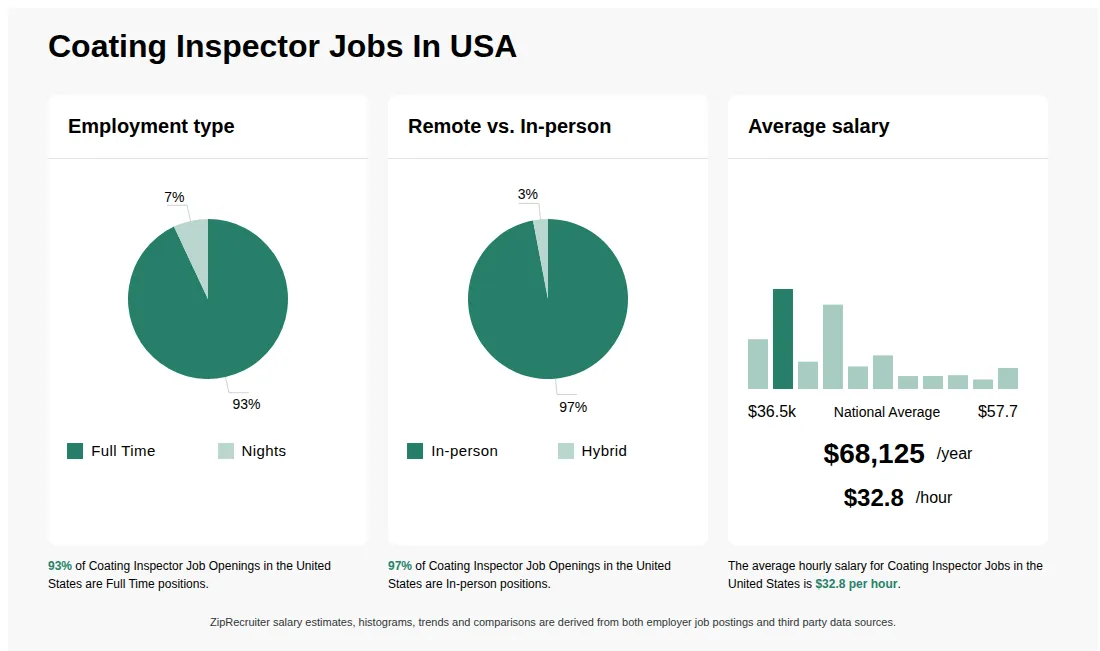
$17.55 - $21.20
13% of jobs
$22.88 is the 25th percentile. Wages below this are outliers.
$21.20 - $24.85
27% of jobs
$24.85 - $28.50
7% of jobs
The median wage is $29.02 / hr.
$28.50 - $32.15
22% of jobs
$32.15 - $35.80
5% of jobs
$36.02 is the 75th percentile. Wages above this are outliers.
$35.80 - $39.44
9% of jobs
$39.44 - $43.09
3% of jobs
$43.09 - $46.74
3% of jobs
$46.74 - $50.39
3% of jobs
$50.39 - $54.04
2% of jobs
$54.04 - $57.69
5% of jobs
$17
$32
$57
A coating inspector checks industrial equipment to ensure protective coatings were correctly applied and minimize corrosion risk. They go through rigorous training to learn how to identify problems in coating applications and to suggest which types of coatings will protect the materials from corroding. Manufacturing plants, roadway projects such as bridges, and other major industries that utilize paint need coating inspectors for quality assurance.
| Aspect | Coating Inspector | NDT Technician |
|---|---|---|
| Certifications | SSPC, NACE, AWS certifications | ASNT, NAS-410 certifications |
| Work Environment | Industrial sites, construction, offshore | Manufacturing, aerospace, oil & gas |
| Job Focus | Surface preparation, coating application, inspection | Material testing, flaw detection, non-destructive testing |
| Industry Usage | Construction, maintenance, industrial coating projects | Manufacturing, aerospace, power generation |
While both roles involve inspection and testing, a Coating Inspector specializes in surface coatings, ensuring proper application and quality, whereas an NDT Technician focuses on non-destructive testing methods to detect flaws in materials. Both roles require specific certifications and are vital in industrial and construction sectors, but they serve different inspection purposes.
Cities with the most Coating Inspector job openings:
The most popular types of Coating Inspector jobs are:
The top employers for Coating Inspector jobs are:
States with the most job openings for Coating Inspector jobs include:
The top searched job categories for Coating Inspector jobs are:
For Coating Inspector jobs, the most frequently searched job titles are:
Other
Posted 26 days ago
ABOUT CANEIL
CANEIL is an engineering and asset integrity company supporting clients throughout North America. We provide inspection, integrity management, engineering, and technical services for pipelines, facilities, and other critical infrastructure.
POSITION SUMMARY
CANEIL is seeking NACE/AMPP Coating Inspectors for an upcoming pipeline atmospheric coating inspection program throughout the United States. Work will be concentrated primarily in the southern and central states, with regular travel required between pipeline and field inspection locations.
This is a contract position with a minimum anticipated duration of approximately 12 weeks. The expected schedule is approximately six days per week and 10 hours per day, although actual hours may vary based on client requirements, weather, inspection locations, and field conditions.
Applicants holding a current NACE/AMPP Coating Inspector Program Level 1, Level 2, or Level 3 certification are encouraged to apply.
The successful candidate will perform atmospheric coating and corrosion condition inspections at various pipeline locations, including above-ground assets, exposed pipeline sections, and active excavation or integrity dig sites. The inspector will document conditions, collect field measurements, enter inspection information into the client’s data-management system, assign condition rankings, and assist in determining repair requirements and priorities.
KEY RESPONSIBILITIES
REQUIRED QUALIFICATIONS
PREFERRED QUALIFICATIONS
TOOLS AND EQUIPMENT
COMPENSATION AND TRAVEL
WHY JOIN CANEIL
HOW TO APPLY
Interested candidates are encouraged to apply through LinkedIn with an updated resume outlining their NACE/AMPP certification level, coating inspection experience, pipeline or oil and gas experience, UT qualifications, travel availability, and anticipated availability to begin work.
Please also indicate whether you have access to a reliable personal vehicle and the basic inspection equipment required for the assignment.


