Eastman Chemical Company is seeking a recent 2026 or upcoming 2027 PhD graduate in Chemical Engineering with emphasis on Paper and Pulp science. This role is based in Kingsport, Tennessee and will ...
Eastman Chemical Company is seeking a recent 2026 or upcoming 2027 PhD graduate in Chemical Engineering with emphasis on Paper and Pulp science. This role is based in Kingsport, Tennessee and will ...

Technical and Engineering Graduate Roles Description - The following posting is a pipeline ... Chemical Engineer: * Skills Areas: Statistics, and data analysis. Autocad, Ability to understand ...
Technical and Engineering Graduate Roles Description - The following posting is a pipeline ... Chemical Engineer: * Skills Areas: Statistics, and data analysis. Autocad, Ability to understand ...

Research Associate, McKetta Department of Chemical Engineering, Cockrell School of Engineering
Austin, TX · On-site
With 11 undergraduate and 13 graduate programs, over 20 research centers and a faculty community ... Ph.D. in Chemical Engineering, Environmental Engineering, or closely related discipline.
Research Associate, McKetta Department of Chemical Engineering, Cockrell School of Engineering
Austin, TX · On-site
With 11 undergraduate and 13 graduate programs, over 20 research centers and a faculty community ... Ph.D. in Chemical Engineering, Environmental Engineering, or closely related discipline.
The McKetta Department of Chemical Engineering's undergraduate and graduate programs are both top-10 ranked programs in the nation according to U.S. News & World Report. The department leads ...
The McKetta Department of Chemical Engineering's undergraduate and graduate programs are both top-10 ranked programs in the nation according to U.S. News & World Report. The department leads ...
The McKetta Department of Chemical Engineering's undergraduate and graduate programs are both top-10 ranked programs in the nation according to U.S. News & World Report. The department leads ...
The McKetta Department of Chemical Engineering's undergraduate and graduate programs are both top-10 ranked programs in the nation according to U.S. News & World Report. The department leads ...
The McKetta Department of Chemical Engineering's undergraduate and graduate programs are both top-10 ranked programs in the nation according to U.S. News & World Report. The department leads ...
The McKetta Department of Chemical Engineering's undergraduate and graduate programs are both top-10 ranked programs in the nation according to U.S. News & World Report. The department leads ...

2027 Graduate - Chemist/Chemical Engineer - Applied Chemistry and Physics
Laurel, MD · On-site
$85 - $165/hr
Description Do you want to become an expert in chemistry or chemical engineering? Are you passionate about tackling tough problems to provide real-world impact and drive the future? If you are ...
2027 Graduate - Chemist/Chemical Engineer - Applied Chemistry and Physics
Laurel, MD · On-site
$85 - $165/hr
Description Do you want to become an expert in chemistry or chemical engineering? Are you passionate about tackling tough problems to provide real-world impact and drive the future? If you are ...

Description Do you want to become an expert in chemistry or chemical engineering? Are you passionate about tackling tough problems to provide real-world impact and drive the future? If you are ...
Description Do you want to become an expert in chemistry or chemical engineering? Are you passionate about tackling tough problems to provide real-world impact and drive the future? If you are ...

... the Department of Chemical Engineering. There are two projects available for the selected ... and to mentor graduate students within the Karim and Epling groups. Job Responsibilities
... the Department of Chemical Engineering. There are two projects available for the selected ... and to mentor graduate students within the Karim and Epling groups. Job Responsibilities
Industrial Hygienist / Chemical Engineer (Interdisciplinary)
Bremerton, WA · On-site +1
$45K - $73K/yr
... Chemical Engineer, assisting with conducting surveys or interviews to evaluate health hazards in ... A bachelor's or graduate/higher level degree in industrial hygiene, occupational health sciences ...
Industrial Hygienist / Chemical Engineer (Interdisciplinary)
Bremerton, WA · On-site +1
$45K - $73K/yr
... Chemical Engineer, assisting with conducting surveys or interviews to evaluate health hazards in ... A bachelor's or graduate/higher level degree in industrial hygiene, occupational health sciences ...

... Chemical Engineer, assisting with conducting surveys or interviews to evaluate health hazards in ... A bachelor's or graduate/higher level degree in industrial hygiene, occupational health sciences ...
... Chemical Engineer, assisting with conducting surveys or interviews to evaluate health hazards in ... A bachelor's or graduate/higher level degree in industrial hygiene, occupational health sciences ...

Chemical Engineering Intern
$16 - $20.75/hr
Whether you are a recent graduate or a seasoned professional, we offer a diverse range of ... Monument Chemical Houston is seeking qualified candidates to fill our Chemical Engineering ...
Chemical Engineering Intern
$16 - $20.75/hr
Whether you are a recent graduate or a seasoned professional, we offer a diverse range of ... Monument Chemical Houston is seeking qualified candidates to fill our Chemical Engineering ...
Chemical Engineering Intern
Houston, TX · On-site
$16 - $20.75/hr
Whether you are a recent graduate or a seasoned professional, we offer a diverse range of ... Monument Chemical Houston is seeking qualified candidates to fill our Chemical Engineering ...
Chemical Engineering Intern
Houston, TX · On-site
$16 - $20.75/hr
Whether you are a recent graduate or a seasoned professional, we offer a diverse range of ... Monument Chemical Houston is seeking qualified candidates to fill our Chemical Engineering ...
Chemical Engineering Intern
Pasadena, TX · On-site
$15.25 - $19.75/hr
Whether you are a recent graduate or a seasoned professional, we offer a diverse range of ... Monument Chemical Houston is seeking qualified candidates to fill our Chemical Engineering ...
Chemical Engineering Intern
Pasadena, TX · On-site
$15.25 - $19.75/hr
Whether you are a recent graduate or a seasoned professional, we offer a diverse range of ... Monument Chemical Houston is seeking qualified candidates to fill our Chemical Engineering ...
Chemical Engineering Intern
$15.25 - $19.75/hr
Whether you are a recent graduate or a seasoned professional, we offer a diverse range of ... Monument Chemical Houston is seeking qualified candidates to fill our Chemical Engineering ...
Chemical Engineering Intern
$15.25 - $19.75/hr
Whether you are a recent graduate or a seasoned professional, we offer a diverse range of ... Monument Chemical Houston is seeking qualified candidates to fill our Chemical Engineering ...

... Chemical Engineer, assisting with conducting surveys or interviews to evaluate health hazards in ... A bachelor's or graduate/higher level degree in industrial hygiene, occupational health sciences ...
... Chemical Engineer, assisting with conducting surveys or interviews to evaluate health hazards in ... A bachelor's or graduate/higher level degree in industrial hygiene, occupational health sciences ...
Villanova University invites applications for adjunct teaching positions in Chemical Engineering for graduate courses taught in the evening and/or undergraduate courses taught during the day.
Villanova University invites applications for adjunct teaching positions in Chemical Engineering for graduate courses taught in the evening and/or undergraduate courses taught during the day.
A successful candidate is expected to teach chemical engineering undergraduate and graduate courses ... direct an internationally recognized sponsored research program, collaborate with other faculty ...
A successful candidate is expected to teach chemical engineering undergraduate and graduate courses ... direct an internationally recognized sponsored research program, collaborate with other faculty ...
Qualifications The successful candidate is expected to teach undergraduate and graduate chemical engineering courses, develop a sponsored research program, supervise graduate students, collaborate ...
Qualifications The successful candidate is expected to teach undergraduate and graduate chemical engineering courses, develop a sponsored research program, supervise graduate students, collaborate ...
Chemical Operator
Brandenburg, KY · On-site
$18.50 - $21/hr
At Monument, you'll find careers in several engineering and skilled trades roles and disciplines ... Whether you are a recent graduate or a seasoned professional, we offer a diverse range of ...
Chemical Operator
Brandenburg, KY · On-site
$18.50 - $21/hr
At Monument, you'll find careers in several engineering and skilled trades roles and disciplines ... Whether you are a recent graduate or a seasoned professional, we offer a diverse range of ...
Chemical Engineer Graduate information
See salary details
$40K - $49.1K
6% of jobs
$49.1K - $58.2K
7% of jobs
$66.9K is the 25th percentile. Wages below this are outliers.
$58.2K - $67.3K
12% of jobs
$67.3K - $76.4K
15% of jobs
The median wage is $81.5K / yr.
$76.4K - $85.5K
17% of jobs
$85.5K - $94.5K
10% of jobs
$103.1K is the 75th percentile. Wages above this are outliers.
$94.5K - $103.6K
9% of jobs
$103.6K - $112.7K
12% of jobs
$112.7K - $121.8K
7% of jobs
$121.8K - $130.9K
2% of jobs
$130.9K - $140K
3% of jobs
$40K
$87.5K
$140K
How much do chemical engineer graduate jobs pay per year?
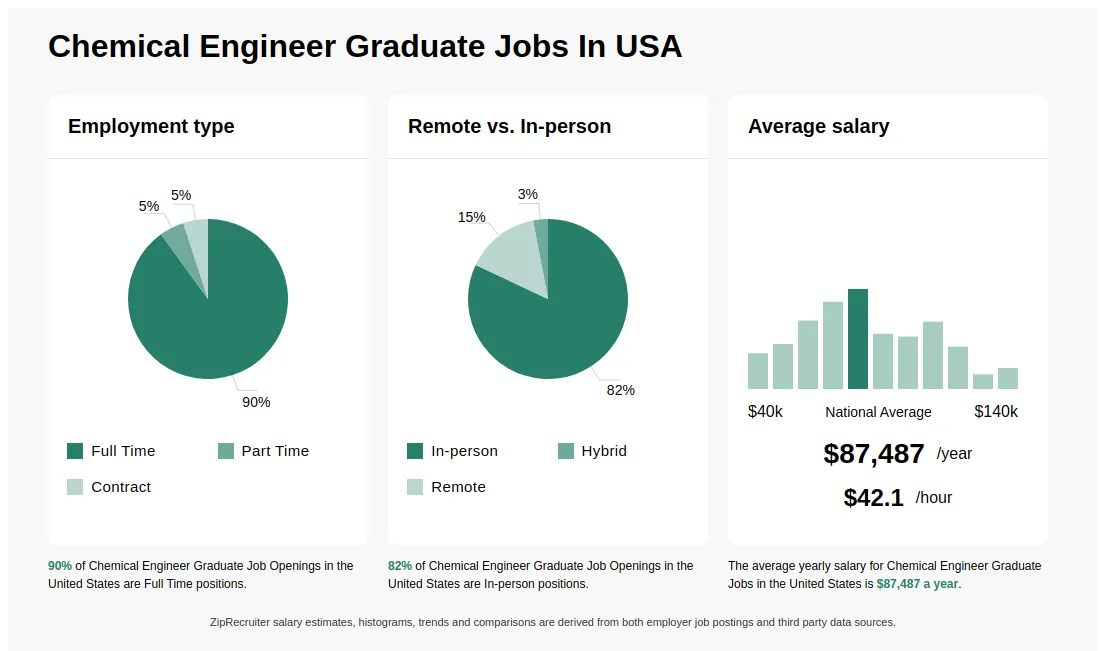
As of Sep 6, 2026, the average yearly pay for chemical engineer graduate in the United States is $87,487.00, according to ZipRecruiter salary data. Most workers in this role earn between $67,500.00 and $106,500.00 per year, depending on experience, location, and employer.
What are the qualifications to get a job as a chemical engineer graduate?
The qualifications that you need to get an entry-level engineering job as a graduate of a chemical engineer program include a relevant degree and demonstrable research, lab, or analysis skills. You can gain experience during your undergraduate studies by taking part in an internship program or assisting in academic research at your university. You can obtain a bachelor’s degree in chemical engineering, though some schools offer a five-year program that leads to a master’s degree in chemical engineering.
What does a chemical engineer graduate do?
A Chemical Engineer Graduate typically assists in designing, developing, and optimizing processes for producing chemicals, fuels, food, pharmaceuticals, and other products. They apply principles of chemistry, physics, biology, and math to solve problems involving the production or use of chemicals. Graduates often work under the supervision of senior engineers and may be involved in research, process development, safety analysis, or quality control. Over time, they gain experience and may take on more complex projects or leadership roles.
What types of projects and responsibilities can a chemical engineer graduate expect during their first year on the job?
As a Chemical Engineer Graduate, you can anticipate working on a variety of projects that may include process optimization, safety assessments, and assisting with the design or scale-up of chemical processes. Typically, you'll support senior engineers by collecting and analyzing data, running simulations, and preparing technical reports. Collaboration is key, and you'll often work closely with multidisciplinary teams including mechanical engineers, quality assurance staff, and plant operators. This early exposure helps you build foundational skills and gain insights into different areas of the chemical engineering field.
What are the key skills and qualifications needed to thrive as a chemical engineer graduate, and why are they important?
To thrive as a Chemical Engineer Graduate, you need a solid understanding of chemical engineering principles, process design, and analytical problem-solving, typically backed by a relevant engineering degree. Familiarity with industry-standard software such as Aspen Plus or MATLAB, and knowledge of safety and quality regulations, are often required. Strong teamwork, effective communication, and adaptability are crucial soft skills for collaborating on projects and conveying technical information. These skills and qualities are vital to ensure safe, efficient, and innovative solutions in diverse engineering environments.
What is the difference between Chemical Engineer Graduate vs Chemical Technician?
| Aspect | Chemical Engineer Graduate | Chemical Technician |
|---|---|---|
| Required Credentials | Bachelor's degree in chemical engineering or related field | Associate degree or diploma in chemical technology |
| Work Environment | Design, develop, and optimize chemical processes, often in labs or plant settings | Assist in process operations, sampling, and quality control in manufacturing plants |
| Employer & Industry Usage | Engineering firms, manufacturing, energy, pharmaceuticals | Manufacturing plants, laboratories, production facilities |
The main difference between a Chemical Engineer Graduate and a Chemical Technician lies in their education, responsibilities, and work scope. Chemical Engineer Graduates focus on designing and improving chemical processes, requiring a bachelor's degree, while Chemical Technicians support these processes through hands-on tasks with an associate degree. Both roles are essential in the chemical industry but serve different functions based on their training and responsibilities.
More about Chemical Engineer Graduate jobs
What cities are hiring for Chemical Engineer Graduate jobs?
Cities with the most Chemical Engineer Graduate job openings:
What are the most commonly searched types of Chemical Engineer Graduate jobs?
The most popular types of Chemical Engineer Graduate jobs are:
What states have the most Chemical Engineer Graduate jobs?
States with the most job openings for Chemical Engineer Graduate jobs include:
What job categories do people searching Chemical Engineer Graduate jobs look for?
The top searched job categories for Chemical Engineer Graduate jobs are:

Full-time
Medical, Dental, Vision, Life, Retirement, PTO
This job post has expired 1 day ago. Applications are no longer accepted.
Eastman Chemical rating

8.3
Based on 69 frontline employees who took The Breakroom Quiz
26th of 104 rated chemical manufacturers
Job description
Founded in 1920, Eastman is a global specialty materials company that produces a broad range of products found in items people use every day. With the purpose of enhancing the quality of life in a material way, Eastman works with customers to deliver innovative products and solutions while maintaining a commitment to safety and sustainability. The company’s innovation-driven growth model takes advantage of world-class technology platforms, deep customer engagement, and differentiated application development to grow its leading positions in attractive end markets such as transportation, building and construction, and consumables. As a globally inclusive company, Eastman employs approximately 13,000 people around the world and serves customers in more than 100 countries. The company had 2025 revenue of approximately $8.8 billion and is headquartered in Kingsport, Tennessee, USA. For more information, visit www.eastman.com.
Responsibilities
**Please note – This posting is for recent or upcoming PhD graduates to join our team in 2027. PhD graduation date must be in 2026 or anticipated graduation in 2027**
Eastman Chemical Company is seeking a recent 2026 or upcoming 2027 PhD graduate in Chemical Engineering with emphasis on Paper and Pulp science. This role is based in Kingsport, Tennessee and will play a critical technical leadership role across product development, pilot plant operations, manufacturing support, and process scale‑up.
This position is ideal for candidates with substantial hands‑on experience in cellulose ester chemistry, pulping or paper machine operations, fiber modification, coated paper development, sustainable packaging, or mill process optimization.
Job Duties/Responsibilities:
- Lead development and scale‑up of cellulose ester products and processes across lab, pilot plant, and full‑scale manufacturing environments.
- Apply engineering and chemistry fundamentals to improve reaction systems, optimize assets, and drive step‑change operational performance.
- Design and execute plant trials, experiments, and capability studies to reduce raw‑material usage, improve yield, enhance quality, and increase capacity.
- Lead pilot plant campaigns, new equipment commissioning, and scale‑up programs across multiple business areas.
- Collaborate with R&D, manufacturing, technicians, and business teams to advance new product and process initiatives.
- Use statistical analysis, Six Sigma tools, and data‑driven insights to identify opportunities and deliver measurable improvements.
- Communicate technical strategies, experimental results, and recommendations to technology, manufacturing, business, and leadership stakeholders.
- Promote and model strong safety practices in all laboratory, pilot, and manufacturing activities.
Qualifications
- Required Degree: PhD in Chemical Engineering, Chemistry, or related field with emphasis on Paper and Pulp Technology.
- Strong commitment to safe operation in lab and pilot settings.
- Working knowledge of paper and pulp, polymer esters, or related chemical process technology.
- Demonstrated experience in Fiber chemistry, product development, or process improvements.
- Strong understanding of esterification chemistry, polymer reaction systems, and fundamental process engineering.
- Proficiency in statistical analysis and data‑driven process optimization.
- Ability to independently design and execute complex experiments and plant trials.
- Demonstrated ability to improve product quality, increase production rates, reduce variability, and optimize mill operations.
- Desire to engage well with technicians/operators, peers, and management and to collaborate to find innovative solutions
Benefits
Your total rewards go far beyond a competitive salary. When you join Eastman, you gain access to an exceptional suite of programs designed to protect your health, grow your wealth, and fuel your career.
Compensation & Incentives
• Base pay plus performance-based incentive opportunities that let you share in our success.
Health & Wellness
• Comprehensive medical, prescription-drug, and dental coverage—paired with a Health Savings Account option to help you save tax-free dollars for care today or in the future.
• A robust menu of voluntary benefits—including vision, optional life, critical-illness protection, and more—so you can tailor coverage to fit your life.
• Holistic wellness support: financial-planning tools, family-building assistance (adoption, pregnancy, and fertility resources), parental leave, and confidential Employee Assistance Program counseling.
Retirement & Financial Strategies
• 401(k) with a company match—plus an additional annual retirement contribution from Eastman to accelerate your long-term savings.
Time Away
• Eleven paid holidays, one personal day, paid time off, and paid vacation to recharge, celebrate, or handle life’s moments.
Growth & Development
• Access to mentorship, learning resources, and leadership programs that empower you to thrive in your current role and chart the next steps in your career.
At Eastman, we invest in the whole you—so you can bring your best self to work every day and build a future you’re proud of.
Eastman Chemical Company is an equal opportunity employer. All qualified applicants will receive consideration for employment without regard to age, race, color, religion, sex, sexual orientation, gender identity, national origin, disability, pregnancy, veteran status or any other protected classes as designated by law.
Eastman is committed to creating a powerfully engaged workplace, where everyone can contribute to their fullest potential each day.
What Eastman Chemical employees say
Pay
Benefits
Hours and flexibility
Workplace
Get the full story on Breakroom