Stay current with chemical engineering trends, technologies, and best practices * Contribute to research, development, and innovation efforts * Prioritize safety and identify and mitigate process ...
Stay current with chemical engineering trends, technologies, and best practices * Contribute to research, development, and innovation efforts * Prioritize safety and identify and mitigate process ...
Chemical Engineering New Graduate | Boulder, CO Full time · Onsite · Boulder, CO Important: if an employer asks you to log into their system via iCloud or Google, send a code, an SMS or Telegram ...
Chemical Engineering New Graduate | Boulder, CO Full time · Onsite · Boulder, CO Important: if an employer asks you to log into their system via iCloud or Google, send a code, an SMS or Telegram ...

Graduate Rotational Opportunities at Westlake (GROW) is a leadership development program for newly ... S. degree in Chemical Engineering * 0-2 years of relevant work experience * Minimum 3.0 GPA
Graduate Rotational Opportunities at Westlake (GROW) is a leadership development program for newly ... S. degree in Chemical Engineering * 0-2 years of relevant work experience * Minimum 3.0 GPA
Graduate Rotational Opportunities at Westlake (GROW) is a leadership development program for newly ... S. degree in Chemical Engineering * 0-2 years of relevant work experience * Minimum 3.0 GPA
Graduate Rotational Opportunities at Westlake (GROW) is a leadership development program for newly ... S. degree in Chemical Engineering * 0-2 years of relevant work experience * Minimum 3.0 GPA
Chemical Engineering New Graduate | Boulder, CO Full time · Onsite · Boulder, CO Important: if an employer asks you to log into their system via iCloud or Google, send a code, an SMS or Telegram ...
Chemical Engineering New Graduate | Boulder, CO Full time · Onsite · Boulder, CO Important: if an employer asks you to log into their system via iCloud or Google, send a code, an SMS or Telegram ...

IMEG is hiring a Chemical Engineering New Graduate in Boulder, CO. This entry-level role offers hands-on design, analysis, and project execution experience, with mentorship, training, and ...
IMEG is hiring a Chemical Engineering New Graduate in Boulder, CO. This entry-level role offers hands-on design, analysis, and project execution experience, with mentorship, training, and ...
IMEG is hiring a Chemical Engineering New Graduate in Boulder, CO. This entry-level role offers hands-on design, analysis, and project execution experience, with mentorship, training, and ...
IMEG is hiring a Chemical Engineering New Graduate in Boulder, CO. This entry-level role offers hands-on design, analysis, and project execution experience, with mentorship, training, and ...
Senior Propellant Chemical Engineer
Culpeper, VA · On-site
$76K - $142K/yr
Graduate Degree and a minimum of 2 years of prior related experience. In lieu of a degree, minimum ... Master's or PhD in Chemistry, Chemical Engineering, or Materials Engineering or related science ...
Senior Propellant Chemical Engineer
Culpeper, VA · On-site
$76K - $142K/yr
Graduate Degree and a minimum of 2 years of prior related experience. In lieu of a degree, minimum ... Master's or PhD in Chemistry, Chemical Engineering, or Materials Engineering or related science ...
Senior Propellant Chemical Engineer
$76K - $142K/yr
Graduate Degree and a minimum of 2 years of prior related experience. In lieu of a degree, minimum ... Master's or PhD in Chemistry, Chemical Engineering, or Materials Engineering or related science ...
Senior Propellant Chemical Engineer
$76K - $142K/yr
Graduate Degree and a minimum of 2 years of prior related experience. In lieu of a degree, minimum ... Master's or PhD in Chemistry, Chemical Engineering, or Materials Engineering or related science ...
IMEG is hiring a Chemical Engineering New Graduate in Boulder, CO. This entry-level role offers hands-on design, analysis, and project execution experience, with mentorship, training, and ...
IMEG is hiring a Chemical Engineering New Graduate in Boulder, CO. This entry-level role offers hands-on design, analysis, and project execution experience, with mentorship, training, and ...
IMEG is hiring a Chemical Engineering New Graduate in Ann Arbor, MI. This entry-level role offers hands‑on design, analysis, and project execution experience, with mentorship, training, and ...
IMEG is hiring a Chemical Engineering New Graduate in Ann Arbor, MI. This entry-level role offers hands‑on design, analysis, and project execution experience, with mentorship, training, and ...
IMEG is hiring a Chemical Engineering New Graduate in Ann Arbor, MI. This entry-level role offers hands‑on design, analysis, and project execution experience, with mentorship, training, and ...
IMEG is hiring a Chemical Engineering New Graduate in Ann Arbor, MI. This entry-level role offers hands‑on design, analysis, and project execution experience, with mentorship, training, and ...
IMEG is hiring a Chemical Engineering New Graduate in Ann Arbor, MI. This entry-level role offers hands-on design, analysis, and project execution experience, with mentorship, training, and ...
IMEG is hiring a Chemical Engineering New Graduate in Ann Arbor, MI. This entry-level role offers hands-on design, analysis, and project execution experience, with mentorship, training, and ...
IMEG is hiring a Chemical Engineering New Graduate in Ann Arbor, MI. This entry-level role offers hands-on design, analysis, and project execution experience, with mentorship, training, and ...
IMEG is hiring a Chemical Engineering New Graduate in Ann Arbor, MI. This entry-level role offers hands-on design, analysis, and project execution experience, with mentorship, training, and ...

... engineering/scientific work involving chemical processes to produce useful analytical products ... Successfully completed 1 full year of graduate level education in a field which demonstrates the ...
... engineering/scientific work involving chemical processes to produce useful analytical products ... Successfully completed 1 full year of graduate level education in a field which demonstrates the ...

Senior Propellant Chemical Engineer
Camden, AR · On-site
$76K - $142K/yr
Graduate Degree and a minimum of 2 years of prior related experience. In lieu of a degree, minimum ... Master's or PhD in Chemistry, Chemical Engineering, or Materials Engineering or related science ...
Senior Propellant Chemical Engineer
Camden, AR · On-site
$76K - $142K/yr
Graduate Degree and a minimum of 2 years of prior related experience. In lieu of a degree, minimum ... Master's or PhD in Chemistry, Chemical Engineering, or Materials Engineering or related science ...

Five years of experience or more, and 18 semester credit hours of graduate study in Chemical Engineering or a related discipline are strongly preferred. Additional Requirements * May require a ...
Five years of experience or more, and 18 semester credit hours of graduate study in Chemical Engineering or a related discipline are strongly preferred. Additional Requirements * May require a ...

Senior Propellant Chemical Engineer
Orange, VA · On-site
$76K - $142K/yr
Graduate Degree and a minimum of 2 years of prior related experience. In lieu of a degree, minimum ... Master's or PhD in Chemistry, Chemical Engineering, or Materials Engineering or related science ...
Senior Propellant Chemical Engineer
Orange, VA · On-site
$76K - $142K/yr
Graduate Degree and a minimum of 2 years of prior related experience. In lieu of a degree, minimum ... Master's or PhD in Chemistry, Chemical Engineering, or Materials Engineering or related science ...
Senior Propellant Chemical Engineer
Camden, AR · On-site
$76K - $142K/yr
Graduate Degree and a minimum of 2 years of prior related experience. In lieu of a degree, minimum ... Master's or PhD in Chemistry, Chemical Engineering, or Materials Engineering or related science ...
Senior Propellant Chemical Engineer
Camden, AR · On-site
$76K - $142K/yr
Graduate Degree and a minimum of 2 years of prior related experience. In lieu of a degree, minimum ... Master's or PhD in Chemistry, Chemical Engineering, or Materials Engineering or related science ...
Chemical Engineer (New Grad)
Los Angeles, CA · On-site
$96K - $106K/yr
This is a strong opportunity for a recent graduate who is curious, hands‑on, eager to learn, and ... Bachelor's degree in Chemical Engineering, Chemistry, or a related field (graduating students and ...
Chemical Engineer (New Grad)
Los Angeles, CA · On-site
$96K - $106K/yr
This is a strong opportunity for a recent graduate who is curious, hands‑on, eager to learn, and ... Bachelor's degree in Chemical Engineering, Chemistry, or a related field (graduating students and ...
Chemical Engineer Graduate information
See salary details
$40K - $49.1K
6% of jobs
$49.1K - $58.2K
7% of jobs
$66.9K is the 25th percentile. Wages below this are outliers.
$58.2K - $67.3K
12% of jobs
$67.3K - $76.4K
15% of jobs
The median wage is $81.5K / yr.
$76.4K - $85.5K
17% of jobs
$85.5K - $94.5K
10% of jobs
$103.1K is the 75th percentile. Wages above this are outliers.
$94.5K - $103.6K
9% of jobs
$103.6K - $112.7K
12% of jobs
$112.7K - $121.8K
7% of jobs
$121.8K - $130.9K
2% of jobs
$130.9K - $140K
3% of jobs
$40K
$87.5K
$140K
How much do chemical engineer graduate jobs pay per year?
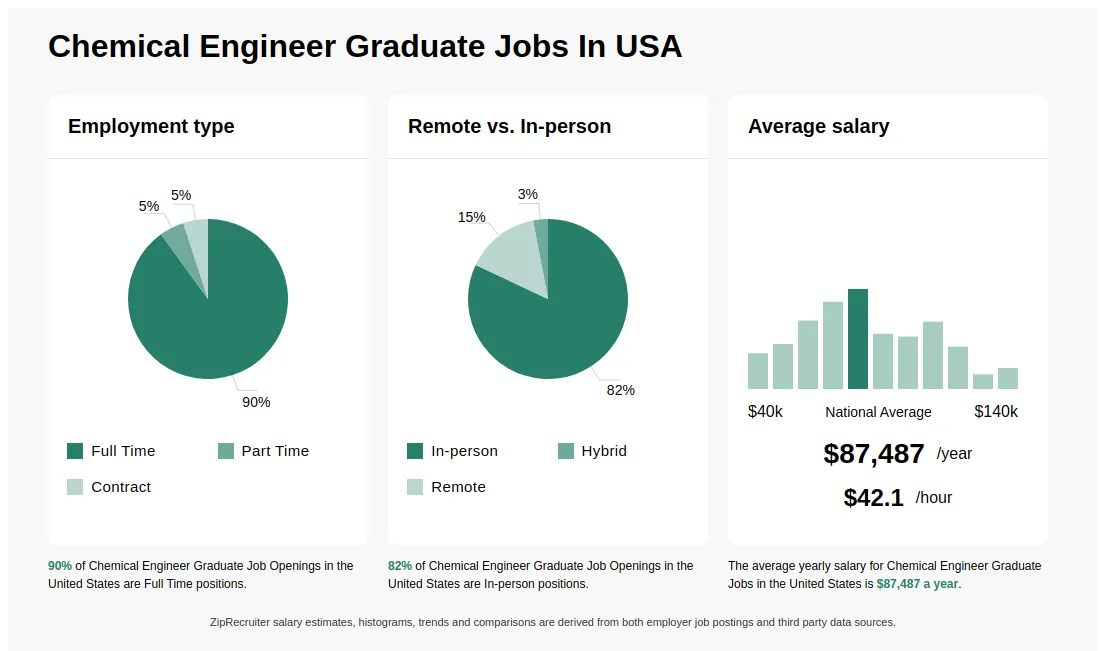
As of Sep 15, 2026, the average yearly pay for chemical engineer graduate in the United States is $87,487.00, according to ZipRecruiter salary data. Most workers in this role earn between $67,500.00 and $106,500.00 per year, depending on experience, location, and employer.
What are the qualifications to get a job as a chemical engineer graduate?
The qualifications that you need to get an entry-level engineering job as a graduate of a chemical engineer program include a relevant degree and demonstrable research, lab, or analysis skills. You can gain experience during your undergraduate studies by taking part in an internship program or assisting in academic research at your university. You can obtain a bachelor’s degree in chemical engineering, though some schools offer a five-year program that leads to a master’s degree in chemical engineering.
What does a chemical engineer graduate do?
A Chemical Engineer Graduate typically assists in designing, developing, and optimizing processes for producing chemicals, fuels, food, pharmaceuticals, and other products. They apply principles of chemistry, physics, biology, and math to solve problems involving the production or use of chemicals. Graduates often work under the supervision of senior engineers and may be involved in research, process development, safety analysis, or quality control. Over time, they gain experience and may take on more complex projects or leadership roles.
What types of projects and responsibilities can a chemical engineer graduate expect during their first year on the job?
As a Chemical Engineer Graduate, you can anticipate working on a variety of projects that may include process optimization, safety assessments, and assisting with the design or scale-up of chemical processes. Typically, you'll support senior engineers by collecting and analyzing data, running simulations, and preparing technical reports. Collaboration is key, and you'll often work closely with multidisciplinary teams including mechanical engineers, quality assurance staff, and plant operators. This early exposure helps you build foundational skills and gain insights into different areas of the chemical engineering field.
What are the key skills and qualifications needed to thrive as a chemical engineer graduate, and why are they important?
To thrive as a Chemical Engineer Graduate, you need a solid understanding of chemical engineering principles, process design, and analytical problem-solving, typically backed by a relevant engineering degree. Familiarity with industry-standard software such as Aspen Plus or MATLAB, and knowledge of safety and quality regulations, are often required. Strong teamwork, effective communication, and adaptability are crucial soft skills for collaborating on projects and conveying technical information. These skills and qualities are vital to ensure safe, efficient, and innovative solutions in diverse engineering environments.
What is the difference between Chemical Engineer Graduate vs Chemical Technician?
| Aspect | Chemical Engineer Graduate | Chemical Technician |
|---|---|---|
| Required Credentials | Bachelor's degree in chemical engineering or related field | Associate degree or diploma in chemical technology |
| Work Environment | Design, develop, and optimize chemical processes, often in labs or plant settings | Assist in process operations, sampling, and quality control in manufacturing plants |
| Employer & Industry Usage | Engineering firms, manufacturing, energy, pharmaceuticals | Manufacturing plants, laboratories, production facilities |
The main difference between a Chemical Engineer Graduate and a Chemical Technician lies in their education, responsibilities, and work scope. Chemical Engineer Graduates focus on designing and improving chemical processes, requiring a bachelor's degree, while Chemical Technicians support these processes through hands-on tasks with an associate degree. Both roles are essential in the chemical industry but serve different functions based on their training and responsibilities.
More about Chemical Engineer Graduate jobs
What cities are hiring for Chemical Engineer Graduate jobs?
Cities with the most Chemical Engineer Graduate job openings:
What are the most commonly searched types of Chemical Engineer Graduate jobs?
The most popular types of Chemical Engineer Graduate jobs are:
What states have the most Chemical Engineer Graduate jobs?
States with the most job openings for Chemical Engineer Graduate jobs include:
What are popular job titles related to Chemical Engineer Graduate jobs?
For Chemical Engineer Graduate jobs, the most frequently searched job titles are:
Chemical Engineer, New Graduate
Boulder, CO • On-site
Jobtailor
Other
Posted 8 days ago
Job description
- Interact with clients to understand needs, gather project requirements, communicate technical information, and build client relationships
- Support consulting project execution, planning, and scheduling
- Document design decisions and client instructions while monitoring project design progress
- Analyze low- to medium-complexity engineering tasks and collaborate with senior engineers and consultants on practical solutions
- Develop Process Flow Diagrams and Piping and Instrumentation Diagrams
- Assist with equipment and instrument specifications
- Assist in process controls design and development
- Perform and document technical calculations
- Perform field work to document existing conditions and current installations
- Support cost estimate development, solicit vendor quotes, and assist with bid package documentation
- Review construction progress and participate in quality control processes
- Stay current with chemical engineering trends, technologies, and best practices
- Contribute to research, development, and innovation efforts
- Prioritize safety and identify and mitigate process plant safety risks
- Collaborate with engineers, architects, and project managers to deliver integrated solutions
- Bachelor of Science (BS) Degree in Mechanical or Chemical Engineering, or equivalent required
- Knowledge of design techniques, tools, and concepts involved in producing technical plans and specifications
- Skilled in AutoCAD and AutoCAD Plant 3D
- Ability to work collaboratively in a team environment
- Attention to detail and problem-solving skills
- Eagerness to learn and adapt to new challenges
- Basic knowledge of BIM software
- Clear oral and written communication skills
- Proficiency with MS Office Suite, including Word, Excel, and Outlook
- Ability to travel up to 5% with occasional overnight stays
- Prior internship experience in engineering consulting or the chemical process industry preferred
- Engineering in Training (EIT) License preferred
Demonstrates expertise in Mechanical or Chemical Engineering with a strong focus on project execution, design documentation, and client interaction. Proficient in technical calculations, process design, and safety risk mitigation while collaborating effectively with multidisciplinary teams.
Highest-signal resume keywords- Bachelor Of Science (BS) Degree In Mechanical Or Chemical Engineering
- AutoCAD And AutoCAD Plant 3D
- Process Flow Diagrams And Piping And Instrumentation Diagrams
- Engineering In Training (EIT) License
- Clear Oral And Written Communication Skills
- Technical Calculations
- Process Controls Design
- Design Techniques And Tools
- Field Work Documentation
- Cost Estimate Development
- Attention To Detail
- Problem-Solving Skills
- Team Collaboration
- Eagerness To Learn And Adapt
- Engineering In Training (EIT) License
- Chemical Engineering
- Engineering Consulting
- Safety Risk Mitigation
- Quality Control Processes
- MS Office Suite
- BIM Software