1

Certified Risk Adjustment Coder Jobs (NOW HIRING)

Certified Risk Coder

Monterey Park, CA · On-site +1

$56K - $85K/yr

Quality - Risk Adjustment Employment Type: Full Time Location: 1600 Corporate Center Dr., Monterey Park, CA 91754 Compensation: $56,000 - $85,000 / year Description The Certified Risk Coder plays a ...

New

Coders will add risk-adjusting diagnoses that are valid but not reported Requirements Active certification through AAPC or AHIMA is required Minimum 5 years verifiable risk adjustment coding ...

RISK ADJUSTMENT CODER

Wilmington, NC · On-site

$16 - $21.50/hr

RISK ADJUSTMENT CODER Job Summary: * Perform code abstraction of medical records to ensure ICD-10-CM codes are accurately assigned and supported by clinical documentation * Identify diagnosis and ...

RISK ADJUSTMENT CODER

Wilmington, NC · Remote

$16 - $21.50/hr

RISK ADJUSTMENT CODER (MUST RESIDE IN NC) Job Summary: * Perform code abstraction of medical records to ensure ICD-10-CM codes are accurately assigned and supported by clinical documentation

Certified Risk Coder

Monterey Park, CA · Remote

$56K - $85K/yr

The Certified Risk Coder plays a critical role in supporting Astrana Health's value-based care and risk adjustment initiatives by ensuring the accurate capture and validation of diagnoses through ...

New

Certified Risk Coder

Monterey Park, CA · Remote

$56K - $85K/yr

Description The Certified Risk Coder plays a critical role in supporting Astrana Health's value-based care and risk adjustment initiatives by ensuring the accurate capture and validation of diagnoses ...

New

Certified Professional Coder (CPC) and Certified Risk Adjustment Coder (CRC). Proficient in Microsoft Word Excel and PowerPoint. Competent in Electronic Health Records NextGen and Cerner experience ...

Certified Medical Coder

Houston, TX · On-site

$21.50 - $29.25/hr

Certified Medical Coder Certified Medical Coder role is responsible for reviewing, abstracting, and ... Follows CMS Risk Adjustment guidelines and has a complete understanding of their real-world ...

Certified Medical Coder

Houston, TX · On-site

$21.50 - $29.25/hr

Summary Certified Medical Coder role is responsible for reviewing, abstracting, and coding ... Follows CMS Risk Adjustment guidelines and has a complete understanding of their real-world ...

Certified Medical Coder

Houston, TX · On-site

$21.50 - $29.25/hr

Certified Medical Coder Certified Medical Coder role is responsible for reviewing, abstracting, and ... Follows CMS Risk Adjustment guidelines and has a complete understanding of their real-world ...

Showing results 21-40

Certified Risk Adjustment Coder information

See salary details

$17

$29

$70

How much do certified risk adjustment coder jobs pay per hour?

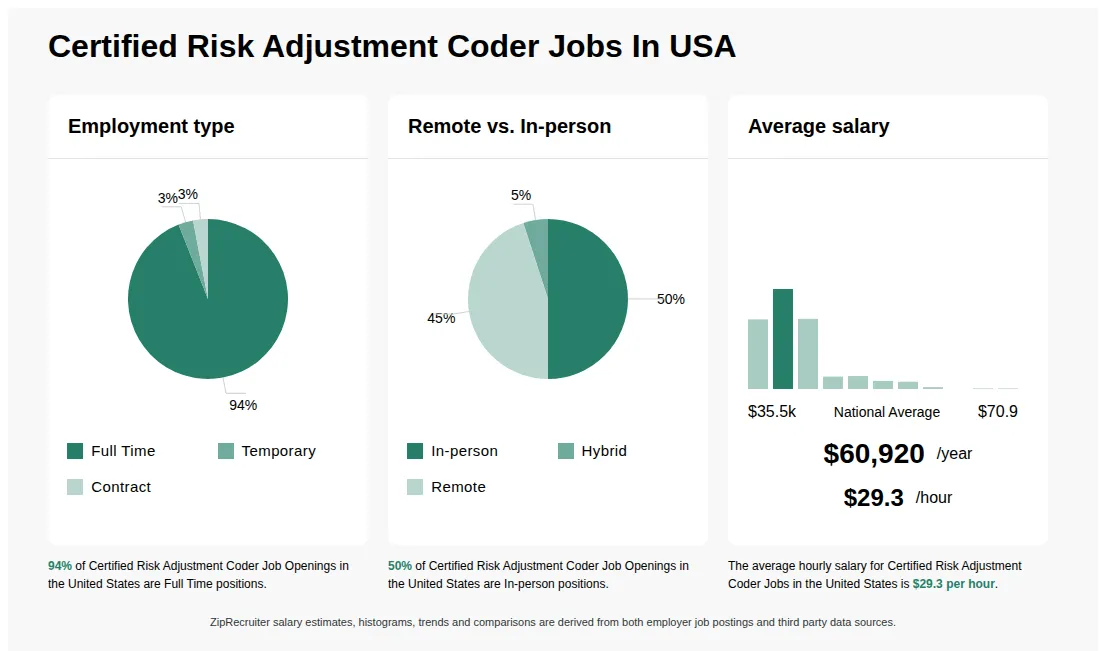
As of Sep 9, 2026, the average hourly pay for certified risk adjustment coder in the United States is $29.29, according to ZipRecruiter salary data. Most workers in this role earn between $21.88 and $29.09 per hour, depending on experience, location, and employer.

What is a Certified Risk Adjustment Coder?

A Certified Risk Adjustment Coder is a professional who specializes in reviewing and coding medical records to ensure accurate documentation of diagnoses for risk adjustment purposes. These coders play a crucial role in healthcare reimbursement, especially for Medicare Advantage and other risk-adjusted health plans. They analyze patient records using ICD-10-CM codes to help healthcare organizations receive appropriate compensation based on the severity of patient conditions. Certified Risk Adjustment Coders typically hold certifications such as the CRC from the AAPC, demonstrating their expertise in this specialized field.

What are the key skills and qualifications needed to thrive as a Certified Risk Adjustment Coder, and why are they important?

To thrive as a Certified Risk Adjustment Coder, you need expertise in medical coding, a thorough understanding of ICD-10-CM guidelines, and certification such as CRC (Certified Risk Adjustment Coder). Familiarity with coding software, electronic health records (EHRs), and risk adjustment models like HCC is typically required. Attention to detail, analytical thinking, and strong communication skills help ensure accurate code assignment and effective collaboration with healthcare providers. These skills and qualifications are crucial for capturing precise patient data, which directly impacts healthcare reimbursement and compliance.

What are some common challenges Certified Risk Adjustment Coders face, and how can they overcome them?

Certified Risk Adjustment Coders often encounter challenges such as staying current with evolving coding guidelines and accurately interpreting complex medical records. To overcome these difficulties, coders should regularly participate in ongoing education, leverage resources from professional organizations, and collaborate closely with providers to clarify documentation. Maintaining a strong attention to detail and utilizing coding software tools can also help minimize errors and improve coding accuracy. Engaging in peer reviews within the team can further enhance consistency and knowledge sharing.

What is the difference between Certified Risk Adjustment Coder vs Certified Medical Coder?

AspectCertified Risk Adjustment CoderCertified Medical Coder
CertificationsRequires risk adjustment-specific credentials like RAC, CRC, or CPC-RRequires CPC or CCS certifications
Work EnvironmentPrimarily in health insurance, risk adjustment, and payer settingsHospitals, clinics, physician offices, and outpatient facilities
Industry UsageUsed mainly in health insurance and risk adjustment programsUsed across healthcare providers for medical coding and billing

The Certified Risk Adjustment Coder specializes in coding for risk adjustment programs within health insurance, focusing on accurate documentation for reimbursement. In contrast, the Certified Medical Coder works across various healthcare settings, primarily coding diagnoses and procedures for billing. While both roles require coding certifications, their focus areas and work environments differ significantly.

How do you become a certified risk adjustment coder?

To become a certified risk adjustment coder, you typically need to complete relevant training or coursework in medical coding and risk adjustment, gain experience in medical billing or coding, and pass a certification exam such as the Certified Risk Adjustment Coder (CRC) offered by the American Academy of Professional Coders (AAPC). Continuing education is often required to maintain certification and stay current with industry updates.

Is certified risk adjustment coding a good career?

Certified risk adjustment coding is a growing field within healthcare, focusing on accurately coding patient diagnoses for insurance reimbursement and risk assessment. It requires knowledge of medical terminology, coding systems like ICD-10, and often involves certification such as the RAC or CRC. The role offers stable employment opportunities, competitive salaries, and the potential for remote work, making it a viable career choice for those interested in healthcare administration and coding.
More about Certified Risk Adjustment Coder jobs

What cities are hiring for Certified Risk Adjustment Coder jobs?

Cities with the most Certified Risk Adjustment Coder job openings:

Who are the top companies hiring for Certified Risk Adjustment Coder jobs?

The top employers for Certified Risk Adjustment Coder jobs are:

What states have the most Certified Risk Adjustment Coder jobs?

States with the most job openings for Certified Risk Adjustment Coder jobs include:

What are popular job titles related to Certified Risk Adjustment Coder jobs?

For Certified Risk Adjustment Coder jobs, the most frequently searched job titles are:

Infographic showing various Certified Risk Adjustment Coder job openings in the United States as of September 2026, with employment types broken down into 1% Locum Tenens, 3% As Needed, 74% Full Time, 16% Part Time, and 6% Contract. Highlights an 96% Physical, 1% Hybrid, and 3% Remote job distribution, with an average salary of $60,920 per year, or $29.3 per hour.

HEALTH CODER - HCC & RISK ADJUSTMENT

Burlingame, CA • On-site

North East Medical Services
Health Care and Social Assistance • 51 - 200 employees

$42.79 - $48.75/hr

Other

Re-posted 25 days ago


Key responsibilities

  • Perform comprehensive review of patient charts to identify and validate diagnosis codes in alignment with HCC and risk adjustment guidelines.

  • Develop and deliver provider education sessions and materials on best practices for clinical documentation and HCC/RA coding.

  • Analyze coding data to identify trends, documentation gaps, and opportunities for improvement.


Job description

The Healthcare Coder plays a critical role in supporting accurate and compliant coding for NEMS MSO operations with a focus on Medicare Risk Adjustment (RA) programs. This position ensures accurate capture of Hierarchical Condition Category (HCC) coding and improves risk adjustment scores by conducting chart audits, providing provider education, and supporting clinical documentation improvement (CDI) initiatives. The Healthcare Coder will collaborate closely with providers, clinical staff, and leadership to improve coding accuracy and compliance, directly impacting the organization's quality outcomes and financial performance.
ESSENTIAL JOB FUNCTIONS:
  • HCC Coding and Risk Adjustment (RA) Program Support
    • Perform comprehensive review of patient charts to identify and validate diagnosis codes in alignment with HCC and risk adjustment guidelines.
    • Ensure all coding adheres to CMS and ICD-10 guidelines, focusing on accuracy, completeness, and compliance.
    • Conduct prospective and retrospective chart audits to assess risk adjustment coding accuracy.
  • Provider Training and Clinical Documentation Improvement (CDI)
  • Develop and deliver provider education sessions and materials on best practices for clinical documentation and HCC/RA coding.
  • Provide one-on-one and group training to providers and clinical staff to improve documentation quality and accuracy.
  • Serve as a resource and subject matter expert on HCC, risk adjustment, and related coding standards.
  • Data Analysis and Reporting
    • Analyze coding data to identify trends, documentation gaps, and opportunities for improvement.
    • Generate reports and dashboards to track coding performance and documentation accuracy.
    • Collaborate with the Quality and Analytics teams to optimize risk adjustment processes.
  • Compliance and Continuous Improvement
    • Stay up to date with changes in coding, risk adjustment, and Medicare regulations.
    • Assist in the development and implementation of internal coding policies and procedures.
    • Participate in quality improvement initiatives related to coding and documentation.
    • Performs other job duties as required by manager/supervisor

  • Education & Certification:
    • BS/BA Degree in Health Science or General Education is required.
    • Certified Professional Coder (CPC), Certified Risk Adjustment Coder (CRC), or equivalent coding certification is required.
    • Additional CDI or auditing certifications (CCDS, CDEO, CPMA) are preferred.
  • Experience:
    • Minimum of 3 years of experience in medical coding with a focus on HCC, risk adjustment, and Medicare Advantage programs.
    • Experience in provider education, clinical documentation improvement (CDI), and chart audits.
    • Previous experience working in an IPA, managed care organization, or similar setting is strongly preferred.
  • Skills & Competencies:
    • Excellent communication, presentation, and interpersonal skills.
    • Strong understanding of CMS guidelines for Medicare Advantage and risk adjustment program.
    • Exceptional knowledge of ICD-10-CM coding and HCC risk adjustment coding methodologies.
    • Proficiency in electronic health records (EHR) and coding software.
    • Strong analytical and problem-solving skills.

LANGUAGE:
  • Must be able to fluently speak, read and write English.
  • Fluency in other languages is an asset.

STATUS:
  • This is an FLSA Non-exempt position.
  • This is not an OSHA high-risk position.
  • This a full-time position.