Experience in the processes used to manufacture engineered ceramics. * Familiarity with laboratory testing techniques used in the characterization of the structure and properties of nonmetallic ...
Experience in the processes used to manufacture engineered ceramics. * Familiarity with laboratory testing techniques used in the characterization of the structure and properties of nonmetallic ...
Ceramics Instructor
Encinitas, CA · On-site
The Ceramics Instructor will also support studio events, collaborate with other staff on programming, and contribute to a positive, inclusive community experience. Qualifications * Ceramic and ...
Ceramics Instructor
Encinitas, CA · On-site
The Ceramics Instructor will also support studio events, collaborate with other staff on programming, and contribute to a positive, inclusive community experience. Qualifications * Ceramic and ...
Lead Ceramics Materials Engineer, Nuclear Reactors
Los Angeles, CA · On-site
$115K - $150K/yr
Materials Engineer, Ceramics II - $115,000 - $150,000 Senior Materials Engineer, Ceramics - $140,000 - $185,000 Determined based on technical assessments during the interview process. Location: * We ...
New
Lead Ceramics Materials Engineer, Nuclear Reactors
Los Angeles, CA · On-site
$115K - $150K/yr
Materials Engineer, Ceramics II - $115,000 - $150,000 Senior Materials Engineer, Ceramics - $140,000 - $185,000 Determined based on technical assessments during the interview process. Location: * We ...
New

Experience in the processes used to manufacture engineered ceramics. * Familiarity with laboratory testing techniques used in the characterization of the structure and properties of nonmetallic ...
Experience in the processes used to manufacture engineered ceramics. * Familiarity with laboratory testing techniques used in the characterization of the structure and properties of nonmetallic ...

Ceramics Researcher
Laurel, MD · On-site
Possess a BS in Materials Science & Engineering, Ceramics, Composites, or related field. * Have 2+ ... years of experience synthesizing and processing materials, particularly advanced ceramics, graded ...
Ceramics Researcher
Laurel, MD · On-site
Possess a BS in Materials Science & Engineering, Ceramics, Composites, or related field. * Have 2+ ... years of experience synthesizing and processing materials, particularly advanced ceramics, graded ...
Materials Engineer - Ceramics
Whitehall, MI · On-site
$90 - $130/hr
Experience in the processes used to manufacture engineered ceramics. * Familiarity with laboratory testing techniques used in the characterization of the structure and properties of nonmetallic ...
New
Materials Engineer - Ceramics
Whitehall, MI · On-site
$90 - $130/hr
Experience in the processes used to manufacture engineered ceramics. * Familiarity with laboratory testing techniques used in the characterization of the structure and properties of nonmetallic ...
New
Experience in the processes used to manufacture engineered ceramics. * Familiarity with laboratory testing techniques used in the characterization of the structure and properties of nonmetallic ...
Experience in the processes used to manufacture engineered ceramics. * Familiarity with laboratory testing techniques used in the characterization of the structure and properties of nonmetallic ...
2026 Ceramics Fall Intern
Bentonville, AR · On-site
$13.25 - $17.50/hr
Research, develop, and propose new ideas for ceramic programming based on personal interests, community needs, and current trends in contemporary ceramics and craft. * Contribute to the creation of ...
2026 Ceramics Fall Intern
Bentonville, AR · On-site
$13.25 - $17.50/hr
Research, develop, and propose new ideas for ceramic programming based on personal interests, community needs, and current trends in contemporary ceramics and craft. * Contribute to the creation of ...
2026 Ceramics Fall Intern
Bentonville, AR · On-site
$12.25 - $16.75/hr
Research, develop, and propose new ideas for ceramic programming based on personal interests, community needs, and current trends in contemporary ceramics and craft. * Contribute to the creation of ...
2026 Ceramics Fall Intern
Bentonville, AR · On-site
$12.25 - $16.75/hr
Research, develop, and propose new ideas for ceramic programming based on personal interests, community needs, and current trends in contemporary ceramics and craft. * Contribute to the creation of ...
CERAMICS PROGRAM COORDINATOR
Bethlehem, PA · On-site
$20/hr
... programming firings, loading and unloading kilns, etc.) • Ability to use, maintain, and instruct others in the use of studio equipment, tools, and processes, including, but not limited to: mixing ...
CERAMICS PROGRAM COORDINATOR
Bethlehem, PA · On-site
$20/hr
... programming firings, loading and unloading kilns, etc.) • Ability to use, maintain, and instruct others in the use of studio equipment, tools, and processes, including, but not limited to: mixing ...

NC · On-site
... programming kilns • Mixing of glazes, slips, and stains • Reclaiming clay in a pug mill • ... ceramics required · Preferred Master Potters Certificate, Associates in Fine Art, or higher · ...
NC · On-site
... programming kilns • Mixing of glazes, slips, and stains • Reclaiming clay in a pug mill • ... ceramics required · Preferred Master Potters Certificate, Associates in Fine Art, or higher · ...
Manufacturing Engineer- SR (Multiple Positions) (REF288132U)
Anderson, SC · On-site
$90 - $120/hr
This position requires a bachelor's degree or foreign equivalent in Materials Science, Ceramics Engineering, Mechanical Engineering or a related field. 5 years of experience as a Thermo Shock ...
Manufacturing Engineer- SR (Multiple Positions) (REF288132U)
Anderson, SC · On-site
$90 - $120/hr
This position requires a bachelor's degree or foreign equivalent in Materials Science, Ceramics Engineering, Mechanical Engineering or a related field. 5 years of experience as a Thermo Shock ...

Staff Materials Engineer
$148K - $161K/yr
MS in Ceramics Engineering, Materials Science, or similar discipline * 5-10 years relevant experience with hands on formulations, characterization, and analysis Preferred Skills and Experience * PhD ...
Quick apply
Staff Materials Engineer
$148K - $161K/yr
MS in Ceramics Engineering, Materials Science, or similar discipline * 5-10 years relevant experience with hands on formulations, characterization, and analysis Preferred Skills and Experience * PhD ...

Possess a BS in Materials Science & Engineering, Ceramics, Composites, or related field. * Have 2+ ... years of experience synthesizing and processing materials, particularly advanced ceramics, graded ...
Possess a BS in Materials Science & Engineering, Ceramics, Composites, or related field. * Have 2+ ... years of experience synthesizing and processing materials, particularly advanced ceramics, graded ...

Manufacturing Engineer- SR (Multiple Positions) (REF288132U)-Anderson, South Carolina
Abbeville, SC · On-site
$74K - $101K/yr
This position requires a bachelor's degree or foreign equivalent in Materials Science, Ceramics Engineering, Mechanical Engineering or a related field. 5 years of experience as a Thermo Shock ...
Manufacturing Engineer- SR (Multiple Positions) (REF288132U)-Anderson, South Carolina
Abbeville, SC · On-site
$74K - $101K/yr
This position requires a bachelor's degree or foreign equivalent in Materials Science, Ceramics Engineering, Mechanical Engineering or a related field. 5 years of experience as a Thermo Shock ...
Manufacturing Engineer- SR (Multiple Positions) (REF288132U)
Anderson, SC · On-site
$79K - $108K/yr
This position requires a bachelor's degree or foreign equivalent in Materials Science, Ceramics Engineering, Mechanical Engineering or a related field. 5 years of experience as a Thermo Shock ...
Manufacturing Engineer- SR (Multiple Positions) (REF288132U)
Anderson, SC · On-site
$79K - $108K/yr
This position requires a bachelor's degree or foreign equivalent in Materials Science, Ceramics Engineering, Mechanical Engineering or a related field. 5 years of experience as a Thermo Shock ...
NC · On-site
$15/hr
HERITAGE ARTS CERAMICS LAB ASSISTANT Hours: Part-time, 15 hours weekly The Lab Assistant's primary ... Kiln operation, including loading, unloading, and programming kilns * Mixing of glazes, slips, and ...
Quick apply
NC · On-site
$15/hr
HERITAGE ARTS CERAMICS LAB ASSISTANT Hours: Part-time, 15 hours weekly The Lab Assistant's primary ... Kiln operation, including loading, unloading, and programming kilns * Mixing of glazes, slips, and ...
Manufacturing Engineer- SR (Multiple Positions) (REF288132U)
Anderson, SC · On-site
$79K - $108K/yr
This position requires a bachelor's degree or foreign equivalent in Materials Science, Ceramics Engineering, Mechanical Engineering or a related field. 5 years of experience as a Thermo Shock ...
Manufacturing Engineer- SR (Multiple Positions) (REF288132U)
Anderson, SC · On-site
$79K - $108K/yr
This position requires a bachelor's degree or foreign equivalent in Materials Science, Ceramics Engineering, Mechanical Engineering or a related field. 5 years of experience as a Thermo Shock ...
This position requires a bachelor's degree or foreign equivalent in Materials Science, Ceramics Engineering, Mechanical Engineering or a related field. 5 years of experience as a Thermo Shock ...
This position requires a bachelor's degree or foreign equivalent in Materials Science, Ceramics Engineering, Mechanical Engineering or a related field. 5 years of experience as a Thermo Shock ...
Manufacturing Engineer- SR (Multiple Positions) (REF288132U)-Anderson, South Carolina
Fair Play, SC · On-site
$78K - $107K/yr
This position requires a bachelor's degree or foreign equivalent in Materials Science, Ceramics Engineering, Mechanical Engineering or a related field. 5 years of experience as a Thermo Shock ...
Manufacturing Engineer- SR (Multiple Positions) (REF288132U)-Anderson, South Carolina
Fair Play, SC · On-site
$78K - $107K/yr
This position requires a bachelor's degree or foreign equivalent in Materials Science, Ceramics Engineering, Mechanical Engineering or a related field. 5 years of experience as a Thermo Shock ...
Ceramics Engineer information
See salary details
$27K - $37K
5% of jobs
$37K - $47K
5% of jobs
$47K - $57K
3% of jobs
$57K - $67K
3% of jobs
$67K - $77K
6% of jobs
$77.9K is the 25th percentile. Wages below this are outliers.
$77K - $87K
18% of jobs
The median wage is $94.3K / yr.
$87K - $97K
12% of jobs
$97K - $107K
15% of jobs
$110.3K is the 75th percentile. Wages above this are outliers.
$107K - $117K
21% of jobs
$117K - $127K
10% of jobs
$127K - $137K
1% of jobs
$27K
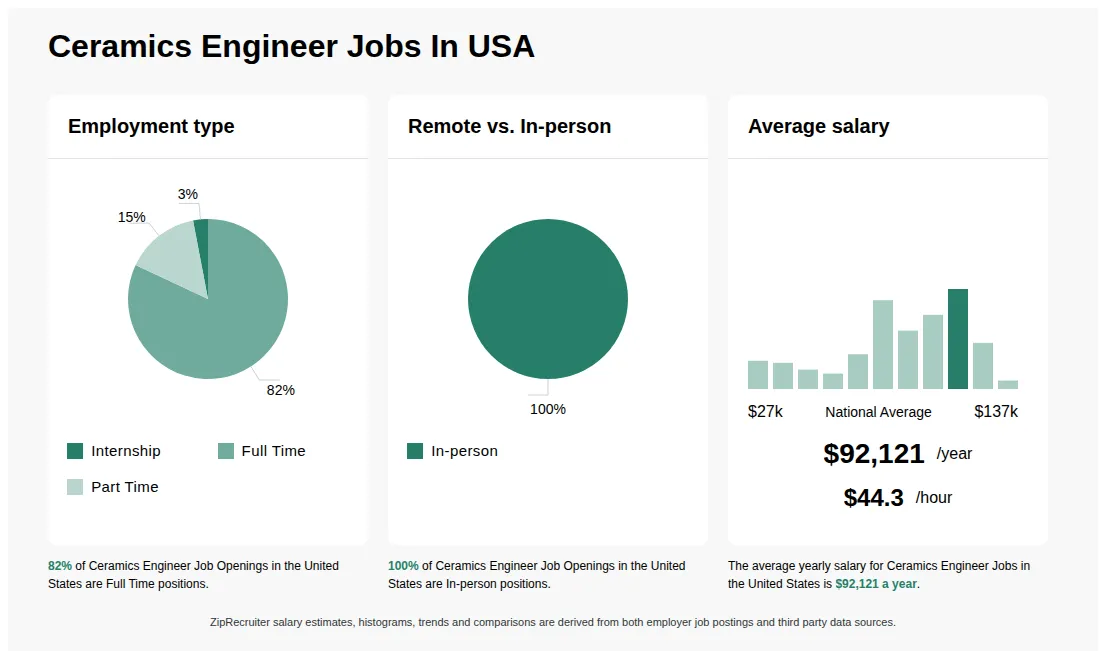
$92.1K
$137K
How much do ceramics engineer jobs pay per year?
As of Sep 4, 2026, the average yearly pay for ceramics engineer in the United States is $92,121.00, according to ZipRecruiter salary data. Most workers in this role earn between $77,000.00 and $112,000.00 per year, depending on experience, location, and employer.
What is a ceramics engineer?
Ceramics engineers are professionals who design, develop, and manufacture products made from ceramic materials. They work with inorganic, non-metallic materials such as clay, glass, porcelain, and advanced ceramics used in electronics, medical devices, and aerospace components. Their responsibilities include improving material properties, enhancing production processes, and ensuring the quality and performance of ceramic products. Ceramics engineers often collaborate with scientists and manufacturers to innovate and solve technical challenges related to ceramics.
What are the key skills and qualifications needed to thrive as a ceramics engineer?
To thrive as a Ceramics Engineer, you need a solid background in materials science, chemistry, and engineering principles, usually supported by a bachelor's or master's degree in materials or ceramics engineering. Familiarity with characterization tools like X-ray diffraction (XRD), scanning electron microscopy (SEM), and computer-aided design (CAD) software is essential. Strong problem-solving, attention to detail, and effective teamwork skills help set top professionals apart. These competencies are vital for developing innovative ceramic materials and products that meet industry standards and solve complex engineering challenges.
What are some common challenges ceramics engineers face when working on new materials development projects?
Ceramics Engineers often encounter challenges such as ensuring consistency in material properties during scale-up from laboratory to production, managing high-temperature processing constraints, and addressing brittleness or fracture risks in ceramic components. They must also collaborate closely with materials scientists, design engineers, and manufacturing teams to balance performance requirements with cost and manufacturability. Effective problem-solving and strong communication skills are essential for overcoming these hurdles and delivering innovative, reliable ceramic solutions.
What is the difference between Ceramics Engineer vs Materials Engineer?
| Aspect | Ceramics Engineer | Materials Engineer |
|---|---|---|
| Credentials | Bachelor's or higher in ceramics, materials science, or engineering | Bachelor's or higher in materials science, metallurgical, or materials engineering |
| Work Environment | Research labs, manufacturing facilities, R&D departments | Manufacturing plants, research labs, product development |
| Industry Usage | Specializes in ceramic materials for electronics, aerospace, biomedical | Works with various materials including metals, polymers, ceramics across industries |
While both roles involve materials science, Ceramics Engineers focus specifically on ceramic materials, their properties, and applications, often working in specialized industries like electronics or aerospace. Materials Engineers have a broader scope, working with multiple material types to develop and improve products across various sectors.
More about Ceramics Engineer jobs
What cities are hiring for Ceramics Engineer jobs?
Cities with the most Ceramics Engineer job openings:
What states have the most Ceramics Engineer jobs?
States with the most job openings for Ceramics Engineer jobs include:
What job categories do people searching Ceramics Engineer jobs look for?
The top searched job categories for Ceramics Engineer jobs are:

Full-time
Medical, Dental, Vision, Life, Retirement
Posted 6 days ago
Howmet Aerospace rating

7.8
Based on 166 frontline employees who took The Breakroom Quiz
49th of 72 rated aerospace companies
Job description
This posting is for Sr. Materials Engineer and will be located at Howmet Research Center in Whitehall Michigan. This role will act as a subject matter technical resource in ceramic materials used in the production of aerospace and power generation investment cast components, including raw material processing, laboratory testing as well as root cause analysis of process and material challenges. The role will provide hands-on and remote support of ceramic core and shell mold manufacturing, raw material quality and Material Engineering support to technical teams throughout Howmet. Travel to Howmet and supplier facilities is required and is typically less than 15% but may vary depending on need. Training in specialized areas involved with the role will be given to the chosen candidate.
Required Qualifications:
- B.S. Materials Science, Materials Engineering, Ceramic Engineering or comparable field from an ABET accredited institution and 1+ years of relevant experience or equivalent education.
- Experience in the processes used to manufacture engineered ceramics.
- Familiarity with laboratory testing techniques used in the characterization of the structure and properties of nonmetallic materials including: microscopy, density, particle size, MOR and dilatometry.
- Ability to effectively communicate with suppliers, production facilities, technical teams, and leadership on projects and technical efforts.
- Strong reasoning and critical thinking skills to drive root cause and resolution of product and process challenges.
Employee must be legally authorized to work in the United States. Verification of employment eligibility will be required at the time of hire. Visa sponsorship is not available for this position.
This position is subject to the Internal Traffic in Arms Regulations (ITAR) which requires U.S. person status.
Preferred Qualifications:
2+ years of experience in industry in a ceramic related discipline.
Experience in industrial milling, blending and firing processes used in processing of ceramics.
Familiarity with investment casting and related processes is desirable but not required.
Company Description
Howmet Aerospace, headquartered in Pittsburgh, Pennsylvania, is a leading global provider of advanced engineered solutions for the aerospace and transportation industries. The Company’s primary businesses focus on jet engine components, aerospace fastening systems and titanium structural parts necessary for mission-critical performance and efficiency in aerospace and defense applications, as well as forged wheels for commercial transportation. Howmet Aerospace is transforming the next phase of more fuel-efficient, quieter aerospace engines and sustainable ground transportation. For more information, visit www.howmet.com/joinus
What Howmet Aerospace employees say
Pay
Benefits
Hours and flexibility
Workplace
Get the full story on Breakroom

About Howmet Aerospace
Sourced by ZipRecruiter
Howmet Aerospace Inc. (NYSE: HWM), headquartered in Pittsburgh, Pennsylvania, is a leading global provider of advanced engineered solutions for the aerospace and transportation industries. The Company's sales for 2021 approximated $5 billion. The Company's primary businesses focus on jet engine components, aerospace fastening systems, titanium structural parts and forged wheels. With nearly 1,150 granted and pending patents, the Company's differentiated technologies promote more fuel efficiency for aircraft and commercial transportation. Howmet is proud to be an Equal Employment Opportunity and Affirmative Action employer. We celebrate diversity and are committed to creating an inclusive environment for all employees.
Industry
Aviation
Company size
10,000+ Employees
Headquarters location
Pittsburgh, PA, US
Year founded
1888