If we succeed, the applications are vast: from catalysis and green synthesis to ab initio synthetic ... We hold ourselves to the rigor of a research institute, but we ship like an engineering firm.
If we succeed, the applications are vast: from catalysis and green synthesis to ab initio synthetic ... We hold ourselves to the rigor of a research institute, but we ship like an engineering firm.
Chemistry Research Collaborator (Part-time)
$80 - $110/hr
This opportunity is ideal for researchers with expertise in organic synthesis, reaction mechanisms, catalysis, structural and physical chemistry, chemical biology, computational and theoretical ...
Chemistry Research Collaborator (Part-time)
$80 - $110/hr
This opportunity is ideal for researchers with expertise in organic synthesis, reaction mechanisms, catalysis, structural and physical chemistry, chemical biology, computational and theoretical ...
Postdoctoral Research Associate
Upton, NY · On-site
$82 - $85/hr
The Chemistry Division has an opening for a Postdoctoral Research Associate position in catalysis. The successful candidate will work on synthesis, catalytic evaluation, and characterization to ...
Postdoctoral Research Associate
Upton, NY · On-site
$82 - $85/hr
The Chemistry Division has an opening for a Postdoctoral Research Associate position in catalysis. The successful candidate will work on synthesis, catalytic evaluation, and characterization to ...
Description ORGANIZATIONAL OVERVIEW The Flatiron Institute is a research unit established by the ... The Initiative for Computational Catalysis is the newest to the Flatiron Institute launched in July ...
Description ORGANIZATIONAL OVERVIEW The Flatiron Institute is a research unit established by the ... The Initiative for Computational Catalysis is the newest to the Flatiron Institute launched in July ...
Postdoctoral Research Associate
Boston, MA · On-site
$60.31 - $85.19/hr
The research focus is on developing and applying first-principles-based and data-driven ... catalysis and photochemistry and to design photo-active proteins and macromolecular catalysts.
Postdoctoral Research Associate
Boston, MA · On-site
$60.31 - $85.19/hr
The research focus is on developing and applying first-principles-based and data-driven ... catalysis and photochemistry and to design photo-active proteins and macromolecular catalysts.

Postdoctoral Research Associate
Boston, MA · On-site
$60K - $85K/yr
The research focus is on developing and applying first-principles-based and data-driven ... catalysis and photochemistry and to design photo-active proteins and macromolecular catalysts.
Postdoctoral Research Associate
Boston, MA · On-site
$60K - $85K/yr
The research focus is on developing and applying first-principles-based and data-driven ... catalysis and photochemistry and to design photo-active proteins and macromolecular catalysts.

Postdoctoral Research Associate
Boston, MA · On-site
$60K - $85K/yr
The research focus is on developing and applying first-principles-based and data-driven ... catalysis and photochemistry and to design photo-active proteins and macromolecular catalysts.
Postdoctoral Research Associate
Boston, MA · On-site
$60K - $85K/yr
The research focus is on developing and applying first-principles-based and data-driven ... catalysis and photochemistry and to design photo-active proteins and macromolecular catalysts.

S. Polyolefin Catalysis team at the Innovation and Technology Center in Pittsburgh. The role ... Plan and initiate independent research programs in support of business and technology goals.
New
Quick apply
S. Polyolefin Catalysis team at the Innovation and Technology Center in Pittsburgh. The role ... Plan and initiate independent research programs in support of business and technology goals.
New
Postdoctoral Research Associate - Alternative Fuels
Boston, MA · On-site
$60K - $85K/yr
... research developing alternative fuels and advancing energy-innovation technologies ... Applying catalysis and reaction-engineering approaches, the role targets low-carbon fuel pathways ...
Postdoctoral Research Associate - Alternative Fuels
Boston, MA · On-site
$60K - $85K/yr
... research developing alternative fuels and advancing energy-innovation technologies ... Applying catalysis and reaction-engineering approaches, the role targets low-carbon fuel pathways ...
S. Polyolefin Catalysis team at the Innovation and Technology Center in Pittsburgh. The role ... Plan and initiate independent research programs in support of business and technology goals.
New
S. Polyolefin Catalysis team at the Innovation and Technology Center in Pittsburgh. The role ... Plan and initiate independent research programs in support of business and technology goals.
New
Postdoctoral Research Associate - Alternative Fuels
Boston, MA · On-site
$60K - $85K/yr
... research developing alternative fuels and advancing energy-innovation technologies ... Applying catalysis and reaction-engineering approaches, the role targets low-carbon fuel pathways ...
Postdoctoral Research Associate - Alternative Fuels
Boston, MA · On-site
$60K - $85K/yr
... research developing alternative fuels and advancing energy-innovation technologies ... Applying catalysis and reaction-engineering approaches, the role targets low-carbon fuel pathways ...

Postdoctoral Research Associate
Bozeman, MT · On-site
$57K/yr
Strong publication record in experimental chemistry (organic, organometallic, catalysis ... Research Statement (max 3 pages) Applicants will be required to list a minimum of three references ...
Postdoctoral Research Associate
Bozeman, MT · On-site
$57K/yr
Strong publication record in experimental chemistry (organic, organometallic, catalysis ... Research Statement (max 3 pages) Applicants will be required to list a minimum of three references ...
S. Polyolefin Catalysis team at the Innovation and Technology Center in Pittsburgh. The role ... Plan and initiate independent research programs in support of business and technology goals.
S. Polyolefin Catalysis team at the Innovation and Technology Center in Pittsburgh. The role ... Plan and initiate independent research programs in support of business and technology goals.
Research Scientist, Computational Enzymology
Cambridge, MA · On-site
$140 - $190/hr
If we succeed, the applications are vast: catalysis, green synthesis, ab initio synthetic biology ... We hold ourselves to the rigor of a research institute, but we ship like an engineering firm.
Research Scientist, Computational Enzymology
Cambridge, MA · On-site
$140 - $190/hr
If we succeed, the applications are vast: catalysis, green synthesis, ab initio synthetic biology ... We hold ourselves to the rigor of a research institute, but we ship like an engineering firm.
If we succeed, the applications are vast: catalysis, green synthesis, ab initio synthetic biology ... We hold ourselves to the rigor of a research institute, but we ship like an engineering firm.
If we succeed, the applications are vast: catalysis, green synthesis, ab initio synthetic biology ... We hold ourselves to the rigor of a research institute, but we ship like an engineering firm.

Postdoctoral Appointee - Chemical Recycling of Polymers
Lumberton, NC · On-site
$72K - $121K/yr
Conduct research on chemical recycling processes and organometallic catalysis * Perform mechanistic studies using reaction kinetics analysis and related physical organic and inorganic techniques
Postdoctoral Appointee - Chemical Recycling of Polymers
Lumberton, NC · On-site
$72K - $121K/yr
Conduct research on chemical recycling processes and organometallic catalysis * Perform mechanistic studies using reaction kinetics analysis and related physical organic and inorganic techniques

Research Specialist I
San Diego, CA · On-site
$17.90/hr
... catalysis, and redox processes, Knowledge with related analytical instruments, and Good English ... San Diego State University Research Foundation is an equal opportunity employer. Consistent with ...
Research Specialist I
San Diego, CA · On-site
$17.90/hr
... catalysis, and redox processes, Knowledge with related analytical instruments, and Good English ... San Diego State University Research Foundation is an equal opportunity employer. Consistent with ...

Research Technician
Kansas City, MO · On-site
$17.50 - $24/hr
The Pillai Lab studies how complex protein features, like folding, catalysis, assembly and ... Research Technician Who we seek : S elf-motivated, inquisitive scientists with strong ...
Research Technician
Kansas City, MO · On-site
$17.50 - $24/hr
The Pillai Lab studies how complex protein features, like folding, catalysis, assembly and ... Research Technician Who we seek : S elf-motivated, inquisitive scientists with strong ...
Research Specialist I
San Diego, CA · On-site
$17.90/hr
... catalysis, and redox processes, Knowledge with related analytical instruments, and Good English ... San Diego State University Research Foundation is an equal opportunity employer. Consistent with ...
Research Specialist I
San Diego, CA · On-site
$17.90/hr
... catalysis, and redox processes, Knowledge with related analytical instruments, and Good English ... San Diego State University Research Foundation is an equal opportunity employer. Consistent with ...

AI-Enabled Catalyst Discovery Postdoctoral Researcher
Idaho Falls, ID · On-site
$105K/yr
Demonstrated ability to work in multidisciplinary research teams. The ideal candidate will possess: * Experience applying machine learning to chemistry, catalysis, material science, or reaction ...
AI-Enabled Catalyst Discovery Postdoctoral Researcher
Idaho Falls, ID · On-site
$105K/yr
Demonstrated ability to work in multidisciplinary research teams. The ideal candidate will possess: * Experience applying machine learning to chemistry, catalysis, material science, or reaction ...
Catalysis Research information
See salary details
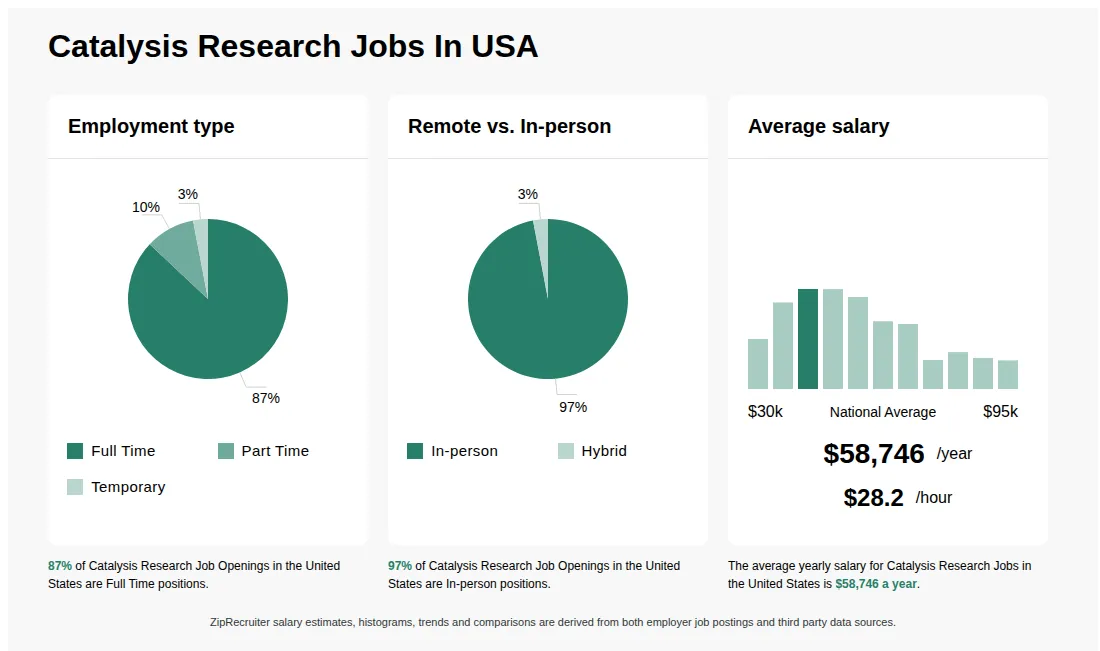
$30K - $35.9K
7% of jobs
$35.9K - $41.8K
13% of jobs
$43.8K is the 25th percentile. Wages below this are outliers.
$41.8K - $47.7K
15% of jobs
$47.7K - $53.6K
15% of jobs
The median wage is $53.9K / yr.
$53.6K - $59.5K
14% of jobs
$59.5K - $65.5K
9% of jobs
$66.9K is the 75th percentile. Wages above this are outliers.
$65.5K - $71.4K
9% of jobs
$71.4K - $77.3K
4% of jobs
$77.3K - $83.2K
5% of jobs
$83.2K - $89.1K
4% of jobs
$89.1K - $95K
4% of jobs
$30K
$58.7K
$95K
How much do catalysis research jobs pay per year?
As of Sep 7, 2026, the average yearly pay for catalysis research in the United States is $58,746.00, according to ZipRecruiter salary data. Most workers in this role earn between $44,000.00 and $70,000.00 per year, depending on experience, location, and employer.
What is catalysis research?
A Catalysis Research job involves studying and developing catalysts that speed up chemical reactions without being consumed. Researchers in this field work to improve catalyst efficiency, selectivity, and durability for applications in industries such as energy, pharmaceuticals, and environmental science. They may conduct experiments, analyze reaction mechanisms, and design new catalytic materials. This role often requires expertise in chemistry, materials science, and chemical engineering.
What are the typical daily responsibilities for someone working in catalysis research?
In Catalysis Research, your daily responsibilities often include designing and conducting experiments, synthesizing and testing catalysts, analyzing reaction data, and documenting your findings. You'll use sophisticated analytical instruments and work both independently and as part of a collaborative research team. The role also involves reviewing scientific literature, contributing to technical reports or publications, and occasionally presenting your work to colleagues or at conferences. This dynamic environment offers the opportunity to tackle scientific challenges and drive innovation in fields such as energy, environmental sustainability, and chemical manufacturing.
What are the key skills and qualifications needed to thrive in catalysis research, and why are they important?
Success in Catalysis Research requires a deep understanding of chemistry, materials science, and reaction mechanisms, often supported by an advanced degree such as a PhD in chemistry or chemical engineering. Familiarity with laboratory instrumentation (e.g., FTIR, GC-MS), analytical software, and safety certifications is essential for daily research activities. Strong analytical thinking, attention to detail, and effective teamwork help researchers excel in complex experimental settings. These competencies are critical for designing experiments, interpreting results, and contributing to innovative solutions in the field.
More about Catalysis Research jobs
What cities are hiring for Catalysis Research jobs?
Cities with the most Catalysis Research job openings:
What are the most commonly searched types of Catalysis Research jobs?
The most popular types of Catalysis Research jobs are:
What states have the most Catalysis Research jobs?
States with the most job openings for Catalysis Research jobs include:
What job categories do people searching Catalysis Research jobs look for?
The top searched job categories for Catalysis Research jobs are:
Full-time
Posted 17 days ago
Job description
About us
We're reverse-engineering the origin of life - one of the great unsolved problems in science, and one we think AI finally makes tractable. We believe that understanding this transition, from geochemistry to biochemistry, will let us orchestrate molecular networks and build systems that are more capable, adaptive, efficient, and intelligent.
If we succeed, the applications are vast: from catalysis and green synthesis to ab initio synthetic biology and programmable matter. Understanding and harnessing these processes could let ten billion of us thrive on this planet, and let us dream that diverse life keeps evolving and thriving beyond it.
We're a small, diverse team of AI engineers, computational scientists, and bench scientists. We hold ourselves to the rigor of a research institute, but we ship like an engineering firm. Global team, HQs in Cambridge, MA and London, UK.
The role
You'll turn quantum-chemistry calculations into kinetic datasets and mechanistic insight our ML models can actually train on. You'll study reaction mechanisms across homogeneous, heterogeneous, and enzymatic systems, and build the protocols that make that data reliable at scale.
What you'll do
Essential experience
Highly preferred
Logistics
Compensation is highly competitive. We're also able to sponsor visas for the right candidate.
We're reverse-engineering the origin of life - one of the great unsolved problems in science, and one we think AI finally makes tractable. We believe that understanding this transition, from geochemistry to biochemistry, will let us orchestrate molecular networks and build systems that are more capable, adaptive, efficient, and intelligent.
If we succeed, the applications are vast: from catalysis and green synthesis to ab initio synthetic biology and programmable matter. Understanding and harnessing these processes could let ten billion of us thrive on this planet, and let us dream that diverse life keeps evolving and thriving beyond it.
We're a small, diverse team of AI engineers, computational scientists, and bench scientists. We hold ourselves to the rigor of a research institute, but we ship like an engineering firm. Global team, HQs in Cambridge, MA and London, UK.
The role
You'll turn quantum-chemistry calculations into kinetic datasets and mechanistic insight our ML models can actually train on. You'll study reaction mechanisms across homogeneous, heterogeneous, and enzymatic systems, and build the protocols that make that data reliable at scale.
What you'll do
- Run DFT and post-HF calculations to study kinetics and mechanism, primarily in homogeneous catalysis
- Build and benchmark reproducible protocols for kinetic data generation, with real uncertainty quantification
- Design kinetic datasets for ML training and validation, and set data-quality standards with ML collaborators
- Extend these methods systematically across catalytic systems and reaction conditions
Essential experience
- PhD in computational or theoretical chemistry with a catalysis focus, and first-author papers on catalytic mechanisms
- Fluency with a production quantum-chemistry package (Gaussian, ORCA, or similar)
- Sound DFT judgment for transition-metal systems: functional choice, basis sets, dispersion corrections
- Hands-on kinetics: transition-state location, IRC, rate constants, free-energy and thermodynamic analysis
- Python and the computational-chemistry stack (ASE, cclib, RDKit)
Highly preferred
- First-author work in homogeneous-catalysis kinetics
- Heterogeneous (periodic DFT, surfaces, adsorption) or enzyme catalysis
- Advanced methods for hard systems: DLPNO-CCSD(T), CASPT2, multireference approaches
- High-throughput workflows, HPC, and automation
- Uncertainty quantification and protocol benchmarking
- Dataset design and prior collaboration with ML teams
Logistics
Compensation is highly competitive. We're also able to sponsor visas for the right candidate.