1

Calibration Supervisor Jobs (NOW HIRING)

Showing results 21-40

Calibration Supervisor information

See salary details

$25.5K

$72.3K

$135.5K

How much do calibration supervisor jobs pay per year?

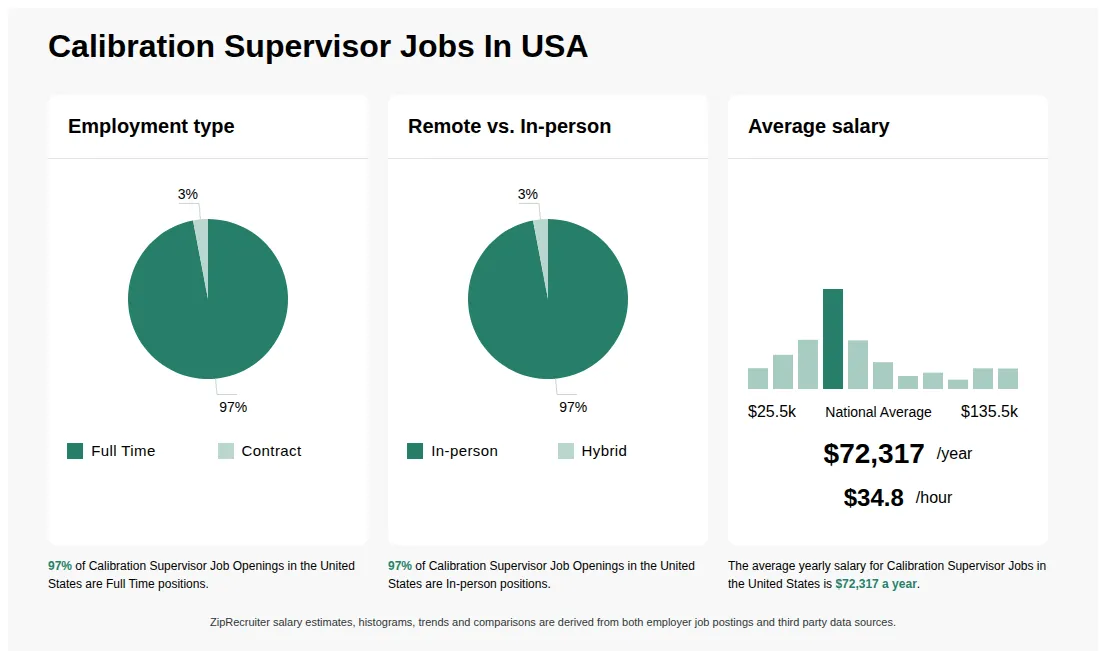
As of Sep 14, 2026, the average yearly pay for calibration supervisor in the United States is $72,317.00, according to ZipRecruiter salary data. Most workers in this role earn between $53,500.00 and $86,500.00 per year, depending on experience, location, and employer.

What does a calibration supervisor do?

A Calibration Supervisor oversees the calibration and maintenance of measurement instruments and equipment to ensure accuracy and compliance with industry standards. They manage a team of technicians, coordinate calibration schedules, and maintain documentation for audits and quality control. This role is essential in industries like manufacturing, aerospace, and healthcare, where precise measurements are critical. Additionally, they ensure adherence to regulatory requirements and continuously improve calibration procedures.

What are the key skills and qualifications needed to thrive as a calibration supervisor?

To excel as a Calibration Supervisor, you typically need in-depth knowledge of metrology, quality assurance procedures, and a background in engineering or a related technical field. Proficiency with calibration management software, familiarity with ISO/IEC 17025 standards, and relevant certifications such as ASQ or NIST are often required. Strong leadership, problem-solving, and communication skills set exceptional supervisors apart. These abilities are crucial for ensuring all equipment meets compliance standards, leading teams effectively, and maintaining consistent quality in calibration processes.

What are some of the main challenges that calibration supervisors face in their day-to-day work?

Calibration Supervisors often encounter challenges such as maintaining strict compliance with quality and industry standards while managing tight deadlines and resource constraints. They coordinate teams to ensure all calibration tasks are completed accurately and documentation is thorough, which requires strong attention to detail and organizational skills. Additionally, supervisors must address unexpected equipment issues or changing priorities, adapting quickly to keep projects on track. Their ability to effectively communicate with technicians, engineers, and quality managers helps ensure smooth operations and resolves issues efficiently.

More about Calibration Supervisor jobs

What are the most commonly searched types of Calibration Supervisor jobs?

The most popular types of Calibration Supervisor jobs are:

What states have the most Calibration Supervisor jobs?

States with the most job openings for Calibration Supervisor jobs include:

What are popular job titles related to Calibration Supervisor jobs?

For Calibration Supervisor jobs, the most frequently searched job titles are:

Infographic showing various Calibration Supervisor job openings in the United States as of September 2026, with employment types broken down into 1% As Needed, 76% Full Time, 20% Part Time, 2% Contract, and 1% Nights. Highlights an 97% Physical, 1% Hybrid, and 2% Remote job distribution, with an average salary of $72,317 per year, or $34.8 per hour.

Calibration Technician -Scottsdale

Scottsdale, AZ

National Calibration
Computer and Electronic Product Manufacturing • 11 - 50 employees

$21.50 - $29.25/hr

Full-time

Re-posted 2 days ago


Job description

National Calibration Inc. was established in 1955, and is a growing full service ISO 17025 Accredited Calibration Laboratory with multiple offices located throughout the Southwestern United States.
Our accredited laboratory provides calibration and repair of test and measurement equipment to include: Electronics, Force, Linear, Torque, Pressure, and Weight.
We are a family owned business based in Scottsdale, AZ that has 35 employees with openings in Albuquerque, NM  and Scottsdale, AZ.

Calibration Technician I will be associated with basic calibration, quality, customer service, and operational requirements associated to the technicians assigned section. Taskings will be done in direct coordination with the Calibration Technicians II and III as well as the Lead Technician of the defined disciplines assigned. Calibration Technician I’s will be responsible for ensuring that they are learning the proper techniques, theory, application, development, quality processes, and upkeep of their training records. Calibration Technician I’s will be required to progress and learn to become a quality oriented productive member of the team.
 JOB RESPONSIBILITIES:

  • Position requires up to 50% or more travel
  • Maintain, repair, and calibrate physical/dimensional and basic electronics test measurement and diagnostic equipment (TMDE) and laboratory standards with experience in all technical areas.
  • Operate under close supervision and achieve technical guidance, as required, from supervisor or higher-level technician.
  • Capture test readings using common instruments such as micrometers and calipers, etc.
  • Develop knowledge of pressure principles, understanding of units of measure, and application of proper techniques and principles to assigned area and discipline.
  •  Learn to review standards and specifications to develop calibration templates, procedures, and set guidelines for approval through QA and in accordance with international standards.
  • Provide Customer Service at a high level and always maintain professionalism while relaying information to Clients and Management.
  • Focus on developing skills for completing calibrations using developed procedures and practices to ensure and understanding of the operation and use of the equipment being serviced.
  • Learn and understand the Quality System and the ISO 17025 standard as it relates to calibration
  • Effectively communicate with other employees in all departments
  • Cleaning and maintenance of lab equipment and lab
  • Perform other duties as requested by the calibration lab manager or lead

PHYSICAL REQUIREMENTS:

  • Frequently required to stand, walk, and reach with hands and arms
  • Occasionally required to sit; climb or balance; and stoop, kneel, crouch, or crawl
  • Frequently lift or move heavy instruments, up to 50 pounds, short distances