Experience in tissue engineering, extracorporeal shock wave therapy, and endogenous stem cell activation is desirable. Outstanding candidates with a MS or PhD degree in biomedical engineering ...
Experience in tissue engineering, extracorporeal shock wave therapy, and endogenous stem cell activation is desirable. Outstanding candidates with a MS or PhD degree in biomedical engineering ...
Experience in tissue engineering, extracorporeal shock wave therapy, and endogenous stem cell activation is desirable. Outstanding candidates with a MS or PhD degree in biomedical engineering ...
Experience in tissue engineering, extracorporeal shock wave therapy, and endogenous stem cell activation is desirable. Outstanding candidates with a MS or PhD degree in biomedical engineering ...

Postdoctoral Research Associate
Gainesville, FL · On-site
$63K - $65K/yr
Ph.D. in Neurobiology, Stem Cell Biology, Biomedical Engineering, Cell Biology, Molecular Biology ... tissue engineering, and advanced multi-omic / bioinformatics integrations to model and dissect ...
Postdoctoral Research Associate
Gainesville, FL · On-site
$63K - $65K/yr
Ph.D. in Neurobiology, Stem Cell Biology, Biomedical Engineering, Cell Biology, Molecular Biology ... tissue engineering, and advanced multi-omic / bioinformatics integrations to model and dissect ...

... medicine including tissue engineering, and molecular imaging. Successful candidates for this ... Internal Medicine, Surgery, Biomedical Engineering, or other relevant departments at USF.
... medicine including tissue engineering, and molecular imaging. Successful candidates for this ... Internal Medicine, Surgery, Biomedical Engineering, or other relevant departments at USF.
... medicine including tissue engineering, and molecular imaging. Successful candidates for this ... Internal Medicine, Surgery, Biomedical Engineering, or other relevant departments at USF.
... medicine including tissue engineering, and molecular imaging. Successful candidates for this ... Internal Medicine, Surgery, Biomedical Engineering, or other relevant departments at USF.
... medicine including tissue engineering, and molecular imaging. Successful candidates for this ... Internal Medicine, Surgery, Biomedical Engineering, or other relevant departments at USF.
... medicine including tissue engineering, and molecular imaging. Successful candidates for this ... Internal Medicine, Surgery, Biomedical Engineering, or other relevant departments at USF.
D. in Computer Science, Biomedical Informatics, Data Science, Biomedical Engineering, Electrical ... Digital pathology and computational tissue analysis * Clinical decision support using EHR data
D. in Computer Science, Biomedical Informatics, Data Science, Biomedical Engineering, Electrical ... Digital pathology and computational tissue analysis * Clinical decision support using EHR data

Collection of tissue, blood or other biological specimens. * Bench chemistry, microbiology ... Bachelor's degree in Biology, Biomedical Sciences, Neuroscience, Engineering, or a related ...
Collection of tissue, blood or other biological specimens. * Bench chemistry, microbiology ... Bachelor's degree in Biology, Biomedical Sciences, Neuroscience, Engineering, or a related ...

RESEARCHER ASSOCIATE
Tampa, FL · On-site
Collection of tissue, blood or other biological specimens. * Bench chemistry, microbiology ... Bachelor's degree in Biology, Biomedical Sciences, Neuroscience, Engineering, or a related ...
RESEARCHER ASSOCIATE
Tampa, FL · On-site
Collection of tissue, blood or other biological specimens. * Bench chemistry, microbiology ... Bachelor's degree in Biology, Biomedical Sciences, Neuroscience, Engineering, or a related ...
... Biomedical Engineering or Neuroscience preferred * Certification and Licensing: N/A * Experience: 4+ years of collective research experience in animal studies (rodent handling), brain tissue ...
... Biomedical Engineering or Neuroscience preferred * Certification and Licensing: N/A * Experience: 4+ years of collective research experience in animal studies (rodent handling), brain tissue ...
Engineer I, Product Development
Miami, FL · On-site
$68K - $86K/yr
... of Good Tissue, Manufacturing and Laboratory Practices (GTP/GMP/GLP). This role primarily ... Bachelor's degree in biomedical, biotechnology, chemical or related engineering field. * 1 or more ...
Engineer I, Product Development
Miami, FL · On-site
$68K - $86K/yr
... of Good Tissue, Manufacturing and Laboratory Practices (GTP/GMP/GLP). This role primarily ... Bachelor's degree in biomedical, biotechnology, chemical or related engineering field. * 1 or more ...
Postdoctoral Associate
Gainesville, FL · On-site
$58K/yr
Computer Science, Engineering Department: 19020000 - EG-MECHANICAL - AEROSPACE ENG Classification ... This position offers a rich opportunity to engage research at the frontier of biomedical and ...
Postdoctoral Associate
Gainesville, FL · On-site
$58K/yr
Computer Science, Engineering Department: 19020000 - EG-MECHANICAL - AEROSPACE ENG Classification ... This position offers a rich opportunity to engage research at the frontier of biomedical and ...

Building Maintenance Technician-Level I
Plantation, FL · On-site
$18 - $24.50/hr
... Pre-Engineering, Biomedical Engineering, Business, and Computer Science, a Science Research ... Refill tissue, paper towels, and soap dispensers. * Dusting - Remove cobwebs from the ceiling and ...
Quick apply
Building Maintenance Technician-Level I
Plantation, FL · On-site
$18 - $24.50/hr
... Pre-Engineering, Biomedical Engineering, Business, and Computer Science, a Science Research ... Refill tissue, paper towels, and soap dispensers. * Dusting - Remove cobwebs from the ceiling and ...
School Janitor
Plantation, FL · On-site
$14.25 - $19/hr
... Pre-Engineering, Biomedical Engineering, Business, and Computer Science, a Science Research ... Refill tissue, paper towels, and soap dispensers. * Dusting - Remove cobwebs from the ceiling and ...
Quick apply
School Janitor
Plantation, FL · On-site
$14.25 - $19/hr
... Pre-Engineering, Biomedical Engineering, Business, and Computer Science, a Science Research ... Refill tissue, paper towels, and soap dispensers. * Dusting - Remove cobwebs from the ceiling and ...
Biomedical Tissue Engineering information
See Florida salary details
$30.6K - $37.4K
6% of jobs
$37.4K - $44.1K
12% of jobs
$44.1K - $50.8K
5% of jobs
$54.2K is the 25th percentile. Wages below this are outliers.
$50.8K - $57.5K
3% of jobs
$57.5K - $64.3K
13% of jobs
$64.3K - $71K
7% of jobs
The median wage is $72.1K / yr.
$71K - $77.7K
19% of jobs
$83.4K is the 75th percentile. Wages above this are outliers.
$77.7K - $84.4K
11% of jobs
$84.4K - $91.2K
12% of jobs
$91.2K - $97.9K
4% of jobs
$97.9K - $104.6K
7% of jobs
$30.6K
$70.8K
$104.6K
How much do biomedical tissue engineering jobs pay per year?
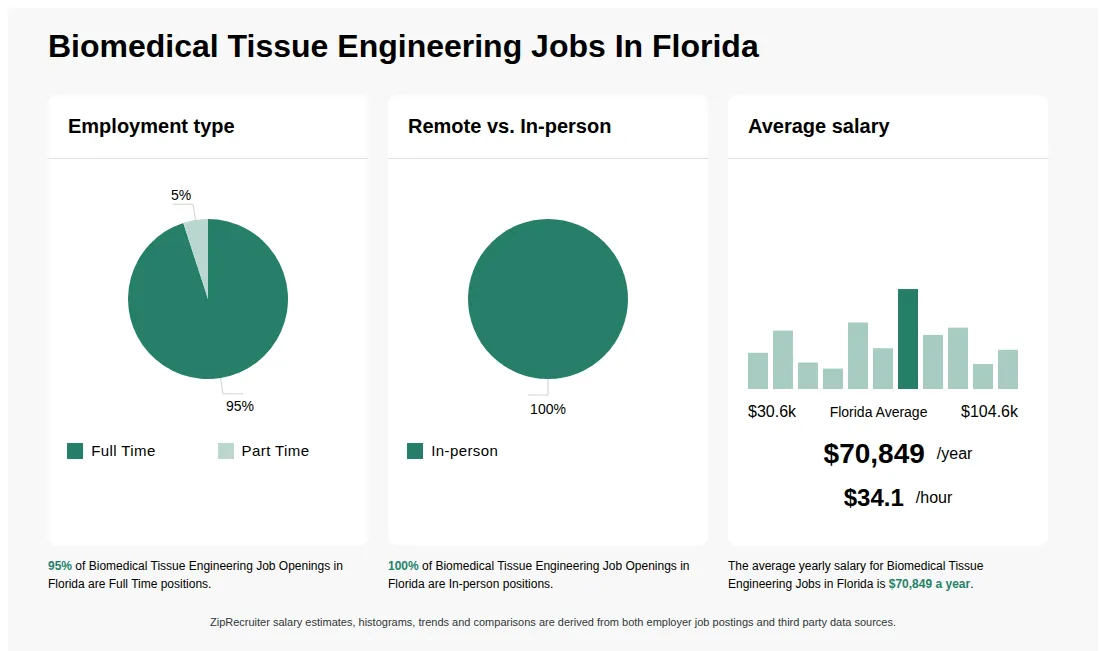
As of Sep 14, 2026, the average yearly pay for biomedical tissue engineering in Florida is $70,849.00, according to ZipRecruiter salary data. Most workers in this role earn between $55,700.00 and $86,700.00 per year, depending on experience, location, and employer.
What is biomedical tissue engineering?
Biomedical tissue engineering is a field of science and engineering focused on developing biological substitutes to restore, maintain, or improve the function of damaged tissues or organs. It combines principles from biology, engineering, materials science, and medicine to create scaffolds, cells, and biologically active molecules. These engineered tissues can be used for research, drug testing, or transplantation. The goal is to provide alternatives to traditional organ transplants and help address the shortage of donor tissues.
What are the key skills and qualifications needed to thrive as a biomedical tissue engineer, and why are they important?
To thrive as a Biomedical Tissue Engineer, you need a strong background in biology, biomaterials, and engineering principles, often supported by a degree in biomedical engineering or a related field. Familiarity with tissue culture techniques, CAD software, 3D bioprinting, and regulatory standards is commonly required. Strong problem-solving, collaboration, and communication skills help you excel in multidisciplinary teams and research environments. These competencies are crucial for developing innovative therapies and ensuring the safety and effectiveness of tissue-engineered products.
What are some common challenges faced by professionals in biomedical tissue engineering, and how can they be addressed?
Professionals in biomedical tissue engineering often encounter challenges such as ensuring the biocompatibility of materials, achieving successful integration of engineered tissues with host tissues, and managing complex multidisciplinary projects. Addressing these challenges typically involves close collaboration with biologists, clinicians, and materials scientists, as well as staying current with advances in biomaterials and regenerative medicine. Continuous learning, effective communication, and a problem-solving mindset are key to overcoming these hurdles and contributing to successful project outcomes.
What is the difference between Biomedical Tissue Engineering vs Biomedical Research Scientist?
| Aspect | Biomedical Tissue Engineering | Biomedical Research Scientist |
|---|---|---|
| Required Credentials | Degree in biomedical engineering, tissue engineering, or related fields | Degree in biology, biochemistry, or related sciences |
| Work Environment | Laboratories, research facilities, clinical settings | Laboratories, research institutions, hospitals |
| Employer & Industry | Medical device companies, biotech firms, research institutes | Universities, government agencies, biotech companies |
| Common Search & Comparison | Focus on developing tissue scaffolds, regenerative therapies | Focus on understanding biological processes, drug development |
Biomedical Tissue Engineering primarily involves designing and developing biological tissues and regenerative solutions, often requiring engineering and biological expertise. In contrast, Biomedical Research Scientists focus on understanding biological mechanisms and developing new therapies through scientific research. While both roles work in biomedical settings, their core objectives and skill sets differ, making this comparison relevant for those exploring careers in biomedical sciences.
What can you do with biomedical tissue engineering?
Biomedical tissue engineering professionals develop artificial tissues and organs for medical applications, such as regenerative therapies, transplantation, and disease modeling. They work with biomaterials, cell cultures, and bioreactors, often requiring knowledge of biology, materials science, and laboratory techniques. Careers can include research, product development, and clinical implementation in healthcare settings.
What are popular job titles related to Biomedical Tissue Engineering jobs in Florida?
For Biomedical Tissue Engineering jobs in Florida, the most frequently searched job titles are:
What job categories do people searching Biomedical Tissue Engineering jobs in Florida look for?
The top searched job categories for Biomedical Tissue Engineering jobs in Florida are:

Urology- Research Asst Professor
Miami, FL • On-site
The University of Miami
• Colleges, Universities, and Professional Schools • 10K+ employees10,000+ employees
Full-time
Re-posted 23 days ago
University Of Miami rating

7.7
Based on 52 frontline employees who took The Breakroom Quiz
Job description
Current Employees:
If you are a current Staff, Faculty or Temporary employee at the University of Miami, please click here to log in to Workday to use the internal application process. To learn how to apply for a faculty or staff position using the Career worklet, please review this tip sheet.
Research Assistant Professor Positions (Research Track)
The Department of Biomedical Engineering (BME) in the University of Miami (UM) College of Engineering, the Desai Sethi Urology Institute and the Miami Project to cure paralysis at UM Health system have multiple exciting opportunities for Research Assistant Professors, with the earliest start date of June 01, 2024. These positions are sponsored by multiple NIH Research Grants and UM to continue long-term research projects in the laboratory of Prof. Yingchun Zhang.
Zhang's research aims to achieve the long-term goal of advancing Precision Rehabilitation. This will be accomplished through the comprehensive and quantitative assessment of dynamic activation and interactions of the brain, muscles, and brain-to-muscle pathways, using a combination of multimodal neuroimaging, neuroengineering, and neuromodulation techniques. Current research is dedicated to the advancement of innovative technologies aimed at achieving quantitative and precise diagnosis, phenotyping, and personalized treatment for a variety of neurological, neurodegenerative, and neuromuscular conditions. These conditions encompass psychiatric disorders, Alzheimer's disease (AD), stroke, spinal cord injury, pelvic floor dysfunctions, as well as the resultant movement disorders and pain conditions.
The Research Assistant Professor will primarily work with Prof. Zhang and will also be embedded in the multidisciplinary team of investigators from BME at UM, and scientists/clinicians from the Desai Sethi Urology Institute and the Miami Project to cure paralysis at UM Health system. The position provides faculty level salary support, benefits, and a platform for professional growth including grant writing.
Position Description and Requirements:
Multimodal neuroimaging and neuroengineering: Developing novel technologies in precision diagnosis, phenotyping and personalized treatment of movement disorders, neuromuscular diseases and pain including the chronic pelvic pain. Experience in surface and intracranial EEG, ECoG, EMG, and/or tACS is desirable. Multimodal neuroimaging and neuromodulation: Developing novel techniques in precision diagnosis, phenotyping and personalized treatment of psychiatric disorders and Alzheimer's disease. Experience in surface and intracranial EEG, ECoG NIRS, MRI, TMS and/or Transcranial Focused Ultrasound is desirable. Regenerative rehabilitation: Developing regenerative therapies to enhance reduced muscle mass, restore impaired muscle innervation and co,ordination in conjunction with rehabilitative interventions. Experience in tissue engineering, extracorporeal shock wave therapy, and endogenous stem cell activation is desirable.
Outstanding candidates with a MS or PhD degree in biomedical engineering, electrical engineering or relevant field, and strong publication records in relevant journals and outstanding writing and oral communication skills are encouraged to apply. Postdoctoral research experience is preferred.
Interested applicants should send a curriculum vitae, statement describing research accomplishments and future research goals, relevant reprints, and the names of three references to y.zhang@miami.edu.
Current Employees:
If you are a current Staff, Faculty or Temporary employee at the University of Miami, please click here to log in to Workday to use the internal application process. To learn how to apply for a faculty or staff position using the Career worklet, please review this tip sheet.
Job Status:
Full time
Employee Type:
Faculty
If you are a current Staff, Faculty or Temporary employee at the University of Miami, please click here to log in to Workday to use the internal application process. To learn how to apply for a faculty or staff position using the Career worklet, please review this tip sheet.
Research Assistant Professor Positions (Research Track)
The Department of Biomedical Engineering (BME) in the University of Miami (UM) College of Engineering, the Desai Sethi Urology Institute and the Miami Project to cure paralysis at UM Health system have multiple exciting opportunities for Research Assistant Professors, with the earliest start date of June 01, 2024. These positions are sponsored by multiple NIH Research Grants and UM to continue long-term research projects in the laboratory of Prof. Yingchun Zhang.
Zhang's research aims to achieve the long-term goal of advancing Precision Rehabilitation. This will be accomplished through the comprehensive and quantitative assessment of dynamic activation and interactions of the brain, muscles, and brain-to-muscle pathways, using a combination of multimodal neuroimaging, neuroengineering, and neuromodulation techniques. Current research is dedicated to the advancement of innovative technologies aimed at achieving quantitative and precise diagnosis, phenotyping, and personalized treatment for a variety of neurological, neurodegenerative, and neuromuscular conditions. These conditions encompass psychiatric disorders, Alzheimer's disease (AD), stroke, spinal cord injury, pelvic floor dysfunctions, as well as the resultant movement disorders and pain conditions.
The Research Assistant Professor will primarily work with Prof. Zhang and will also be embedded in the multidisciplinary team of investigators from BME at UM, and scientists/clinicians from the Desai Sethi Urology Institute and the Miami Project to cure paralysis at UM Health system. The position provides faculty level salary support, benefits, and a platform for professional growth including grant writing.
Position Description and Requirements:
Multimodal neuroimaging and neuroengineering: Developing novel technologies in precision diagnosis, phenotyping and personalized treatment of movement disorders, neuromuscular diseases and pain including the chronic pelvic pain. Experience in surface and intracranial EEG, ECoG, EMG, and/or tACS is desirable. Multimodal neuroimaging and neuromodulation: Developing novel techniques in precision diagnosis, phenotyping and personalized treatment of psychiatric disorders and Alzheimer's disease. Experience in surface and intracranial EEG, ECoG NIRS, MRI, TMS and/or Transcranial Focused Ultrasound is desirable. Regenerative rehabilitation: Developing regenerative therapies to enhance reduced muscle mass, restore impaired muscle innervation and co,ordination in conjunction with rehabilitative interventions. Experience in tissue engineering, extracorporeal shock wave therapy, and endogenous stem cell activation is desirable.
Outstanding candidates with a MS or PhD degree in biomedical engineering, electrical engineering or relevant field, and strong publication records in relevant journals and outstanding writing and oral communication skills are encouraged to apply. Postdoctoral research experience is preferred.
Interested applicants should send a curriculum vitae, statement describing research accomplishments and future research goals, relevant reprints, and the names of three references to y.zhang@miami.edu.
Current Employees:
If you are a current Staff, Faculty or Temporary employee at the University of Miami, please click here to log in to Workday to use the internal application process. To learn how to apply for a faculty or staff position using the Career worklet, please review this tip sheet.
Job Status:
Full time
Employee Type:
Faculty
What University Of Miami employees say
Pay
Benefits
Hours and flexibility
Workplace
Get the full story on Breakroom

About University of Miami
Sourced by ZipRecruiter
The University of Miami, located in the beautiful Coral Gables, Florida, is a comprehensive, private research institution in the United States. Operating within the higher education industry, the institution offers a multitude of degree programs spanning over 180 majors and program through its 12 colleges. The University was founded in 1925 with the mission to disseminate knowledge, transform lives, and change the world - a mission it has held faithfully to this day. Notably, the University of Miami has gained global recognition for its commitment to research and innovation, with over $324 million in research and sponsored project funding awarded annually.
Industry
Colleges, universities, and professional schools
Company size
10,000+ Employees
Headquarters location
Coral Gables, FL, US
Year founded
1925