1

Biomedical Machine Learning Jobs in Texas (NOW HIRING)

next page

Showing results 1-20

Biomedical Machine Learning information

See Texas salary details

$14

$26

$36

How much do biomedical machine learning jobs pay per hour?

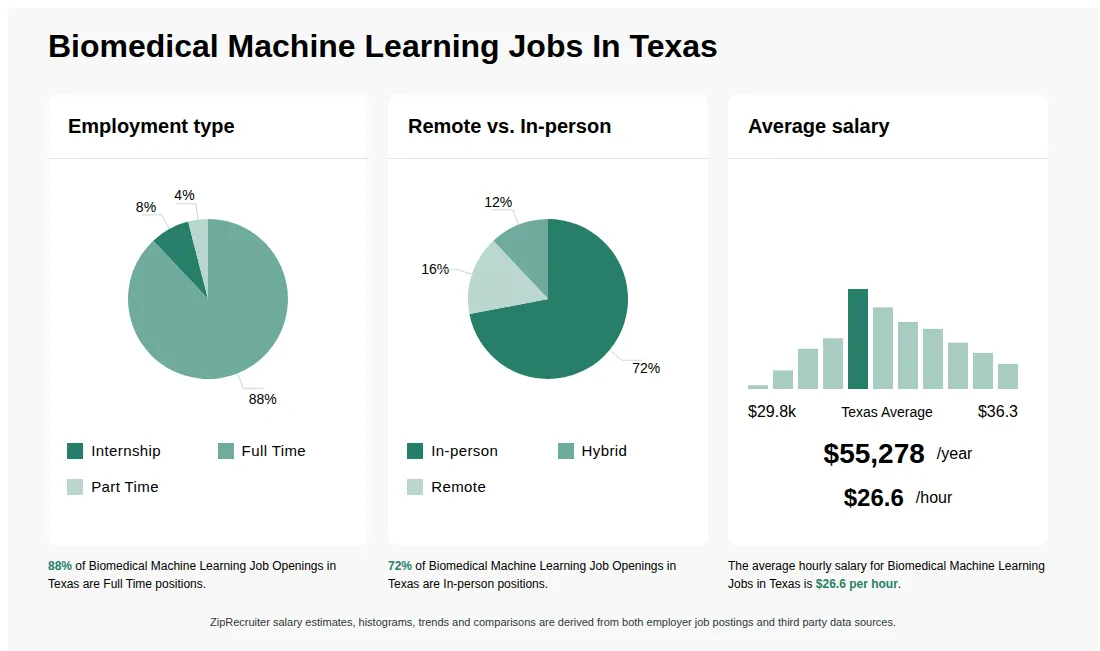
As of Jun 29, 2026, the average hourly pay for biomedical machine learning in Texas is $26.58, according to ZipRecruiter salary data. Most workers in this role earn between $22.60 and $30.00 per hour, depending on experience, location, and employer.

What is a Biomedical Machine Learning job?

A Biomedical Machine Learning job involves developing and applying machine learning algorithms to analyze biomedical data for healthcare and research applications. Professionals in this field work with medical imaging, genomics, electronic health records, and wearable device data to improve disease diagnosis, treatment, and patient outcomes. They collaborate with researchers, clinicians, and data scientists to design predictive models and extract insights from complex biological data. This role requires expertise in machine learning, data processing, and domain-specific knowledge in healthcare or life sciences.

What does a typical day look like for someone in a Biomedical Machine Learning role?

A typical day in Biomedical Machine Learning involves cleaning and preparing biomedical datasets, developing or refining machine learning models, running experiments, and interpreting results in collaboration with domain experts such as bioinformaticians and clinicians. Professionals often participate in team meetings to discuss project goals, share insights, and adjust research directions based on feedback. The role may also involve reading scientific literature to stay current with new methodologies and contributing to academic publications or technical documentation. Working closely with both technical and healthcare-focused colleagues, you'll help translate data-driven insights into meaningful biomedical solutions that impact patient care or research outcomes.

What are the key skills and qualifications needed to thrive in the Biomedical Machine Learning position, and why are they important?

To thrive in Biomedical Machine Learning, you need a solid background in statistics, machine learning, programming (Python or R), and a strong understanding of biological or medical data, often supported by advanced degrees in computer science, biomedical engineering, or related fields. Experience with frameworks like TensorFlow, PyTorch, and familiarity with biomedical datasets is highly valued, and certifications in data science or biomedical informatics can be advantageous. Strong analytical thinking, communication skills, and the ability to collaborate with interdisciplinary teams are crucial soft skills. These competencies are vital to developing robust models that address complex healthcare challenges while ensuring scientific rigor and regulatory compliance.


What are the most commonly searched types of Biomedical Machine Learning jobs in Texas? The most popular types of Biomedical Machine Learning jobs in Texas are:
What cities in Texas are hiring for Biomedical Machine Learning jobs? Cities in Texas with the most Biomedical Machine Learning job openings:
Infographic showing various Biomedical Machine Learning job openings in Texas as of June 2026, with employment types broken down into 2% As Needed, 7% Full Time, 85% Part Time, 2% Temporary, and 4% Contract. Highlights an 87% Physical, 2% Hybrid, and 11% Remote job distribution, with an average salary of $55,278 per year, or $26.6 per hour.

Data Scientist - Innovation - PhD (Irving, TX)

Caris Life Sciences

Irving, TX • On-site

Full-time

Posted 20 days ago


Job description

Job Summary:
Caris Life Sciences is transforming cancer care through precision medicine and cutting-edge molecular science. As a Data Scientist on the Innovation Team, you will develop machine learning and deep learning algorithms on molecular sequencing data to improve cancer diagnostics and treatment.
Responsibilities:
• Processing, manipulating, and analyzing large diverse datasets generated from NGS to develop biomarkers for cancer diagnosis, prognosis, and treatment.
• Developing novel algorithms for feature extraction and biomarker discovery from molecular sequencing data.
• Applying first-principles analysis to translate open research questions into tractable, well-defined problems.
• Applying state-of-the-art machine learning and deep learning methods to biological and clinical research questions.
• Creating rigorous evaluation frameworks and tracking experiments systematically using tools such as MLflow or Weights & Biases.
• Authoring peer-reviewed research publications and presenting findings at scientific conferences.
Qualifications:
Required:
• PhD in Data Science, Bioinformatics, Computational Biology, Genomics, Statistics, Computer Science, Engineering, Biophysics, or a related quantitative or biological field.
• PhD recently completed, or up to approximately 2 years of post-doctoral research experience (academic or industry).
• Demonstrated work on a cancer biology or translational research problem (PhD thesis chapter, peer-reviewed publication, or postdoc / industry role).
• Hands-on experience with molecular sequencing data (e.g., WGS, WES, RNA-seq, cfDNA) including production-grade pipelines and analysis.
• Hands-on experience with generative AI -- large language models, foundation models (e.g., genomic or protein language models), or agentic workflows applied to scientific or clinical data.
• Proficiency with PyTorch and modern deep learning architectures (transformers, attention mechanisms), with demonstrated application of ML/DL to biological or clinical data.
• First-author or co-first-author peer-reviewed publications in machine learning venues (e.g., NeurIPS, ICML, ICLR) or in bioinformatics / computational biology journals.
• Strong Python; comfortable in Linux; proficient with git and collaborative workflows.
Preferred:
• Multi-omics integration experience (genomics, transcriptomics, proteomics, methylation, etc.).
• Experience with epigenetics -- DNA methylation analysis, chromatin biology, or related.
• Interest in cell-free DNA, liquid biopsy, and next-generation early cancer diagnostics.
• Interest in novel algorithm development for biomedical signal extraction in sequencing data.
• Proficiency in cloud platforms (AWS EC2, S3, HealthOmics) and containerization (Docker).
Company:
Caris Life Sciences develops molecular profiling and AI-driven technologies to support precision medicine in oncology. Founded in 2008, the company is headquartered in Irving, USA, with a team of 1001-5000 employees. The company is currently Late Stage.