Intern/Aide - Part-time
$14.25 - $19/hr
Summary The intern/aide will receive training on machine learning algorithms, implementing them ... or biomedical sciences. * Strong skills in computer science and programming (algorithm ...
$14.25 - $19/hr
Summary The intern/aide will receive training on machine learning algorithms, implementing them ... or biomedical sciences. * Strong skills in computer science and programming (algorithm ...
$14.25 - $19/hr
Summary The intern/aide will receive training on machine learning algorithms, implementing them ... or biomedical sciences. * Strong skills in computer science and programming (algorithm ...
Houston, TX · On-site
$16 - $20/hr
... biomedical sciences. * Strong skills in computer science and programming (algorithm implementation, data structure, and machine learning). * Familiarity with cutting-edge models such as foundation ...
Houston, TX · On-site
$16 - $20/hr
... biomedical sciences. * Strong skills in computer science and programming (algorithm implementation, data structure, and machine learning). * Familiarity with cutting-edge models such as foundation ...
Dallas, TX · On-site
Peifeng Ruan ( at the Quantitative Biomedical Research Center (QBRC) in the Peter O'Donnell Jr. ... D. in computer science, bioinformatics, data science, machine learning, or a related quantitative ...
Dallas, TX · On-site
Peifeng Ruan ( at the Quantitative Biomedical Research Center (QBRC) in the Peter O'Donnell Jr. ... D. in computer science, bioinformatics, data science, machine learning, or a related quantitative ...
Peifeng Ruan ( at the Quantitative Biomedical Research Center (QBRC) in the Peter O'Donnell Jr. ... D. in computer science, bioinformatics, data science, machine learning, or a related quantitative ...
Peifeng Ruan ( at the Quantitative Biomedical Research Center (QBRC) in the Peter O'Donnell Jr. ... D. in computer science, bioinformatics, data science, machine learning, or a related quantitative ...
The Quantitative Biomedical Research Center (QBRC) is a well-established interdisciplinary research center at UT Southwestern that brings together experts in artificial intelligence, machine learning ...
The Quantitative Biomedical Research Center (QBRC) is a well-established interdisciplinary research center at UT Southwestern that brings together experts in artificial intelligence, machine learning ...
San Antonio, TX · On-site
$80 - $110/hr
Identify and pursue new research directions for current and emerging technologies in machine learning, data science and analytics, biomedical engineering, neuromorphic processing, and human ...
San Antonio, TX · On-site
$80 - $110/hr
Identify and pursue new research directions for current and emerging technologies in machine learning, data science and analytics, biomedical engineering, neuromorphic processing, and human ...
The Quantitative Biomedical Research Center (QBRC) is a well-established interdisciplinary research center at UT Southwestern that brings together experts in artificial intelligence, machine learning ...
The Quantitative Biomedical Research Center (QBRC) is a well-established interdisciplinary research center at UT Southwestern that brings together experts in artificial intelligence, machine learning ...
Houston, TX · On-site
$72.36 - $88.44/hr
Research experience in computational imaging, biomedical imaging, biophotonics, microscopy, optical system design, machine learning, or related areas. * Experience designing, developing, fabricating ...
Houston, TX · On-site
$72.36 - $88.44/hr
Research experience in computational imaging, biomedical imaging, biophotonics, microscopy, optical system design, machine learning, or related areas. * Experience designing, developing, fabricating ...
Specific focus areas of research are open but may include application of artificial intelligence, machine learning and data science. About the Department of Biomedical Engineering The UTSW Department ...
Specific focus areas of research are open but may include application of artificial intelligence, machine learning and data science. About the Department of Biomedical Engineering The UTSW Department ...
Austin, TX · On-site
Evidence of exceptional ability in neuroscience, biomedical engineering, electrical engineering, machine learning, or a related field * 4+ years of academic or industry experience * A strong ...
Austin, TX · On-site
Evidence of exceptional ability in neuroscience, biomedical engineering, electrical engineering, machine learning, or a related field * 4+ years of academic or industry experience * A strong ...
Dallas, TX · On-site
Specific focus areas of research are open but may include application of artificial intelligence, machine learning and data science. About the Department of Biomedical Engineering The UTSW Department ...
Dallas, TX · On-site
Specific focus areas of research are open but may include application of artificial intelligence, machine learning and data science. About the Department of Biomedical Engineering The UTSW Department ...
Dallas, TX · On-site
$80 - $100/hr
... biomedical engineering, or a related field and enjoys learning and stepping into new challenges. A strong foundation in signal processing, time-frequency analysis, deep learning, and machine learning ...
Dallas, TX · On-site
$80 - $100/hr
... biomedical engineering, or a related field and enjoys learning and stepping into new challenges. A strong foundation in signal processing, time-frequency analysis, deep learning, and machine learning ...
You'll develop and evaluate state-of-the-art AI and machine learning approaches, build and maintain ... Other Other duties as assigned Education Required: • Bachelor's Degree in Biomedical Engineering ...
New
You'll develop and evaluate state-of-the-art AI and machine learning approaches, build and maintain ... Other Other duties as assigned Education Required: • Bachelor's Degree in Biomedical Engineering ...
New
Austin, TX · On-site
$47K/yr
Analyze research data using signal processing, machine learning, statistical methods, and other ... Bachelor's degree in Electrical and Computer Engineering, Biomedical Engineering, Neuroscience, or ...
Austin, TX · On-site
$47K/yr
Analyze research data using signal processing, machine learning, statistical methods, and other ... Bachelor's degree in Electrical and Computer Engineering, Biomedical Engineering, Neuroscience, or ...
Houston, TX · On-site
$64K - $76K/yr
The fellow will expand their knowledge and skills in machine learning, reinforcement learning, and ... Dr. Paolucci is a Biomedical Engineer with a Computer Science background, and his research ...
Houston, TX · On-site
$64K - $76K/yr
The fellow will expand their knowledge and skills in machine learning, reinforcement learning, and ... Dr. Paolucci is a Biomedical Engineer with a Computer Science background, and his research ...
The fellow will expand their knowledge and skills in machine learning, reinforcement learning, and ... Dr. Paolucci is a Biomedical Engineer with a Computer Science background, and his research ...
The fellow will expand their knowledge and skills in machine learning, reinforcement learning, and ... Dr. Paolucci is a Biomedical Engineer with a Computer Science background, and his research ...
Houston, TX · On-site
$64K - $76K/yr
The fellow will expand their knowledge and skills in machine learning, reinforcement learning, and ... Dr. Paolucci is a Biomedical Engineer with a Computer Science background, and his research ...
Houston, TX · On-site
$64K - $76K/yr
The fellow will expand their knowledge and skills in machine learning, reinforcement learning, and ... Dr. Paolucci is a Biomedical Engineer with a Computer Science background, and his research ...
Houston, TX · On-site
$64K - $76K/yr
The fellow will expand their knowledge and skills in machine learning, reinforcement learning, and ... Dr. Paolucci is a Biomedical Engineer with a Computer Science background, and his research ...
Houston, TX · On-site
$64K - $76K/yr
The fellow will expand their knowledge and skills in machine learning, reinforcement learning, and ... Dr. Paolucci is a Biomedical Engineer with a Computer Science background, and his research ...
Houston, TX · On-site
$64 - $76/hr
The fellow will expand their knowledge and skills in machine learning, reinforcement learning, and ... Dr. Paolucci is a Biomedical Engineer with a Computer Science background, and his research ...
Houston, TX · On-site
$64 - $76/hr
The fellow will expand their knowledge and skills in machine learning, reinforcement learning, and ... Dr. Paolucci is a Biomedical Engineer with a Computer Science background, and his research ...
... Biomedical Informatics, Data Science, or Engineering to join the lab as Graduate Research ... Implement and benchmark baseline machine learning algorithms for various predictive modeling tasks ...
... Biomedical Informatics, Data Science, or Engineering to join the lab as Graduate Research ... Implement and benchmark baseline machine learning algorithms for various predictive modeling tasks ...
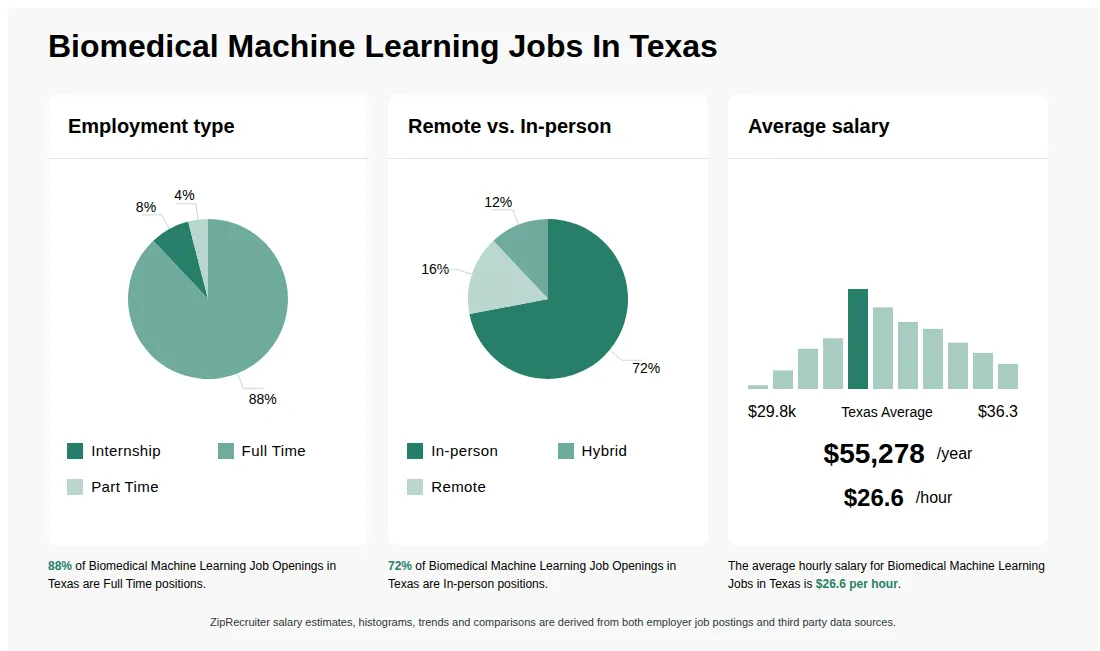
$14.33 - $16.33
0% of jobs
$16.33 - $18.32
3% of jobs
$18.32 - $20.32
8% of jobs
$20.32 - $22.31
10% of jobs
$22.79 is the 25th percentile. Wages below this are outliers.
$22.31 - $24.31
19% of jobs
The median wage is $25.57 / hr.
$24.31 - $26.30
16% of jobs
$26.30 - $28.30
13% of jobs
$29.34 is the 75th percentile. Wages above this are outliers.
$28.30 - $30.30
12% of jobs
$30.30 - $32.29
9% of jobs
$32.29 - $34.29
6% of jobs
$34.29 - $36.28
4% of jobs
$14
$26
$36
A Biomedical Machine Learning job involves developing and applying machine learning algorithms to analyze biomedical data for healthcare and research applications. Professionals in this field work with medical imaging, genomics, electronic health records, and wearable device data to improve disease diagnosis, treatment, and patient outcomes. They collaborate with researchers, clinicians, and data scientists to design predictive models and extract insights from complex biological data. This role requires expertise in machine learning, data processing, and domain-specific knowledge in healthcare or life sciences.
A typical day in Biomedical Machine Learning involves cleaning and preparing biomedical datasets, developing or refining machine learning models, running experiments, and interpreting results in collaboration with domain experts such as bioinformaticians and clinicians. Professionals often participate in team meetings to discuss project goals, share insights, and adjust research directions based on feedback. The role may also involve reading scientific literature to stay current with new methodologies and contributing to academic publications or technical documentation. Working closely with both technical and healthcare-focused colleagues, you'll help translate data-driven insights into meaningful biomedical solutions that impact patient care or research outcomes.
To thrive in Biomedical Machine Learning, you need a solid background in statistics, machine learning, programming (Python or R), and a strong understanding of biological or medical data, often supported by advanced degrees in computer science, biomedical engineering, or related fields. Experience with frameworks like TensorFlow, PyTorch, and familiarity with biomedical datasets is highly valued, and certifications in data science or biomedical informatics can be advantageous. Strong analytical thinking, communication skills, and the ability to collaborate with interdisciplinary teams are crucial soft skills. These competencies are vital to developing robust models that address complex healthcare challenges while ensuring scientific rigor and regulatory compliance.
The most popular types of Biomedical Machine Learning jobs in Texas are:
For Biomedical Machine Learning jobs in Texas, the most frequently searched job titles are:
The top searched job categories for Biomedical Machine Learning jobs in Texas are:
Cities in Texas with the most Biomedical Machine Learning job openings:

$14.25 - $19/hr
Part-time, Internship
Re-posted 26 days ago
8.0
Based on 24 frontline employees who took The Breakroom Quiz
191st of 631 rated colleges and universities
The intern/aide will receive training on machine learning algorithms, implementing them, and fitting them on the datasets in the cluster computers. Overall, the position will offer great exposure to genomic data science and advanced machine learning. The PI will identify the specific datasets and machine learning algorithms. The intern will implement the algorithms in Python/R and fit them on the datasets in the cluster computers. This is part-time position, 16 hours/week.
Get the full story on Breakroom

Sourced by ZipRecruiter
Colleges, universities, and professional schools
5,001 - 10,000 Employees
Houston, TX, US
1900





