1

Avma Jobs (NOW HIRING)

AVMA PLIT liability insurance is free for all student members of the AVMA. You may apply for this coverage on their website. Please check to make sure your coverage is current and submit a ...

AVMA PLIT liability insurance is free for all student members of the AVMA. You may apply for this coverage on their website. Please check to make sure your coverage is current and submit a ...

AVMA PLIT liability insurance is free for all student members of the AVMA. You may apply for this coverage on their website. Please check to make sure your coverage is current and submit a ...

AVMA PLIT liability insurance is free for all student members of the AVMA. You may apply for this coverage on their website. Please check to make sure your coverage is current and submit a ...

AVMA PLIT liability insurance is free for all student members of the AVMA. You may apply for this coverage on their website. Please check to make sure your coverage is current and submit a ...

Be Seen First

Ensuring that the AVMA Committee on Veterinary Technician Education and Activities (CVTEA) essential skills are taught and properly documented in our online competency tracking system * Participating ...

next page

Showing results 1-20

Avma information

See salary details

$67.5K

$95.8K

$136.5K

How much do avma jobs pay per year?

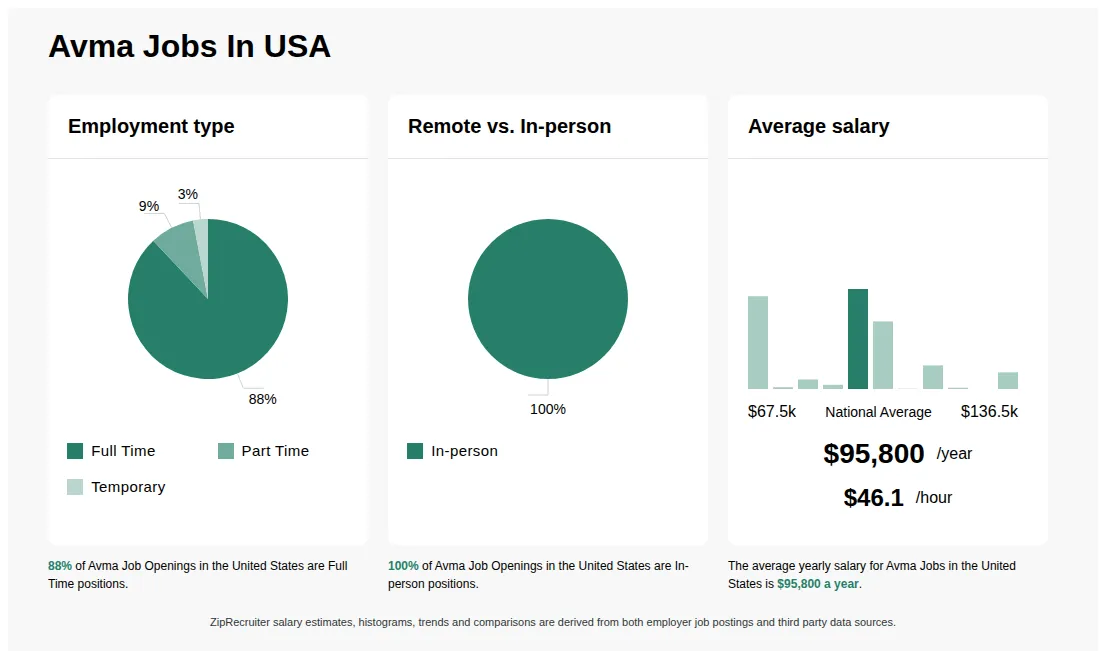
As of Jun 4, 2026, the average yearly pay for avma in the United States is $95,800.00, according to ZipRecruiter salary data. Most workers in this role earn between $69,500.00 and $98,500.00 per year, depending on experience, location, and employer.

What is an AVMA job?

An AVMA job typically refers to a position associated with the American Veterinary Medical Association (AVMA) or roles that align with veterinary medicine standards set by the AVMA. These jobs can include veterinarians, veterinary technicians, researchers, and other animal healthcare professionals. AVMA ensures high-quality veterinary practices through accreditation, education, and advocacy. Many AVMA-associated jobs require specialized training and adherence to ethical guidelines.

What are the key skills and qualifications needed to thrive as a veterinarian (as represented by AVMA members), and why are they important?

To thrive as a veterinarian, you need a Doctor of Veterinary Medicine (DVM) degree, relevant licensure, and a strong foundation in animal health, diagnostics, and surgical procedures. Familiarity with laboratory diagnostic tools, practice management software, and continuing education certifications is also important. Compassion, strong communication, and problem-solving skills help veterinarians effectively interact with clients and manage animal care. These skills ensure the delivery of high-quality veterinary services, client trust, and the well-being of animal patients.

What are some unique challenges an AVMA (American Veterinary Medical Association) staff member might face when supporting veterinary professionals?

As an AVMA staff member, one common challenge is staying up-to-date with rapidly evolving veterinary practices and regulatory changes to provide accurate resources and advocacy. Staff often work closely with a diverse membership, requiring strong communication skills to address the varied needs of veterinarians, students, and technicians. Additionally, balancing administrative responsibilities with member support and policy development can be demanding, but it offers valuable opportunities to contribute to the advancement of animal health and veterinary standards.

What are AVMA veterinarians?

AVMA veterinarians are licensed professionals who are members of the American Veterinary Medical Association (AVMA), a leading organization representing veterinarians in the United States. These veterinarians work to protect animal and human health by providing medical care, performing surgeries, diagnosing diseases, and advising on animal welfare. AVMA membership signifies a commitment to high standards in veterinary medicine, continuing education, and ethical practice. Members also benefit from resources, advocacy, and professional development opportunities provided by the AVMA.

What is the difference between Avma vs Veterinary Technician?

AspectAvmaVeterinary Technician
CredentialsNot applicable (organization)Licensed or certified, usually requiring an associate degree and passing a credential exam
Work EnvironmentProfessional organization setting, advocacy, and policyVeterinary clinics, hospitals, labs, assisting veterinarians
Industry UsageRepresents the American Veterinary Medical Association, a professional bodyHands-on animal care and support roles in veterinary practices

The AVMA (American Veterinary Medical Association) is a professional organization representing veterinarians, focusing on advocacy, education, and policy. A Veterinary Technician, on the other hand, is a trained healthcare professional working directly with animals in veterinary clinics. While AVMA sets standards and provides resources, Veterinary Technicians perform clinical tasks to support veterinarians in animal care.


What cities are hiring for Avma jobs? Cities with the most Avma job openings:
What are the most commonly searched types of Avma jobs? The most popular types of Avma jobs are:
What states have the most Avma jobs? States with the most job openings for Avma jobs include:
What job categories do people searching Avma jobs look for? The top searched job categories for Avma jobs are:
Adjunct Instructor- Veterinary Technology

Adjunct Instructor- Veterinary Technology

Trocaire College

Buffalo, NY

Other

Posted 29 days ago


Job description

Primary Functions:

Trocaire College invites applications for an Adjunct Instructor position in the Veterinary Technology program. The ideal candidate will be a New York State-licensed veterinarian or veterinary technician who is a graduate of an AVMA-accredited veterinary technology program. The Adjunct Instructor will be responsible for delivering high-quality instruction to students, fostering an engaging learning environment, and contributing to the academic success of students enrolled in the program.

The program offers both in-person and online courses, instructors should be comfortable engaging students in traditional classroom settings as well as virtual learning environments.

Essential Functions:

  1. Develop and deliver course materials in accordance with the Veterinary Technology curriculum.
  2. Provide instruction in lecture, laboratory, and/or clinical settings as assigned.
  3. Assess and evaluate student performance through exams, assignments, and practical skills assessments.
  4. Maintain and update course materials, recordings, and assessments on designated learning platforms.
  5. Maintain accurate records of student attendance, grades, and progress.
  6. Engage students through active learning strategies and hands-on experiences.
  7. Ensure compliance with AVMA accreditation standards in instructional delivery.
  8. Provide academic support and guidance to students to foster their professional growth.
  9. Collaborate with program faculty and staff to enhance course content and program quality.
  10. Participate in faculty meetings, department meetings, training sessions, and professional development as required.

Minimum Qualifications:

  1. Graduated from an AVMA-accredited Veterinary School (or equivalent) or Veterinary Technology Program
  2. Must be a New York State-licensed veterinarian or a licensed veterinary technician (LVT) in good standing.
  3. Maintains up-to-date immunization against infections and diseases related to the occupation of Veterinary Technician (e.g., pre-exposure rabies vaccination).
  4. Maintain professional memberships as appropriate such as the American Veterinary Medical Association (AVMA), National Association of Veterinary Technicians in America (NAVTA) and a state or local professional organization.
  5. Detail-oriented with strong organizational, communication and interpersonal skills.
  6. Minimum of two years of clinical experience or teaching experience preferred.
  7. Commitment to student-centered learning and fostering an inclusive academic environment.
  8. Proficiency with instructional technology and willingness to integrate technology into teaching.

Preferred Qualifications:

  1. Ability to think creatively to solve problems.
  2. Knowledge of or willingness to learn and apply the AVMA standards of accreditation and contemporary medicine.
  3. Teaching experience in the post-secondary environment.
  4. Experience with distance education or the willingness to learn how to work effectively in the virtual environment.
  5. Experience with companion animals. Knowledge of or willingness to learn skills associated with large animals, exotics and laboratory animals.

Job Specific Competencies:

  1. A commitment to Trocaire College's mission and vision.
  2. A commitment to enriching the lives of students by promoting a positive learning environment; enhancing the quality of the student experience; and philosophically supporting programs and policies that facilitate student success.
  3. Full knowledge of Microsoft Office 365 and Adobe Acrobat functionality and ability to apply that knowledge in day-to-day tasks.
  4. Ability to multi-task and handle high volume workload.
  5. Familiarity with educational technology and its impact in the classroom, labs, and online courses. For both in-person and online course offerings management and utilization of teaching platforms and technologies such as Blackboard, Microsoft Teams, Panopto, and ExamSoft for effective course delivery.

Position Specifications and Working Conditions:

The physical demands and the work environment characteristics described here are representative of those that must be met by an employee to successfully perform the essential functions of the job. Reasonable accommodations may be made to enable individuals with disabilities to perform the essential functions.

  1. Work in a clinical, laboratory, or classroom setting, including both office and hands-on environments.
  2. Stand for extended periods during lectures, labs, and surgical procedures.
  3. Perform physical tasks such as lifting and restraining animals of various sizes.
  4. Utilize computers for medical records, diagnostic imaging, course preparation and management.
  5. Exposure to zoonotic diseases, biohazards, and allergens such as pet dander.
  6. Work with potentially anxious or aggressive animals, requiring patience and proper handling techniques.
  7. Frequent standing, bending, and kneeling during patient exams and lab work.
  8. Handling and restraining animals, including lifting patients weighing up to 50 lbs.
  9. Working with veterinary software for patient records, scheduling, and lab results.
  10. Exposure to needles, X-rays, anesthesia, and other medical procedures.
  11. Fast-paced, sometimes high-stress environment, assisting with or performing surgeries and treatments in a laboratory setting.
  12. Risk of bites, scratches, and exposure to bodily fluids.