Imagery Scientist - SAR Middle -Job#778 Springfield, Virginia, United States Apply Imagery Scientist - SAR Middle Location: Springfield, VA / Washington Metro Area TS/SCI REQUIRED/Current CI Poly or ...
New
Imagery Scientist - SAR Middle -Job#778 Springfield, Virginia, United States Apply Imagery Scientist - SAR Middle Location: Springfield, VA / Washington Metro Area TS/SCI REQUIRED/Current CI Poly or ...
New
Imagery Scientist - SAR Middle -Job#778 Springfield, Virginia, United States Apply Imagery Scientist - SAR Middle Location: Springfield, VA / Washington Metro Area TS/SCI REQUIRED/Current CI Poly or ...
New
Falls Church, VA · On-site
$180K - $210K/yr
The ideal candidate is an experienced SAR imagery scientist with a passion for advanced scientific problem solving, imagery exploitation, and operational intelligence support. This role will drive ...
Falls Church, VA · On-site
$180K - $210K/yr
The ideal candidate is an experienced SAR imagery scientist with a passion for advanced scientific problem solving, imagery exploitation, and operational intelligence support. This role will drive ...
El Segundo, CA · On-site
$8.0K/mo
We combine atmospheric science, weather-resistant UAS, radar and satellite observations, numerical weather prediction, novel sensing systems, and sustainable seeding technologies to design, operate ...
El Segundo, CA · On-site
$8.0K/mo
We combine atmospheric science, weather-resistant UAS, radar and satellite observations, numerical weather prediction, novel sensing systems, and sustainable seeding technologies to design, operate ...
We combine atmospheric science, weather-resistant UAS, radar and satellite observations, numerical weather prediction, novel sensing systems, and sustainable seeding technologies to design, operate ...
We combine atmospheric science, weather-resistant UAS, radar and satellite observations, numerical weather prediction, novel sensing systems, and sustainable seeding technologies to design, operate ...
SAIC has an opportunity for a Research Scientist to provide technical support services in applying ... Task 3: Multiscale Predictability of Atmospheric Rivers and Air-Sea Interaction: Investigate the ...
SAIC has an opportunity for a Research Scientist to provide technical support services in applying ... Task 3: Multiscale Predictability of Atmospheric Rivers and Air-Sea Interaction: Investigate the ...
Falls Church, VA · On-site
$110K - $150K/yr
What Impact You'll Have GRVTY is seeking a motivated and experienced imagery scientist to provide analytical and geospatial support focused on EO imagery products. The ideal candidate has experience ...
Falls Church, VA · On-site
$110K - $150K/yr
What Impact You'll Have GRVTY is seeking a motivated and experienced imagery scientist to provide analytical and geospatial support focused on EO imagery products. The ideal candidate has experience ...
Atmospheric Science education in the age of AI. * Development and use of fast-physics for meteorological and climate models. * Forensic meteorology. Position Responsibilities: The successful ...
Atmospheric Science education in the age of AI. * Development and use of fast-physics for meteorological and climate models. * Forensic meteorology. Position Responsibilities: The successful ...
Silver Spring, MD · On-site
$120K - $150K/yr
Our company is looking for a Research Scientist, with experience in Atmospheric Science and Machine Learning (ML), to join DeVine in a full time capacity. DeVine contributes to projects in data ...
Silver Spring, MD · On-site
$120K - $150K/yr
Our company is looking for a Research Scientist, with experience in Atmospheric Science and Machine Learning (ML), to join DeVine in a full time capacity. DeVine contributes to projects in data ...
Silver Spring, MD · On-site
$120K - $150K/yr
Our company is looking for a Research Scientist , with experience in Atmospheric Science and Machine Learning (ML), to join DeVine in a full time capacity. This position will be supporting a ...
Silver Spring, MD · On-site
$120K - $150K/yr
Our company is looking for a Research Scientist , with experience in Atmospheric Science and Machine Learning (ML), to join DeVine in a full time capacity. This position will be supporting a ...
Falls Church, VA · On-site
$110K - $150K/yr
What Impact You'll Have GRVTY is seeking a motivated and experienced imagery scientist to provide analytical and geospatial support focused on EO imagery products. The ideal candidate has experience ...
Falls Church, VA · On-site
$110K - $150K/yr
What Impact You'll Have GRVTY is seeking a motivated and experienced imagery scientist to provide analytical and geospatial support focused on EO imagery products. The ideal candidate has experience ...
MANTECH seeks a motivated, career and customer-oriented Expert Electro-Optical Imagery Scientist to join our team in Springfield, VA. This is a full-time onsite position. Responsibilities include but ...
MANTECH seeks a motivated, career and customer-oriented Expert Electro-Optical Imagery Scientist to join our team in Springfield, VA. This is a full-time onsite position. Responsibilities include but ...
MANTECH seeks a motivated, career and customer-oriented Expert SAR Imagery Scientist to join our team in Springfield, VA. This is a full-time onsite position. Responsibilities include but are not ...
MANTECH seeks a motivated, career and customer-oriented Expert SAR Imagery Scientist to join our team in Springfield, VA. This is a full-time onsite position. Responsibilities include but are not ...
MANTECH seeks a motivated, career and customer-oriented SAR Imagery Scientist to join our team in Springfield, VA. This is a full-time onsite position. Responsibilities include but are not limited to:
MANTECH seeks a motivated, career and customer-oriented SAR Imagery Scientist to join our team in Springfield, VA. This is a full-time onsite position. Responsibilities include but are not limited to:
We combine atmospheric science, weather-resistant UAS, radar and satellite observations, numerical weather prediction, novel sensing systems, and sustainable seeding technologies to design, operate ...
We combine atmospheric science, weather-resistant UAS, radar and satellite observations, numerical weather prediction, novel sensing systems, and sustainable seeding technologies to design, operate ...
Falls Church, VA · On-site
$180K - $210K/yr
The ideal candidate is an expert imagery scientist with a passion for advanced scientific problem solving, imagery exploitation, and operational intelligence support. This role will drive solutions ...
Falls Church, VA · On-site
$180K - $210K/yr
The ideal candidate is an expert imagery scientist with a passion for advanced scientific problem solving, imagery exploitation, and operational intelligence support. This role will drive solutions ...
Silver Spring, MD · On-site
$120K - $150K/yr
Our company is looking for a Research Scientist , with experience in Atmospheric Science and Machine Learning (ML), to join DeVine in a full time capacity. This position will be supporting a ...
Quick apply
Silver Spring, MD · On-site
$120K - $150K/yr
Our company is looking for a Research Scientist , with experience in Atmospheric Science and Machine Learning (ML), to join DeVine in a full time capacity. This position will be supporting a ...
Springfield, VA · On-site
$91K - $153K/yr
MANTECH seeks a motivated, career and customer-oriented SAR Imagery Scientist to join our team in Springfield, VA . This is a full-time onsite position. Responsibilities include but are not limited ...
Springfield, VA · On-site
$91K - $153K/yr
MANTECH seeks a motivated, career and customer-oriented SAR Imagery Scientist to join our team in Springfield, VA . This is a full-time onsite position. Responsibilities include but are not limited ...
Falls Church, VA · On-site
$110K - $150K/yr
What Impact You'll Have GRVTY is seeking a motivated and experienced imagery scientist to provide analytical and geospatial support focused on EO imagery products. The ideal candidate has experience ...
Falls Church, VA · On-site
$110K - $150K/yr
What Impact You'll Have GRVTY is seeking a motivated and experienced imagery scientist to provide analytical and geospatial support focused on EO imagery products. The ideal candidate has experience ...
Falls Church, VA · On-site
$180K - $210K/yr
The ideal candidate is an experienced SAR imagery scientist with a passion for advanced scientific problem solving, imagery exploitation, and operational intelligence support. This role will drive ...
Falls Church, VA · On-site
$180K - $210K/yr
The ideal candidate is an experienced SAR imagery scientist with a passion for advanced scientific problem solving, imagery exploitation, and operational intelligence support. This role will drive ...
Imagery Scientist - SAR Middle Location: Springfield, VA / Washington Metro Area TS/SCI REQUIRED/Current CI Poly or Willing to take one Required Allen Integrated Solutions is supporting NGA ...
Imagery Scientist - SAR Middle Location: Springfield, VA / Washington Metro Area TS/SCI REQUIRED/Current CI Poly or Willing to take one Required Allen Integrated Solutions is supporting NGA ...
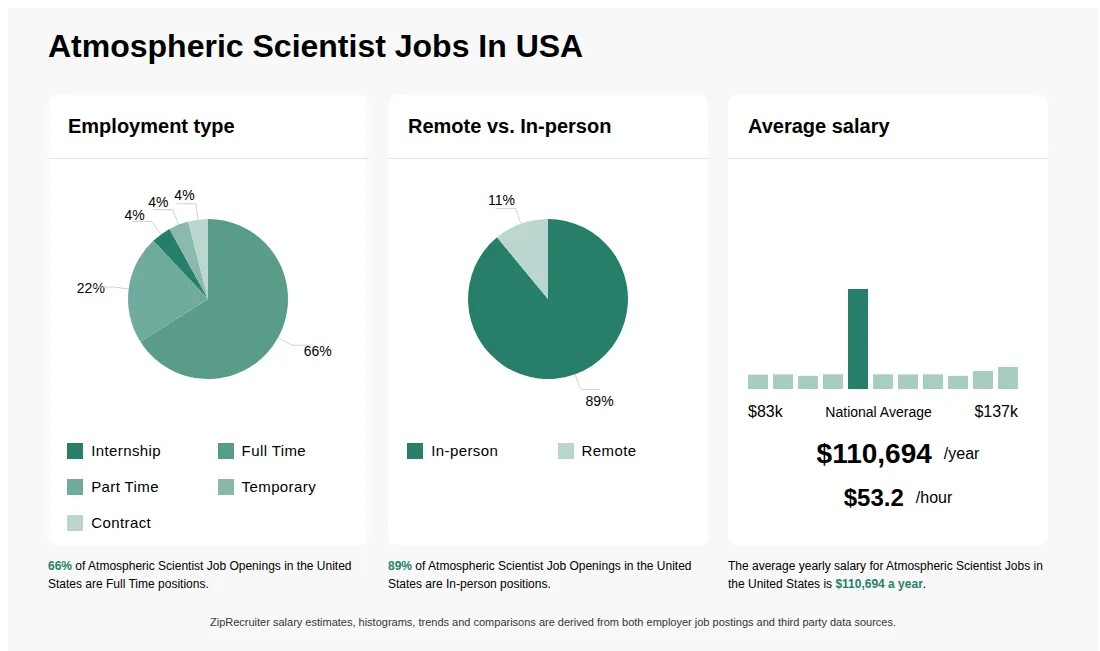
$83K - $87.9K
5% of jobs
$87.9K - $92.8K
5% of jobs
$92.8K - $97.7K
5% of jobs
$97.7K - $102.6K
5% of jobs
$103.1K is the 25th percentile. Wages below this are outliers.
$102.6K - $107.5K
41% of jobs
$107.5K - $112.5K
5% of jobs
$112.5K - $117.4K
5% of jobs
$118.8K is the 75th percentile. Wages above this are outliers.
$117.4K - $122.3K
5% of jobs
$122.3K - $127.2K
5% of jobs
$127.2K - $132.1K
7% of jobs
$132.1K - $137K
9% of jobs
$83K
$110.7K
$137K
Atmospheric scientists study the weather to predict short-term and long-term patterns. Some, like meteorologists, may work to forecast the weather over a few of days. Others spend research years of data to create models to learn about weather conditions in the past, or model future climate conditions based on pollution, historical temperatures, precipitation records, and observational tools from space. They report their findings in conferences, professional journals, or research papers. Qualifications for the job include a bachelor’s degree, although many research positions require a master’s degree or doctorate.
| Aspect | Atmospheric Scientist | Meteorologist |
|---|---|---|
| Required Credentials | Bachelor's or higher in atmospheric science, meteorology, or related field; often advanced degrees | Bachelor's or higher in meteorology or atmospheric science; certifications like AMS are common |
| Work Environment | Research labs, universities, government agencies, field research | Weather stations, TV stations, government agencies, forecasting centers |
| Industry Usage | Research, academia, government research projects | Weather forecasting, media, public safety |
Atmospheric Scientists focus on research and understanding atmospheric processes, often working in labs or academia. Meteorologists primarily forecast weather and communicate it to the public, working in media or forecasting centers. Both roles require similar educational backgrounds, but their work environments and primary objectives differ.
Cities with the most Atmospheric Scientist job openings:
The most popular types of Atmospheric Scientist jobs are:
The top employers for Atmospheric Scientist jobs are:
States with the most job openings for Atmospheric Scientist jobs include:
For Atmospheric Scientist jobs, the most frequently searched job titles are:

Springfield, VA • On-site
Other
Posted 3 days ago
New

Sourced by ZipRecruiter
Guided missile and space vehicle manufacturing
11 - 50 Employees
Stafford, VA, US
2015



