Station Asset Engineer (Assc - Sr)
$80K - $127K/yr
The minimal qualifications outlined below apply to the Station Asset Engineer Assc, with increased educational, skill, experience and certification requirements for higher level Station Asset ...
$80K - $127K/yr
The minimal qualifications outlined below apply to the Station Asset Engineer Assc, with increased educational, skill, experience and certification requirements for higher level Station Asset ...
$80K - $127K/yr
The minimal qualifications outlined below apply to the Station Asset Engineer Assc, with increased educational, skill, experience and certification requirements for higher level Station Asset ...
San Angelo, TX · On-site
$80K - $127K/yr
The minimal qualifications outlined below apply to the Station Asset Engineer Assc, with increased educational, skill, experience and certification requirements for higher level Station Asset ...
San Angelo, TX · On-site
$80K - $127K/yr
The minimal qualifications outlined below apply to the Station Asset Engineer Assc, with increased educational, skill, experience and certification requirements for higher level Station Asset ...
Corpus Christi, TX · On-site
$80K - $127K/yr
The minimal qualifications outlined below apply to the Station Asset Engineer Assc, with increased educational, skill, experience and certification requirements for higher level Station Asset ...
Corpus Christi, TX · On-site
$80K - $127K/yr
The minimal qualifications outlined below apply to the Station Asset Engineer Assc, with increased educational, skill, experience and certification requirements for higher level Station Asset ...
$80K - $127K/yr
The minimal qualifications outlined below apply to the Station Asset Engineer Assc, with increased educational, skill, experience and certification requirements for higher level Station Asset ...
$80K - $127K/yr
The minimal qualifications outlined below apply to the Station Asset Engineer Assc, with increased educational, skill, experience and certification requirements for higher level Station Asset ...
$80K - $127K/yr
The minimal qualifications outlined below apply to the Station Asset Engineer Assc, with increased educational, skill, experience and certification requirements for higher level Station Asset ...
$80K - $127K/yr
The minimal qualifications outlined below apply to the Station Asset Engineer Assc, with increased educational, skill, experience and certification requirements for higher level Station Asset ...
$80K - $127K/yr
The minimal qualifications outlined below apply to the Station Asset Engineer Assc, with increased educational, skill, experience and certification requirements for higher level Station Asset ...
$80K - $127K/yr
The minimal qualifications outlined below apply to the Station Asset Engineer Assc, with increased educational, skill, experience and certification requirements for higher level Station Asset ...
$80K - $127K/yr
The minimal qualifications outlined below apply to the Station Asset Engineer Assc, with increased educational, skill, experience and certification requirements for higher level Station Asset ...
$80K - $127K/yr
The minimal qualifications outlined below apply to the Station Asset Engineer Assc, with increased educational, skill, experience and certification requirements for higher level Station Asset ...
$80K - $127K/yr
The minimal qualifications outlined below apply to the Station Asset Engineer Assc, with increased educational, skill, experience and certification requirements for higher level Station Asset ...
$80K - $127K/yr
The minimal qualifications outlined below apply to the Station Asset Engineer Assc, with increased educational, skill, experience and certification requirements for higher level Station Asset ...
$80K - $127K/yr
The minimal qualifications outlined below apply to the Station Asset Engineer Assc, with increased educational, skill, experience and certification requirements for higher level Station Asset ...
$80K - $127K/yr
The minimal qualifications outlined below apply to the Station Asset Engineer Assc, with increased educational, skill, experience and certification requirements for higher level Station Asset ...
We are seeking a Real-Time 3D Asset Engineer with technical art skills to help us create modern training systems, compelling visual tools, and real-time content pipelines for critical national ...
We are seeking a Real-Time 3D Asset Engineer with technical art skills to help us create modern training systems, compelling visual tools, and real-time content pipelines for critical national ...
Ashtabula, OH · On-site
$93K - $117K/yr
The engineer will also be appointed as the Asset Engineer, overseeing asset condition and integrity and managing the mechanical integrity program to meet current and future performance targets.
Quick apply
Ashtabula, OH · On-site
$93K - $117K/yr
The engineer will also be appointed as the Asset Engineer, overseeing asset condition and integrity and managing the mechanical integrity program to meet current and future performance targets.
$80K - $127K/yr
The minimal qualifications outlined below apply to the Transmission Line Asset Engineer Assc, with increased educational, skill, experience and certification requirements for higher level ...
$80K - $127K/yr
The minimal qualifications outlined below apply to the Transmission Line Asset Engineer Assc, with increased educational, skill, experience and certification requirements for higher level ...
$80K - $127K/yr
The minimal qualifications outlined below apply to the Transmission Line Asset Engineer Assc, with increased educational, skill, experience and certification requirements for higher level ...
$80K - $127K/yr
The minimal qualifications outlined below apply to the Transmission Line Asset Engineer Assc, with increased educational, skill, experience and certification requirements for higher level ...
San Angelo, TX · On-site
$80K - $127K/yr
The minimal qualifications outlined below apply to the Transmission Line Asset Engineer Assc, with increased educational, skill, experience and certification requirements for higher level ...
San Angelo, TX · On-site
$80K - $127K/yr
The minimal qualifications outlined below apply to the Transmission Line Asset Engineer Assc, with increased educational, skill, experience and certification requirements for higher level ...
$80K - $127K/yr
The minimal qualifications outlined below apply to the Transmission Line Asset Engineer Assc, with increased educational, skill, experience and certification requirements for higher level ...
$80K - $127K/yr
The minimal qualifications outlined below apply to the Transmission Line Asset Engineer Assc, with increased educational, skill, experience and certification requirements for higher level ...
$80K - $127K/yr
The minimal qualifications outlined below apply to the Transmission Line Asset Engineer Assc, with increased educational, skill, experience and certification requirements for higher level ...
$80K - $127K/yr
The minimal qualifications outlined below apply to the Transmission Line Asset Engineer Assc, with increased educational, skill, experience and certification requirements for higher level ...
The minimal qualifications outlined below apply to the Transmission Line Asset Engineer Assc, with increased educational, skill, experience and certification requirements for higher level ...
The minimal qualifications outlined below apply to the Transmission Line Asset Engineer Assc, with increased educational, skill, experience and certification requirements for higher level ...
$80K - $127K/yr
The minimal qualifications outlined below apply to the Transmission Line Asset Engineer Assc, with increased educational, skill, experience and certification requirements for higher level ...
$80K - $127K/yr
The minimal qualifications outlined below apply to the Transmission Line Asset Engineer Assc, with increased educational, skill, experience and certification requirements for higher level ...
$80K - $127K/yr
The minimal qualifications outlined below apply to the Transmission Line Asset Engineer Assc, with increased educational, skill, experience and certification requirements for higher level ...
$80K - $127K/yr
The minimal qualifications outlined below apply to the Transmission Line Asset Engineer Assc, with increased educational, skill, experience and certification requirements for higher level ...
Verify compliance with engineering, safety and procedures, as well as verify and identify opportunities to improve the overall reliability and performance of assigned assets and installations.
Verify compliance with engineering, safety and procedures, as well as verify and identify opportunities to improve the overall reliability and performance of assigned assets and installations.
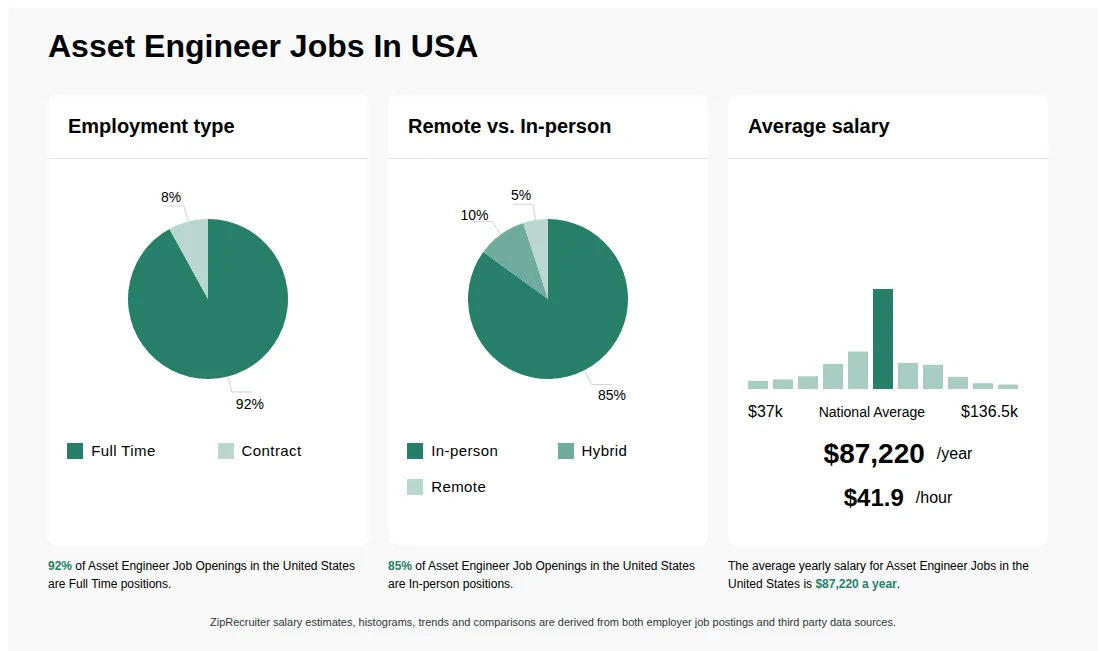
$37K - $46K
3% of jobs
$46K - $55.1K
3% of jobs
$55.1K - $64.1K
4% of jobs
$64.1K - $73.2K
9% of jobs
$76.3K is the 25th percentile. Wages below this are outliers.
$73.2K - $82.2K
15% of jobs
The median wage is $85.8K / yr.
$82.2K - $91.3K
39% of jobs
$92.5K is the 75th percentile. Wages above this are outliers.
$91.3K - $100.3K
9% of jobs
$100.3K - $109.4K
9% of jobs
$109.4K - $118.4K
4% of jobs
$118.4K - $127.5K
2% of jobs
$127.5K - $136.5K
1% of jobs
$37K
$87.2K
$136.5K
| Aspect | Asset Engineer | Maintenance Engineer |
|---|---|---|
| Credentials | Bachelor's in engineering or related field, certifications like PMP or asset management certifications | Bachelor's in engineering, technical diploma, certifications in maintenance or equipment repair |
| Work Environment | Project sites, asset management offices, industrial facilities | Manufacturing plants, industrial facilities, equipment repair workshops |
| Industry Usage | Oil & gas, utilities, manufacturing, infrastructure | Manufacturing, facilities management, industrial sectors |
| Primary Focus | Managing and optimizing physical assets throughout their lifecycle | Maintaining and repairing equipment to ensure operational efficiency |
While both roles involve working with industrial assets, Asset Engineers focus on asset management, lifecycle optimization, and strategic planning. Maintenance Engineers concentrate on equipment repair, troubleshooting, and ensuring machinery operates efficiently. Understanding these differences helps employers and professionals identify the right role for specific operational needs.
Cities with the most Asset Engineer job openings:
States with the most job openings for Asset Engineer jobs include:
For Asset Engineer jobs, the most frequently searched job titles are:
Pharr, TX
$80K - $127K/yr
Full-time
Posted 10 days ago
Job Posting End Date
09-13-2026Please note the job posting will close on the day before the posting end date.
Job Summary
Responsible to the assigned supervisor for performing entry level engineering work activities and projects requiring the application of engineering knowledge in a safe, effective, efficient and economic accomplishment of assigned objectives.Job Description
What You'll Do:
Technical Expertise: Possesses entry-level knowledge and experience in the application of theory to solve well-defined problems or provide analysis, with guidance from higher-level engineers. Assists higher-level engineers in handling well-defined portions of more complex problems and analyses.Exhibits fundamental understanding of standards, codes and regulations relevant to the area of assignment. Gains familiarity with standards, codes and regulations relevant to the area of assignment. Gains familiarity with pertinent equipment, materials, systems and business processes.
Leadership & Guidance: Coordinates work activities of others as required to resolve routine engineering tasks. Demonstrates working knowledge of appropriate policies and procedures; however, activities are generally monitored by higher-level employees to ensure work is performed in accordance with established guidelines. Performs work activities as assigned and coached by higher-level employees. Demonstrates ability to work with others in both supplying information and seeking assistance as necessary. Demonstrates willingness and capabilities to assume leadership roles.
Planning & Organization Ability: Provides input to routine project planning documents related to scheduling and understands the use of scheduling techniques (CPM, PERT, flow charts, etc.) for budget and planning activities. Monitors project status and recommends action accordingly. Prepares cost estimates using established standards. Develops understanding of the workflow for routine engineering projects. Accomplishes work according to plans and schedules established by higher-level employees.
Problem Solving & Initiative: Actively seeks out information and understanding of engineering problems and solution techniques applicable to area of responsibility. Applies basic techniques to perform analysis associated with the resolution of routine technical problems. Uses initiative in looking for opportunities and presenting new ideas and new approaches.
Communication: Assists and participates in the preparation of reports and technical papers. Assimilates information and instructions readily. Communicates effectively, both verbally and in writing and presents ideas clearly. Listens to and understands instructions, and requests clarification as required.
Interpersonal Skills: Begins networking with peers to share information and encourage cooperation. Understands the agendas and perspectives of others. Develops effective give-and-take relationship. Demonstrates the ability to be a team player. Relates to people in an open, friendly, and sincere manner.
Decision Making: Knows which decisions they are authorized to make. Develops decision-making skills under guidance of higher-level employees and makes routine decisions subject to review and contributes to team decision-making.
Business Awareness & Characteristics: Demonstrates an attitude and desire to listen to and satisfy both internal and external customers who use and depend upon their organizational unit's work. Applies economic analysis techniques in problem solving. Pursues effective ways to protect and enhance the environment while providing reliable electricity at a competitive cost. Active participation in professional and business organizations is encouraged. Develops an understanding of the roles and responsibilities of the department.
Note: This position is posted at multiple grade levels and offers a range of opportunity for advancement. The minimal qualifications outlined below apply to the Station Asset Engineer Assc, with increased educational, skill, experience and certification requirements for higher level Station Asset Engineers.
What We're Looking For:
This is an entry level position for new graduates with a Bachelor's degree in engineering in a program accredited by ABET*; Passing the Fundamentals of Engineering examination in preparation for future licensing as a Professional Engineer (PE) is encouraged and preferred.
Individuals with a Bachelor's degree in Engineering Technology can satisfy this degree requirement, if they obtain a certified Professional Engineering (PE) license.
*VP or above may waive the requirement for a degree from a university with an Non ABET accredited program
What You'll Get:
Salary Range: $80,000 - $127,439 per year
In addition to a competitive compensation, AEP offers a unique comprehensive benefits package that aims to support and enhance the overall well-being of our employees.
At AEP, we're more than just an energy company - we're a team of dedicated professionals committed to delivering safe, reliable, and innovative energy solutions. Guided by our mission to put the customer first, we strive to exceed expectations by listening, responding, and continuously improving the way we serve our communities. If you're passionate about making a meaningful impact and being part of a forward-thinking organization, this is the company for you!
Compensation Data
Compensation Grade:
SP20-006Compensation Range:
$74,551.00 - $128,688.00The Physical Demand Level for this job is: S - Sedentary Work: Exerting up to 10 pounds of force occasionally (Occasionally: activity or condition exists up to 1/3 of the time) and/or a negligible amount of force frequently. (Frequently: activity or condition exists from 1/3 to 2/3 of the time) to lift, carry, push, pull or otherwise move objects, including the human body. Sedentary work involves sitting most of the time but may involve walking or standing for brief periods of time. Jobs are sedentary if walking and standing are required only occasionally, and all other sedentary criteria are met.
Hear about it first! Get job alerts by email. Log in to your Candidate Home Account today! If you don't have an account, you can create one.
It is hereby reaffirmed that it is the policy of American Electric Power (AEP) to provide Equal Employment Opportunity in all respects of the employer-employee relationship including recruiting, hiring, upgrading and promotion, conditions and privileges of employment, company sponsored training programs, educational assistance, social and recreational programs, compensation, benefits, transfers, discipline, layoffs and termination of employment to all employees and applicants without discrimination because of race, color, religion, sex (including pregnancy, gender identity, and sexual orientation), national origin, age, veteran or military status, disability, genetic information, or any other basis prohibited by applicable law. When required by law, we might record certain information or applicants for employment may be invited to voluntarily disclose protected characteristics.

