1

Assay Development Scientist Jobs (NOW HIRING)

Be Seen First

Experience supporting product development within clinical diagnostics, including assay development ... Strong experimental design, laboratory troubleshooting, and scientific data analysis skills.

The position requires a strong background in cell culture, bacteriology, and in vitro assay development, as well as the ability to work independently, mentor junior scientists, and collaborate ...

next page

Showing results 1-20

Assay Development Scientist information

See salary details

$20

$38

$61

How much do assay development scientist jobs pay per hour?

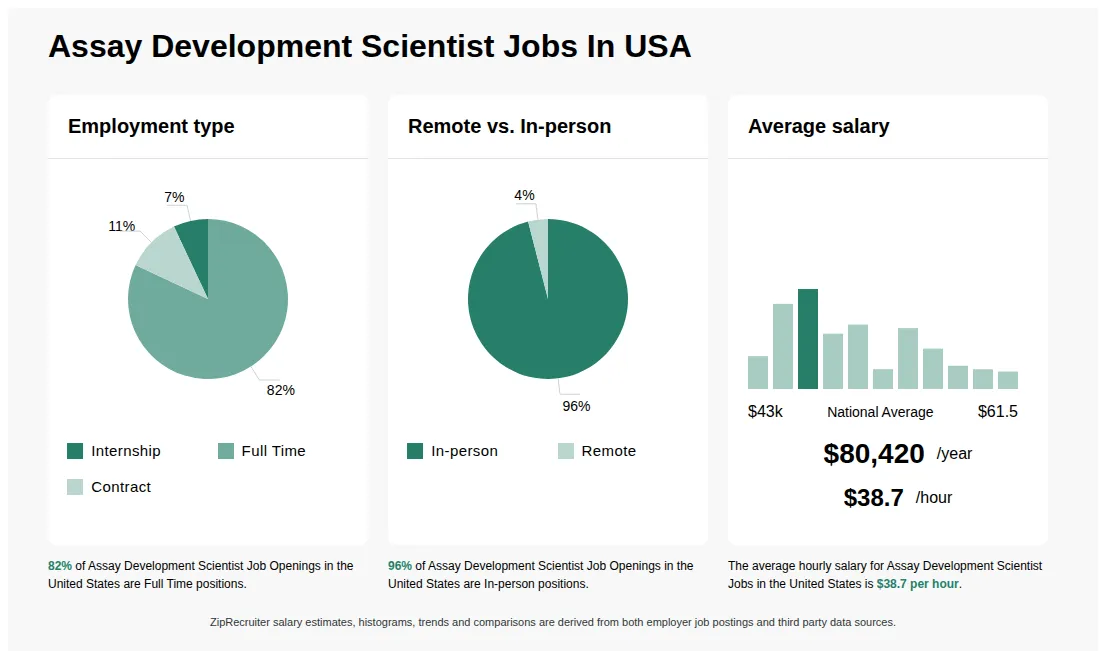
As of Jun 9, 2026, the average hourly pay for assay development scientist in the United States is $38.66, according to ZipRecruiter salary data. Most workers in this role earn between $28.37 and $46.15 per hour, depending on experience, location, and employer.

What is an Assay Development Scientist job?

An Assay Development Scientist designs, optimizes, and validates biochemical and cell-based assays for drug discovery, diagnostics, or research applications. They work with a variety of techniques such as ELISA, PCR, and high-throughput screening to measure biological or chemical responses. Their role involves troubleshooting, data analysis, and collaboration with cross-functional teams to ensure assay accuracy and reproducibility.

What are the key skills and qualifications needed to thrive in the Assay Development Scientist position, and why are they important?

To thrive as an Assay Development Scientist, you need a strong background in biochemistry, molecular biology, or a related field, along with experience in assay design, optimization, and validation. Proficiency with laboratory instrumentation such as plate readers, liquid handlers, and data analysis software (e.g., GraphPad Prism or SoftMax Pro), as well as familiarity with regulatory guidelines, is often required. Effective problem-solving, meticulous attention to detail, and strong communication skills set exceptional candidates apart. These abilities ensure the successful development of reliable assays, facilitate collaboration with interdisciplinary teams, and support impactful scientific advancements.

What does a typical day look like for an Assay Development Scientist?

A typical day for an Assay Development Scientist involves designing experiments, running and optimizing biochemical or cell-based assays, analyzing data, and documenting results. You will often collaborate closely with cross-functional teams, including research scientists, project managers, and quality assurance specialists, to ensure assays meet project requirements. Regular meetings to discuss progress, troubleshoot technical challenges, and plan next steps are common. The role also involves staying up-to-date with new technologies and industry standards to continuously improve assay performance.

What cities are hiring for Assay Development Scientist jobs? Cities with the most Assay Development Scientist job openings:
What are the most commonly searched types of Assay Development Scientist jobs? The most popular types of Assay Development Scientist jobs are:
What states have the most Assay Development Scientist jobs? States with the most job openings for Assay Development Scientist jobs include:
Infographic showing various Assay Development Scientist job openings in the United States as of May 2026, with employment types broken down into 6% Full Time, 91% Part Time, 2% Temporary, and 1% Nights. Highlights an 91% Physical, 3% Hybrid, and 6% Remote job distribution, with an average salary of $80,420 per year, or $38.7 per hour.
Associate Scientist, Cell Signaling and Assay Development

Associate Scientist, Cell Signaling and Assay Development

Celcuity Inc.

Minneapolis, MN

$90K - $125K/yr

Other

Posted 8 days ago


Job description

POSITION SUMMARY:

Reporting to the Director, Tissue or Assay / Laboratory Manager, the Associate Scientist will play a key role in the development, validation, and execution of live-cell assays supporting translational oncology research. This individual will contribute to advancing precision medicine by characterizing cell signaling pathways and ensuring the generation of high-quality, reproducible data in a high-complexity, CLIA-certified laboratory environment.

PRIMARY RESPONSIBILITIES AND DUTIES:

  • Assay Development & Validation:

Design, develop, validate, and transfer cell signaling and pathway-based assays across multiple cancer tissue types.

  • Cell Culture & Maintenance:

Culture, maintain, and ensure consistency of human cell lines and primary samples under varied laboratory conditions.

  • Cellular Characterization:

Perform phenotypic and pathway characterization using cell-based assays and integrate informatics data to identify and classify cell types.

  • Regulatory Compliance:

Adhere to CAP/CLIA standards and HIPAA regulations, maintaining compliance within a high-complexity clinical testing environment.

  • Cross-Functional Collaboration:

Partner with Scientific Directors and laboratory leadership to troubleshoot assays, optimize protocols, and improve laboratory efficiency.

  • Quality & Data Integrity:

Monitor and maintain quality control processes, including QC metrics, preventive maintenance (PM), and standard operating procedures (SOPs), ensuring data accuracy and reliability.

QUALIFICATIONS AND SKILLS:

Education & Experience:

  • Ph.D. in a relevant scientific discipline with experience in activity-based live-cell assay development for small molecules; OR
  • Master's degree with 5+ years of relevant industry experience; OR
  • Bachelor's degree in a scientific field with 6-8+ years of relevant industry experience.

Required Technical Skills:

  • Hands-on experience with human cell culture techniques
  • Experience with microplate-based live-cell assays
  • Knowledge of multiparametric (e.g., 5-channel) cell cytometry
  • Experience with immunochemistry techniques
  • Strong understanding of laboratory quality systems, including QC, PM, and SOP adherence

Preferred Qualifications:

  • Experience with Jess (ProteinSimple) systems
  • Experience working with human primary cells

About Us:

Celcuity is a clinical-stage, publicly traded biotechnology company seeking to extend the lives of cancer patients through the development of targeted therapies for the treatment of multiple solid tumor indications. The company was founded to develop a better way to treat the cellular drivers of tumor growth.

Our lead therapeutic candidate, gedatolisib, is an intravenously administered, potential first-in-class PI3K/AKT/mTOR (PAM) pathway inhibitor. Its mechanism of action and pharmacokinetic properties are highly differentiated from other currently approved and investigational therapies that target PI3K or mTOR alone or together. Gedatolisib phase 3 clinical development programs are focused on the treatment of patients with HR+/HER2- ABC in the 1L and 2L settings. A Phase 1b/2 clinical trial evaluating gedatolisib in combination with darolutamide in patients with metastatic castration resistant prostate cancer, is on-going.

Celcuity is an Equal-Opportunity Employer.

Celcuity is committed to fair and equitable compensation practices, and we strive to provide employees with total compensation packages that are competitive. For this role, the anticipated base pay range is $90,000-$125,000 DOE. The exact base pay offered for this role will depend on various factors, including but not limited to the candidate's geography, qualifications, skills, and experience.