Our Assay Development team translates emerging biomarker science into robust assays for research and future clinical applications. We are seeking a Scientist / Senior Scientist who is intellectually ...
Our Assay Development team translates emerging biomarker science into robust assays for research and future clinical applications. We are seeking a Scientist / Senior Scientist who is intellectually ...

Sr. Data Scientist, Assay Development
Palo Alto, CA · On-site
$130K - $170K/yr
... scientists to develop statistical analysis methods supporting early cancer detection assays. This role spans assay development, analytical validation, and QC and control strategy, contributing to ...
Sr. Data Scientist, Assay Development
Palo Alto, CA · On-site
$130K - $170K/yr
... scientists to develop statistical analysis methods supporting early cancer detection assays. This role spans assay development, analytical validation, and QC and control strategy, contributing to ...

Scientific Director Key Responsibilities ... Method Development & Validation • Assay Development: Designs, develops, and validates new testing ...
Scientific Director Key Responsibilities ... Method Development & Validation • Assay Development: Designs, develops, and validates new testing ...

Senior Associate Scientist - Assay Development
Tarrytown, NY · On-site
$80K - $131K/yr
We are seeking a Senior Associate Scientist Bioanalytical Assay Development USA to join our Assay Development Group, supporting our Bioanalytical Sciences organization in a hybrid work mode. In this ...
Senior Associate Scientist - Assay Development
Tarrytown, NY · On-site
$80K - $131K/yr
We are seeking a Senior Associate Scientist Bioanalytical Assay Development USA to join our Assay Development Group, supporting our Bioanalytical Sciences organization in a hybrid work mode. In this ...

Scientist / Senior Scientist, Assay Development (Reagents)
Berkeley, CA · On-site
$111.72 - $161.90/hr
What we are looking for in you Glyphic is seeking a Scientist or Senior Scientist to build and ... Lead assay reagent development activities, including formulation, characterization, and ...
Scientist / Senior Scientist, Assay Development (Reagents)
Berkeley, CA · On-site
$111.72 - $161.90/hr
What we are looking for in you Glyphic is seeking a Scientist or Senior Scientist to build and ... Lead assay reagent development activities, including formulation, characterization, and ...
Sr. Data Scientist, Assay Development
Palo Alto, CA · On-site
$130K - $170K/yr
... scientists to develop statistical analysis methods supporting early cancer detection assays. This role spans assay development, analytical validation, and QC and control strategy, contributing to ...
Quick apply
Sr. Data Scientist, Assay Development
Palo Alto, CA · On-site
$130K - $170K/yr
... scientists to develop statistical analysis methods supporting early cancer detection assays. This role spans assay development, analytical validation, and QC and control strategy, contributing to ...

Scientist / Senior Scientist, Assay Development (Reagents)
Berkeley, CA · On-site
$112K - $153K/yr
What we are looking for in you Glyphic is seeking a Scientist or Senior Scientist to build and ... Lead assay reagent development activities, including formulation, characterization, and ...
Scientist / Senior Scientist, Assay Development (Reagents)
Berkeley, CA · On-site
$112K - $153K/yr
What we are looking for in you Glyphic is seeking a Scientist or Senior Scientist to build and ... Lead assay reagent development activities, including formulation, characterization, and ...
Scientist / Senior Scientist, Assay Development (Reagents)
Berkeley, CA · On-site
$112K - $153K/yr
What we are looking for in you Glyphic is seeking a Scientist or Senior Scientist to build and ... Lead assay reagent development activities, including formulation, characterization, and ...
Scientist / Senior Scientist, Assay Development (Reagents)
Berkeley, CA · On-site
$112K - $153K/yr
What we are looking for in you Glyphic is seeking a Scientist or Senior Scientist to build and ... Lead assay reagent development activities, including formulation, characterization, and ...
Scientist, Assay Development & Digital Pathology (AcelaBio)
San Diego, CA · On-site
$150K - $200K/yr
About the opportunity This is a high-impact, technically hands-on role at the intersection of immunostaining assay development, quantitative image analysis, and client science. You will build and ...
Quick apply
Scientist, Assay Development & Digital Pathology (AcelaBio)
San Diego, CA · On-site
$150K - $200K/yr
About the opportunity This is a high-impact, technically hands-on role at the intersection of immunostaining assay development, quantitative image analysis, and client science. You will build and ...
Scientist, Assay Development & Digital Pathology (AcelaBio)
San Diego, CA · On-site
$150 - $200/hr
About the opportunity This is a high-impact, technically hands-on role at the intersection of immunostaining assay development, quantitative image analysis, and client science. You will build and ...
Scientist, Assay Development & Digital Pathology (AcelaBio)
San Diego, CA · On-site
$150 - $200/hr
About the opportunity This is a high-impact, technically hands-on role at the intersection of immunostaining assay development, quantitative image analysis, and client science. You will build and ...

Senior Scientist, Assay Development
Cambridge, MA · On-site
$126 - $182/hr
FL103 is seeking a highly motivated and experienced senior scientist to lead the design, development, optimization and validation of extracellular vesicle based in vitro assays to help diagnose ...
Senior Scientist, Assay Development
Cambridge, MA · On-site
$126 - $182/hr
FL103 is seeking a highly motivated and experienced senior scientist to lead the design, development, optimization and validation of extracellular vesicle based in vitro assays to help diagnose ...
Senior Scientist, Assay Development
Cambridge, MA · On-site
$100K - $136K/yr
FL103 is seeking a highly motivated and experienced senior scientist to lead the design, development, optimization and validation of extracellular vesicle based in vitro assays to help diagnose ...
Senior Scientist, Assay Development
Cambridge, MA · On-site
$100K - $136K/yr
FL103 is seeking a highly motivated and experienced senior scientist to lead the design, development, optimization and validation of extracellular vesicle based in vitro assays to help diagnose ...
Senior Process Engineer, Assay Development
$131K - $140K/yr
The Senior Process Engineer will work in close partnership with assay development scientists, automation engineers, quality/regulatory specialists, and laboratory operations to design and qualify ...
Quick apply
Senior Process Engineer, Assay Development
$131K - $140K/yr
The Senior Process Engineer will work in close partnership with assay development scientists, automation engineers, quality/regulatory specialists, and laboratory operations to design and qualify ...
Senior Scientist, Reagent/Assay Development
Santa Clara, CA · On-site
$99 - $133/hr
The Position Senior Scientist, Reagent/Assay Development will contribute to the development and optimization of reagents and assays for next-generation sequencing (NGS) applications. This role ...
Senior Scientist, Reagent/Assay Development
Santa Clara, CA · On-site
$99 - $133/hr
The Position Senior Scientist, Reagent/Assay Development will contribute to the development and optimization of reagents and assays for next-generation sequencing (NGS) applications. This role ...
Senior Associate Scientist - Assay Development
Tarrytown, NY · On-site
$80.30 - $131.10/hr
Regeneron's Assay Development Group (ADG), located in Tarrytown, NY, is seeking a highly motivated Senior Associate Scientist to join the team. The ADG in Bioanalytical sciences develops preclinical ...
Senior Associate Scientist - Assay Development
Tarrytown, NY · On-site
$80.30 - $131.10/hr
Regeneron's Assay Development Group (ADG), located in Tarrytown, NY, is seeking a highly motivated Senior Associate Scientist to join the team. The ADG in Bioanalytical sciences develops preclinical ...

... scientific principles and analytical techniques, and drive novel molecular biology assays from research to product proof-of-concept. The Assay Development Technologist will be responsible for ...
... scientific principles and analytical techniques, and drive novel molecular biology assays from research to product proof-of-concept. The Assay Development Technologist will be responsible for ...
Senior Scientist, Assay Development
Cambridge, MA · On-site
$100K - $136K/yr
FL103 is seeking a highly motivated and experienced senior scientist to lead the design, development, optimization and validation of extracellular vesicle based in vitro assays to help diagnose ...
Senior Scientist, Assay Development
Cambridge, MA · On-site
$100K - $136K/yr
FL103 is seeking a highly motivated and experienced senior scientist to lead the design, development, optimization and validation of extracellular vesicle based in vitro assays to help diagnose ...

Bioinformatics Scientist -- NGS Assay Development (Remote)
$90K - $120K/yr
The scientist will work closely with molecular biology, software, product development, regulatory ... Investigate assay failures and unexpected results using sequencing data, genomic context ...
Bioinformatics Scientist -- NGS Assay Development (Remote)
$90K - $120K/yr
The scientist will work closely with molecular biology, software, product development, regulatory ... Investigate assay failures and unexpected results using sequencing data, genomic context ...
The Position The Senior Scientist, Reagent/Assay Development will contribute to the development and optimization of reagents and assays for next-generation sequencing (NGS) applications. This role ...
The Position The Senior Scientist, Reagent/Assay Development will contribute to the development and optimization of reagents and assays for next-generation sequencing (NGS) applications. This role ...
Senior Scientist, Reagent/Assay Development
Santa Clara, CA · On-site
$99 - $133/hr
The Position The Senior Scientist, Reagent/Assay Development will contribute to the development and optimization of reagents and assays for next-generation sequencing (NGS) applications. This role ...
Senior Scientist, Reagent/Assay Development
Santa Clara, CA · On-site
$99 - $133/hr
The Position The Senior Scientist, Reagent/Assay Development will contribute to the development and optimization of reagents and assays for next-generation sequencing (NGS) applications. This role ...
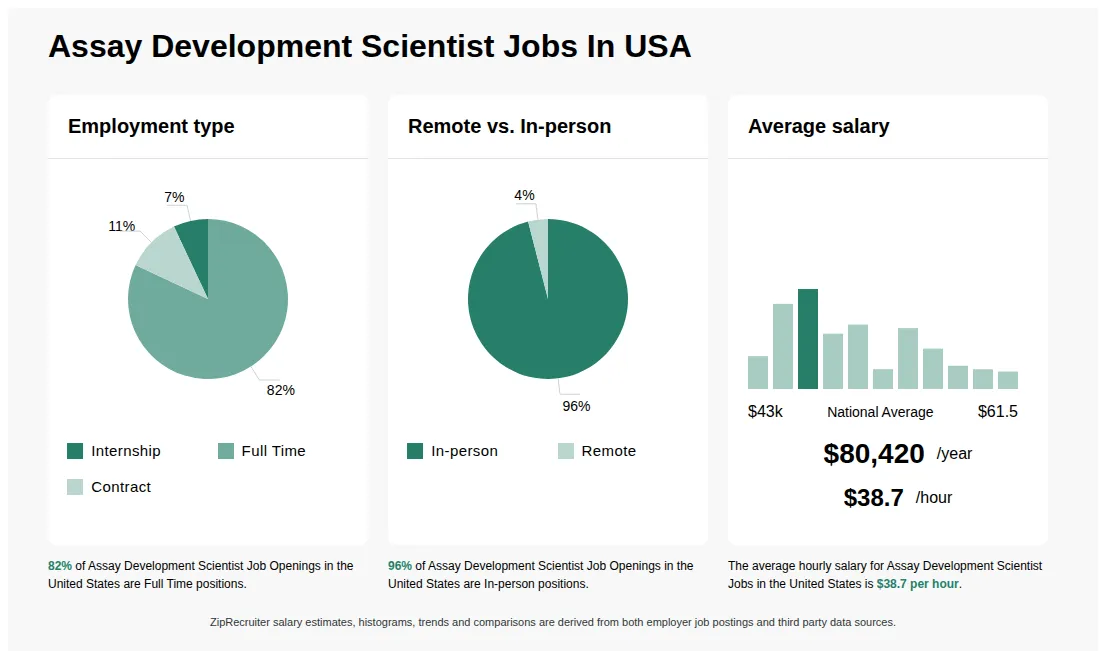
Assay Development Scientist information
See salary details
$20.67 - $24.39
6% of jobs
$24.39 - $28.10
17% of jobs
$28.40 is the 25th percentile. Wages below this are outliers.
$28.10 - $31.82
20% of jobs
The median wage is $34.05 / hr.
$31.82 - $35.53
11% of jobs
$35.53 - $39.25
13% of jobs
$39.25 - $42.96
3% of jobs
$44.48 is the 75th percentile. Wages above this are outliers.
$42.96 - $46.68
12% of jobs
$46.68 - $50.39
7% of jobs
$50.39 - $54.11
4% of jobs
$54.11 - $57.82
3% of jobs
$57.82 - $61.54
3% of jobs
$20
$38
$61
How much do assay development scientist jobs pay per hour?
As of Sep 6, 2026, the average hourly pay for assay development scientist in the United States is $38.66, according to ZipRecruiter salary data. Most workers in this role earn between $28.37 and $46.15 per hour, depending on experience, location, and employer.
What is an assay development scientist?
An Assay Development Scientist designs, optimizes, and validates biochemical and cell-based assays for drug discovery, diagnostics, or research applications. They work with a variety of techniques such as ELISA, PCR, and high-throughput screening to measure biological or chemical responses. Their role involves troubleshooting, data analysis, and collaboration with cross-functional teams to ensure assay accuracy and reproducibility.
What does an assay development scientist do?
A typical day for an Assay Development Scientist involves designing experiments, running and optimizing biochemical or cell-based assays, analyzing data, and documenting results. You will often collaborate closely with cross-functional teams, including research scientists, project managers, and quality assurance specialists, to ensure assays meet project requirements. Regular meetings to discuss progress, troubleshoot technical challenges, and plan next steps are common. The role also involves staying up-to-date with new technologies and industry standards to continuously improve assay performance.
What are the key skills and qualifications needed to thrive as an assay development scientist?
To thrive as an Assay Development Scientist, you need a strong background in biochemistry, molecular biology, or a related field, along with experience in assay design, optimization, and validation. Proficiency with laboratory instrumentation such as plate readers, liquid handlers, and data analysis software (e.g., GraphPad Prism or SoftMax Pro), as well as familiarity with regulatory guidelines, is often required. Effective problem-solving, meticulous attention to detail, and strong communication skills set exceptional candidates apart. These abilities ensure the successful development of reliable assays, facilitate collaboration with interdisciplinary teams, and support impactful scientific advancements.
More about Assay Development Scientist jobs
What cities are hiring for Assay Development Scientist jobs?
Cities with the most Assay Development Scientist job openings:
What are the most commonly searched types of Assay Development Scientist jobs?
The most popular types of Assay Development Scientist jobs are:
What states have the most Assay Development Scientist jobs?
States with the most job openings for Assay Development Scientist jobs include:
What job categories do people searching Assay Development Scientist jobs look for?
The top searched job categories for Assay Development Scientist jobs are:
$115K/yr
Full-time
Re-posted 12 days ago
Job description
Spear Bio, founded in 2021, is a well-funded and rapidly growing biotech start-up headquartered in Woburn, Massachusetts. Our proprietary technology, Successive Proximity Extension Amplification Reaction (SPEAR), is a novel wash-free immunoassay platform, offering unprecedented sensitivity. We are dedicated to revolutionizing early disease diagnosis and monitoring by providing scalable, ultrasensitive solutions that deliver unparalleled accuracy in measuring low-abundant biomarkers, enabling clinicians and researchers to improve patient outcomes and advance global health.
Scientist/Senior Scientist, Assay Development - Neuroscience Biomarkers:
Our Assay Development team translates emerging biomarker science into robust assays for research and future clinical applications. We are seeking a Scientist / Senior Scientist who is intellectually curious, hands-on, self-motivated, and comfortable solving difficult scientific problems to play a pivotal role in advancing initiatives for our new range of ultrasensitive immunoassays. The ideal candidate combines deep neurobiology knowledge with experimental rigor, practical troubleshooting skills, and a strong sense of accountability.
The successful candidate will help optimize assay strategies, identify the most relevant molecular forms and epitopes, evaluate preanalytical variables and matrix effects, interpret clinical-sample data, and troubleshoot complex assay-development challenges.
We welcome applications from exceptional recent Ph.D. graduates and postdoctoral fellows who have demonstrated strong scientific ownership, as well as industry scientists who have rapidly taken on increasing responsibility in biotechnology or diagnostics environments. **This role is based onsite in our lab in Woburn, MA 5 days/week.
Responsibilities:
Requirements:
We offer competitive compensation, meaningful stock ownership, comprehensive benefits, and a great work environment. This is an opportunity to enter an innovative, high-growth startup at an early stage and play an integral role in the company's growth and success. We are focused on identifying candidates who have demonstrated leadership and excellence throughout their careers and are excited by the prospect of building an industry-leading company.
Spear Bio Inc. provides equal opportunity in employment to all persons. No person shall be denied equal access because of race, creed, color, religion, national origin, sex, sexual orientation, gender identity, age, or physical/mental disability.
Spear Bio does not accept resume submissions from external recruiting agencies. Any unsolicited resumes or candidate information submitted without prior written agreement will be deemed the property of Spear Bio, and no placement fees will be paid.
Scientist/Senior Scientist, Assay Development - Neuroscience Biomarkers:
Our Assay Development team translates emerging biomarker science into robust assays for research and future clinical applications. We are seeking a Scientist / Senior Scientist who is intellectually curious, hands-on, self-motivated, and comfortable solving difficult scientific problems to play a pivotal role in advancing initiatives for our new range of ultrasensitive immunoassays. The ideal candidate combines deep neurobiology knowledge with experimental rigor, practical troubleshooting skills, and a strong sense of accountability.
The successful candidate will help optimize assay strategies, identify the most relevant molecular forms and epitopes, evaluate preanalytical variables and matrix effects, interpret clinical-sample data, and troubleshoot complex assay-development challenges.
We welcome applications from exceptional recent Ph.D. graduates and postdoctoral fellows who have demonstrated strong scientific ownership, as well as industry scientists who have rapidly taken on increasing responsibility in biotechnology or diagnostics environments. **This role is based onsite in our lab in Woburn, MA 5 days/week.
Responsibilities:
- Develop a portfolio of ultrasensitive immunoassays throughout the product lifecycle, from initial screening and optimization through feasibility, verification, and transfer.
- Plan, design, and execute hands-on assay-development studies, including antibody selection and pairing, reagent conjugation, buffer optimization, reference-material evaluation, matrix characterization, and analytical validation for research and future clinical applications.
- Provide scientific leadership and translate biomarker biology into assay-design strategies by optimizing for clinically relevant molecular forms, isoforms, post-translational modifications, cleavage fragments, aggregation states, epitopes, and sample types.
- Analyze data from clinical and preclinical samples and interpret findings in the context of disease biology, sample characteristics, and published literature.
- Collaborate closely with Platform, Product Development, Operations, and Business Development teams to transition assays from feasibility through verification and transfer.
- Prepare clear scientific presentations, technical reports, study summaries, abstracts, and publications.
- Contribute to a rigorous, accountable, and highly collaborative startup environment.
Requirements:
- Ph.D. in Neuroscience, Neurobiology, Molecular Biology, Biochemistry, Biomedical Engineering, or a closely related field.
- Strong scientific expertise in fluid biomarkers and assay-development strategies for the diagnosis, stratification, or therapeutic monitoring of neurodegenerative diseases, such as Alzheimer's disease, Parkinson's disease, or related neurological disorders.
- Strong understanding of biomarker heterogeneity and the factors that influence measurement in human biofluids.
- Hands-on experience developing immunoassays or other quantitative protein-detection methods.
- Demonstrated ability to design experiments independently and troubleshoot technical challenges.
- Evidence of meaningful scientific contributions through peer-reviewed publications, patents, conference presentations, or translational research programs.
- Strong written and verbal communication skills.
- Experience working in a startup or fast-paced biotechnology environment.
- A record of rapidly increasing scientific ownership, leadership, or responsibility.
- Can work 5 days/week on site in Woburn, MA .
We offer competitive compensation, meaningful stock ownership, comprehensive benefits, and a great work environment. This is an opportunity to enter an innovative, high-growth startup at an early stage and play an integral role in the company's growth and success. We are focused on identifying candidates who have demonstrated leadership and excellence throughout their careers and are excited by the prospect of building an industry-leading company.
Spear Bio Inc. provides equal opportunity in employment to all persons. No person shall be denied equal access because of race, creed, color, religion, national origin, sex, sexual orientation, gender identity, age, or physical/mental disability.
Spear Bio does not accept resume submissions from external recruiting agencies. Any unsolicited resumes or candidate information submitted without prior written agreement will be deemed the property of Spear Bio, and no placement fees will be paid.