1

Arabic Translation Jobs (NOW HIRING)

Translation * Accurately translate materials (both digital and hard copy) from Arabic into English and vice versa. * Capture subtle nuances, cultural references, and abstract concepts with contextual ...

Translation * Accurately translate materials (both digital and hard copy) from Arabic into English and vice versa. * Capture subtle nuances, cultural references, and abstract concepts with contextual ...

Translation * Accurately translate materials (both digital and hard copy) from Arabic & French into English and vice versa. * Capture subtle nuances, cultural references, and abstract concepts with ...

Showing results 21-40

Arabic Translation information

See salary details

$15

$23

$37

How much do arabic translation jobs pay per hour?

As of Aug 16, 2026, the average hourly pay for arabic translation in the United States is $23.12, according to ZipRecruiter salary data. Most workers in this role earn between $18.51 and $22.60 per hour, depending on experience, location, and employer.

What is an Arabic translation?

An Arabic Translation job involves converting written or spoken content from Arabic to another language or vice versa while preserving meaning, tone, and context. Translators may work with documents, websites, books, or legal materials, while interpreters handle real-time spoken communication. Strong language proficiency, cultural awareness, and accuracy are essential for success in this role.

What skills and qualifications are needed for Arabic translation?

To thrive in Arabic Translation, you must possess fluency in both Arabic and target languages, exceptional linguistic accuracy, and a solid understanding of both cultures, often supported by a degree in languages or translation. Familiarity with computer-assisted translation (CAT) tools, terminology databases, and relevant certifications like ATA are highly valuable. Strong attention to detail, time management, and excellent communication skills set top translators apart. These competencies ensure clear, culturally-appropriate translations and efficient project delivery in diverse professional settings.

What challenges do professionals face in Arabic translation?

Professionals in Arabic Translation often encounter challenges such as navigating idiomatic expressions, regional dialect variations, and maintaining accuracy in technical or legal documents. Workloads can be project-based and may require meeting tight deadlines, both when working independently or as part of a larger team. Additionally, staying updated on language trends and evolving industry terminology is crucial for delivering high-quality work. Collaboration with project managers, editors, and subject-matter experts is common to ensure translations are accurate, culturally appropriate, and aligned with client expectations.

Are Arabic translators in demand?

Arabic translators are in high demand due to the language's significance in international business, diplomacy, and media. They often work in various sectors such as government, healthcare, and technology, with proficiency in translation tools and certification enhancing job prospects.

How to become an Arabic translator?

To become an Arabic translator, you typically need fluency in both Arabic and the target language, along with strong writing and cultural knowledge. Earning a relevant degree or certification in translation or linguistics can improve job prospects, and proficiency with translation tools like CAT software is often beneficial.
More about Arabic Translation jobs

What cities are hiring for Arabic Translation jobs?

Cities with the most Arabic Translation job openings:

What are the most commonly searched types of Arabic Translation jobs?

The most popular types of Arabic Translation jobs are:

What states have the most Arabic Translation jobs?

States with the most job openings for Arabic Translation jobs include:

What job categories do people searching Arabic Translation jobs look for?

The top searched job categories for Arabic Translation jobs are:

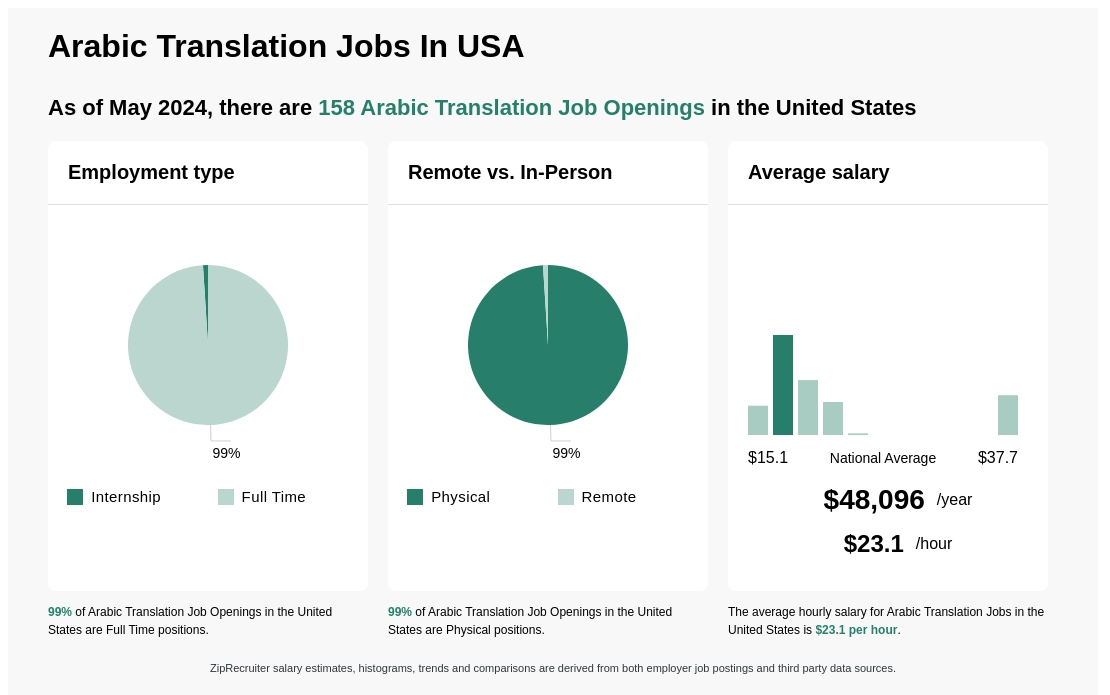
Infographic showing various Arabic Translation job openings in the United States as of August 2026, with employment types broken down into 1% As Needed, 73% Full Time, 18% Part Time, 1% Temporary, and 7% Contract. Highlights an 79% Physical, 3% Hybrid, and 18% Remote job distribution, with an average salary of $48,096 per year, or $23.1 per hour.

AU/QL - Linguist - CAT III - Arabic-Yemeni/Arabic-Levantine - FGGA

Arrow Security &Training LLC

Augusta, GA • On-site

Full-time

Re-posted 7 days ago


Job description

Company Overview

Arrow Security & Training LLC (AST) is a privately-owned training company with our corporate headquarters in Nashua, New Hampshire. AST is a Service-Disabled Veteran Owned Small Business (SDVOSB) who provides tailored military training, training support, and a host of services to government and private sector clients worldwide.

Job Description

AST, LLC is currently seeking CAT III - Arabic-Yemeni/Arabic-Levantine linguist / translator candidates to be considered for employment.

Summary of duties include:

  • Provide foreign language support services, including transcription, and translation / interpretation (comprising idiomatic translations of non-technical material using correct syntax and expression from English to the SCRL language(s) or vice versa) services in support of military interrogations, intelligence collection, and other operational missions.
  • Provide any and all cultural and ethnic context of translations, interpretations, and transcriptions with an expert linguist?s opinion given to the supported organization or agency as to the most likely meaning/intent of terms, phrases, or statements that may have multiple valid interpretations.
  • Perform document exploitation, scan, research, and analyze foreign language documents and intercepted data for key information; and must be able to supplement interpretations and translations with information pertinent and specific to professional fields; such as medicine, scientific, engineering, legal, etc. and identify and extract information components meeting military information requirement list criteria as well as provide input to reports.