1

Aquaculture Jobs (NOW HIRING)

next page

Showing results 1-20

Aquaculture information

See salary details

$5

$21

$42

How much do aquaculture jobs pay per hour?

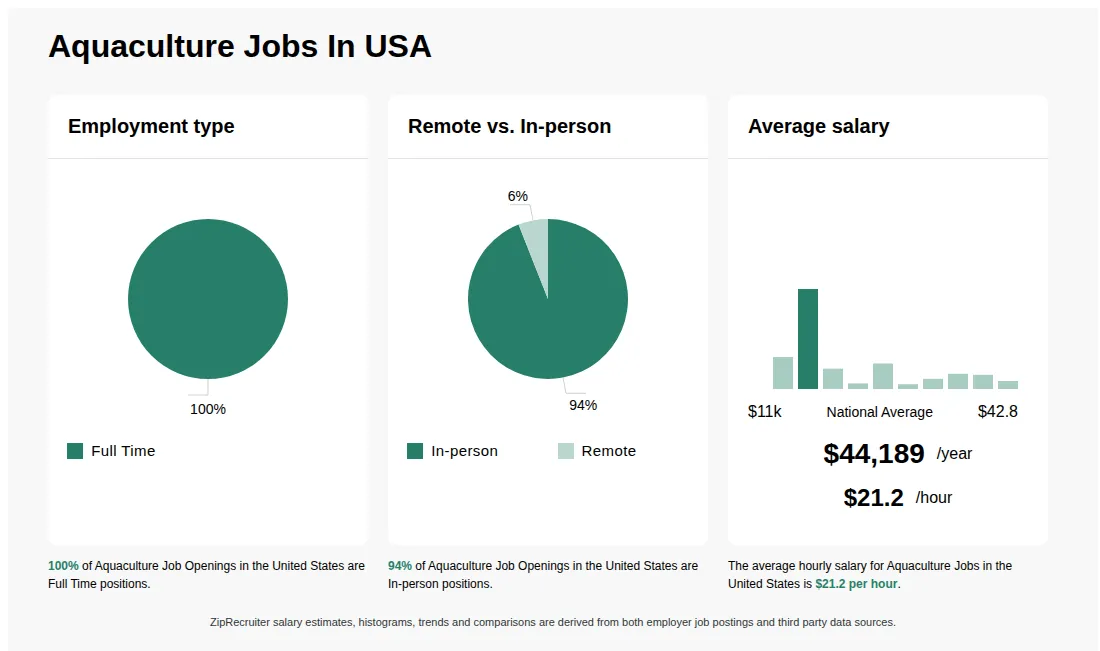
As of Jul 27, 2026, the average hourly pay for aquaculture in the United States is $21.24, according to ZipRecruiter salary data. Most workers in this role earn between $13.46 and $29.57 per hour, depending on experience, location, and employer.

What is an aquaculture job?

An aquaculture job involves the cultivation and management of aquatic organisms such as fish, shellfish, and aquatic plants in controlled environments like tanks, ponds, or ocean farms. These roles often require knowledge of biology, water quality management, and sometimes certifications in safety or environmental standards.

What Is Aquaculture?

Aquaculture is a form of maritime or water agriculture, sometimes referred to as aquafarming. In aquaculture, farmers, breeders, and other marine scientists develop methods to cultivate freshwater or saltwater organisms, such as oysters, clams, fish, plants, and algae, for the purposes of harvesting them. Aquaculture is distinct from commercial fishing because aquaculturists function more like farmworkers, breeding animals in a controlled environment. Some aquaculture farmers, such as those producing algae, are more focused on developing non-food uses for their products.

What are the key skills and qualifications needed to thrive in Aquaculture, and why are they important?

To thrive in Aquaculture, you need a solid understanding of aquatic biology, water quality management, and fish husbandry, often supported by a degree in marine biology, fisheries, or a related field. Familiarity with water testing kits, feeding systems, hatchery equipment, and sometimes certifications like HACCP are typically required. Strong problem-solving, attention to detail, and teamwork skills help professionals address challenges and maintain healthy aquatic environments. These skills ensure efficient production, biosecurity, and the sustainability of aquaculture operations.

How much does an aquaculturist make?

Aquaculturists typically earn a median annual salary of around $45,000 to $60,000, depending on experience, location, and level of education. Salaries can increase with specialized skills, certifications, and management responsibilities in aquaculture facilities.

What are some careers in aquaculture?

Careers in aquaculture include roles such as aquaculture technician, fish farm manager, hatchery supervisor, marine biologist, and aquaculture engineer. These jobs often require knowledge of aquatic biology, water quality management, and the use of specialized equipment, with certifications sometimes needed for certain positions.

What are some typical challenges faced in an aquaculture role, and how can they be managed effectively?

Working in aquaculture often involves dealing with environmental variables such as water quality, disease management, and maintaining optimal conditions for aquatic species. Common challenges include monitoring for disease outbreaks, managing feed efficiency, and adhering to environmental regulations. Effective management relies on strong observation skills, using technology for real-time monitoring, and collaborating closely with team members such as biologists and technicians. Proactive communication and continuous learning are key to addressing issues quickly and maintaining healthy stock.

What jobs pay 500,000 a year in the US?

In aquaculture, high-paying roles such as senior executive positions, like CEO or COO of large aquaculture companies, can reach or exceed $500,000 annually, especially with bonuses and stock options. These roles typically require extensive industry experience, advanced degrees, and strong management skills. Most other aquaculture jobs tend to have lower salary ranges, with top executives being the primary earners at this level.

What is the difference between Aquaculture vs Fish Hatchery Technician?

AspectAquacultureFish Hatchery Technician
CredentialsHigh school diploma or equivalent; some roles may require degrees in marine biology or aquacultureHigh school diploma; on-the-job training often provided
Work EnvironmentResearch facilities, fish farms, marine or freshwater environmentsFish hatcheries, freshwater or marine tanks, outdoor ponds
Industry UsageBroader industry including farming, research, conservationSpecific to fish breeding and hatchery operations
Job FocusManaging entire aquaculture systems, water quality, fish healthFeeding, monitoring, and maintaining fish in hatchery settings

While both roles involve working with fish, aquaculture encompasses the broader practice of farming aquatic organisms, including managing entire systems and water quality. Fish hatchery technicians focus specifically on breeding and raising fish in hatchery environments. Understanding these differences helps job seekers find roles aligned with their skills and interests in the aquatic industry.

What is aquaculture?

Aquaculture, also known as fish farming, is the practice of breeding, raising, and harvesting aquatic organisms such as fish, shellfish, and seaweed in controlled environments. This industry helps meet the global demand for seafood while reducing pressure on wild fish populations. Aquaculture can take place in freshwater or marine environments and can range from small-scale family operations to large commercial enterprises. It plays a crucial role in food security, economic development, and environmental sustainability when managed responsibly.
What cities are hiring for Aquaculture jobs? Cities with the most Aquaculture job openings:
What are the most commonly searched types of Aquaculture jobs? The most popular types of Aquaculture jobs are:
What states have the most Aquaculture jobs? States with the most job openings for Aquaculture jobs include:
Infographic showing various Aquaculture job openings in the United States as of July 2026, with employment types broken down into 1% Internship, 84% Full Time, 10% Part Time, 3% Temporary, 1% Contract, and 1% Nights. Highlights an 96% Physical, and 4% Remote job distribution, with an average salary of $44,189 per year, or $21.2 per hour.
Aquaculture Biologist II - Oysters

Aquaculture Biologist II - Oysters

University of Southern Mississippi

Ocean Springs, MS • On-site

Other

This job post has expired today. Applications are no longer accepted.


University Of Southern Mississippi rating

5.7

Company rating: 5.7 out of 10

Based on 8 frontline employees who took The Breakroom Quiz

576th of 612 rated colleges and universities


Job description

Special Instructions to Applicants
Applicants must be currentlyauthorized to work in the United States on a full-time basis without the needfor visa sponsorship. The University will not sponsor applicants for work visas(e.g., H-1B).

Job Summary

This is a mid-level professional andtechnical scientific position focused on advanced marine aquaculture operationsand applied research. The incumbent independently performs hatchery, nursery,and grow-out activities with a focus on oyster production and supports ongoingresearch initiatives. Primary duties involve performing advanced aquacultureoperations, supporting applied research, and supervises lower-level staff inoyster hatchery, nursery, and grow-out systems. Responsibilities includeoverseeing daily operations, troubleshooting system performance, supervisinglower-level staff and interns, guiding experimental design and implementation,and contributing to data analysis and reporting. This position operates withlimited supervision and contributes scientific input for operationalimprovements and project planning. This position is affiliated with the ThadCochran Marine Aquaculture Center in Ocean Springs, MS, which is part of theGulf Coast Research Laboratory (GCRL) at the Cedar Point campus of theUniversity of Southern Mississippi.

Primary Duties and Responsibilities

  1. Perform and assist in planning advanced aquaculture tasks related to oyster hatchery, nursery, and grow-out systems to support production and research goals.
  2. Oversee daily aquaculture operations, ensuring proper system function, animal health, and culture conditions.
  3. Troubleshoot and resolve issues related to system performance, water quality, and equipment functionality.
  4. Supervise and train lower-level staff, interns, and students in aquaculture procedures and safety protocols.
  5. Contribute to experimental design, implementation, data collection, and analysis in support of applied research projects.
  6. Coordinate with faculty, partners, and program staff to support project planning, scheduling, and logistics for aquaculture operations and research activities.
  7. Performs other duties as assigned.

What University Of Southern Mississippi employees say

Pay

Hours and flexibility

Workplace

Get the full story on Breakroom