For more information, visit As a Postdoctoral Scientist in the Sarvestani Lab, you will have the ... antibody staining) * Engineering (CAD/3d printing, microcontrollers, signal processing) What you ...
For more information, visit As a Postdoctoral Scientist in the Sarvestani Lab, you will have the ... antibody staining) * Engineering (CAD/3d printing, microcontrollers, signal processing) What you ...
For more information, visit As a Postdoctoral Scientist in the Sarvestani Lab, you will have the ... antibody staining) * Engineering (CAD/3d printing, microcontrollers, signal processing) What you ...
For more information, visit As a Postdoctoral Scientist in the Sarvestani Lab, you will have the ... antibody staining) * Engineering (CAD/3d printing, microcontrollers, signal processing) What you ...

Postdoctoral Research Fellow
Boston, MA · On-site
$70K - $71K/yr
... engineer how therapeutics behave within tumors. The successful candidate will lead projects ... Antibody-drug, protein-drug, or polymer-drug conjugates. * Stimuli-responsive or activatable ...
Postdoctoral Research Fellow
Boston, MA · On-site
$70K - $71K/yr
... engineer how therapeutics behave within tumors. The successful candidate will lead projects ... Antibody-drug, protein-drug, or polymer-drug conjugates. * Stimuli-responsive or activatable ...

Postdoctoral Research Associate - Geeleher Lab (dry lab)
Memphis, TN · On-site
$85K/yr
... bispecific antibody-drug conjugates and logic-gated cellular therapies. Pediatric cancers are ... compensation scale (www.stjude.org/postdoc; Note: starting salary for this position is ...
Postdoctoral Research Associate - Geeleher Lab (dry lab)
Memphis, TN · On-site
$85K/yr
... bispecific antibody-drug conjugates and logic-gated cellular therapies. Pediatric cancers are ... compensation scale (www.stjude.org/postdoc; Note: starting salary for this position is ...

Characterize biochemical and biophysical properties of candidate antibody/monobody therapeutics ... Core knowledge of protein engineering (expression, purification, characterization) * Experience ...
Characterize biochemical and biophysical properties of candidate antibody/monobody therapeutics ... Core knowledge of protein engineering (expression, purification, characterization) * Experience ...

Post Doctoral Fellow
Saint Louis, MO · On-site
$47K - $64K/yr
... antibody enhancement. Unwanted/unsafe epitopes will be removed via viral engineering. Research ... This is a full-time Postdoctoral Researcher role at Saint Louis University. What can the Tse lab ...
Post Doctoral Fellow
Saint Louis, MO · On-site
$47K - $64K/yr
... antibody enhancement. Unwanted/unsafe epitopes will be removed via viral engineering. Research ... This is a full-time Postdoctoral Researcher role at Saint Louis University. What can the Tse lab ...

Characterize biochemical and biophysical properties of candidate antibody/monobody therapeutics ... Core knowledge of protein engineering (expression, purification, characterization) * Experience ...
Characterize biochemical and biophysical properties of candidate antibody/monobody therapeutics ... Core knowledge of protein engineering (expression, purification, characterization) * Experience ...
Post Doctoral Fellow
Saint Louis, MO · On-site
$47K - $64K/yr
... antibody enhancement. Unwanted/unsafe epitopes will be removed via viral engineering. Research ... This is a full-time Postdoctoral Researcher role at Saint Louis University. What can the Tse lab ...
Post Doctoral Fellow
Saint Louis, MO · On-site
$47K - $64K/yr
... antibody enhancement. Unwanted/unsafe epitopes will be removed via viral engineering. Research ... This is a full-time Postdoctoral Researcher role at Saint Louis University. What can the Tse lab ...
... bispecific antibody-drug conjugates and logic-gated cellular therapies. Pediatric cancers are ... Proficiency in a major programming language used for data analysis, such as R or Python.
... bispecific antibody-drug conjugates and logic-gated cellular therapies. Pediatric cancers are ... Proficiency in a major programming language used for data analysis, such as R or Python.
NY · On-site
$70K - $80K/yr
To be considered for a postdoctoral associate position, ideal candidates will have experience and ... vibratome, cryostat, microtome, antibody staining). * Engineering (CAD/3d printing ...
NY · On-site
$70K - $80K/yr
To be considered for a postdoctoral associate position, ideal candidates will have experience and ... vibratome, cryostat, microtome, antibody staining). * Engineering (CAD/3d printing ...

Post Doctoral Scholar
Columbus, OH · On-site
... and antibody-antigen interactions in cancer and viral diseases, with the goal of advancing ... The postdoc will work in a fast-paced, collaborative environment, contribute to high-impact ...
Post Doctoral Scholar
Columbus, OH · On-site
... and antibody-antigen interactions in cancer and viral diseases, with the goal of advancing ... The postdoc will work in a fast-paced, collaborative environment, contribute to high-impact ...
Post Doctoral Scholar
Columbus, OH · On-site
... and antibody-antigen interactions in cancer and viral diseases, with the goal of advancing ... The postdoc will work in a fast-paced, collaborative environment, contribute to high-impact ...
Post Doctoral Scholar
Columbus, OH · On-site
... and antibody-antigen interactions in cancer and viral diseases, with the goal of advancing ... The postdoc will work in a fast-paced, collaborative environment, contribute to high-impact ...

Scientist/Senior Scientist, Assay Development - Molecular Assay Chemistry and Biophysics
Woburn, MA · On-site
$100K - $136K/yr
... antibody-based recognition, nucleic-acid interactions, conjugation chemistry, reaction kinetics ... D. graduates and postdoctoral fellows with strong hands-on research ownership, as well as startup ...
Scientist/Senior Scientist, Assay Development - Molecular Assay Chemistry and Biophysics
Woburn, MA · On-site
$100K - $136K/yr
... antibody-based recognition, nucleic-acid interactions, conjugation chemistry, reaction kinetics ... D. graduates and postdoctoral fellows with strong hands-on research ownership, as well as startup ...
Scientist/Senior Scientist, Assay Development - Molecular Assay Chemistry and Biophysics
Woburn, MA · On-site
$115K/yr
... antibody-based recognition, nucleic-acid interactions, conjugation chemistry, reaction kinetics ... D. graduates and postdoctoral fellows with strong hands-on research ownership, as well as startup ...
Scientist/Senior Scientist, Assay Development - Molecular Assay Chemistry and Biophysics
Woburn, MA · On-site
$115K/yr
... antibody-based recognition, nucleic-acid interactions, conjugation chemistry, reaction kinetics ... D. graduates and postdoctoral fellows with strong hands-on research ownership, as well as startup ...

... antibody biomolecular engineering. Responsibilities * Work collaboratively across teams to ... postdoc experience. MSc in immunology, cell biology, or a closely related field with 4+ years of ...
... antibody biomolecular engineering. Responsibilities * Work collaboratively across teams to ... postdoc experience. MSc in immunology, cell biology, or a closely related field with 4+ years of ...

Postdoctoral Fellow-MSH
$53K - $73K/yr
... Engineering and Therapeutics at Icahn School of Medicine at Mount Sinai in NYC The lab is ... and antibody-protein interactions. An emerging direction of the lab is to conjugate machine ...
Postdoctoral Fellow-MSH
$53K - $73K/yr
... Engineering and Therapeutics at Icahn School of Medicine at Mount Sinai in NYC The lab is ... and antibody-protein interactions. An emerging direction of the lab is to conjugate machine ...
Postdoctoral Scientist- Gonzalez Lab
San Francisco, CA · On-site
$70K - $80K/yr
Programming and data analysis (MATLAB, Python, etc.) * Optics and engineering (machining CNC/3D ... Histology (vibratome, cryostat, microtome, antibody staining). Qualifications * A Ph.D. in ...
Postdoctoral Scientist- Gonzalez Lab
San Francisco, CA · On-site
$70K - $80K/yr
Programming and data analysis (MATLAB, Python, etc.) * Optics and engineering (machining CNC/3D ... Histology (vibratome, cryostat, microtome, antibody staining). Qualifications * A Ph.D. in ...
Scientist/Sr. Scientist Yeast Surface Dislay
Cambridge, MA · On-site
$125K - $170K/yr
Does it excite you to work at the frontier of antibody and binder discovery, and do you have ... PhD in Protein Engineering, Immunology, Molecular Biology, Biochemistry, or a related field ...
Scientist/Sr. Scientist Yeast Surface Dislay
Cambridge, MA · On-site
$125K - $170K/yr
Does it excite you to work at the frontier of antibody and binder discovery, and do you have ... PhD in Protein Engineering, Immunology, Molecular Biology, Biochemistry, or a related field ...

... antibody biomolecular engineering. Responsibilities * Work collaboratively across teams to ... postdoc experience. MSc in immunology, cell biology, or a closely related field with 4+ years of ...
... antibody biomolecular engineering. Responsibilities * Work collaboratively across teams to ... postdoc experience. MSc in immunology, cell biology, or a closely related field with 4+ years of ...
Postdoctoral Fellow-MSH
Manhattan, NY · On-site
$53K - $73K/yr
... Engineering and Therapeutics at Icahn School of Medicine at Mount Sinai in NYC The lab is ... and antibody-protein interactions. An emerging direction of the lab is to conjugate machine ...
Postdoctoral Fellow-MSH
Manhattan, NY · On-site
$53K - $73K/yr
... Engineering and Therapeutics at Icahn School of Medicine at Mount Sinai in NYC The lab is ... and antibody-protein interactions. An emerging direction of the lab is to conjugate machine ...
Antibody Engineering Postdoc information
See salary details
$34.5K - $48K
3% of jobs
$48K - $61.5K
13% of jobs
$61.5K - $75K
9% of jobs
$75.8K is the 25th percentile. Wages below this are outliers.
$75K - $88.5K
10% of jobs
$88.5K - $102K
13% of jobs
The median wage is $105.7K / yr.
$102K - $115.5K
12% of jobs
$115.5K - $129K
9% of jobs
$139.1K is the 75th percentile. Wages above this are outliers.
$129K - $142.5K
11% of jobs
$142.5K - $156K
14% of jobs
$156K - $169.5K
5% of jobs
$169.5K - $183K
3% of jobs
$34.5K
$111.2K
$183K
How much do antibody engineering postdoc jobs pay per year?
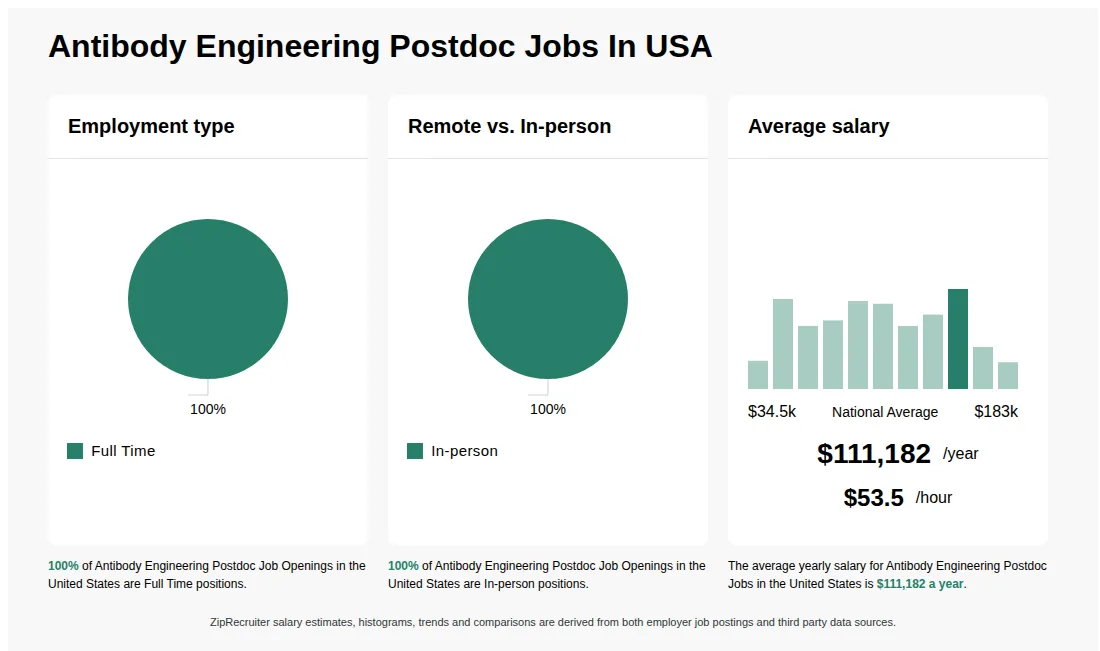
As of Sep 12, 2026, the average yearly pay for antibody engineering postdoc in the United States is $111,182.00, according to ZipRecruiter salary data. Most workers in this role earn between $77,000.00 and $144,000.00 per year, depending on experience, location, and employer.
What is an antibody engineering postdoc?
Antibody Engineering Postdocs are researchers who have completed their doctoral studies and are engaged in advanced research focused on designing, modifying, and optimizing antibodies for various applications. Their work often involves molecular biology, protein engineering, and immunology to develop antibodies with improved specificity, affinity, or therapeutic potential. These postdoctoral scientists typically work in academic, biotech, or pharmaceutical settings, contributing to projects such as drug discovery, diagnostics, or understanding immune responses. The position is highly collaborative and may include publishing research, mentoring students, and presenting findings at conferences.
What are the key skills and qualifications needed to thrive as an antibody engineering postdoc?
To thrive as an Antibody Engineering Postdoc, you need a PhD in molecular biology, biochemistry, or a related field, with expertise in protein engineering and antibody design. Experience with techniques such as phage display, flow cytometry, and bioinformatics tools, as well as familiarity with relevant laboratory software, is crucial. Strong problem-solving abilities, attention to detail, and effective collaboration and communication skills help you excel in multidisciplinary research environments. These competencies are essential for advancing innovative antibody therapeutics and contributing meaningful scientific discoveries.
What are some common challenges faced by antibody engineering postdocs when optimizing antibody affinity and specificity?
Antibody Engineering Postdocs often encounter challenges balancing affinity improvement with maintaining specificity, as enhancing one property can inadvertently compromise the other. Additionally, experimental hurdles such as expression yield, stability, and solubility of engineered antibodies require careful troubleshooting. Collaboration with structural biologists, biochemists, and computational modelers is typically essential to interpret results and iterate designs effectively. Being adaptable and open to interdisciplinary feedback is key to overcoming these complex challenges.
What is the difference between Antibody Engineering Postdoc vs Antibody Development Scientist?
| Aspect | Antibody Engineering Postdoc | Antibody Development Scientist |
|---|---|---|
| Required Credentials | PhD in immunology, molecular biology, or related field | Bachelor's or Master's in related sciences, with experience in antibody development |
| Work Environment | Academic or research institutions, laboratories | Biotech or pharmaceutical industry, R&D labs |
| Employer & Industry Usage | Primarily academia, research institutes | Industry-focused, product development companies |
| Common Search & Comparison Intent | Understanding research-focused roles in antibody engineering | Roles involved in antibody development and production |
While both roles involve working with antibodies, the Antibody Engineering Postdoc is primarily research-oriented, focusing on developing new antibody technologies in academic or research settings. In contrast, the Antibody Development Scientist typically works in industry, focusing on the development, optimization, and production of antibody-based therapeutics or diagnostics.
What are popular job titles related to Antibody Engineering Postdoc jobs?
For Antibody Engineering Postdoc jobs, the most frequently searched job titles are:

Postdoctoral Scientist-Sarvestani Lab
On-site
Howard Hughes Medical Institute (HHMI)
• Scientific Research and Development Services • 1 - 5K employees1,001 - 5,000 employees
Full-time
Medical, Retirement
Re-posted yesterday
Job description
Primary Work Address: 518 Clark Hall, Ithaca, NY, 14853Current HHMI Employees, click here to apply via your Workday account.
The Sarvestani Lab at Cornell University's Department of Neurobiology and Behavior seeking an energetic, curious, and driven Postdoctoral Scientist interested in systems neuroscience to join our research team. The Sarvestani lab focuses on identifying fundamental mechanism by which visual and motor systems across the brain and body underlie perceptual abilities optimized to the specialized behavioral demands of different animals. Our work is deeply engaged with theories of embodied cognition that consider the body as an inseparable component to perception, and a necessary component of intelligence. We aim to experimentally test such fundamental relationships between the brain, body, and behavior, using cross-species comparisons in tree shrews and rats.
We place particular emphasis on advanced technical approaches, including multiphoton microscopy, electrophysiology in freely moving animals, behavioral quantification using large-array motion capture cameras, and wireless embedded sensors, to record neuronal activity and bodily movements in behaving animals with high spatiotemporal precision. By understanding how moving bodies and perception are integrated, we can develop more effective clinical interventions and inspire the next revolution in AI - one that reflects how biological brains learn through embodied experience. For more information, visit https://sarvestanilab.com/
As a Postdoctoral Scientist in the Sarvestani Lab, you will have the chance to bring your enthusiasm, ideas, and expertise to various ongoing and new projects. Some of the research areas we are exploring include:
The role of motor experience in plasticity and error correction in the adult visual system
The role of early motor experience in development of visual circuits in infant animals
The role of proprioception in neural dynamics of visual perception
The role of self-motion induced sensory statistics in visual perception using a video-audio sensory substitution device
Application Instructions
Please include the following items in one PDF as part of your application. Cover Letter MUST be included for full consideration.
A cover letter including a summary of your research experience, your career goals, and why you think you are a good fit for the Sarvestani lab specifically.
Your curriculum vitae, including a list of publications.
Names and contact information for at least 2 references.
What we provide:
A competitive compensation package with comprehensive health and welfare benefits.
One on one mentorship with Dr. Sarvestani, targeted for academic or industry career paths.
Opportunity to work in both traditional (rodent) and exotic (tree shrew) models of visuomotor behavior.
Exposure to cutting-edge scientific research and opportunities for professional development.
Authorship on independent and collaborative scientific publications.
Opportunities to attend domestic conferences in addition to departmental and HHMI retreats to present scientific findings.
Being part of the vibrant community at the Cornell Department of Neurobiology & Behavior.
What you'll do:
To be considered for a postdoctoral associate position, ideal candidates will have experience and prior training in some of the following areas:
Programming in Python and/or Matlab.
Electrophysiology, calcium imaging, microstimulation.
Behavioral testing or quantification in animals.
Lab animal husbandry and surgical approaches (cranial implants, intracranial injections).
Histology and fluorescence imaging (vibratome, cryostat, microtome, antibody staining)
Engineering (CAD/3d printing, microcontrollers, signal processing)
What you bring:
A Ph.D. in neuroscience, bioengineering, or related field of science.
Advanced experience in coding and analysis of large brain and behavior datasets.
Ability to learn quickly and to work both independently and as part of a team.
High level of research integrity and motivation.
Positive attitude with a problem-solving, resilient approach.
Resourcefulness in overcoming challenges, and the ability to adapt and thrive in a fast-paced environment.
Willingness to fully participate in lab and departmental activities, to positively engage with other team members and promote their success (e.g., by reviewing manuscripts, participating in practice talks), mentor junior colleagues, and contribute to an inclusive and productive research climate.
Physical Requirements
Remaining in a normal seated or standing position for extended periods of time; reaching and grasping by extending hand(s) or arm(s); dexterity to manipulate objects with fingers, for example using a keyboard; communication skills using the spoken word; ability to see and hear within normal parameters; ability to move about workspace. The position requires mobility, including the ability to move materials weighing up to several pounds (such as a laptop computer or tablet).
Persons with disabilities may be able to perform the essential duties of this position with reasonable accommodation. Requests for reasonable accommodation will be evaluated on an individual basis.
Please Note:
This job description sets forth the job's principal duties, responsibilities, and requirements; it should not be construed as an exhaustive statement, however. Unless they begin with the word "may," the Essential Duties and Responsibilities described above are "essential functions" of the job, as defined by the Americans with Disabilities Act.
#LI-LL1
Compensation and Benefits
Our employees are compensated from a total rewards perspective in many ways for their contributions to our mission, including competitive pay, exceptional health benefits, retirement plans, time off, and a range of recognition and wellness programs. Visit our Benefits at HHMI site to learn more.
Hiring Pay Range
$70,000.00 - $82,250.00Pay Type:
AnnualThe posted range reflects HHMI's good faith estimate of the anticipated hiring salary range for this role at the time of posting. Actual hiring compensation is determined by a candidate's qualifications, experience, and internal equity.
HHMI is an Equal Opportunity Employer
We use E-Verify to confirm the identity and employment eligibility of all new hires.

About Howard Hughes Medical Institute
Sourced by ZipRecruiter
Industry
Scientific research and development services
Company size
1,001 - 5,000 Employees
Headquarters location
Chevy Chase, MD, US
Year founded
1953