1

Antibody Engineering Postdoc Jobs (NOW HIRING)

Information on being a postdoc at WashU in St. Louis can be found at Trains under the supervision ... Design and execute independent research projects focused on antibody engineering, ADC development ...

Postdoc Fellow

Columbus, OH · On-site

$44K - $60K/yr

Postdoc Fellow Department: Veterinary Medicine | Veterinary Biosciences Xu lab at the department of ... Prior work on antibody engineering or rational design. Experience mentoring junior researchers or ...

Synthetic Biology & Protein Engineering: translational synthetic biology, protein and antibody ... Fred Hutch has more than 200 postdoctoral fellows working in labs across all five research ...

next page

Showing results 1-20

Antibody Engineering Postdoc information

See salary details

$34.5K

$111.2K

$183K

How much do antibody engineering postdoc jobs pay per year?

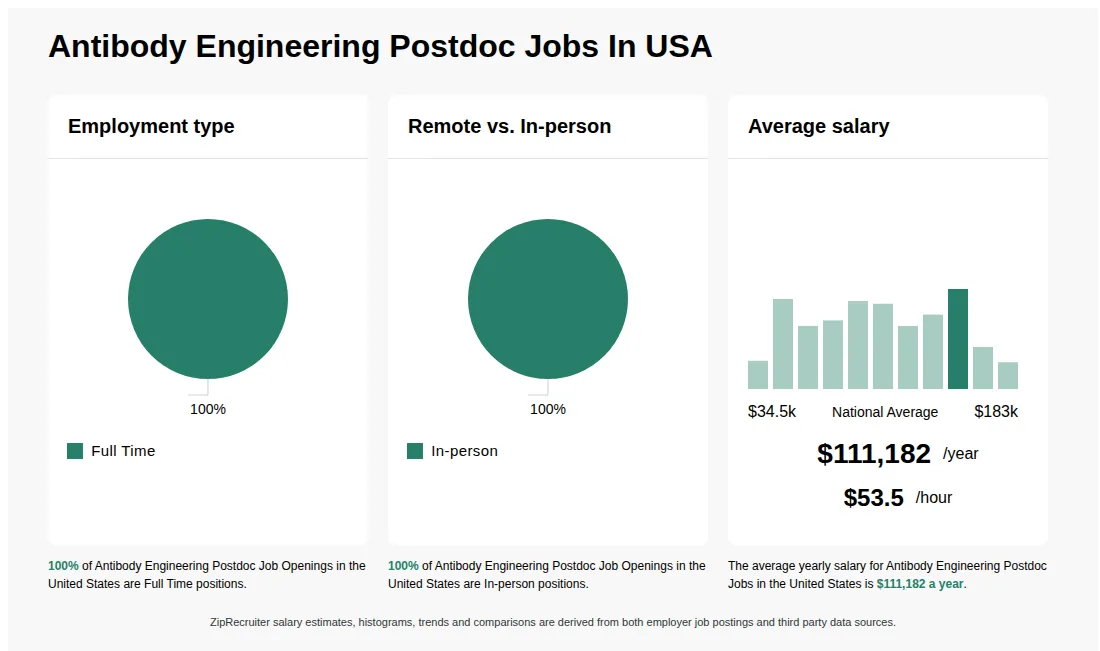
As of Sep 12, 2026, the average yearly pay for antibody engineering postdoc in the United States is $111,182.00, according to ZipRecruiter salary data. Most workers in this role earn between $77,000.00 and $144,000.00 per year, depending on experience, location, and employer.

What is an antibody engineering postdoc?

Antibody Engineering Postdocs are researchers who have completed their doctoral studies and are engaged in advanced research focused on designing, modifying, and optimizing antibodies for various applications. Their work often involves molecular biology, protein engineering, and immunology to develop antibodies with improved specificity, affinity, or therapeutic potential. These postdoctoral scientists typically work in academic, biotech, or pharmaceutical settings, contributing to projects such as drug discovery, diagnostics, or understanding immune responses. The position is highly collaborative and may include publishing research, mentoring students, and presenting findings at conferences.

What are the key skills and qualifications needed to thrive as an antibody engineering postdoc?

To thrive as an Antibody Engineering Postdoc, you need a PhD in molecular biology, biochemistry, or a related field, with expertise in protein engineering and antibody design. Experience with techniques such as phage display, flow cytometry, and bioinformatics tools, as well as familiarity with relevant laboratory software, is crucial. Strong problem-solving abilities, attention to detail, and effective collaboration and communication skills help you excel in multidisciplinary research environments. These competencies are essential for advancing innovative antibody therapeutics and contributing meaningful scientific discoveries.

What are some common challenges faced by antibody engineering postdocs when optimizing antibody affinity and specificity?

Antibody Engineering Postdocs often encounter challenges balancing affinity improvement with maintaining specificity, as enhancing one property can inadvertently compromise the other. Additionally, experimental hurdles such as expression yield, stability, and solubility of engineered antibodies require careful troubleshooting. Collaboration with structural biologists, biochemists, and computational modelers is typically essential to interpret results and iterate designs effectively. Being adaptable and open to interdisciplinary feedback is key to overcoming these complex challenges.

What is the difference between Antibody Engineering Postdoc vs Antibody Development Scientist?

AspectAntibody Engineering PostdocAntibody Development Scientist
Required CredentialsPhD in immunology, molecular biology, or related fieldBachelor's or Master's in related sciences, with experience in antibody development
Work EnvironmentAcademic or research institutions, laboratoriesBiotech or pharmaceutical industry, R&D labs
Employer & Industry UsagePrimarily academia, research institutesIndustry-focused, product development companies
Common Search & Comparison IntentUnderstanding research-focused roles in antibody engineeringRoles involved in antibody development and production

While both roles involve working with antibodies, the Antibody Engineering Postdoc is primarily research-oriented, focusing on developing new antibody technologies in academic or research settings. In contrast, the Antibody Development Scientist typically works in industry, focusing on the development, optimization, and production of antibody-based therapeutics or diagnostics.

What are popular job titles related to Antibody Engineering Postdoc jobs?

For Antibody Engineering Postdoc jobs, the most frequently searched job titles are:

Infographic showing various Antibody Engineering Postdoc job openings in the United States as of September 2026, with employment types broken down into 1% Internship, 90% Full Time, 6% Part Time, 2% Contract, and 1% Nights. Highlights an 83% Physical, 4% Hybrid, and 13% Remote job distribution, with an average salary of $111,182 per year, or $53.5 per hour.

Senior Scientist, Antibody Engineering

South San Francisco, CA • On-site

$110K - $150K/yr

Full-time

Medical, Dental, Vision, Life, Retirement, PTO

Posted 29 days ago


Job description

Senior Scientist Antibody Engineering  
August 2026

Department: Technology
Work Location:  Corporate Headquarters (South San Francisco)

Position Summary:

Join our innovative team at TCG Labs-Soleil as an antibody engineering expert! We are seeking a highly skilled and motivated scientist to lead and advance our display-based antibody engineering capabilities within the cutting-edge Biologics Technology Group. In this pivotal role, you will design, build, and screen antibody display libraries by incorporating both AI-driven and conventional computational tools to bias library design toward higher hit rates and faster timelines. You will work closely with colleagues within Technology and collaborate cross-functionally with scientists across research and early development to drive technical excellence and support our growing pipeline of protein and antibody-based therapeutics.

Responsibilities:

  • Directly contribute to the therapeutic pipeline by developing and optimizing display-based antibody engineering strategies, including humanization, affinity maturation, bispecific and multispecific antibody design, and innovative molecular formats.
  • Design, construct, and screen phage (or possibly other display format) antibody libraries, applying AI-based and bioinformatic computational tools to bias library composition toward higher-affinity, higher-diversity candidates, improved hit rates, and efficient timelines.
  • As a member of the computational engineering team, contribute to in silico designs and translate the outputs into library construction and screening strategy, and feeding experimental results back to sharpen future computational designs.
  • Evaluate and implement cutting-edge antibody display technologies (e.g., phage, and possibly yeast or mammalian display) to enhance discovery and screening capabilities.
  • Collaborate closely with protein sciences, analytics, and in vitro teams to integrate computational design with experimental validation.
  • Drive technology innovation by staying current with emerging trends in antibody engineering and computational protein design, incorporating advances into the team's workflows.
  • Troubleshoot and resolve complex technical challenges related to in vitro antibody discovery, engineering, and characterization.
  • Design, implement, and analyze experiments efficiently, delivering data-driven insights that inform pipeline decisions.

Qualifications:

  • Ph.D. with 5+ years of postdoctoral or industry experience or M.S. with 10+ years of industry experience in antibody discovery, engineering, biochemistry, bioinformatics, or related fields within biotech or pharma.
  • Deep expertise in in vitro antibody discovery platforms, including synthetic and immune library construction and phage display for lead identification, optimization, affinity maturation and other engineering approaches (yeast or mammalian display experience a plus).
  • Experience designing and curating large antibody display libraries, applying AI- or bioinformatics-based computational filtering, ranking, and diversity-optimization approaches to concentrate screening effort on the most promising candidates.
  • Track record of closing the loop between wet-lab results and in silico models, using experimental data to refine computational design for subsequent rounds of library generation.
  • Confident Python programming skills with the ability to write, debug, and maintain code, and comfort navigating a Linux/command-line environment.
  • Working familiarity with computational structure prediction tools (e.g., AlphaFold, Rosetta, or similar) sufficient to collaborate effectively with structure-based antibody engineers.
  • Strong problem-solving skills with the ability to troubleshoot complex molecular and biochemical challenges.
  • Demonstrated ability to prioritize tasks and manage multiple projects in a dynamic, fast-paced environment.
  • Meticulous attention to experimental detail, adept at multitasking and managing concurrent experiments without compromising quality.
  • Excellent oral and written communication skills, with a track record of presenting scientific findings and contributing to publications or patents.
  • Strong team player with the ability to lead cross-functional collaborations, including with computational scientists, and with flexibility to adapt to new scientific domains and quickly acquire new techniques.

Company Overview
TCG Labs-Soleil, established in partnership with The Column Group, a science-focused venture capital firm, is pioneering a novel 'venture capital-biotech' model. Our core mission is to efficiently translate scientific insights into therapeutic solutions for patients facing serious diseases. This model supports scientific entrepreneurs from the initial idea to clinical proof of concept (PoC) by combining a dedicated fund (TCG Labs) with our independent, evergreen R&D center led by a top-tier scientific team (Soleil). Together, we create an integrated ecosystem that fosters the development of single-asset portfolio companies, strategically poised for transacting after clinical PoC. 
For more details, visit TCGLSoleil.com and follow us on LinkedIn

EEO Statement
TCG Labs-Soleil is an Equal Opportunity Employer. We do not discriminate against qualified applicants based upon any protected group status, including but not limited to race, religion, color, creed, sex (including breastfeeding and related conditions), gender identity/gender expression, pregnancy (including childbirth and related conditions), national origin, ancestry, age, marital status, military or veteran status, sexual orientation, genetic information, physical or mental disability or medical condition as defined by applicable equal opportunity laws. Any request for accommodation can be directed to contact@tcglsoleil.com. 

Benefits and Compensation 
TCG Labs-Soleil provides a competitive benefits package that includes access to Medical, Dental, and Vision Insurance, Life Insurance, Short and Long Term Disability, Health Savings Account (HSA), Flexible Spending Accounts (FSA), 401k plan and PTO.

The anticipated salary range for fully qualified candidates applying for this role will be $134,835 - $240,776 annually (not including discretionary bonus, equity, and benefits). The final salary offered will be dependent on several factors that include but are not limited to relevant previous experience including duration and type of experience within the industry, education, and internal equity, as well as alignment with market data, including potential adjustments for geographic location.

Staffing Agencies
TCG Labs-Soleil does not accept unsolicited agency resumes and will not pay fees to any third-party agency or firm that doesn't have a signed agreement with TCG Labs-Soleil. Please do not send agency CVs/resumes through TCG Labs-Soleil website or TCG Labs-Soleil Employees.  Inquiries must be sent to contact@tcglsoleil.com with the Subject Heading: Staffing Agency Request.