Our Antibody Biopolymer Conjugate Drug (ABCD) platform combines protein engineering, polymer ... postdoctoral and/or industry experience; or M.S. or B.S. in related discipline with 5+ years of ...
Our Antibody Biopolymer Conjugate Drug (ABCD) platform combines protein engineering, polymer ... postdoctoral and/or industry experience; or M.S. or B.S. in related discipline with 5+ years of ...
Our Antibody Biopolymer Conjugate Drug (ABCD) platform combines protein engineering, polymer ... postdoctoral and/or industry experience; or M.S. or B.S. in related discipline with 5+ years of ...
Our Antibody Biopolymer Conjugate Drug (ABCD) platform combines protein engineering, polymer ... postdoctoral and/or industry experience; or M.S. or B.S. in related discipline with 5+ years of ...
Scientist
Gaithersburg, MD · On-site
$101K - $154K/yr
D. in Life Sciences, Engineering or related field preferred. o Additional postdoctoral or ... or antibody engineering), and molecular biology OR structural biology and membrane protein ...
Scientist
Gaithersburg, MD · On-site
$101K - $154K/yr
D. in Life Sciences, Engineering or related field preferred. o Additional postdoctoral or ... or antibody engineering), and molecular biology OR structural biology and membrane protein ...

To that end, we are leveraging the latest advances in gene therapy to engineer long-lived host ... Although these anti-drug antibody (ADA) responses are rarely observed in newborn macaques, a large ...
To that end, we are leveraging the latest advances in gene therapy to engineer long-lived host ... Although these anti-drug antibody (ADA) responses are rarely observed in newborn macaques, a large ...

Scientist
Gaithersburg, MD · On-site
$101K - $154K/yr
D. in Life Sciences, Engineering or related field preferred. o Additional postdoctoral or ... or antibody engineering), and molecular biology OR structural biology and membrane protein ...
Scientist
Gaithersburg, MD · On-site
$101K - $154K/yr
D. in Life Sciences, Engineering or related field preferred. o Additional postdoctoral or ... or antibody engineering), and molecular biology OR structural biology and membrane protein ...

Postdoctoral Fellow - Gamma-Herpesvirus Vaccine and Immunotherapy Research
Duarte, CA · On-site
$51K - $69K/yr
... for two postdoctoral scholar positions. Our interdisciplinary research program focuses on ... Our work integrates molecular virology, vaccine engineering, immunology, antibody discovery, and ...
Postdoctoral Fellow - Gamma-Herpesvirus Vaccine and Immunotherapy Research
Duarte, CA · On-site
$51K - $69K/yr
... for two postdoctoral scholar positions. Our interdisciplinary research program focuses on ... Our work integrates molecular virology, vaccine engineering, immunology, antibody discovery, and ...
Postdoctoral Fellow - Gamma-Herpesvirus Vaccine and Immunotherapy Research
Duarte, CA · On-site
$51K - $69K/yr
... for two postdoctoral scholar positions. Our interdisciplinary research program focuses on ... Our work integrates molecular virology, vaccine engineering, immunology, antibody discovery, and ...
Postdoctoral Fellow - Gamma-Herpesvirus Vaccine and Immunotherapy Research
Duarte, CA · On-site
$51K - $69K/yr
... for two postdoctoral scholar positions. Our interdisciplinary research program focuses on ... Our work integrates molecular virology, vaccine engineering, immunology, antibody discovery, and ...
... class engineering & automation. Our goal is to supercharge the discovery of next-generation ... Role Overview We are seeking a motivated and hands-on Research Scientist (PhD or Postdoctoral level ...
... class engineering & automation. Our goal is to supercharge the discovery of next-generation ... Role Overview We are seeking a motivated and hands-on Research Scientist (PhD or Postdoctoral level ...
... class engineering & automation. Our goal is to supercharge the discovery of next-generation ... Role Overview We are seeking a motivated and hands-on Research Scientist (PhD or Postdoctoral level ...
... class engineering & automation. Our goal is to supercharge the discovery of next-generation ... Role Overview We are seeking a motivated and hands-on Research Scientist (PhD or Postdoctoral level ...
The project will involve cell/EV engineering and preclinical quantitative in vivo imaging ... Tissue processing (perfusion, tissue extraction/cryosectioning) and antibody staining. * Experience ...
The project will involve cell/EV engineering and preclinical quantitative in vivo imaging ... Tissue processing (perfusion, tissue extraction/cryosectioning) and antibody staining. * Experience ...
... class engineering & automation. Our goal is to supercharge the discovery of next-generation ... Role Overview We are seeking a motivated and hands-on Research Scientist (PhD or Postdoctoral level ...
... class engineering & automation. Our goal is to supercharge the discovery of next-generation ... Role Overview We are seeking a motivated and hands-on Research Scientist (PhD or Postdoctoral level ...
Postdoctoral fellow in antibody bioconjugation
Boston, MA · On-site
$53K - $72K/yr
Applications are invited for positions involving research in biomedical applications of antibody ... A Ph.D. in Pharmaceutical Science or Biomedical Engineering, or related area, and experience in ...
Postdoctoral fellow in antibody bioconjugation
Boston, MA · On-site
$53K - $72K/yr
Applications are invited for positions involving research in biomedical applications of antibody ... A Ph.D. in Pharmaceutical Science or Biomedical Engineering, or related area, and experience in ...

... Category Postdoc Department Computational Biology Shift Weekday Day Position Type Full Time ... Proficiency in a major programming language used for data analysis, such as R or Python.
... Category Postdoc Department Computational Biology Shift Weekday Day Position Type Full Time ... Proficiency in a major programming language used for data analysis, such as R or Python.

Postdoctoral Position in Jeffrey J. Gray's Computational Protein Structure and Design Lab
Baltimore, MD · On-site
$80K/yr
This position will allow you to learn the emerging deep learning approaches to proteins and antibodies and craft new machine learning approaches for antibody engineering, protein-protein docking, and ...
Postdoctoral Position in Jeffrey J. Gray's Computational Protein Structure and Design Lab
Baltimore, MD · On-site
$80K/yr
This position will allow you to learn the emerging deep learning approaches to proteins and antibodies and craft new machine learning approaches for antibody engineering, protein-protein docking, and ...
Programming and data analysis (MATLAB, Python, etc.) * Optics and engineering (machining CNC/3D ... Histology (vibratome, cryostat, microtome, antibody staining) What you bring: * A Ph.D. in ...
Programming and data analysis (MATLAB, Python, etc.) * Optics and engineering (machining CNC/3D ... Histology (vibratome, cryostat, microtome, antibody staining) What you bring: * A Ph.D. in ...

Programming and data analysis (MATLAB, Python, etc.) * Optics and engineering (machining CNC/3D ... Histology (vibratome, cryostat, microtome, antibody staining) What you bring: * A Ph.D. in ...
Programming and data analysis (MATLAB, Python, etc.) * Optics and engineering (machining CNC/3D ... Histology (vibratome, cryostat, microtome, antibody staining) What you bring: * A Ph.D. in ...
Programming and data analysis (MATLAB, Python, etc.) * Optics and engineering (machining CNC/3D ... Histology (vibratome, cryostat, microtome, antibody staining) What you bring: * A Ph.D. in ...
Programming and data analysis (MATLAB, Python, etc.) * Optics and engineering (machining CNC/3D ... Histology (vibratome, cryostat, microtome, antibody staining) What you bring: * A Ph.D. in ...

Postdoctoral Research Fellow
Boston, MA · On-site
$70K - $71K/yr
... engineer how therapeutics behave within tumors. The successful candidate will lead projects ... Antibody-drug, protein-drug, or polymer-drug conjugates. * Stimuli-responsive or activatable ...
Postdoctoral Research Fellow
Boston, MA · On-site
$70K - $71K/yr
... engineer how therapeutics behave within tumors. The successful candidate will lead projects ... Antibody-drug, protein-drug, or polymer-drug conjugates. * Stimuli-responsive or activatable ...

Postdoctoral Research Fellow
Boston, MA · On-site
$70K - $71K/yr
... engineer how therapeutics behave within tumors.The successful candidate will lead projects ... Antibody-drug, protein-drug, or polymer-drug conjugates.Stimuli-responsive or activatable chemistry.
Postdoctoral Research Fellow
Boston, MA · On-site
$70K - $71K/yr
... engineer how therapeutics behave within tumors.The successful candidate will lead projects ... Antibody-drug, protein-drug, or polymer-drug conjugates.Stimuli-responsive or activatable chemistry.
For more information, visit As a Postdoctoral Scientist in the Sarvestani Lab, you will have the ... antibody staining) * Engineering (CAD/3d printing, microcontrollers, signal processing) What you ...
For more information, visit As a Postdoctoral Scientist in the Sarvestani Lab, you will have the ... antibody staining) * Engineering (CAD/3d printing, microcontrollers, signal processing) What you ...
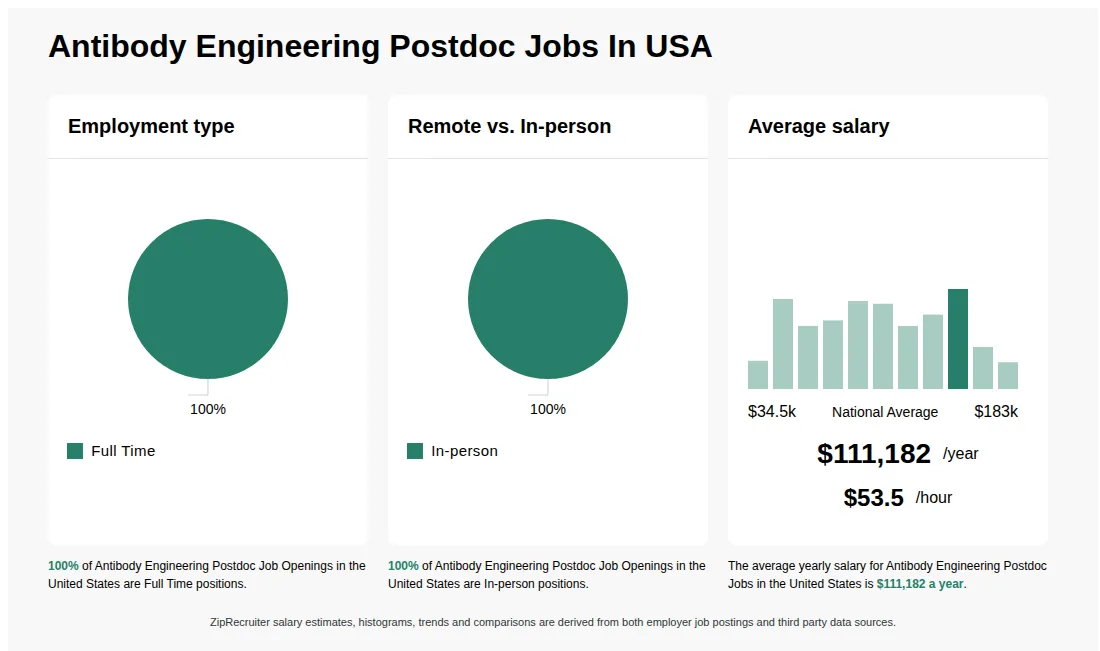
Antibody Engineering Postdoc information
See salary details
$34.5K - $48K
3% of jobs
$48K - $61.5K
13% of jobs
$61.5K - $75K
9% of jobs
$75.8K is the 25th percentile. Wages below this are outliers.
$75K - $88.5K
10% of jobs
$88.5K - $102K
13% of jobs
The median wage is $105.7K / yr.
$102K - $115.5K
12% of jobs
$115.5K - $129K
9% of jobs
$139.1K is the 75th percentile. Wages above this are outliers.
$129K - $142.5K
11% of jobs
$142.5K - $156K
14% of jobs
$156K - $169.5K
5% of jobs
$169.5K - $183K
3% of jobs
$34.5K
$111.2K
$183K
How much do antibody engineering postdoc jobs pay per year?
As of Sep 12, 2026, the average yearly pay for antibody engineering postdoc in the United States is $111,182.00, according to ZipRecruiter salary data. Most workers in this role earn between $77,000.00 and $144,000.00 per year, depending on experience, location, and employer.
What is an antibody engineering postdoc?
Antibody Engineering Postdocs are researchers who have completed their doctoral studies and are engaged in advanced research focused on designing, modifying, and optimizing antibodies for various applications. Their work often involves molecular biology, protein engineering, and immunology to develop antibodies with improved specificity, affinity, or therapeutic potential. These postdoctoral scientists typically work in academic, biotech, or pharmaceutical settings, contributing to projects such as drug discovery, diagnostics, or understanding immune responses. The position is highly collaborative and may include publishing research, mentoring students, and presenting findings at conferences.
What are the key skills and qualifications needed to thrive as an antibody engineering postdoc?
To thrive as an Antibody Engineering Postdoc, you need a PhD in molecular biology, biochemistry, or a related field, with expertise in protein engineering and antibody design. Experience with techniques such as phage display, flow cytometry, and bioinformatics tools, as well as familiarity with relevant laboratory software, is crucial. Strong problem-solving abilities, attention to detail, and effective collaboration and communication skills help you excel in multidisciplinary research environments. These competencies are essential for advancing innovative antibody therapeutics and contributing meaningful scientific discoveries.
What are some common challenges faced by antibody engineering postdocs when optimizing antibody affinity and specificity?
Antibody Engineering Postdocs often encounter challenges balancing affinity improvement with maintaining specificity, as enhancing one property can inadvertently compromise the other. Additionally, experimental hurdles such as expression yield, stability, and solubility of engineered antibodies require careful troubleshooting. Collaboration with structural biologists, biochemists, and computational modelers is typically essential to interpret results and iterate designs effectively. Being adaptable and open to interdisciplinary feedback is key to overcoming these complex challenges.
What is the difference between Antibody Engineering Postdoc vs Antibody Development Scientist?
| Aspect | Antibody Engineering Postdoc | Antibody Development Scientist |
|---|---|---|
| Required Credentials | PhD in immunology, molecular biology, or related field | Bachelor's or Master's in related sciences, with experience in antibody development |
| Work Environment | Academic or research institutions, laboratories | Biotech or pharmaceutical industry, R&D labs |
| Employer & Industry Usage | Primarily academia, research institutes | Industry-focused, product development companies |
| Common Search & Comparison Intent | Understanding research-focused roles in antibody engineering | Roles involved in antibody development and production |
While both roles involve working with antibodies, the Antibody Engineering Postdoc is primarily research-oriented, focusing on developing new antibody technologies in academic or research settings. In contrast, the Antibody Development Scientist typically works in industry, focusing on the development, optimization, and production of antibody-based therapeutics or diagnostics.
What are popular job titles related to Antibody Engineering Postdoc jobs?
For Antibody Engineering Postdoc jobs, the most frequently searched job titles are:

Scientist/Sr Scientist - Protein Production and Purification
Palo Alto, CA • On-site
Kodiak Sciences Inc.
• Biotechnology Research and Development • 11 - 50 employees11 - 50 employees
Full-time
This job post has expired 2 days ago. Applications are no longer accepted.
Job description
Kodiak Sciences Inc. is a fast-growing, clinical-stage biopharmaceutical company focused on transforming ophthalmology through innovative therapeutics. Our Antibody Biopolymer Conjugate Drug (ABCD) platform combines protein engineering, polymer chemistry, small molecule drug discovery, bioconjugation, and drug delivery to address high-prevalence ophthalmic diseases.
We are seeking a motivated and independent Protein Production Scientist/Sr. Scientist to join our Discovery Medicine group as part of the Protein Engineering team. The successful candidate will be an outstanding scientist with demonstrated expertise in recombinant protein expression and purification and will play a central role in advancing our discovery and research programs. This individual will excel at developing and executing robust protein production strategies, delivering high-quality recombinant proteins that enable antibody engineering, biochemical characterization, and functional evaluation. This is an exciting opportunity to contribute to the development of innovative therapeutics within a collaborative, fast-paced, and interdisciplinary research environment.
Responsibilities
- Design, execute, and optimize recombinant protein expression workflows for a broad range of recombinant protein targets, including antibodies, therapeutic proteins, enzymes, and research reagents, using transient mammalian expression systems (e.g., HEK293, CHO) and bacterial expression platforms.
- Develop, optimize, and execute purification processes for diverse recombinant proteins using affinity, ion exchange, size exclusion, and other chromatographic techniques.
- Purify protein conjugates, including protein-polymer and protein-drug conjugates, by applying established methodologies and developing innovative purification strategies to address complex molecular formats.
- Perform biochemical and biophysical characterization of recombinant proteins using SDS-PAGE, SEC, DLS, mass photometry, isoelectric focusing (IEF), and complementary analytical techniques to evaluate protein quality, purity, identity, aggregation, stability, and other critical quality attributes.
- Maintain, optimize, and troubleshoot mammalian cell culture and recombinant protein production processes to ensure robust, reproducible expression and high-quality protein yields.
- Plan, prioritize, and coordinate protein production activities across multiple research programs to meet project objectives and timelines.
- Analyze and interpret experimental data, prepare technical reports, and present scientific findings and recommendations to cross-functional project teams.
- Maintain comprehensive laboratory notebooks, experimental records, and protein inventory databases to ensure data integrity, traceability, regulatory compliance, and efficient sample management.
- Independently manage laboratory operations, maintain equipment and reagent inventories, and drive continuous improvement initiatives to enhance protein production, purification, and analytical workflows.
Education & Qualifications
- Ph.D. in Biochemistry, Cell Biology, Molecular Biology, Protein Science, or a related discipline with 0-5 years of relevant postdoctoral and/or industry experience; or M.S. or B.S. in related discipline with 5+ years of relevant industry experience.
- Demonstrated expertise in recombinant protein expression using transient mammalian expression systems (e.g., HEK293, CHO); experience with bacterial expression systems is preferred.
- Extensive hands-on experience in the purification of antibodies and diverse recombinant proteins using affinity, ion exchange, size exclusion, and other chromatographic techniques in both column- and batch-based formats.
- Proficiency in operating, optimizing and troubleshooting protein purification platforms, including ÄKTA FPLC systems; experience with KingFisher or other automated purification platforms is highly desirable.
- Strong foundation in protein biochemistry and hands-on experience with biochemical and biophysical characterization techniques, including SDS-PAGE, SEC, DLS, UV-Vis spectroscopy, mass photometry, isoelectric focusing (IEF), and related analytical methods.
- Demonstrated ability to independently design, execute, optimize, troubleshoot, and interpret recombinant protein expression, purification, and characterization experiments.
- Proven ability to optimize protein production workflows and implement innovative approaches to improve productivity, protein quality, and throughput.
- Excellent organization skills, meticulous attention to detail, and commitment to maintaining accurate experimental records and documentation.
- Strong written and verbal communication skills, with the ability to effectively collaborate and communicate scientific findings across multidisciplinary research teams.

About Kodiak Sciences
Sourced by ZipRecruiter
Industry
Biotechnology research and development
Company size
11 - 50 Employees
Headquarters location
Palo Alto, CA, US
Year founded
2009