2

Animal Welfare Remote Jobs (NOW HIRING)

Remote, USA (large metropolitan area preferred) Employment Status: Full-time, At-Will, Exempt ... Research and analyze companies , including their structure, leadership, animal welfare standards ...

This is a remote position within the United States that requires travel as outlined below ... As a contingent driver for our Animal Relocation team, you will meet animal welfare professionals ...

... advancing animal welfare by ensuring the accuracy, quality, and execution of critical data ... Where and When You'll Work This position is a remote role with occasional travel up to 5% to ASPCA ...

This is a remote-based position that requires up to 75% travel to support customers, research ... Ensure compliance with animal welfare, regulatory, and internal research protocols. * Oversee ...

... improving animal welfare across our society. Our Shelter Partnership Team's work focuses on ... Regular travel between LAAS shelters and the remote work location is required. This position is ...

... animal welfare, and safety), SOPs, and technical study requirements * Review and edit study ... Remote work is an option. * We are passionate about our culture! Our Tarsans live our values of ...

next page

Showing results 1-20

Animal Welfare Remote information

See salary details

$9

$21

$27

How much do animal welfare remote jobs pay per hour?

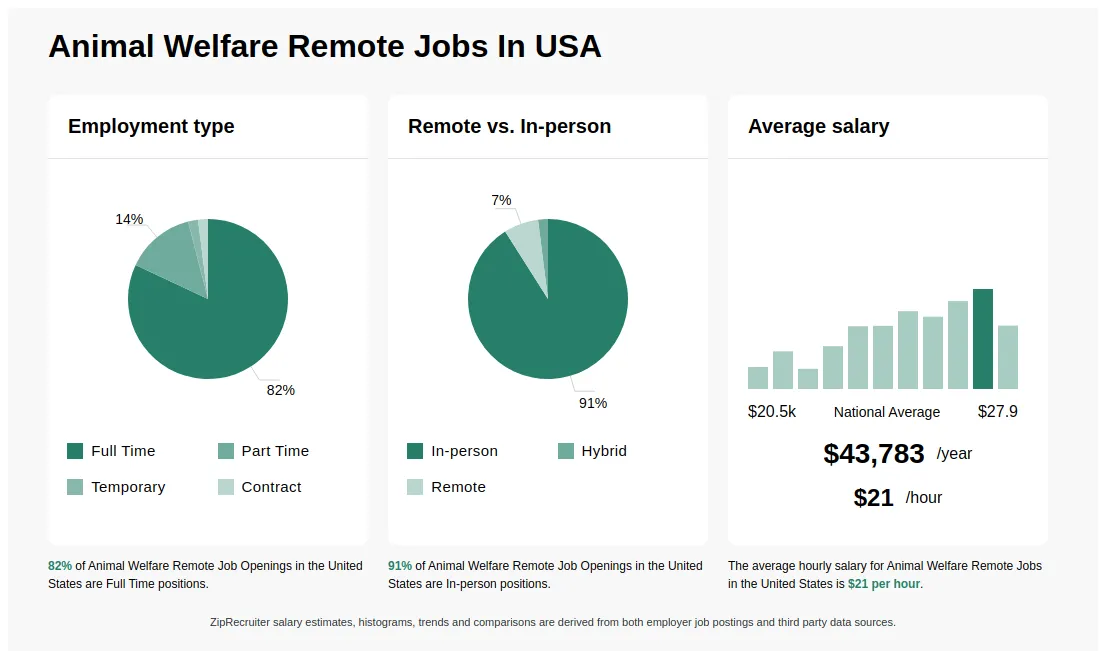
As of Jul 30, 2026, the average hourly pay for animal welfare remote in the United States is $21.05, according to ZipRecruiter salary data. Most workers in this role earn between $17.31 and $25.00 per hour, depending on experience, location, and employer.

What are the typical daily responsibilities for someone in an Animal Welfare Remote role?

Daily responsibilities in an Animal Welfare Remote role often include reviewing animal care reports, coordinating with field staff or volunteers via virtual meetings, and responding to inquiries from the public or partner organizations. You may also be involved in developing educational materials, tracking case progress in online systems, and ensuring compliance with local and federal animal welfare regulations. Collaboration with on-site teams and external partners is common, requiring clear written and verbal communication. This structure allows remote professionals to play a vital role in protecting animal well-being, even while working off-site.

What is an Animal Welfare Remote job?

An Animal Welfare Remote job involves working from home or another remote location to support the well-being and protection of animals. Responsibilities may include advocacy, research, education, fundraising, or coordinating rescue efforts. These roles are often found in non-profit organizations, government agencies, or animal shelters and may require strong communication and organizational skills. Some positions involve direct interaction with animals, while others focus on policy, outreach, or administrative tasks.

What are the key skills and qualifications needed to thrive in the Animal Welfare Remote position, and why are they important?

To excel in an Animal Welfare Remote position, candidates should possess a background in animal science or a related field, strong organizational and communication skills, and experience working with animal care protocols. Familiarity with case management databases, virtual collaboration tools, and certifications such as Certified Animal Welfare Administrator (CAWA) are often preferred. Outstanding attention to detail, empathy, and the ability to self-motivate make individuals particularly successful in this role. These qualifications ensure that remote animal welfare professionals can provide effective support and advocacy while maintaining high standards of care and compliance from a distance.

More about Animal Welfare Remote jobs
What cities are hiring for Animal Welfare Remote jobs? Cities with the most Animal Welfare Remote job openings:
What are the most commonly searched types of Animal Welfare jobs? The most popular types of Animal Welfare jobs are:
What states have the most Animal Welfare Remote jobs? States with the most job openings for Animal Welfare Remote jobs include:
Infographic showing various Animal Welfare Remote job openings in the United States as of July 2026, with employment types broken down into 80% Full Time, 10% Part Time, and 10% Contract. Highlights an 100% Remote job distribution, with an average salary of $43,783 per year, or $21 per hour.

Animal Health Technician

Agricultural Research Service

Manhattan, KS • On-site, Remote

$55K - $80K/yr

Full-time

Posted 27 days ago


Agricultural Research Service rating

6.2

Company rating: 6.2 out of 10

Based on 5 frontline employees who took The Breakroom Quiz

68th of 72 rated research


Job description

Summary
This position is located in the United States Department of Agriculture (USDA), Agricultural Research Service (ARS), Plains Area, National Bio and Agro-Defense Facility (NBAF) in Manhattan, KS.
In this position, you will be responsible for assisting in animal acquisitions and care outside the containment facilities and managing and directly supporting the medical care of animals in the containment facilities.
Please note, the closing date of this announcement has been extended to 8/7/2026.
Learn more about this agency
Duties
Help
  • Perform clinical care, husbandry, and assist with operations and research teams in containment units with animals exposed to highly infectious and highly transmissible diseases.
  • Functions as part of a team to ensure animal welfare and scientific integrity are maintained.
  • Closely coordinates with Veterinarians and Animal Care Technician Supervisors receiving activities to perform an evaluation of animals following routine SOPs.
  • Follows strict containment, sanitary or sterile procedures when working within the containment barrier and when working with animals in an ABSL-3Ag/ABSL-4/ABSL-4Ag environment.
  • Communicates and collaborates professionally with other personnel, procures animals and considers space availability, required equipment, animal care, and species suitability.
  • Complies with state and Federal county regulations and guidelines in supporting dealing with animals used in research and training, animal transportation, and controlled substance documentation.
  • In performing review of animals and activities, ensures compliance with Animal Welfare Act; AAALAC; IACUC policies and procedures; and USDA Policies and Procedures and Directives relevant to Animal Care and Use.

Requirements
Help
Conditions of employment
  • You must be a US Citizen or US National.
  • Males born after 12/31/1959 must be Selective Service registered or exempt.
  • Subject to satisfactory adjudication of background investigation and/or fingerprint check.
  • Direct Deposit - Per Public Law 104-134 all Federal employees are required to have federal payments made by direct deposit to their financial institution.
  • Successfully pass the E-Verify employment verification check. To learn more about E-Verify, including your rights and responsibilities, visit https://www.e-verify.gov/.
  • As a condition of employment for accepting this position, you will be required to serve a 1-year probationary period unless previous federal service is creditable. During this time your employment will be evaluated, and we may consider: your performance and conduct, the needs and interests of the agency, whether your continued employment would advance organizational goals of the agency or the Government, and whether your continued employment would advance the efficiency of the Federal service. Upon completion of your probationary period your employment will be terminated unless you receive certification, in writing, that your continued employment advances the public interest
  • Motor Vehicle or Commercial Driver's License Required.
  • Drug Test Required.
  • Vaccine(s) Required.
  • Special Physical Requirements/Demands (May wear fully encapsulated suit).
  • SAC and full background investigation required for positions working with BSL-3 (or higher) agents, or in BSL-3/BSL-4 facilities.
  • Department of Justice (DOJ) Security Risk Assessment (SRA) approval is required.
  • Respirator fitting and certification is required.

Qualifications
Applicants must meet all qualifications and eligibility requirements by the closing date of the announcement including specialized experience and/or education, as defined below.
GS-08:
Specialized Experience: Applicant must have one year of specialized experience comparable to GS-07 which is directly related to the work of this position, and which has equipped the applicant with the knowledge, skills, and abilities to perform successfully the duties of the position. For this position, specialized experience is assisting in an experiment or research project related to animal science; collecting animal specimens (i.e. blood, feces, urine, tissue); maintaining data collected from animal research; and ensuring activities are in compliance with policies, laws, or regulations.
OR
Education:Two full years of progressively higher-level graduate education leading to a master's or equivalent graduate degree, if directly related to the position. Related degrees may include Animal Science, Biology, Biosafety, Animal Behavior, Laboratory Animal Medicine, or Veterinary Science.
OR
Combination of graduate level education and specialized experience as described above.
GS-09:
Specialized Experience: Applicant must have one year of specialized experience comparable to GS-08 which is directly related to the work of this position, and which has equipped the applicant with the knowledge, skills, and abilities to perform successfully the duties of the position. For this position, specialized experience is participating in a research project related to animal science; operating and maintaining equipment and supplies used in veterinary care; implementing and adhering to quarantine procedures; and operating software systems to input data, track actions and produce technical reports related to animal husbandry.
OR
Education:Two full years of progressively higher-level graduate education leading to a master's or equivalent graduate degree, if directly related to the position. Related degrees may include Animal Science, Biology, Biosafety, Animal Behavior, Laboratory Animal Medicine, or Veterinary Science.
OR
Combination of graduate level education and specialized experience as described above.
Experience refers to paid and unpaid experience, including volunteer work done through National Service programs (e.g., Peace Corps, AmeriCorps) and other organizations (e.g., professional; philanthropic; religious; spiritual; community, student, social). Volunteer work helps build critical competencies and can provide valuable training and experience that translates directly to paid employment. You will receive credit for all qualifying experience, including volunteer experience.
Physical Demands:
  • When not working with animals, the work involves sitting at a desk within containment (approximately 30- 50%), walking, standing, bending, and carrying of light items. In working with animals (collecting of biological specimens and observation and treatment of newly received and blood donor animals), moderate to heavy physical exertion is required (moving equipment and carcasses up to 60 pounds with appropriate support). Stooping, bending, reaching and active walking is required. The work also requires the ability to move quickly around animals that may be unrestrained, possibly unpredictable, and not accustomed to handling by humans. Some travel may be required.
  • Personal protective equipment (PPE) such as masks or respirators, boots, gloves, and coveralls may be used to perform laboratory and animal related tasks. The work may involve wearing a fully encapsulated positive pressure suit in the ABSL4 animal containment areas.

Work Conditions:
  • The work is performed in an office, indoor and outdoor animal holding facilities, necropsy rooms and laboratories. Temperature extremes are possible. It also involves exposure to disagreeable odors when working around animals and may involve exposure to the risks and hazards of harmful biological, chemical, and physical agents, such as, but not limited to high consequence pathogens. There is the potential for exposure to highly contagious diseases of animals and humans, and to fractious animals. For the health and safety of the incumbent and to prevent the spread of disease, immunization against diseases being studied at NBAF which are transmissible to humans may be required where the vaccine has been approved by the Food and Drug Administration (FDA) for safety and effectiveness under the provisions of the Federal, Food, Drug, and Cosmetic Act, as amended, 21 USC 321-392. Where the FDA for investigation purposes has approved the vaccine, the incumbent will be advised that such immunization is voluntary.
  • Restrictions against contact with birds and livestock outside the laboratory may apply after entering high security animal facilities that are working with disease agents foreign to the United States.
  • Personal protective equipment (PPE) such as masks or respirators, boots, gloves, and coveralls may be used to perform laboratory and animal related tasks that represent a potential source of zoonotic disease or other biohazard. Incumbent may be required to wear a fully encapsulated positive pressure suit in BSL4 animal holding rooms.
  • Various forms of respiratory protection equipment must be worn when working with certain infectious agents, chemicals, and animal allergens.
  • Certain environments may also necessitate the use of hearing protection.
  • PPE provides necessary protection against biological and chemical hazards but may increase the risk of accidents due to decreased vision, hampered communication, limited mobility and dexterity. Physical well-being may be compromised by the prolonged usage of the PPE, which may lead to labored respiration, heat stress and dehydration. Strict agent safety regulations are applied to prevent the escape of animal pathogens from the work environment.
  • The health status of personnel is monitored periodically using biologic and serologic tests and physical examinations.

Education
See above for Education requirements.
The mission of NBAF includes research, diagnosis and training for animal diseases foreign to the U.S. for the purpose of protecting American agriculture and domestic food sources from their potentially devastating effects. NBAF is vital to successfully protecting U.S. Agriculture from the intentional or non-intentional introduction of foreign animal diseases such as Foot-and-Mouth disease. The position supports the biocontainment facilities and may require entry into biosafety level (BSL)-3, -3 enhanced, 3-Ag, 4, and 4A-g labs. The incumbent must demonstrate the physical and psychological capability to conduct normal duties that are appropriate to their position. To prevent the transmission of disease out of biocontainment and retention of the position, the incumbent must meet the following medical standards in a pre-employment medical examination conducted after the receipt of a preliminary job offer and on a periodic basis:
  • Ability to shower out of biocontainment one or more times per day;
  • Not have any skin condition which would prevent this;
  • Body piercings must be able to be removed prior to entry;
  • External medical assist devices must have the ability to be removed prior to entering or not impede the ability to enter biocontainment, and the individual must still be able to shower out safely without assistance;
  • Ability to follow instructions regarding decontamination from biocontainment;
  • Any medical condition which could create an unsafe environment for the individual or his/her co-workers, such as: insufficient control of a medical disorder which could result in sudden loss of consciousness; and inadequate vision and hearing required for safety in a laboratory environment.

Work Conditions:
A baseline blood sample may be required for employees entering and working in the biocontainment facilities. For the health and safety of the incumbent and to prevent the spread of disease, immunization against diseases being studied at NBAF which are transmissible to humans may be required where the vaccine has been approved by the Food and Drug Administration for safety and effectiveness under the provision of the Federal Food, Drug and Cosmetic Act, as amended 21 USC 321-392. Where the vaccine has been approved by the Food and Drug Administration for investigational purposes, the incumbent will be advised that such immunization is voluntary.
Medical confidentiality will be maintained by the examining physician and only fitness (or unfit) for duty determination will be indicated. The incumbent will also be required to pass periodic fitness for duty physicals. In addition, a medical clearance will be required in the event that it becomes necessary to enter an area where an air purifying respirator or other respiratory protection is required.
Due to the contagious nature to livestock of Foot-and-Mouth disease, and other diseases under study at NBAF, Biological Safety Regulations specify a personal quarantine for employees working in BSL-3, -3 enhanced, -3 Ag, 4, and 4Ag-biocontainment. As a condition for employment, all personnel entering the BSL-3 or higher biocontainment facilities at NBAF shall not be in contact with specific susceptible animals and their premises away from NBAF for a period of five (5) days after leaving bio-containment. This role will be expected to be in containment daily. Currently, restricted species are cattle, sheep, goats, deer, other ruminants, and swine. Contact with horses, birds (agricultural and pet birds) and rabbits are normally permitted, but restrictions may be placed on staff working with or near contagious agents affecting these species. Restricted livestock or other restricted animals may not be housed on the premises where the employee lives and where quarantine cannot be enforced. Employees who violate this requirement may be removed from employment or subject to other disciplinary action. Additionally, an approved SRA investigation is required for access to select agent registered spaces.
May be required to receive extra vaccinations to work on specific projects, submit to blood tests, and a respiratory/pulmonary function test.
Additional information
Career Transition Assistance Plan (CTAP), Reemployment Priority List (RPL), or Interagency Career Transition Assistance Plan (ICTAP): Visit the OPM website for information on how to apply as a CTAP, RPL, or ICTAP eligible. To exercise selection priority for this vacancy, CTAP/RPL/ICTAP candidates must meet the basic eligibility requirements and all selective factor

What Agricultural Research Service employees say

Pay

Workplace

Get the full story on Breakroom