1

American Sign Language Jobs (NOW HIRING)

Be Seen First

An American Sign Language (ASL) After School Instructor creates an engaging, inclusive environment to teach sign language basics, vocabulary, and Deaf culture to students and school families. Key ...

New

Be Seen First

An American Sign Language (ASL) After School Instructor creates an engaging, inclusive environment to teach sign language basics, vocabulary, and Deaf culture to students and school families. Key ...

New

Be Seen First

An American Sign Language (ASL) After School Instructor creates an engaging, inclusive environment to teach sign language basics, vocabulary, and Deaf culture to students and school families. Key ...

New

Showing results 41-60

American Sign Language information

See salary details

$29.5K

$65.7K

$71K

How much do american sign language jobs pay per year?

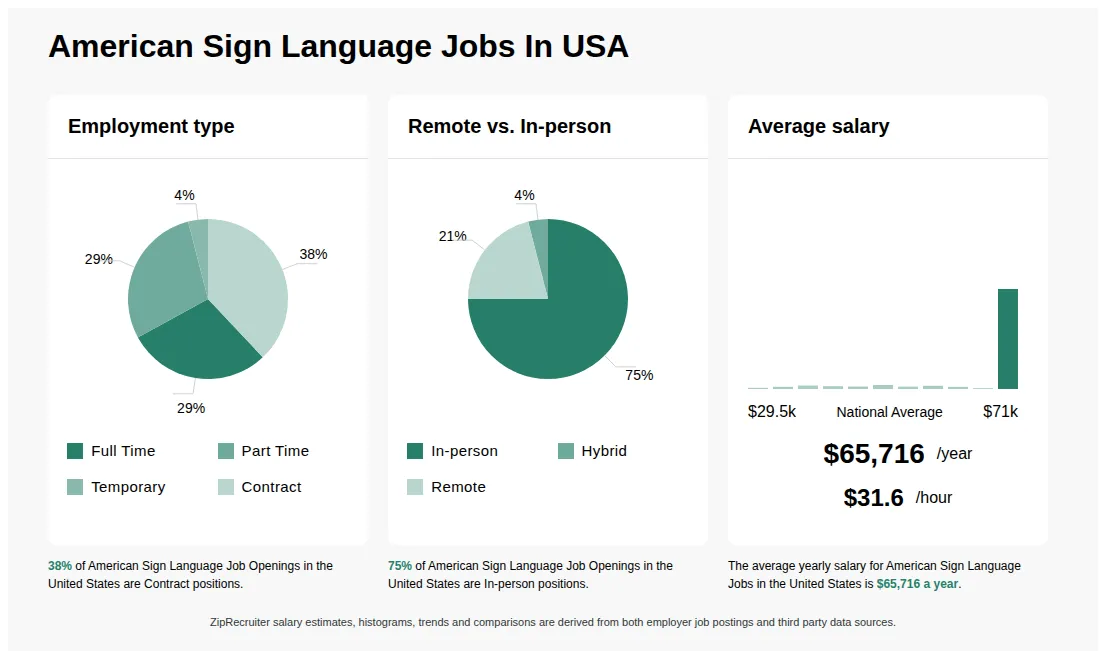
As of Jul 25, 2026, the average yearly pay for american sign language in the United States is $65,716.00, according to ZipRecruiter salary data. Most workers in this role earn between $69,000.00 and $69,000.00 per year, depending on experience, location, and employer.

What are the key skills and qualifications needed to thrive in the American Sign Language position, and why are they important?

To thrive as an American Sign Language Interpreter, fluency in ASL, deep understanding of Deaf culture, and strong interpretation skills are essential, typically supported by relevant certification (such as RID or NIC) and a degree in interpretation or related fields. Familiarity with video remote interpreting (VRI) platforms, captioning software, and interpreting equipment is commonly required. Exceptional interpersonal skills, cultural sensitivity, and the ability to remain impartial under pressure help interpreters succeed. These competencies are crucial for ensuring clear, accurate communication and fostering meaningful engagement between Deaf and hearing individuals in diverse settings.

What types of work environments do American Sign Language Interpreters typically work in?

American Sign Language Interpreters work in a wide variety of settings, including schools, medical facilities, legal environments, businesses, community events, and government institutions. Depending on the position, you may find yourself interpreting in classrooms, during medical appointments, at conferences, or through video remote services. Interpreters may work independently, as part of a team, or alongside other specialists to support accessible communication. Flexible schedules, travel between assignments, and adapting quickly to new environments are common aspects of the role. This diversity provides opportunities to develop specialized skills and advance into roles such as lead interpreter or interpreter coordinator.

What is an American Sign Language job?

An American Sign Language (ASL) job typically involves working with individuals who are deaf or hard of hearing to facilitate communication. Common roles include ASL interpreters, educators, counselors, and advocates who use sign language to assist in various settings such as schools, workplaces, healthcare, and community services. These professionals ensure accessibility, inclusion, and effective communication for the Deaf community. Many ASL jobs require fluency in ASL and may also require certification, depending on the role and location.

More about American Sign Language jobs
What cities are hiring for American Sign Language jobs? Cities with the most American Sign Language job openings:
What are the most commonly searched types of American Sign Language jobs? The most popular types of American Sign Language jobs are:
What states have the most American Sign Language jobs? States with the most job openings for American Sign Language jobs include:
Infographic showing various American Sign Language job openings in the United States as of July 2026, with employment types broken down into 2% As Needed, 81% Full Time, 13% Part Time, and 4% Contract. Highlights an 97% Physical, 1% Hybrid, and 2% Remote job distribution, with an average salary of $65,716 per year, or $31.6 per hour.
High School American Sign Language Teacher

High School American Sign Language Teacher

Talent Search PRO

Chino, CA โ€ข On-site

$45 - $55/hr

Full-time

Medical, Dental, Vision

Posted 9 days ago


Job description

High School American Sign Language Teacher
Location: Chino, California
Job Type: Contract
Pay: $45 to $55/hour
Why consider this opportunity?
Help students build lifelong communication skills while introducing them to American Sign Language and Deaf culture in an engaging, inclusive classroom. This long term contract offers competitive pay, comprehensive benefits, and the opportunity to work with a supportive school leader.
What's in it for you?
  • $45 to $55 per hour
  • Long term contract
  • Health, dental, and vision insurance available
  • Supportive and respected school leadership
What you'll do
  • Teach American Sign Language (ASL) using standards based instructional practices.
  • Create engaging lesson plans that develop receptive and expressive signing skills.
  • Assess student learning through projects, presentations, classroom activities, and formal assessments.
  • Foster an inclusive classroom that supports students with diverse learning styles.
  • Integrate technology and multimedia into daily instruction.
  • Differentiate instruction to meet individual student needs.
  • Communicate with students, parents, and school staff regarding academic progress.
  • Maintain attendance, grades, and student records in accordance with district policies.
  • Participate in department meetings, professional development, and school events.
What you'll need
  • Bachelor's degree in Deaf Studies, American Sign Language, Deaf Education, Education, or a related field.
  • Valid California Single Subject Credential in World Language, American Sign Language with English Learner Authorization.
  • Fluency in American Sign Language.
  • Knowledge of Deaf culture, history, and community.
  • Strong classroom management and lesson planning skills.
  • Excellent communication and interpersonal skills.
  • Commitment to creating an equitable and inclusive learning environment.