1

Air Force Combat Jobs (NOW HIRING)

$90K - $118K/yr

... combat type forces, deployment, mobilization, and contingency operations. Knowledge of Air Force, MAJCOM and military command structure, missions, programs, organizational relationships, program ...

Space Force Combat Forces Command (CFC) Intelligence, Surveillance, and Reconnaissance (ISR ... Space Force, Air Force, USSPACECOM, or Intelligence Community organizations. * Experience with ...

$46.25 - $59.75/hr

This requirement supports Air Force fighter squadrons in Air Combat Command (ACC), Air Force Materiel Command (AFMC), Pacific Air Forces (PACAF), United States Air Forces in Europe - Air Forces ...

$1.7K - $2.2K/wk

This requirement supports Air Force fighter squadrons in Air Combat Command (ACC), Air Force Materiel Command (AFMC), Pacific Air Forces (PACAF), United States Air Forces in Europe - Air Forces ...

$1.4K - $1.8K/wk

This requirement supports Air Force fighter squadrons in Air Combat Command (ACC), Air Force Materiel Command (AFMC), Pacific Air Forces (PACAF), United States Air Forces in Europe - Air Forces ...

next page

Showing results 1-20

Air Force Combat information

What are the key skills and qualifications needed to thrive in Air Force Combat roles, and why are they important?

To succeed in Air Force Combat roles, candidates must possess excellent physical fitness, mental resilience, situational awareness, and typically have at least a high school diploma or equivalent. Training involves mastery of advanced military technology, weapons systems, and potentially certifications in areas like survival, evasion, resistance, and escape (SERE). Outstanding teamwork, leadership, and decision-making under pressure are crucial soft skills for this demanding environment. These competencies ensure mission effectiveness, personal safety, and the ability to operate successfully in high-stress, dynamic combat situations.

What are some common challenges faced by Air Force Combat personnel during deployments?

Air Force Combat personnel often face challenges such as operating in high-stress environments, adapting quickly to rapidly changing mission requirements, and maintaining peak performance during long or unpredictable hours. Team cohesion and communication are critical, as missions require coordinated efforts with both Air Force and joint-service units. Additionally, adjusting to extended periods away from home and managing personal well-being are important aspects to consider for those considering this role.

What are the 7 special forces units?

In the Air Force, the primary special forces unit is the Air Force Special Operations Command (AFSOC), which includes units like the 24th Special Operations Wing and the 27th Special Operations Wing. These units conduct unconventional warfare, direct action, and special reconnaissance missions, often requiring advanced training and specialized skills.

Does the Air Force have combat soldiers?

The Air Force employs combat roles such as Combat Airmen, who are trained for air combat, ground defense, and special operations. These personnel operate advanced aircraft, weapons systems, and perform missions that support national security and air superiority.

What is the difference between Air Force Combat vs Air Force Security Forces?

AspectAir Force CombatAir Force Security Forces
Primary RoleEngaging in combat operations, combat support, and tactical missionsProtecting bases, personnel, and resources through security and law enforcement
Work EnvironmentCombat zones, field operations, military basesMilitary bases, security posts, law enforcement settings
Required CertificationsBasic Combat Training, specialized combat skillsSecurity Forces training, law enforcement certifications

While both roles serve vital functions in the Air Force, Air Force Combat personnel focus on direct combat and tactical operations, often in hostile environments. In contrast, Air Force Security Forces specialize in base security, law enforcement, and force protection, primarily within secure environments. Both roles require rigorous training and are essential to mission success, but they differ significantly in daily duties and operational focus.


What is an Air Force Combat job?

An Air Force Combat job refers to roles within the Air Force that are directly involved in combat or combat support operations. These positions can include pilots, combat controllers, pararescue specialists, and other roles that require direct engagement with enemy forces or support of combat missions. Air Force Combat personnel are highly trained to operate in high-risk environments and often work closely with other branches of the military. Their training includes weapons handling, tactical maneuvers, and survival skills. These roles are essential for achieving air superiority and supporting ground operations.

What combat roles are in the Air Force?

In the Air Force, combat roles include positions such as Combat Aircrew, Tactical Air Control Party (TACP), and Combat Rescue Officer. These roles involve operating aircraft, coordinating air support, and conducting rescue missions, often requiring specialized training and certifications. Personnel in these roles work in high-pressure environments and may deploy to various operational theaters.

What is the $600000 bonus for the Air Force?

The $600,000 bonus for the Air Force typically refers to enlistment or retention incentives offered to certain career fields or specialties, such as pilots or critical skills, to attract and retain qualified personnel. These bonuses are usually paid out over several years and may require a commitment to serve for a specified period, along with meeting specific qualifications and training requirements.
More about Air Force Combat jobs
What cities are hiring for Air Force Combat jobs? Cities with the most Air Force Combat job openings:
What states have the most Air Force Combat jobs? States with the most job openings for Air Force Combat jobs include:
What job categories do people searching Air Force Combat jobs look for? The top searched job categories for Air Force Combat jobs are:
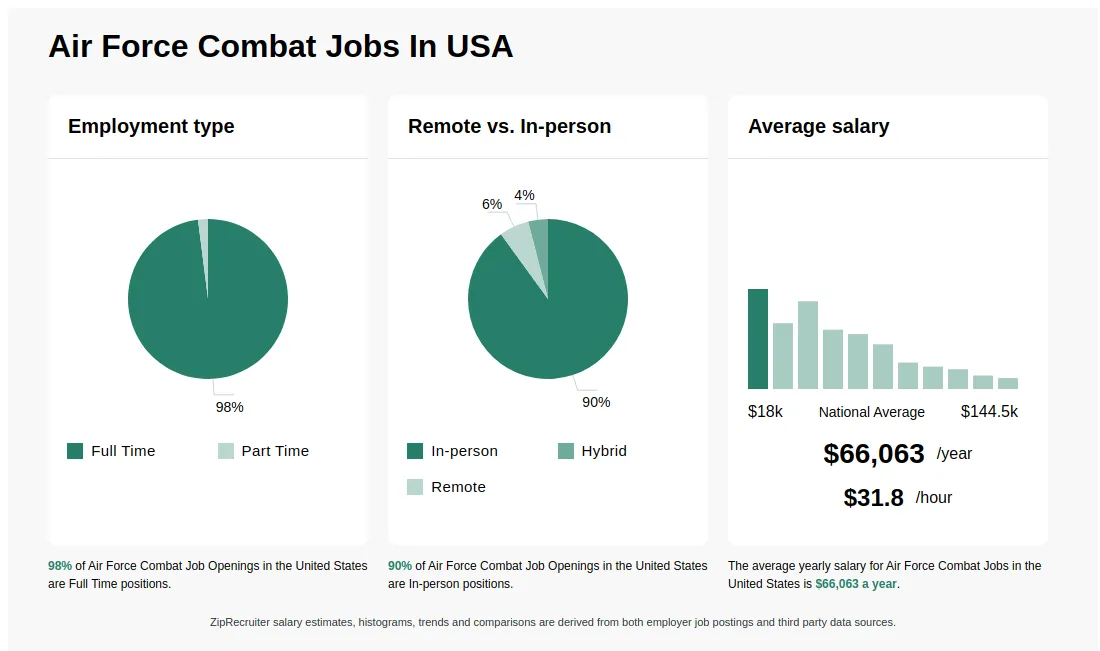
Infographic showing various Air Force Combat job openings in the United States as of June 2026, with employment types broken down into 67% Full Time, and 33% Temporary. Highlights an 100% In-person job distribution.

Executive Director ? Madera Cyber Innovation Center (MCIC)

U.S. Air Force Academy Association & Foundation

Colorado Springs, CO

Full-time

Medical, Dental, Vision, Life, Retirement, PTO

Posted 29 days ago


Job description

Executive Director ? Madera Cyber Innovation Center (MCIC)

This is a civilian employee position that works for a 501(c)3 non-profit that supports the Air Force Academy. This position does not require military service or graduation from the United States Air Force Academy.

UNITED STATES AIR FORCE ACADEMY ASSOCIATION & FOUNDATION

The United States Air Force Academy Association & Foundation (?Association & Foundation?) believe strongly that the United States Air Force Academy (?Academy?) is a vital national resource, upholding the invaluable mission of developing leaders of character for our Air Force, Space Force and nation. The Association & Foundation have joined forces to accomplish their complementary missions to actively support these leaders as well as the Academy and its cadets.

The core values of the United States Air Force Academy are Integrity First, Service Before Self, and Excellence in All We Do. These same core values guide the Association & Foundation, as well as our boards and staff.

Association & Foundation ? Madera Cyber Innovation Center (donation funded)

The Madera Cyber Innovation Center (MCIC) is a 48,000-square-foot facility opened in April 2025 at the U.S. Air Force Academy in Colorado Springs, CO?the Academy?s hub for cyber education, training, and innovation.

The MCIC houses three core organizations: the Institute for Future Conflict (donor-funded cadet education for emerging threats), Air Force CyberWorx (Air Combat Command?funded technology procurement and innovation), and the Department of Computer and Cyber Sciences (classrooms, electronics labs, and cyber training). The facility includes 14 labs and classrooms, three SCIFs, and specialized spaces for digital forensics, reverse engineering, robotics, autonomous systems, telecommunications, ICS, and UAV operations. Its centerpiece is ?Cyber City,? where cadets simulate offensive and defensive operations against realistic urban infrastructure.

THE OVERVIEW

The Association & Foundation, in support of the U.S. Air Force Academy, seeks its first Executive Director?a civilian leader who will serve as the principal integrator and strategic driver across all resident organizations. The success of this role will be measured by the success of the tenant organizations, the coherence of cyber initiatives undertaken by them, and the impact of the MCIC on the missions of the Academy in supporting DAF objectives. This is a full-time, on-site and donation funded position (initial duration of three years). The Executive Director will be required to be on a Volunteer Services Agreement (VSA) with USAFA.

The role requires someone who can operate credibly across three very different worlds: the academic environment of USAFA, the operational tempo of active-duty cyber and space units (16th Air Force / Air Combat Command and U.S. Space Force Combatant Command), and the commercial cyber industry. This person will partner closely with the senior military officer in the MCIC (currently the O-6 leading CyberWorx), the Director of the Institute for Future Conflict, and the Chair of the USAFA Computer Science and Cyber Department; coordinate between the MCIC Board of Advisors and active AF/Space Force units, and report to the Superintendent of USAFA.

SUCCESSFUL OUTCOMES

  • Unified the three resident organizations around a shared strategic plan. Forged a common vision and partnership strategy across IFC, CyberWorx, and the Department of Computer and Cyber Sciences?each with different funding, reporting lines, and cultures?into a coherent, mutually reinforcing mission.
  • Established a productive civil-military operating rhythm with the senior O-6. Built a high-trust partnership with clear lanes of responsibility, shared decision-making norms, and a unified front to external stakeholders.
  • Become the Superintendent?s and Dean?s trusted cyber advisor. Serve as the go-to resource on cyber operational practice and technology trends, threats, and educational innovation?translating commercial and military developments into actionable strategy for Academy leadership.
  • Built operational bridges to active-duty cyber and space units. Established collaboration frameworks with 16th Air Force and U.S. Space Force operational units, and entities of federal and state government with missions relevant to DAF cyber missions (intelligence, research, and doctrinal centers of expertise) ensuring the MCIC?s education and research agenda aligns with real-world mission needs.
  • Activated the Board of Advisors as a strategic asset. Transformed the Board from an advisory body into an active source of industry insight, talent connections, and resources that advance the MCIC?s mission.
  • Brought commercial cyber innovation inside the building. Established relationships with leading cyber companies, startups, and research organizations so cadets and faculty have exposure to current and emerging operational practice technologies, techniques, and threat landscapes.

KNOWLEDGE, SKILLS, AND ABILITIES

  • A bridge-builder who earns trust across military, academic, and commercial cultures without losing credibility in any.
  • Comfortable operating without direct authority; leads through influence, relationships, and the quality of ideas.
  • Shows up with energy, urgency, and a builder?s mindset; sees the MCIC?s early stage as an opportunity, not a limitation.
  • High humility and low ego; succeeds only when the people and organizations around them succeed.
  • Thinks strategically, operates practically; sets a three-year vision and rolls up sleeves to solve a problem this week.
  • Deeply curious about cyber relevant operational practice, technology and threat evolution; stays current out of genuine intellectual interest.
  • Significant leadership in commercial cyber or defense technology, with demonstrated understanding of how cyber capabilities are developed, deployed, and used in enterprise and/or military environments.
  • Proven ability to integrate organizations with different missions, funding streams, and cultures toward shared objectives.
  • Experience operating within or alongside DoD organizations; strong familiarity with military hierarchy, communication norms, and decision-making.
  • Track record building and stewarding relationships with boards, advisory councils, senior executives, and/or flag officers.
  • Understanding of national security interests and the evolving cyber threat landscape across military, intelligence, and civilian domains.

REQUIRED QUALIFICATIONS

  • Bachelor?s degree from accredited and reputable university. Degree in computer science, cybersecurity, engineering, or a closely related field strongly preferred. Military service or equivalent DoD/USG experience strongly preferred.
  • Full-time, on-site presence at the Air Force Academy in Colorado Springs, CO.
  • Ability to pass a DBIDS background check for access to MCIC offices on the Academy campus.
  • The applicant must be able to attain a TS/SCI clearance. Possession of a current/active clearance is strongly preferred.

COMPENSATION AND BENEFITS

The salary range for this position is $185,000 - $250,000. The Association & Foundation offers a competitive benefits package for full-time employees including but not limited to:

  • Medical/Dental/Vision
  • 401(k) ? up to a 6% match
  • Generous Paid Time Off (PTO) policy
  • 12 Holidays
  • Employer Paid Life Insurance
  • Free tickets to Air Force Basketball, Hockey etc.
  • Gym access

SUBMISSION INSTRUCTIONS:

Applicants must submit a cover letter and a resume to receive full consideration. The position will remain open until filled.