1

Academic Journal Editor Jobs (NOW HIRING)

... academic journal. * Coordinate peer review and final edits for grammar, syntax, citations, and ... Communicate with a team of undergraduate editors and faculty advisors about independent research ...

Associate Academic Editor

Rochester, MN · On-site +1

$65K - $80K/yr

Associate Academic Editor Reports to Director of Word on Fire Academic Word on Fire Catholic ... Give input on policy, scope, and direction of book and journal publishing endeavors, regularly ...

The Associate Academic Editor (AAE) works with the imprint head of Word on Fire Academic (WOFA) to ... Give input on policy, scope, and direction of book and journal publishing endeavors, regularly ...

The Assistant Editor supports all phases of the editorial process, including coordinating peer ... academic journals, relevant language expertise, and proven academic research skills a plus.

The Assistant Editor supports all phases of the editorial process, including coordinating peer ... academic journals, relevant language expertise, and proven academic research skills a plus.

Journals Manager

Austin, TX · On-site

$18.25 - $20.25/hr

Attend national professional meetings and maintain contacts with academic publishing colleagues ... Work with societies and journal editors on general problem solving. * Production: Oversee ...

next page

Showing results 1-20

Academic Journal Editor information

See salary details

$11

$31

$57

How much do academic journal editor jobs pay per hour?

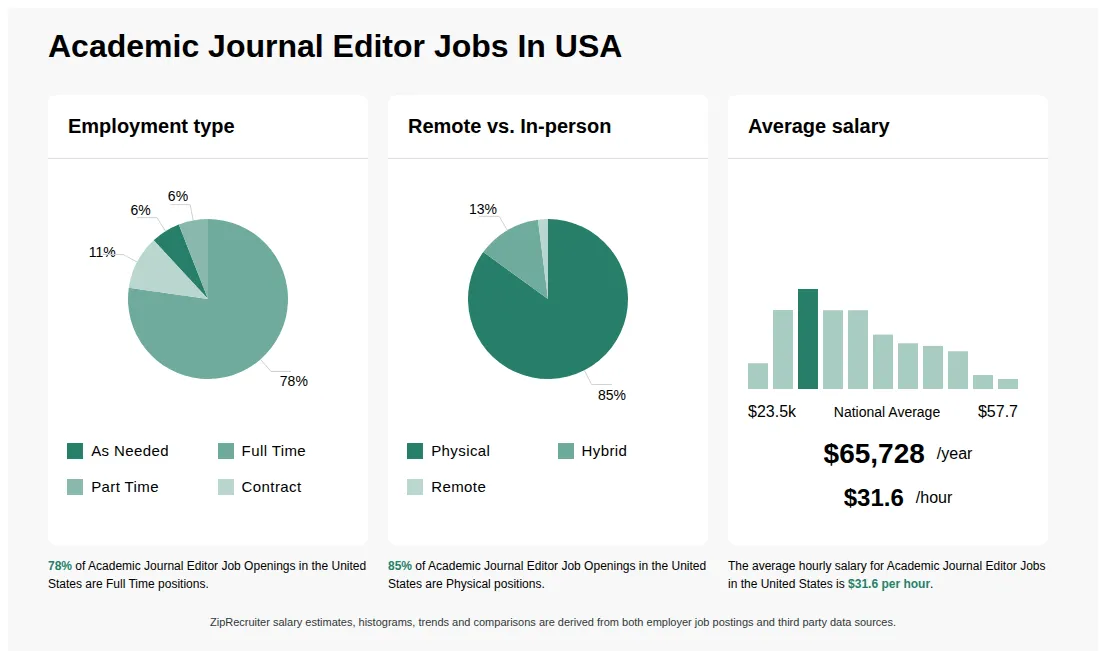
As of Sep 13, 2026, the average hourly pay for academic journal editor in the United States is $31.60, according to ZipRecruiter salary data. Most workers in this role earn between $21.39 and $39.66 per hour, depending on experience, location, and employer.

What does an academic journal editor do?

An Academic Journal Editor oversees the publication process of scholarly articles, ensuring quality, accuracy, and relevance. They manage peer review, coordinate with authors and reviewers, and uphold the journal’s editorial standards. Editors also make final publication decisions, provide feedback for revisions, and maintain the journal’s academic integrity. Their role is crucial in advancing research and scholarly communication.

What skills and qualifications are needed to be an academic journal editor?

To excel as an Academic Journal Editor, you need a deep understanding of academic writing, peer review processes, and subject-matter expertise, typically backed by an advanced degree in a relevant field. Familiarity with manuscript management systems (e.g., ScholarOne or Editorial Manager) and knowledge of publication ethics are highly advantageous. Strong organizational skills, attention to detail, and effective written communication set outstanding editors apart. These competencies are crucial for ensuring the integrity and quality of published research, as well as facilitating a smooth editorial workflow.

What challenges do academic journal editors face in their daily work?

Academic Journal Editors often manage multiple submissions simultaneously, coordinate with a diverse pool of authors and reviewers, and uphold publication timelines while ensuring rigorous peer review and adherence to ethical standards. Balancing competing priorities and handling conflicts—such as disagreements over reviewer feedback—is also common. Effective time management and strong communication skills are essential to navigate these challenges. Despite the demands, many editors find the role rewarding due to its impact on scholarly communication and the opportunity to stay updated with the latest research developments.

More about Academic Journal Editor jobs

What cities are hiring for Academic Journal Editor jobs?

Cities with the most Academic Journal Editor job openings:

What are the most commonly searched types of Academic Journal Editor jobs?

The most popular types of Academic Journal Editor jobs are:

What states have the most Academic Journal Editor jobs?

States with the most job openings for Academic Journal Editor jobs include:

What are popular job titles related to Academic Journal Editor jobs?

For Academic Journal Editor jobs, the most frequently searched job titles are:

Infographic showing various Academic Journal Editor job openings in the United States as of September 2026, with employment types broken down into 1% Internship, 1% As Needed, 63% Full Time, 33% Part Time, 1% Temporary, and 1% Contract. Highlights an 73% Physical, 1% Hybrid, and 26% Remote job distribution, with an average salary of $65,728 per year, or $31.6 per hour.

Food-Fueled Journal Editor (Student)

Campus, IL • On-site

$18.50/hr

Part-time

Posted 16 days ago


Job description

Work Where You Learn: Build Experience, Grow Skills, and Contribute to Your University Community.This position is available only to enrolled American University students.

Most student positions at American University are eligible to use Federal Work Study (FWS) awards, with a few exceptions. FWS funds cannot be applied to janitorial, construction, partisan or sectarian positions. For information or questions regarding FWS funds, please contact American University's Office of Financial Aid.

Important guidance for current American University employees: American University current employees, including those employed in student positions, must apply through their employee Workday account. If you are a current employee at American University, please log intoyour employee Workday accountand select the Find Jobs report which will take you to our internal career listings. Applying outside of your employee Workday account may cause delays in a hire process.

Department:

College of Arts & Sciences

Time Type:

Part time

FLSA Status:

Non-Exempt

Job Description:

Summary:

Food-Fueledis a research journal centered around food-related topics. We aim to showcase and publish a wide variety of exceptional works on food-related issues ranging from policy and law to food science, to personal narratives about the influence of food, nature, and agriculture.

Learn more at: https://wastedfood.american.edu/education/undergraduate-food-systems-science-journal/

Essential Functions:

  • Analyze journal submissions on a rolling basis for relevance, study design, ethics and methodology to consider publication within an academic journal.

  • Coordinate peer review and final edits for grammar, syntax, citations, and overall clarity.

  • Maintain a pre-existing WordPress site for ease of navigation and accessibility.

  • Communicate with a team of undergraduate editors and faculty advisors about independent research, format guidelines, and journal graphics.

Position Type/Expected Hours of Work:

  • Part-time.

  • 5 hours per week.

Salary Range:

  • $18.50 per hour.

Other Details

  • This position is available only to enrolled American University students.

  • Please note this job announcement is not designed to cover or contain a comprehensive listing of activities, duties or responsibilities that are required of the employee for this job. Duties, responsibilities, and activities may change at any time with or without notice.

  • American University is an E-Verify employer.

  • Visit https://www.american.edu/hr/ for additional information about American University employment and benefits.

Current American University Employees

American University current employees (including those employed in student positions) must apply through their employee Workday account. If you are a current employee at American University, please log intoWorkdayand select the Find Jobs report which will take you to our internal career listings.

Contact Us

For more information or assistance with the American University careers site, emailtheworkline@american.edu.

American University is an equal opportunity, affirmative action institution that operates in compliance with applicable laws and regulations. The university does not discriminate on the basis of race, color, national origin, religion, sex (including pregnancy), age, sexual orientation, disability, marital status, personal appearance, gender identity and expression, family responsibilities, political affiliation, source of income, veteran status, an individual's genetic information or any other bases under federal or local laws (collectively "Protected Bases") in its programs and activities.