1

Abbyy Jobs (NOW HIRING)

Solution Engineer

Brooklyn, OH · On-site

$69K - $105K/yr

Familiarity with Intelligent Document Processing tools such as ABBYY or equivalent OCR/IDP technologies * Understanding system integration concepts, including REST APIs, JSON/XML, authentication, and ...

Familiarity with Intelligent Document Processing tools such as ABBYY or equivalent OCR/IDP technologies * Understanding system integration concepts, including REST APIs, JSON/XML, authentication, and ...

Showing results 21-34

Abbyy information

See salary details

$8

$26

$61

How much do abbyy jobs pay per hour?

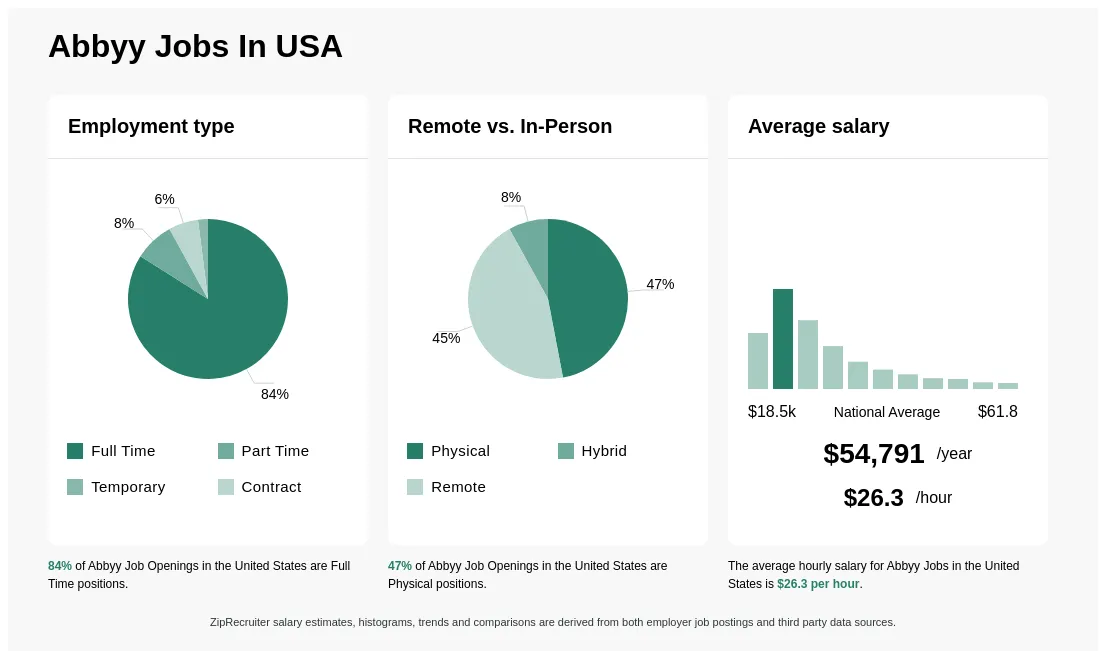
As of Aug 17, 2026, the average hourly pay for abbyy in the United States is $26.34, according to ZipRecruiter salary data. Most workers in this role earn between $15.14 and $30.77 per hour, depending on experience, location, and employer.

What are the key skills and qualifications needed to thrive in the Abbyy position, and why are they important?

To thrive in a role specializing in ABBYY technologies, you need strong analytical skills, experience with document processing, and a background in IT or computer science. Familiarity with ABBYY products like FlexiCapture, ABBYY FineReader, and relevant certifications are typically required. Strong communication, attention to detail, and problem-solving abilities help you excel when working with diverse teams and clients. These technical and interpersonal skills ensure accurate implementation, smooth integration, and successful outcomes on digital transformation projects.

What is an Abbyy job?

An Abbyy job typically involves working with ABBYY's intelligent document processing and OCR (Optical Character Recognition) solutions. Professionals in these roles may focus on developing, implementing, or supporting ABBYY software to automate data extraction, improve document workflows, and enhance business efficiency. Positions can include software engineers, solutions architects, business analysts, and technical support specialists. Responsibilities vary based on the role but generally involve working with AI-driven document processing technologies.

What does a typical workday involve for someone working with Abbyy solutions?

A typical workday for a professional working with ABBYY solutions involves configuring and maintaining ABBYY document processing software, collaborating with clients or project teams to gather requirements, and troubleshooting issues related to data extraction and automation workflows. You might participate in meetings to discuss integration challenges, optimize processing rules, or help customize solutions for various business needs. Frequently, you will need to document your processes and coordinate with IT and business analysts to ensure seamless implementation. This role often offers a mix of technical problem-solving and team-based collaboration, which keeps each day dynamic and engaging.

More about Abbyy jobs

What are the most commonly searched types of Abbyy jobs?

The most popular types of Abbyy jobs are:

What states have the most Abbyy jobs?

States with the most job openings for Abbyy jobs include:

Infographic showing various Abbyy job openings in the United States as of August 2026, with employment types broken down into 80% Full Time, and 20% Contract. Highlights an 80% In-person, 7% Hybrid, and 13% Remote job distribution, with an average salary of $54,791 per year, or $26.3 per hour.

Technical Lead I-Product Owner/AI Engineer

Blue Cross Blue Shield of Michigan

Detroit, MI • On-site

$101K - $133K/yr

Full-time

Posted 22 days ago


Blue Cross Blue Shield of Michigan rating

7.8

Company rating: 7.8 out of 10

Based on 28 frontline employees who took The Breakroom Quiz

193rd of 309 rated insurance


Job description

The AI Engineer/Technical Product owner Lead is responsible for designing, developing, and leading intelligent automation solutions using UiPath's RPA and AI ecosystem. The role 

combines hands-on development with technical leadership, ensuring high-quality 

delivery of AI-enhanced automation projects.

Key Responsibilities:

  • Manage the Intelligent Automation Platform roadmap, strategy, and lifecycle, aligning automation initiatives with business and digital transformation goals.
  • Manage and prioritize the product backlog, define user stories and acceptance criteria, and drive Agile delivery through sprint planning, backlog refinement, release planning, and stakeholder reviews.
  • Partner with business stakeholders, architects, and engineering teams to gather requirements, evaluate automation opportunities, and translate business needs into scalable technical solutions.
  • Lead the design, development, implementation, and support of enterprise automation solutions using UiPath Automation Cloud, Orchestrator, AI Center, Document Understanding, Integration Service, and Agentic AI.
  • Provide technical leadership, architecture guidance, code reviews, and mentorship to RPA developers while promoting engineering best practices and reusable automation components.
  • Establish and maintain platform governance, security, compliance, operational standards, and automation best practices to ensure enterprise-wide platform reliability.
  • Oversee production support, platform upgrades, release deployments, bot monitoring, incident resolution, and performance optimization to ensure high platform availability and scalability.
  • Drive digital transformation by identifying, prioritizing, and delivering AI-powered automation solutions that improve operational efficiency and business outcomes.
  • Collaborate with vendors and internal technology teams to optimize platform performance, licensing, infrastructure, and technology investments.
  • Lead cross-functional teams to successfully deliver automation initiatives within scope, budget, quality, and timeline commitments.
  • Define and monitor product KPIs, platform health metrics, and automation performance, providing executive-level reporting and strategic recommendations.
  • Evaluate emerging automation and AI technologies to continuously enhance enterprise automation capabilities and accelerate platform adoption

Required Skills & Qualifications

  • 10+ years of IT experience with expertise in Product Ownership, Intelligent Automation, and Enterprise Platform Management.
  • Proven experience managing UiPath Automation Platform, including Automation Cloud, Orchestrator, AI Center, Document Understanding, Agentic Automation, and enterprise bot operations.
  • Strong knowledge of Agile/Scrum, product backlog management, user story creation, sprint planning, release management, and product roadmap execution.
  • Experience gathering business requirements, defining acceptance criteria, and translating business needs into scalable technical solutions.
  • Strong understanding of RPA, AI/Generative AI, APIs, cloud technologies, and system integrations.
  • Experience establishing platform governance, automation standards, security, compliance, and operational excellence for enterprise automation.
  • Demonstrated ability to lead cross-functional teams, manage stakeholders, vendors, budgets, and drive digital transformation initiatives.
  • Proficiency with Jira, Azure DevOps, Confluence, SQL, Power BI, and Microsoft Azure.
  • Strong expertise with UiPath Studio, Orchestrator, AI Center, Document Understanding, and Action Center.
  • Proficiency in Python and ML frameworks (TensorFlow, PyTorch, Scikit-Learn).
  • Experience with OCR technologies (Document Understanding, ABBYY, Google Vision, Azure Form Recognizer).
  • Knowledge of API integration, REST/SOAP services, SQL/NoSQL databases.
  • Understanding of cloud platforms (Azure/AWS/GCP) and containerization (Docker).
  • Familiarity with Git, CI/CD pipelines, and DevOps for automation
  • Excellent analytical, problem-solving, communication, and executive presentation skills.
  • Healthcare industry and enterprise automation experience preferred.

AI & ML Expertise:

  • Design and build custom ML models (Python, TensorFlow, PyTorch, Scikit-Learn) to solve business-specific problems.
  • Fine-tune and optimize models for accuracy, performance, and scalability.
  • Manage model lifecycle: training, retraining, versioning, monitoring, and drift detection.
  • Utilize GenAI, NLP, LLM-based solutions to enhance automation (ChatGPT-like assistants, classification models, summarization tools, etc.).

Technical Leads are responsible for activities that contribute to planning, creating, and implementing the IT vision and strategy in alignment with the organization's strategic objectives. They contribute to the development of IT standards, best practices, and technology processes or solutions and often serve as consultants in their domain of expertise. Provide technical expertise to develop and refine methodologies and approaches for their specific field of proficiency; provide thought leadership and advance processes, techniques, and methods; and apply these skills and frameworks to solve business problems and achieve organizational objectives. Analyze trends, assess the impact of emerging ideas, practices, and technologies on the business, provide solutions to address technology and business issues, and may manage financial resources while ensuring the development of high-quality solutions. Additionally, they function with autonomy and establish strategic and lasting relationships with key internal and external stakeholders to drive satisfaction with technology capabilities.

  • Works with business partners to understand and shape business needs.
  • Manages the integration of IT processes or solutions across one or more product, platform, or functional area.  
  • Provides consultation regarding the strategy and implementation of IT initiatives to support products, platforms, services, and business strategies.
  • Works to optimize the alignment of IT and business strategies and may serve as a trusted guide during strategy development.
  • Contributes to the achievement of the technology vision and provides critical input for development and implementation of integrated business technology solutions.
  • Provides input for business and technology planning.  
  • Manages IT technology solutions to ensure successful fulfilment of end-user requirements, and proper and accurate testing and implementation.
  • Provides clarity on objectives, scope, and required organizational change management.
  • Actively participates in and may lead governance activities and boards that involve their areas of responsibility.
  • Ensures compliance with enterprise technology standards, governance processes, and performance metrics to ensure IT delivers value to the enterprise.
  • Maintains a close relationship with product owners, business units, and IT Managers to identify potential applications for emerging technologies.
  • Tracks and understands emerging technologies and how they might apply within the organization. 
  • Works with stakeholders to continually optimize IT governance and decision-making processes as the business context and technology landscape changes.
  • Gathers feedback and measures performance to identify improvement and optimization opportunities and adjusts solutions accordingly.
  • Explores and identifies solutions, methodologies, and frameworks to improve operational efficiency, service delivery and/or information management across all lines of business and technology platforms.
  • Manages/ensures adherence to budget for relevant projects or programs.
  • Provides indirect leadership, coaching, and mentoring to individuals and project/program team members. 
  • Supports individuals in career development as needed by assisting with networking, shadowing opportunities, position opportunity identification, etc.
  • Provides advice regarding the vendor relationship decision-making and contract development process. 
  • Identifies risks by vendor, assesses vendors, and monitors and mitigates risks, as appropriate.
  • Researches and represents thought leadership to advise senior leaders on best practices in their space of expertise.
  • Serves as an emerging thought leader to business partners and IT leaders to uncover ways technology can generate increased business value. 
  • Partners with Enterprise Architect(s) to refine and/or help create the vision and guide the evolution of BCBSM's business, systems, and technologies. 
  • Executes change through frequent communication to stakeholders about the change and the impact of the change (individual and business). 

QUALIFICATIONS 

  • Bachelor's or Master's degree in related field preferred.
  • Minimum seven (7) years of relevant IT and business/industry work experience required. 
  • Minimum three (3) years of indirect leadership experience preferred. 
  • Experience consulting with people at a variety of levels preferred.
  • Deep knowledge in an area of expertise required.
  • Demonstrated ability to lead and successfully execute IT projects and generate associated business value. 
  • Knowledge of project management tools and methodologies required.
  • Knowledge of agile methodology preferred.
  • Knowledge of product management principles preferred.
  • Ability to communicate technical topics in a clear, succinct, and relevant way.
  • Knowledge of current and emerging technologies, technology directions, and strategic application to business needs, including the ability to differentiate between a relevant trend and hype.
  • Applies values, business strategy, policies, precedent, and experience to make complex decisions. Knows when they have enough information to make a decision and makes it. Considers the consequences of a decision and assesses the options before reaching a conclusion.
  • Interacts with clients to identify opportunities that meet organizational and technological needs, as well as meet internal criteria for best practice that meet the client's specific operational requirements as they relate to its organizational strategy. Provides recommendations that align short-term needs with strategic performance drivers.
  • Participates in change initiatives by implementing new directions and providing appropriate information and feedback. Offers ideas for improving work and team processes. Experiments with new approaches and improves productivity through trial and error.
  • Tailors communication style and method (vocabulary, pace, etc.) for the audience. Uses stories, analogies, or examples that effectively illustrate a point. Asks open-ended questions that encourage others to give their point of view. Checks understanding by stating what he/she understands of the message and asking the speaker to verify or clarify.
  • Sets enhanced objectives for self and others. Monitors performance trends and identifies opportunities to improve standards. Provides regular feedback and suggests alternative approaches necessary to ensure that organizational objectives and high standards are achieved. Delegates responsibility and reallocates resources as needed to ensure that priorities are met.
  • Shares new ideas and consistently demonstrates openness to the opinions and views of others. Identifies new and different patterns, trends, and opportunities. Generates solutions that build upon, adapt, and go beyond tradition and status quo.
  • Investigates areas of disagreement. Presents facts, analysis, and conclusions or solutions in a way that demonstrates command of content, factors in perspectives and interests of the audience, and shows what's in it for them or what meets the common good.
  • Analyzes errors, successes and failures, and sets strategies to rectify and increase knowledge. Solicits performance feedback after each assignment. Identifies personal strengths and weaknesses and defines areas for self-development.
  • Creates, explores and implements a strategy for supporting current business needs. Tracks and reviews trend data. Creates components for potential scenarios. Compares and contrasts ways of achieving a prescribed strategy.

What Blue Cross Blue Shield of Michigan employees say

Pay

Benefits

Hours and flexibility

Workplace

Get the full story on Breakroom