
Advanced Electronics
Enon, OH · On-site
Enon, OH · On-site
Gambier, OH · On-site
Newark, OH · On-site
Galion, OH · On-site
Heath, OH · On-site
If you’re familiar with electronics, you have a wide range of careers available. One of the most prestigious and highly-paid options is an electronics engineer. In this position, you design electronic circuits and determine how they travel through a building, as well as find ways to make electronics work more efficiently. You can also work in manufacturing, creating electronic components. The duties of this field require you to connect wires to circuit boards or perform similar tasks. You could also be an electrician, in which your responsibilities involve diagnosing electrical problems at a facility. You can also work in the technology industry.
A warehouse associate at an electronics store is in charge of stocking and cataloging the inventory of the warehouse. In this position, your job duties are to receive inventory from the distributor, put it on the appropriate shelf or bay, and file the receipt of the product. You may also be responsible for bringing heavy items to customers if the warehouse is directly attached to the store. Another aspect of your responsibilities may involve testing and perform basic repairs on faulty equipment.
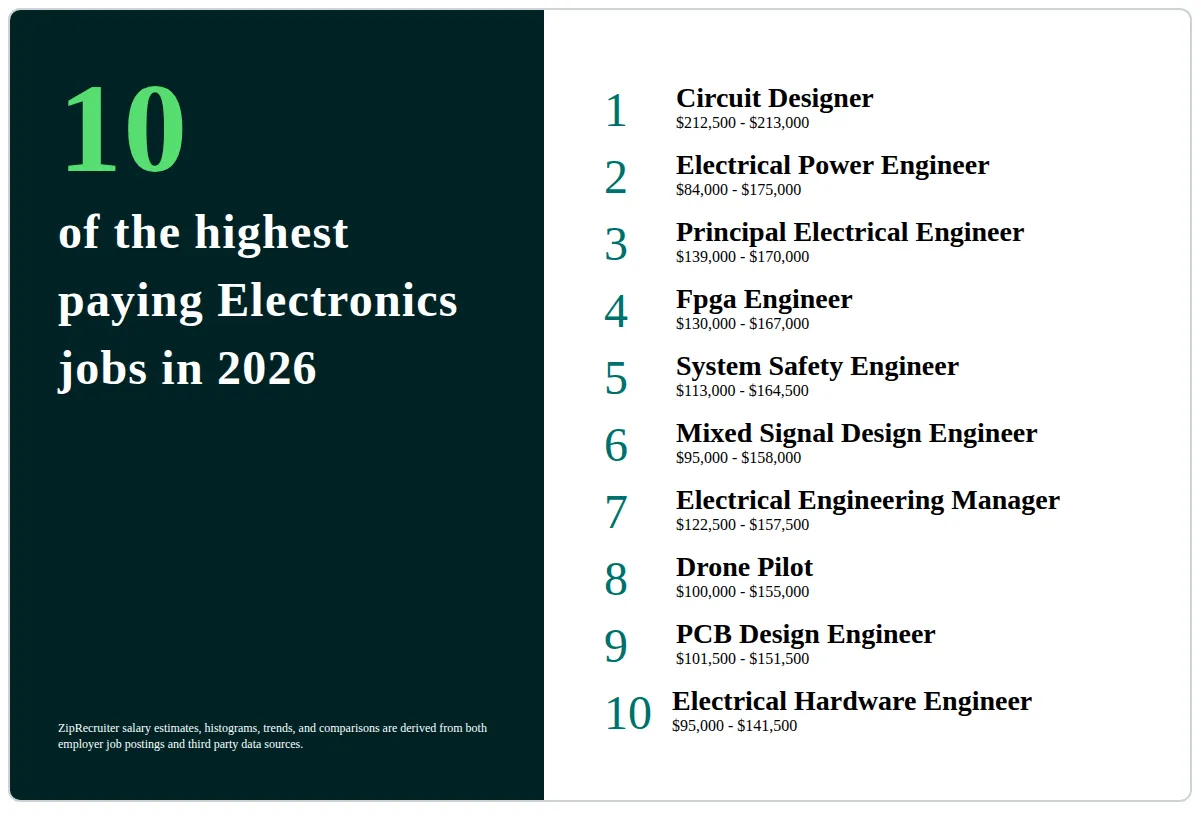
Salary range: $212,500 - $213,000
A circuit designer creates circuit boards for a variety of uses, from power grids to assembly automation. Specific job duties vary, depending on the type of devices, tools, or systems with which you work. As a circuit designer, your responsibilities include following project specifications to develop or improve circuits or circuit boards, troubleshooting the new circuit board, and implementing the new design. You may also run simulation software to test your circuit design to ensure it meets the needs of your client.
Salary range: $84,000 - $175,000
An electrical power engineer is responsible for power system management. As an electrical power engineer, your job is to ensure the efficient functionality of the electrical power grid. Your duties include designing components for the grid, such as generators, transformers, circuit breakers, and transmission lines. You ensure that power stations distribute power to customers efficiently, and manage different types of power systems, such as alternating and direct current. A career as an electrical power engineer requires formal qualifications and education: at least a bachelor’s degree in electrical engineering, state licensure, and experience with power systems.
Salary range: $139,000 - $170,000
A principal electrical engineer serves as a project manager for electrical-related building or construction projects. In this role, your job duties may include designing electrical devices, ensuring proper installation, inspecting completed electrical work, and providing work estimates. You may also supervise a staff of junior engineers, overseeing their work, and ensure that the project is completed within the allotted timeframe and budget. Principal electrical engineers are often the liaison between the engineering team and upper management. You must create reports and communicate regular updates on the status of each project to ensure each stage is meeting deadline expectations.
Salary range: $130,000 - $167,000
Field Programmable Gate Arrays (FPGAs) are integrated circuits used in a variety of technology hardware that are designed to be programmed after they are manufactured. An FPGA engineer uses Hardware Description Language (HDL) to develop and test the configuration that is programmed into these circuits. They may also be responsible for integrating several FPGAs together to form a more complex working system. Their work results in applications that are useful in a variety of industries and technical settings.
Salary range: $113,000 - $164,500
A system safety engineer helps to develop, refine, and update safety protocols and software that controls a large system and ensures that even if aspects of the system fail, it does not put the entire system at jeopardy. For example, if a subsystem on a spaceship fails, your duties as a system safety engineer are to determine how to make sure that it does not affect other systems or endanger the critical life support systems. Systems safety engineering is essential in a wide range of fields, from civil engineering and aeronautics to software and hardware engineering and power plant systems.
Salary range: $95,000 - $158,000
A mixed signal design engineer contributes to the entire life cycle of a mixed signal integrated circuit. Your duties include the design of analog cells, performing verification tasks, validation and simulation of device assembly, the improvement upon an existing block system, and client support and maintenance. You work both independently and in a team environment on interface technology in product specification, device characterization, floor planning, layout supervision, transistor level design, and chip level verification. As part of your responsibilities, you collaborate on technical reports, whitepapers, and user documents.
Salary range: $122,500 - $157,500
As an electrical engineering manager, your job is to manage electrical engineering projects for your company. In this role, you may make hiring decisions, troubleshoot common problems, and give the final approval for the design of an electrical system. This is primarily a management position, but it does require you to know enough about electrical systems to make big decisions. Some details of this job depend on the employer. Large facilities and factories may have dedicated electrical engineering managers, while others may contract you for the duration of a specific job. This position also requires memorizing and enforcing all relevant regulations, including OSHA safety guidelines for working on or near electrical systems.
Salary range: $100,000 - $155,000
The primary responsibilities of a drone pilot are to control and maintain an unmanned aerial vehicle (UAV). You can find drone pilot positions with both the military and other governmental organizations, as well as private companies, such as agricultural operations, film and television production companies, surveyors and mapping specialists, and environmental scientists. As a pilot, you perform a variety of duties, such as flying reconnaissance and taking aerial photography and aerial videography. In the military context, drone pilots operate UAVs which bomb targets from across the world.
Salary range: $101,500 - $151,500
A printed circuit board design engineer oversees the creation of printed circuit boards (PCB) used in phones, computers, and most other electronic devices. As a PCB design engineer, your responsibilities include designing the layout of the unit to incorporate the appropriate components, making recommendations to improve existing designs, and overseeing the actual manufacturing of these products to ensure they meet industry and company standards. These boards are the backbone of modern-day electronics, acting as the central unit of anything that runs on a microchip or CPU. You must design the board in such a way that it meets the specific needs of each product. While there is no universal education requirement, most employers prefer at least an associate degree in an electronics or computer science related field. Most PCB design engineers work for computer hardware manufacturers, but some general tech companies have in-house design departments.
Salary range: $95,000 - $141,500
An electrical hardware engineer develops, tests, and adjusts the electrical components for computers and other electronics. Your responsibilities in this career are to design and create electrical systems, troubleshoot issues, make modifications to improve the device, and perform ongoing maintenance and repair. You are also in charge of preparing detailed and accurate documents on the plan, as well as notes on development and testing. Your duties include overseeing the manufacturing process and collaborating with software developers. As an electrical hardware engineer, you work with both analog and digital circuitry and use both design software and physical tools, such as soldering irons and magnifiers.
Salary range: $107,500 - $140,000
A senior electrical engineer can work in a variety of industries that deal with both large and small-scale electrical systems, including HVAC, power generation and transmission, telecommunications, renewable energy, lighting, electric components in housing, mobile networking, finance, and more. In this career, you are responsible for the design of systems and controls for electronics and electrical systems. You create specifications and drawings for new systems and are often involved with coordinating junior or graduate engineers to assist on specific parts of projects to meet deadlines. As a senior electrical engineer, you use your skills to create systems that help to process information or transmit energy on every scale.
Salary range: $112,000 - $132,500
As a power electronics engineer, you design and test circuits to use in power electronics systems. In this role, you may develop prototypes, find solutions for known flaws in mechanical designs, and collaborate with other engineers to perform cross-functional tasks when testing designs. You often analyze analog circuitry, work with high-frequency magnetics, and help estimate power losses and overall efficiency as electricity works its way through circuits. Your responsibilities also include maintaining accurate documentation of all circuit designs. Some details of this job depend on the company you work for and the type of electronics they need.
Salary range: $83,500 - $132,500
A circuit design engineer develops electronic circuitry found in analog devices such as a computer, smartphone, or television. As a circuit design engineer, your job duties include designing the latest advances in circuits, developing circuit equipment, and troubleshooting after installation. You may also supervise the manufacturing process in plants and factories, as well as perform safety and cost assessments.
Salary range: $83,000 - $132,000
Electrical engineers design, test, and fix devices relating to electricity, electronics, and electromagnetism. An electrical engineer builds virtually every tool in the world that produces, conducts, or operates by way of electricity. Electrical engineers handle the research, design, installation, and handover of new electrical equipment. They also run tests on new devices and solve problems on malfunctioning systems and components. Electrical engineers work with a wide range of electronic equipment, from tiny microchips to supercomputers up to massive power station generators. They have their hands on a myriad of electrical components during their work, including conductors, batteries, capacitors, coils, magnets, transistors, and switches.
Salary range: $77,500 - $131,500
As an instrument engineer, your job is to design and build mechanical and electronic instruments for your employer. Most instruments are purpose-built to accomplish specific objectives, such as measuring the presence of particular chemicals or the pressure within pipes. Fulfilling the responsibilities and duties of an instrument engineer often requires creativity, flexibility, and the ability to coordinate with other engineers. You may also need to manage supplies, test instruments, or work overtime as needed to develop better instruments. This job title refers exclusively to designing and building instruments that measure or control processes and should not be confused with jobs that design and create musical instruments.
Salary range: $90,000 - $129,500
A components engineer oversees the proper selection of components for an electrical or mechanical assembly, or in the design of a new piece of machinery. As a components engineer, your responsibilities include testing and installing these components to ensure they are of the highest quality before utilizing them in a project. Other duties include identifying the best suppliers for each component and maintaining a library of parts for each project or equipment. A components engineer can work in a variety of industries.
Salary range: $84,000 - $126,500
A control systems engineer’s duties include designing, building and maintaining instrumentation, monitors, and other equipment used to control complex systems. Some examples of these control systems include navigation networks, production machinery gauges, and computer system monitors. It is the control systems engineer’s job to maintain safe and efficient field operation of the equipment and to ensure the safety of those utilizing the equipment. These skilled engineers are typically well versed in mechanical, chemical, and electrical engineering concepts and design.
Salary range: $73,000 - $124,000
A medical device engineer is an engineering professional who develops new medical equipment and medical devices. As a medical device engineer, your work will vary depending on your area of expertise and may include biomedical research, material research and sourcing, computer-aided design work, and teaming up with doctors and patients. You also must understand the manufacturing process and ensure the products you design are both useful and cost-effective. You look for innovative solutions to medical problems and design new equipment diagnoses and treatments.
Salary range: $102,000 - $121,000
A DCS engineer is in charge of a distributed control system (DCS). It’s their job to operate this system to implement process management and control solutions. They typically work in the field at power stations, manufacturing facilities, and similar plants. A DCS engineer needs to be able to work calmly in emergency situations and with safety in mind. Job duties involve programming DCS systems, troubleshooting problems, and developing improved processes. This career requires a strong background in engineering, including at least a bachelor’s degree. Other qualifications include communication, management, and computer skills. This job requires experience working in a DCS environment, preferably in the employer’s specific industry.
Salary range: $75,500 - $120,000
A printed circuit board designer (PCB designer) plans the layout of circuits for products such as computers, phones, games, and other devices. As part of your duties, you use computer-aided design programs to create assembly drawings, which are then used by manufacturers in the production of products on a large scale. You may design anything from circuits, computer chips, to industrial and commercial components. Your responsibilities include rigorously testing all your plans to avoid malfunction or component failure, and you provide documentation that proves adherence to industry and legal standards, such as those laid out by the Institute of Printed Circuits (IPC). You also develop detailed specifications to guide the manufacturing process.
Salary range: $82,500 - $115,500
As an electrical design engineer, you design projects for power distribution and electrical systems. You use software, electrical products, and other equipment to make your designs a reality. Your job duties involve all aspects of the design process, such as modeling and drafting, creating layouts, and building electrical circuits. You need strong research skills and extensive knowledge of electrical design to perform your work. Your job involves travel to work sites to oversee the implementation of your design projects on jobs.
Salary range: $97,500 - $112,500
An MEP electrical engineer works on mechanical, electrical, and plumbing systems. Your duties in this career usually focus on working to plan and design one or more of these systems for new construction projects. You may work with other engineers and architects in order to design systems that meet the criteria and requirements set forth by lead engineers and architects. Your responsibilities often start with drafting a design for a system using computer-aided design (CAD) software. You then visit the work site to oversee the implementation of your designs and troubleshoot or alter the plan if necessary.
Salary range: $59,500 - $109,500
As an electronics engineer, you create prototypes for new products in the manufacturing industry or research field. You utilize your design, computer, manufacturing, and engineering knowledge to meet the objectives of your projects, working to develop new products that are both useful and cost effective to make. You may specialize in a specific area of electronic engineering, such as semiconductors, navigation systems, handheld devices, engines, or communication systems. Your job is to come up with ideas and create innovative products and solutions for your employer or client.
Salary range: $83,500 - $108,000
Controls engineers design, develop, and test automated or dynamic systems that are controlled through feedback with sensors or detectors. Examples include automated irrigation systems that can sense moisture levels in soil, or self-driving cars that can navigate congested streets. Controls engineers apply control theory to devices, machines, and processes to attain desired outcomes. They can work on everything from boilers, washing machines, or light switches to complex industrial machinery.
Salary range: $84,500 - $105,500
As an industrial electrical engineer, your responsibilities revolve around the design and development of electrical power systems for industrial construction projects. Your duties are to draw a design to the proper specifications, supervise electrical personnel onsite, prepare equipment usage schedules, train and communicate with staff, and support other electrical engineers. You also troubleshoot control panels in existing power systems and evaluate the project to ensure all construction is compliant with current electrical codes and specifications.