1

Search Rescue Jobs (NOW HIRING)

Performs search, rescue, extrication of victims, and forcible entries. * Performs cleanup activities. * Drives, operates and monitors a variety of fire and emergency vehicles and emergency medical ...

Provides protection of life and property; suppresses, controls and extinguishes fires; performs search, rescue, extrication of victims, and forcible entries; assists individuals from burning ...

Provides protection of life and property; suppresses, controls and extinguishes fires; performs search, rescue, extrication of victims, and forcible entries; assists individuals from burning ...

next page

Showing results 1-20

search rescue information

See salary details

$16.5K

$56.7K

$115.5K

How much do search rescue jobs pay per year?

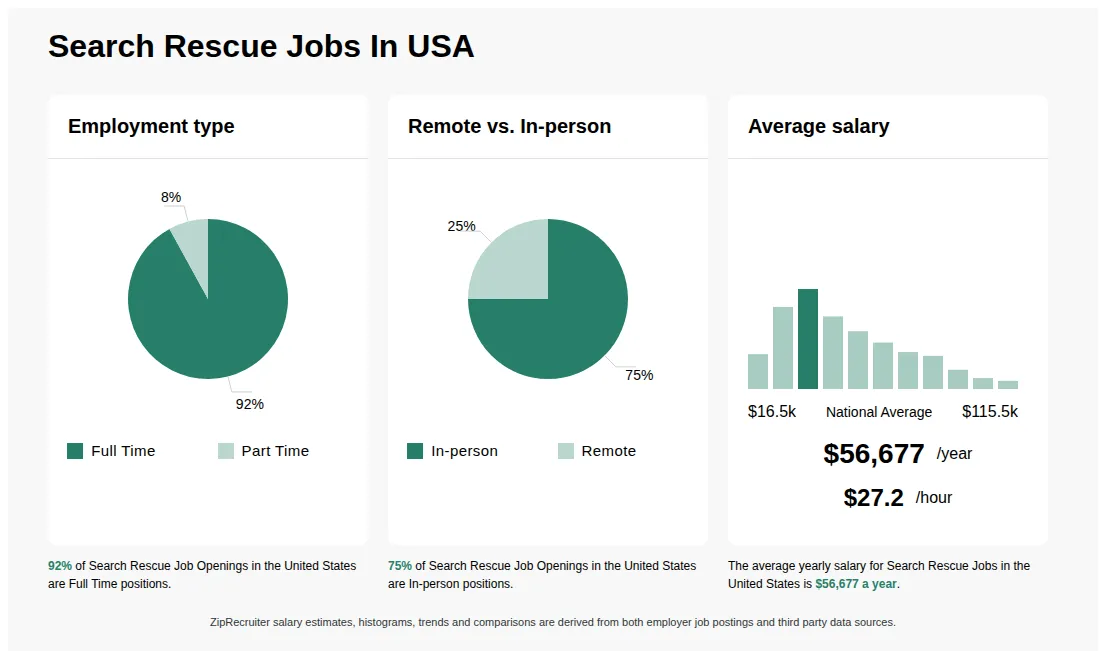
As of Aug 22, 2026, the average yearly pay for search rescue in the United States is $56,677.00, according to ZipRecruiter salary data. Most workers in this role earn between $35,000.00 and $70,500.00 per year, depending on experience, location, and employer.

What is a search and rescue professional?

Search and Rescue (SAR) professionals are trained individuals who locate and assist people who are lost, injured, or in danger, often in remote or hazardous environments. Their work may involve searching for missing hikers, rescuing disaster victims, or providing emergency medical assistance. SAR teams can include volunteers and professionals from various backgrounds such as law enforcement, firefighting, emergency medical services, and the military. Their operations often require specialized skills like navigation, first aid, and survival techniques. These professionals play a crucial role in responding to emergencies and saving lives.

What are jobs in search and rescue?

Jobs in search & rescue, often abbreviated to SAR, involve supervising, training, planning, and coordinating SAR missions and crews that provide on-call support for emergencies and disasters. The duties and responsibilities of these jobs focus on directing staff during rescue efforts as well as volunteers who are helping search for missing people. These positions are found in law enforcement, national parks, the military, and even some non-profit organizations. SAR missions involve using planes, boats, or other exploration devices to traverse terrain, track signals, and otherwise locate people who need rescuing. Job qualifications include strong leadership and communication skills.

What are the key skills and qualifications needed to thrive as a search and rescue professional?

To thrive as a Search and Rescue professional, you need strong physical fitness, situational awareness, and knowledge of emergency response procedures, often backed by certifications such as EMT or wilderness first responder. Familiarity with GPS navigation, radio communication equipment, and rescue tools like ropes and stretchers is essential. Excellent teamwork, problem-solving abilities, and the capacity to remain calm under pressure are crucial soft skills in this field. These skills ensure effective coordination, quick decision-making, and successful outcomes in high-stress, life-saving situations.

What are some common challenges faced by professionals in search and rescue roles, and how can new team members prepare for them?

Search and Rescue professionals often encounter physically demanding environments, unpredictable weather, and high-stress situations requiring quick decision-making. New team members should be prepared for irregular hours, including nights and weekends, and the need to work collaboratively with multidisciplinary teams such as emergency medical personnel and local law enforcement. Building strong physical fitness, staying current on technical rescue skills, and developing effective communication abilities are key to overcoming these challenges and contributing successfully to the team.

What is the difference between Search Rescue vs Search and Rescue Technician?

AspectSearch RescueSearch and Rescue Technician
CertificationsFirst aid, CPR, basic rescue trainingAdvanced rescue certifications, technical rescue training
Work EnvironmentOutdoor, varied terrains, emergency situationsOutdoor, technical rescue scenarios, often specialized
Employer & IndustryGovernment agencies, NGOs, militaryEmergency services, specialized rescue teams
Search & Comparison IntentGeneral search and rescue rolesTechnical rescue operations, specialized skills

Search Rescue involves basic to intermediate rescue efforts in outdoor environments, often performed by volunteers or general emergency personnel. Search and Rescue Technicians typically have advanced training and perform technical rescues in complex scenarios. While both roles focus on saving lives, Search and Rescue Technicians require specialized skills and certifications for technical rescue operations.

Can I get paid for search and rescue?

Search and rescue personnel are often paid employees, especially when working for government agencies, emergency services, or contracted organizations. Compensation varies based on the agency, location, experience, and whether the role is full-time or volunteer; paid positions typically include benefits and require training and certifications such as first aid or technical rescue skills.

What qualifications do you need to be a search and rescue?

To become a search and rescue professional, candidates typically need a high school diploma or equivalent, relevant certifications such as CPR and first aid, and specialized training in rescue techniques, navigation, and survival skills. Physical fitness, the ability to work in challenging environments, and often certification in areas like wilderness or urban rescue are also important.

What cities are hiring for Search Rescue jobs?

Cities with the most Search Rescue job openings:

What are the most commonly searched types of Search Rescue jobs?

The most popular types of Search Rescue jobs are:

What states have the most Search Rescue jobs?

States with the most job openings for Search Rescue jobs include:

Infographic showing various Search Rescue job openings in the United States as of August 2026, with employment types broken down into 75% Full Time, 20% Part Time, and 5% Contract. Highlights an 91% Physical, 3% Hybrid, and 6% Remote job distribution, with an average salary of $56,677 per year, or $27.2 per hour.

Search & Rescue Medic

Vision Quest Solutions Inc

Rapid City, SD • On-site

$17.50 - $23.25/hr

Full-time

Posted 13 days ago


Job description

Description:

About the Role


We are seeking a highly motivated Search & Rescue Medic to join our emergency response team. The ideal candidate is experienced in providing advanced medical care in remote, austere, and high-risk environments while working alongside search and rescue personnel. This position requires physical fitness, sound decision-making, and the ability to remain calm under pressure.

Requirements:Key Responsibilities
  • Provide emergency medical care during search and rescue operations.
  • Assess, stabilize, and treat injured or ill patients in remote environments.
  • Coordinate patient evacuation by ground, air, or water.
  • Operate and maintain medical equipment and supplies.
  • Participate in rescue missions involving wilderness, disaster, and technical rescue incidents.
  • Assist with incident documentation and patient care reports.
  • Attend ongoing training, drills, and certification updates.
Minimum Qualifications
  • Current EMT, Advanced EMT, or Paramedic certification.
  • Current BLS certification (ACLS/PALS preferred).
  • Valid driver's license with a clean driving record.
  • Ability to pass a physical fitness assessment and background check.
  • Strong communication and teamwork skills.
Preferred Qualifications
  • Search and Rescue (SAR) experience.
  • Wilderness First Responder (WFR) or Wilderness EMT certification.
  • Rope rescue, swift water rescue, or technical rescue certifications.
  • Incident Command System (ICS 100/200/700) training.
  • Experience operating in remote or austere environments.
  • Structural and wildland fire experience a plus!
Physical Requirements
  • Lift and carry up to 75 lbs.
  • Hike long distances over difficult terrain.
  • Work in adverse weather conditions.
  • Ability to work extended shifts, nights, weekends, and on-call rotations.
What We Offer
  • Competitive pay based on experience.
  • Paid training and continuing education.
  • Uniforms and necessary equipment.
  • Opportunities for career advancement and specialized training.
How to Apply

Submit your resume, certifications, and a brief cover letter outlining your search and rescue and medical experience to bfish@vqops.com or apply online at vqops.com.