1

Wildlife Manager Jobs (NOW HIRING)

Wildlife Biologist III

Hazard, KY · On-site

$47K - $71K/yr

Direct regional wildlife habitat and land management programs. * Execute open land, forest managing, andprescribed fire initiatives on public lands within an assigned district. * Collaborate with ...

Showing results 21-40

Wildlife Manager information

See salary details

$24.5K

$59.5K

$116K

How much do wildlife manager jobs pay per year?

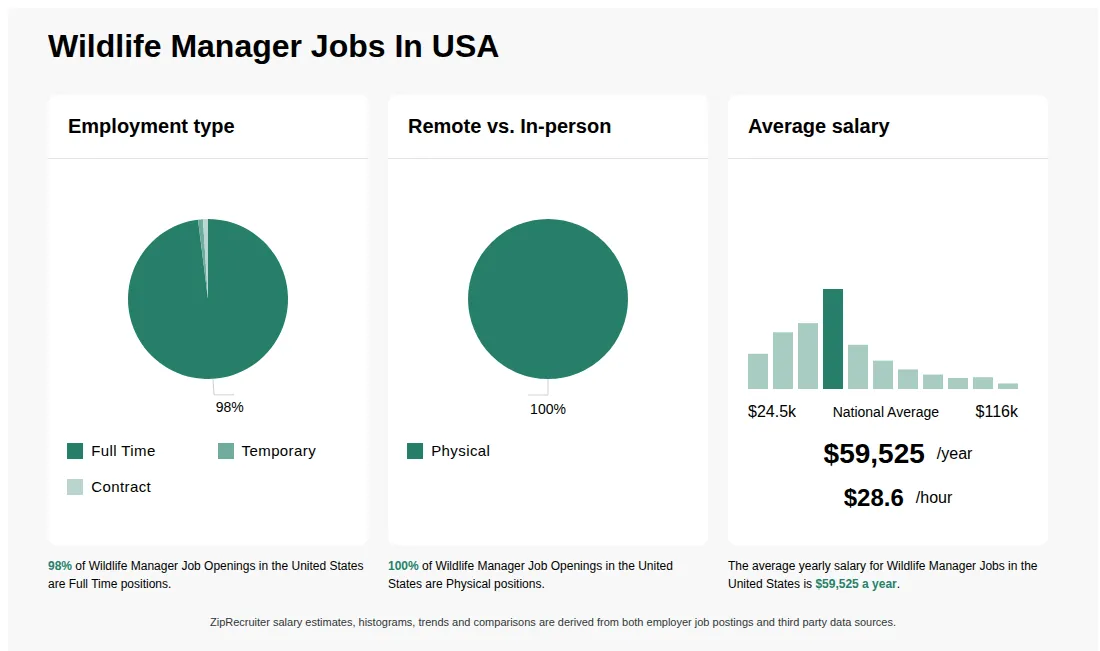
As of Aug 9, 2026, the average yearly pay for wildlife manager in the United States is $59,525.00, according to ZipRecruiter salary data. Most workers in this role earn between $42,000.00 and $68,500.00 per year, depending on experience, location, and employer.

What challenges do wildlife managers face in their day-to-day work?

Wildlife Managers often encounter challenges such as balancing the conservation needs of wildlife with land use demands from agriculture, recreation, or development. Fieldwork can involve working in remote locations, sometimes in harsh weather or challenging terrain, requiring physical stamina and adaptability. Interacting with stakeholders—including government agencies, private landowners, and the public—can also be complex due to differing priorities and expectations. Despite these challenges, the role is highly rewarding for those passionate about conservation, providing opportunities to make a tangible impact on local ecosystems and wildlife populations.

What skills and qualifications are needed to be a wildlife manager?

To thrive as a Wildlife Manager, you need a strong background in ecology, wildlife biology, and conservation, typically supported by a relevant degree. Familiarity with GIS software, field data collection tools, and safety certifications such as CPR or wildlife handling are often required. Strong problem-solving, communication, and leadership skills help Wildlife Managers work effectively with diverse teams and stakeholders. These skills and qualifications are critical for managing habitats, conducting field research, and ensuring wildlife populations and natural areas are sustainably maintained.

What does a wildlife manager do?

A wildlife manager is responsible for conserving and managing wildlife populations and their habitats. They conduct research, develop management plans, monitor ecosystems, and may work with regulations and permits to ensure sustainable practices. The role often requires knowledge of ecology, fieldwork skills, and sometimes certifications in wildlife or environmental management.

What is a wildlife manager?

A Wildlife Manager is responsible for overseeing the conservation and management of wildlife populations and their habitats. They develop and implement strategies to maintain ecological balance, enforce wildlife laws, and collaborate with researchers, policymakers, and the public. Their duties may include habitat restoration, species monitoring, and addressing human-wildlife conflicts. Wildlife Managers often work for government agencies, conservation organizations, or private landowners to ensure sustainable wildlife populations.

More about Wildlife Manager jobs
What cities are hiring for Wildlife Manager jobs? Cities with the most Wildlife Manager job openings:
What are the most commonly searched types of Wildlife jobs? The most popular types of Wildlife jobs are:
What states have the most Wildlife Manager jobs? States with the most job openings for Wildlife Manager jobs include:
Infographic showing various Wildlife Manager job openings in the United States as of August 2026, with employment types broken down into 88% Full Time, 11% Part Time, and 1% Contract. Highlights an 85% Physical, 2% Hybrid, and 13% Remote job distribution, with an average salary of $59,525 per year, or $28.6 per hour.

CPW WILDLIFE MANAGER IV / SE Land Use Coordinator - (Colorado Springs, CO)

State of Colorado

CO • On-site, Remote

$75K - $121K/yr

Other

Medical, Dental, Life, Retirement, PTO

Posted 21 days ago


State Of Colorado rating

7.3

Company rating: 7.3 out of 10

Based on 95 frontline employees who took The Breakroom Quiz

36th of 50 rated states


Job description

Department Information This posting is only open to residents of the State of Colorado at the time of submitting your application. We invite you to explore our website at https://dnr.colorado.gov/about-us to find out more about the work we do to manage Colorado's natural resources for today - and tomorrow. The State of Colorado believes that equity, diversity, and inclusion drive our success, and we encourage candidates from all identities, backgrounds, and abilities to apply

In addition to offering rewarding, meaningful work, we offer: Medical and Dental plans Strong, flexible retirement plans including PERA Defined Benefit Plan or PERA Defined Contribution Plan, plus pre-tax and Roth 401K and 457 plans Paid life insurance Short- and long-term disability coverage Employee Wellness programs Flexible Spending Accounts Health Savings Accounts 11 paid holidays per year plus generous vacation and sick leave Flexible work schedule options and remote-work options Career advancement opportunities throughout the State system Some positions may qualify for the Public Service Loan Forgiveness Program. COLORADO PARKS AND WILDLIFE Colorado Parks and Wildlife (CPW)'s mission is "To perpetuate the wildlife resources of the state, provide a quality state parks system, and provide enjoyable and sustainable outdoor recreation opportunities that educate and inspire current and future generations to serve as active stewards of Colorado's natural resources." C.R.S. 33-9-101 (12) (b)

The Southeast Region work unit is a major, geographical based organizational unit of the Colorado Division of Parks and Wildlife (CPW), essentially the Southeast quadrant of Colorado. The Southeast Region is responsible for administering and managing 8 state parks and 68 state wildlife areas, and exists to provide outdoor recreation and wildlife management in the southeast region of Colorado. This unit manages regional public information, outreach, education, volunteers, and regional coordinators managing water, energy and land use development.

Description of Job This position exists to function as the Region's Land Use Coordinator (LUC), a multi-disciplinary, fully-operational professional with little to no day-to-day supervision. Position serves as one of the region's expert staff leads for reviewing, coordinating, and commenting on large-scale, complex, and often controversial land development proposals involving numerous stakeholders and multiple jurisdictions. The LUC will identify potential impacts to wildlife, engage with local subject matter experts, and summarize science-based recommendations to avoid, minimize, and mitigate adverse impacts to wildlife resources resulting from development activities.

The position collects and verifies field data and other information necessary to comply with program and regulatory standards and requirements for wildlife conservation. While the general program or system exists the application must be individualized for each project or situation. Examples include but are not limited to: coordinating with multiple CPW areas to develop recommendations for USFS Forest Plan and BLM Resource Management Plan revisions; large-scale (multi-CPW area) Environmental Impact Statements and Environmental Assessments; and landscape-scale developments such as regional recreation trail systems, oil and gas developments, renewable energy projects, transmission lines, timber sales, water developments, wetland mitigation banks, grazing allotment permit renewals, commercial and residential developments, mines and gravel pits, railroads, highways and wildlife transportation projects.

The position applies a combination of various scientific principles and theories in natural resource and wildlife management in order to avoid, minimize, and mitigate adverse impacts to habitat resources, and monitor, protect and conserve wildlife species and habitats. The position is responsible for identifying regional habitat conservation and restoration priorities and synchronizing existing plans and strategies. This position ensures communications exchange statewide both internally and externally among stakeholders as well as interested publics to ensure and optimize the long-term perpetuation of wildlife habitat and populations throughout Colorado.

The position works with CPW staff to identify general and specific threats to big game winter range and migration corridors, threatened and endangered species, SWAP species including rare plants and invertebrates. Using available science, this position coordinates and recommends conservation actions directed at avoiding, minimizing, and mitigating threats to big game winter range and migration corridors, threatened and endangered species, SWAP species including rare plants and invertebrates. The position advises the CPW SE Region Leadership on development trends, research, regulatory and policy changes occurring in Colorado.

Provides recommendations to Senior leadership on how those changes may impact CPW operations and policy. The position works with public and private organizations (e.g. municipalities, counties, state agencies, industrial businesses, US Forest Service, Bureau of Land Management, Army Corps of Engineers, Colorado Department of Transportation, Colorado Energy and Carbon Management Commission, Bureau of Reclamation, Division of Mining, Reclamation & Safety, Colorado State land Board, etc

regarding impacts of development on wildlife. The position also serves as the primary contact for land use comments above the county level, in accordance with CPW's Land Use Directive (OG-1), specifically serving as the team leader directly influencing management decisions within the agency in commenting on regional projects that cross area boundaries. Examples would be Environmental Impact Statements, Environmental Assessments, other NEPA documents, Forest Resource Plans, Resource Management Plans, Grazing Plans, County Master Plans, Watershed Plans, and Travel Management Plans; and coordinating between CPW regions when project proposals cross regional boundaries.

Additionally, the position will help develop and implement trainings related to land use reviews and commenting for other staff members who engage with land use activities. Finally, the land use specialist will monitor the effectiveness of CPW's land use commenting process, best management practices, and compensatory mitigation strategies and methodologies. Serves as the lead for coordinating land use development comments and consultations for SE Region on federal guidance, implementation, and planning efforts such as Resource Management Plans, Forest Plans, Environmental Impact Statements, Environmental Assessments, and other federal evaluation documents required by the National Environmental Policy Act (NEPA).

This position serves as one of the primary liaisons with other state agencies (CO State Land Board (SLB), Energy and Carbon Management Commission (ECMC), Department of Agriculture (CDA), etc.), and acts as one of the primary liaisons with County and municipal land use planning staff to coordinate CPW input as appropriate. This position is CPW's regional expert on many types of development and associated impacts on wildlife. As such, this position is responsible for providing internal and external land use-related presentations, trainings, and testimony, as appropriate

Specific job duties include but are not limited to: Land Use Development Consultation Apply theories, principles and practices of natural resource and wildlife management, physical sciences and life sciences (e.g., geology, earth science, engineering, hydrology, soil science, botanical science, biology) in working with federal, state, and local agencies and industry to evaluate potential development proposals and land use change impacts, along with the relevant policy, law, and regulation and how those policies, regulations and laws can be used to further the wildlife conservation mission of CPW: Utilize knowledge, data, expertise, judgment and resourcefulness to interpret circumstances and establish guidance and best management practices for avoidance, minimization, and mitigation of adverse impacts to wildlife and habitats, including recommendations to protect, conserve and enhance land areas and their wildlife habitat resources that can be implemented by CPW and/or other regulatory agencies. Review large-scale, complex, and often controversial land development proposals involving numerous stakeholders and multiple jurisdictions (such as travel management plans, resource management plans, forest plans, watershed plans, water developments, state or interstate highways, commercial developments, and other proposals similar in nature and scope) to determine potential impacts on wildlife and habitats through research, data collection, studies, analysis, etc. Guide and facilitate the land use commenting process at the regional level, prepare comments, and provide testimony during public hearings as needed

Perform complex analyses of data and utilize knowledge of environmental laws and policies, environmental systems and wildlife management to formulate, guide, and coordinate recommendations to regulatory agencies to avoid, minimize and mitigate impacts to wildlife and habitats. Coordinate and direct wildlife impact comments on Federal NEPA documents (EA's, EIS's, RMP's, Forest Plans, etc.) utilizing guidelines related to land use on Federal lands within the region. Monitor for compliance with permit guidelines which are governed by CPW or other agencies for which CPW has submitted recommendations as conditions of approval for an issued permit as well as for other applicable laws and regulations related to wildlife impacts (e.g., ECMC SB-181, Army Corps of Engineers 404 permits, CDOT SB-40 certifications, DMRS Mining Permits, highway development permits, county regulations, state engineering requirements)

Assesses research and data and applies the principles of geology and wildlife biology to develop and negotiate avoidance, minimization, and mitigation strategies that consistently address direct, indirect, and cumulative impacts to wildlife and their habitats within the assigned region. Coordinates the regional process and implementation for determining the short and long-term impacts of development including, but not limited to, the development of species-specific and habitat-specific mitigation models, programs, and strategies. Land Use Development Negotiation and Mitigation The position evaluates, plans, and implements natural resource protection, recovery, remediation and reclamation projects.

In that regard, the position's responsibilities are to: Serve as one of the agency's primary points of contact, often designated as a Cooperating Agency lead and expert for land use proposal reviews and assessments of habitat protection measures. Formulate, compose, facilitate, guide and compile CPW's recommendations for response to large-scale land development proposals. Assist in the coordination and implementation of proposals to address research and data needs identified in CPW's Big Game Policy Report.

Formulate, compose, facilitate, guide and compile CPW's recommendations for wildlife movement mitigation and enhancement measures in collaboration with CPW's Wildlife Movement Coordinator, CDOT, and the Wildlife Transportation Alliance (WTA). Correspond and coordinate with a wide variety of state and federal land management agencies, permitting and regulatory agencies, local governments, private entities, landowners, CPW staff and public interest groups. Evaluate the information collected to formulate a plan of action to mitigate impacts on the environment, wildlife and people who participate in wildlife activities, including determinations of what hazards exist, what resources need to be addressed, and recommending action to be taken against violators.

Conduct consultations related to land use applications, including consultation with developers, energy companies, federal, state, local, and tribal entities, and landowners on-site and coordination with other CPW field operations and biological personnel on development, and negotiation of site-specific mitigation measures with operators. Correspond and coordinate with Regional Energy Liaisons and other CPW staff to guide the planning and implementation of habitat related projects utilizing SB-181 compensatory mitigation funds and to implement local Secretarial Order 3362 conservation plans. Develop and maintain expertise on impacts of development and recreation and related infrastructure; develops and maintains expertise on mitigation and best management practices to minimize impacts from development and recreation.

Develop species-specific best management practices (BMPs) for inclusion into CPW's standardized comment table for impacts to wildlife and habitats. In many cases, these BMPs constitute CPW's official position concerning land use disturbance and recommendations to avoid, minimize, and mitigate. Develop recommendations regarding negotiation strategies to address wildlife-related land use issues, and provide expertise, guidance, and assist in the development and implementation of CPW's Statewide Habitat Conservation and Connectivity Plan.

Attend and participate in various meetings, committees, roundtables and working groups with government agencies and private interests as CPW's representative on the impacts of land use and development on regional natural resources, wildlife, and habitats. Provide testimony, presentations, and case studies on effective strategies and positive outcomes to staff, other agencies, and the public. Help maintain the regional database of land use resources including but not limited to, annotated literature bibliographies, training resources, presentation materials, draft comment letters/templates, and other relevant land use documents including MOUs, legislation, agency planning documents, and policy/guidance documents.

Land Use Development Resources The position serves as the land use expert for the region and performs outreach to the public and other agencies on protecting natural resources, habitat, and wildlife from environmental degradation as the result of land uses and development activities. Develops and maintains expertise on impacts of development and recreation and related infrastructure; develops and maintains expertise on mitigation and best management practices to minimize impacts from development and recreation. Develops species-specific best management practices (BMPs) for inclusion into CPW's standardized comment table for impacts to wildlife and habitats.

In many cases, these BMPs constitute CPW's official position concerning land use disturbance and recommendations to avoid, minimize, and mitigate. Develops recommendations regarding negoti...


What State Of Colorado employees say

Pay

Benefits

Hours and flexibility

Workplace

Get the full story on Breakroom