1

Vr Game Developer Jobs (NOW HIRING)

We are seeking a 3D Developer / Game Developer with Virtual Reality (VR) and Extended Reality (XR) experience to support U.S. Army training and education initiatives at CASCOM in Fort Lee,VA. Program:

We are seeking a 3D Developer / Game Developer with Virtual Reality (VR) and Extended Reality (XR) experience to support U.S. Army training and education initiatives at CASCOM in Fort Lee,VA. Program:

Pinnacle Solutions is looking for a passionate and motivated Game Developer to join our virtual ... Experience in AR/VR development. * Experience in the Lua programming language. * One or more ...

Stay updated with the latest AR/VR technologies, trends, and industry standards. * Provide ... Master's degree in computer science, Game Development, or a related field. * Experience with ...

Qualifications of the Principal VR Developer: * · Bachelor's degree in Computer Science or a related field is preferred. * · 10+ years'' industry experience in VR meditation, training, gaming ...

New

Company Description Here at Ten4, there's a core focus on Creative Services and Gaming. By only ... VR/AR project/company * Engineer with experience in C/C++ and C# * Experience with the Unreal 4 ...

Gameplay Programmer

Cary, NC · On-site

$119K - $132K/yr

Epic's award-winning Unreal Engine technology not only provides game developers the ability to build high-fidelity, interactive experiences for PC, console, mobile, and VR, it is also a tool being ...

Gameplay Programmer

Cary, NC · On-site

$119K - $132K/yr

Epic's award-winning Unreal Engine technology not only provides game developers the ability to build high-fidelity, interactive experiences for PC, console, mobile, and VR, it is also a tool being ...

Epic's award-winning Unreal Engine technology not only provides game developers the ability to build high-fidelity, interactive experiences for PC, console, mobile, and VR, it is also a tool being ...

next page

Showing results 1-20

Vr Game Developer information

See salary details

$32.5K

$108.5K

$180K

How much do vr game developer jobs pay per year?

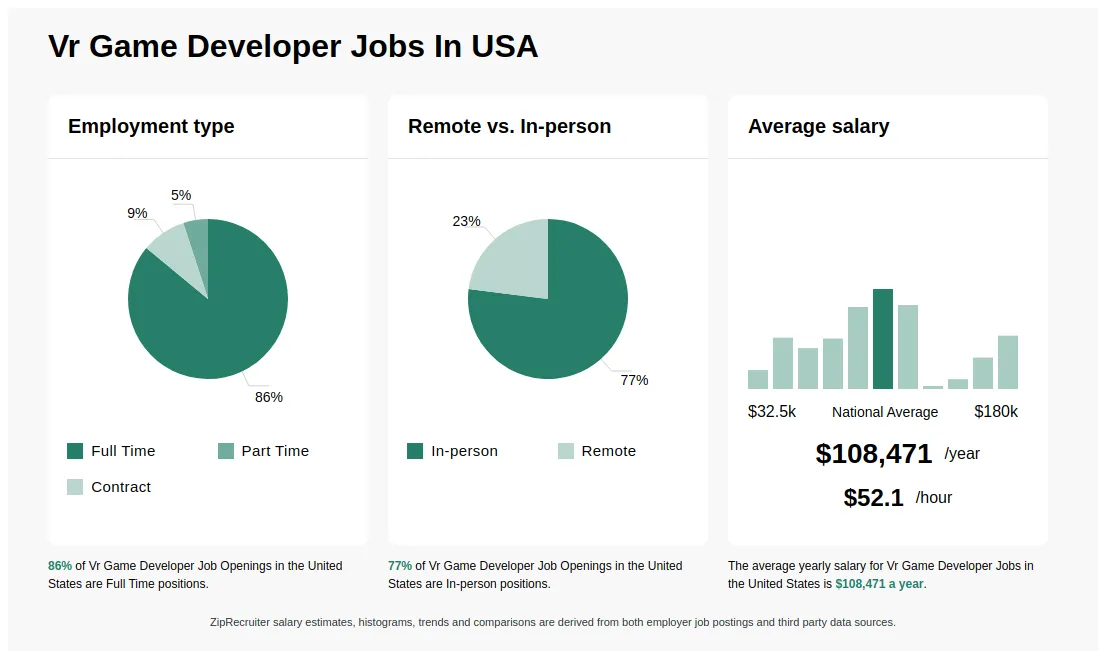
As of Jun 13, 2026, the average yearly pay for vr game developer in the United States is $108,471.00, according to ZipRecruiter salary data. Most workers in this role earn between $81,500.00 and $124,000.00 per year, depending on experience, location, and employer.

What is a VR Game Developer job?

A VR Game Developer is responsible for designing, developing, and optimizing virtual reality games. They work with game engines like Unity or Unreal Engine, write code, and integrate assets to create immersive experiences. Their role includes programming gameplay mechanics, optimizing performance, and implementing VR-specific features like motion tracking and spatial audio. They collaborate with designers, artists, and other developers to ensure a smooth and engaging user experience.

What are some typical challenges faced by VR Game Developers, and how are they addressed within teams?

VR Game Developers often face challenges such as optimizing performance for smooth frame rates, ensuring intuitive user interactions, and addressing motion sickness issues. Teams typically collaborate closely with artists, designers, and testers to iterate on prototypes, test hardware compatibility, and refine user experiences based on feedback. Regular brainstorming sessions and agile development practices help tackle technical obstacles creatively and efficiently. This collaborative approach not only enhances game quality but also fosters ongoing learning and professional growth within the team.

What are the key skills and qualifications needed to thrive in the Vr Game Developer position, and why are they important?

To thrive as a VR Game Developer, you need strong programming skills (often in C# or C++), experience with game engines like Unity or Unreal Engine, and a solid understanding of 3D modeling and interaction design concepts. Familiarity with VR hardware (such as Oculus, HTC Vive, or PlayStation VR) and relevant SDKs, along with certifications or coursework in game development or computer science, are highly valued. Creative problem-solving, collaboration, and a keen eye for user experience set top candidates apart. These competencies are essential for developing immersive, intuitive, and technically robust VR gaming experiences that delight users and meet industry standards.

Is 30 too old to get into game dev?

Age is not a barrier to becoming a VR game developer, as the industry values skills, creativity, and experience over age. Many developers start or transition into game development later in life, often bringing valuable perspectives and skills such as programming, 3D modeling, or design. Continuous learning and building a portfolio with projects or certifications can help regardless of age.

Are VR developers in demand?

VR game developers are in high demand as virtual reality technology expands across gaming, training, and entertainment industries. Skills in 3D modeling, programming, and experience with platforms like Unity or Unreal Engine increase employability in this growing field.

Is VR a dying medium?

VR game developers work in a growing industry as virtual reality continues to expand with advancements in hardware and software. The medium is not dying; instead, it is evolving with increased adoption in gaming, training, and entertainment sectors, creating ongoing opportunities for skilled developers familiar with platforms like Unity and Unreal Engine.

How much do VR game developers make?

VR game developers typically earn between $60,000 and $120,000 annually, depending on experience, location, and the complexity of projects. Senior developers or those with specialized skills in 3D modeling, programming, and game engines like Unity or Unreal tend to earn higher salaries.
What cities are hiring for Vr Game Developer jobs? Cities with the most Vr Game Developer job openings:
What are the most commonly searched types of Vr Game Developer jobs? The most popular types of Vr Game Developer jobs are:
What states have the most Vr Game Developer jobs? States with the most job openings for Vr Game Developer jobs include:
Infographic showing various Vr Game Developer job openings in the United States as of June 2026, with employment types broken down into 100% Full Time. Highlights an 94% Physical, 2% Hybrid, and 4% Remote job distribution, with an average salary of $108,471 per year, or $52.1 per hour.
3D Game Developer - XR/VR

3D Game Developer - XR/VR

Code Plus Inc

Petersburg, VA • On-site

Full-time

Posted 9 days ago


Job description

CODE Plus, Inc., an experienced IT government contractor in Fairfax, VA with offices in Huntsville, AL and have been in business for 31 years and have been servicing different agencies within the Federal sector. Our mission is to deliver high-quality, cost-effective solutions that empower our clients to achieve their goals. At CODEplus, we value teamwork, integrity, and technical excellence, and we pride ourselves on maintaining long-standing partnerships built on trust and results.

We are seeking a 3D Developer / Game Developer with Virtual Reality (VR) and Extended Reality (XR) experience to support U.S. Army training and education initiatives at CASCOM in Fort Lee,VA.

Program: U.S. Army – CASCOM
Location: Fort Lee, VA (Onsite)
Clearance: As required by Army contract
Citizenship Requirement: U.S. Citizenship

In this role, you will design and develop immersive, interactive 3D training applications that enhance learning through real-time simulation and experiential environments. You will collaborate closely with on-site Subject Matter Experts (SMEs) and cross-functional teams to build high-quality, performance-optimized solutions across desktop, web, and immersive platforms (VR/AR/MR).

This is a hands-on development role requiring both technical expertise and creative problem-solving to transform instructional concepts into engaging, mission-focused training tools.


Key Responsibilities
  • Collaborate with SMEs and stakeholders to define requirements, learning objectives, and technical solutions for immersive training applications.
  • Design and develop interactive 3D and VR/XR training experiences using modern game engines.
  • Create and optimize 3D assets (modeling, texturing, rigging) for real-time performance across platforms, including VR/AR devices.
  • Develop low-polygon assets and texture atlases suitable for WebGL and real-time simulation environments.
  • Build and implement immersive interactions, user experiences, and spatial interfaces for VR/XR applications.
  • Use Autodesk 3ds Max and/or Maya to create production-ready 3D assets.
  • Integrate assets into Unity as FBX files and ensure proper scaling, lighting, and performance optimization.
  • Develop scripts and application logic in Unity (C#) to support gameplay systems, simulation logic, and user interactions.
  • Design and implement intuitive UI/UX systems, including VR/XR interaction patterns and Unity Canvas-based interfaces.
  • Support testing, debugging, and performance optimization across multiple platforms, including VR headsets.
  • Work closely with instructional designers, developers, and program stakeholders to ensure solutions align with training objectives.

Required Qualifications
  • Experience developing 3D applications or games using real-time engines (Unity preferred).
  • Demonstrated experience building or contributing to VR, AR, or XR applications.
  • Proficiency in Autodesk 3ds Max and/or Maya for 3D asset creation.
  • Strong experience with Unity 3D, including scripting (C#), asset integration, and scene development.
  • Understanding of real-time rendering, performance optimization, and low-poly modeling techniques.
  • Familiarity with VR/XR interaction design principles (hand tracking, controllers, spatial UI, etc.).
  • Strong attention to detail and ability to translate requirements into functional, user-friendly 3D experiences.
  • Ability to collaborate effectively with SMEs and multidisciplinary teams in an on-site environment.

Preferred Qualifications
  • Experience developing VR/XR training simulations for government, military, or enterprise environments.
  • Familiarity with VR platforms (e.g., Meta Quest, HTC Vive, HoloLens, or similar).
  • Experience deploying applications to WebGL or cross-platform environments.
  • Background in simulation, serious games, or instructional technology.
  • Experience designing immersive UX/UI systems for VR/AR environments.
  • Knowledge of Agile or iterative development processes.