Violin Primary Work Location: Heart of Los Angeles (HOLA), Los Angeles, CA FLSA Grade: Non-Exempt About Learning at the LA Phil Leading the LA Phil's strategic engagement with youth and education ...
Violin Primary Work Location: Heart of Los Angeles (HOLA), Los Angeles, CA FLSA Grade: Non-Exempt About Learning at the LA Phil Leading the LA Phil's strategic engagement with youth and education ...
Violin Instructor
Snellville, GA · On-site
Lawrenceville-Suwanee School of Music is currently seeking a qualified instructor to take over an established studio of violin, viola, bass and cello students and continue helping them grow musically.
Quick apply
Violin Instructor
Snellville, GA · On-site
Lawrenceville-Suwanee School of Music is currently seeking a qualified instructor to take over an established studio of violin, viola, bass and cello students and continue helping them grow musically.
Role Description This is a part-time contract Violin/Strings Teacher role based on-site in Mabank, TX. The teacher will provide individual and small-group instruction in violin and other string ...
Role Description This is a part-time contract Violin/Strings Teacher role based on-site in Mabank, TX. The teacher will provide individual and small-group instruction in violin and other string ...

Join The Music Tree School as a Violin Instructor and be part of a community that values music education and personal growth. At The Music Tree, we believe in creating a welcoming and supportive ...
Quick apply
Join The Music Tree School as a Violin Instructor and be part of a community that values music education and personal growth. At The Music Tree, we believe in creating a welcoming and supportive ...

Cincinnati Hills Christian Academy seeks a qualified violin/viola teacher to join a team of Private Music Lesson Program teachers serving Amleder students. Lessons are given during the school day, so ...
Cincinnati Hills Christian Academy seeks a qualified violin/viola teacher to join a team of Private Music Lesson Program teachers serving Amleder students. Lessons are given during the school day, so ...
Violin Teaching Artist
New York, NY · On-site
Specifically, a Violin Teaching Artist at WHIN is responsible for: Fostering a love of making music in an ensemble setting Modeling high-quality musicianship and citizenship within the WHIN community ...
Violin Teaching Artist
New York, NY · On-site
Specifically, a Violin Teaching Artist at WHIN is responsible for: Fostering a love of making music in an ensemble setting Modeling high-quality musicianship and citizenship within the WHIN community ...
Cincinnati Hills Christian Academy seeks a qualified violin/viola teacher to join a team of Private Music Lesson Program teachers serving Amleder students. Lessons are given during the school day, so ...
Cincinnati Hills Christian Academy seeks a qualified violin/viola teacher to join a team of Private Music Lesson Program teachers serving Amleder students. Lessons are given during the school day, so ...

Strings - Violin Faculty Mentor
Dorchester, MA · On-site
$28 - $38/hr
Training & development We are seeking energetic and experienced Strings (Violin and Cello) Faculty members to join our team at BSMA! The ideal candidate is compassionate, creative, and has a passion ...
Quick apply
Strings - Violin Faculty Mentor
Dorchester, MA · On-site
$28 - $38/hr
Training & development We are seeking energetic and experienced Strings (Violin and Cello) Faculty members to join our team at BSMA! The ideal candidate is compassionate, creative, and has a passion ...
Cincinnati Hills Christian Academy seeks a qualified violin/viola teacher to join a team of Private Music Lesson Program teachers serving Amleder students.Lessons are given during the school day, so ...
Quick apply
Cincinnati Hills Christian Academy seeks a qualified violin/viola teacher to join a team of Private Music Lesson Program teachers serving Amleder students.Lessons are given during the school day, so ...
Violin Instructor
Los Angeles, CA · On-site
$70 - $95/hr
This position will recruit and teach violin students at elementary through advanced levels for both pre-college and adults. ESSENTIAL DUTIES AND RESPONSIBILITIES: * Teach non-college elementary ...
Violin Instructor
Los Angeles, CA · On-site
$70 - $95/hr
This position will recruit and teach violin students at elementary through advanced levels for both pre-college and adults. ESSENTIAL DUTIES AND RESPONSIBILITIES: * Teach non-college elementary ...

Part-Time After-School Violin Teacher Location: American Preparatory Academy - Draper Campuses Program: Sistema Utah After-School Music Program Job Summary Do you want to change the world through ...
Part-Time After-School Violin Teacher Location: American Preparatory Academy - Draper Campuses Program: Sistema Utah After-School Music Program Job Summary Do you want to change the world through ...
As TA, the candidate would be working with violin, viola, and cello students in grades 2-5 on basic string and orchestra technique and providing specialized feedback and assistance with your main ...
As TA, the candidate would be working with violin, viola, and cello students in grades 2-5 on basic string and orchestra technique and providing specialized feedback and assistance with your main ...
Violin Instructors - Arcadia
Arcadia, CA · On-site
Seeking an enthusiastic Violin instructor to teach in local Arcadia, San Gabriel/San Marino music school. Instructor should be able to teach up to Classical advanced level music. Bachelor's in Music ...
Violin Instructors - Arcadia
Arcadia, CA · On-site
Seeking an enthusiastic Violin instructor to teach in local Arcadia, San Gabriel/San Marino music school. Instructor should be able to teach up to Classical advanced level music. Bachelor's in Music ...

Violin Teacher [Part Time]
New York, NY · On-site
$65/hr
Teach weekly violin lessons to students across Zeta's network of schools * Provide instruction through individual and small-group lessons during the school day * Prepare students for recitals and ...
Quick apply
Violin Teacher [Part Time]
New York, NY · On-site
$65/hr
Teach weekly violin lessons to students across Zeta's network of schools * Provide instruction through individual and small-group lessons during the school day * Prepare students for recitals and ...
URGENTLY HIRING - Draper - Sistema Utah - PT Violin Teacher - 26-27 School Year
Draper, UT · On-site
$18.50 - $22/hr
Part-Time After-School Violin Teacher Location: American Preparatory Academy - Draper Campuses Program: Sistema Utah After-School Music Program Job Summary Do you want to change the world through ...
URGENTLY HIRING - Draper - Sistema Utah - PT Violin Teacher - 26-27 School Year
Draper, UT · On-site
$18.50 - $22/hr
Part-Time After-School Violin Teacher Location: American Preparatory Academy - Draper Campuses Program: Sistema Utah After-School Music Program Job Summary Do you want to change the world through ...

Part-time Violin Teacher (SY2026-2027)
Lawrence, MA · On-site
$45 - $50/hr
Develop policies and clear guidelines for participation in the Community Strings violin program. * Communicate with the onsite Head of School and Director of Academics regarding all aspects of ...
Part-time Violin Teacher (SY2026-2027)
Lawrence, MA · On-site
$45 - $50/hr
Develop policies and clear guidelines for participation in the Community Strings violin program. * Communicate with the onsite Head of School and Director of Academics regarding all aspects of ...

Be Seen First
Violin Shop Sales Associate - Music Background Required
Tampa, FL · On-site
$20 - $30/hr
Violin Shop Tampa is the highest-rated orchestral string instrument shop in the United States, serving the Tampa Bay area and beyond for over a decade. We specialize in fine violins, violas, cellos ...
Quick apply
Be Seen First
Violin Shop Sales Associate - Music Background Required
Tampa, FL · On-site
$20 - $30/hr
Violin Shop Tampa is the highest-rated orchestral string instrument shop in the United States, serving the Tampa Bay area and beyond for over a decade. We specialize in fine violins, violas, cellos ...
Violin Instructors - Arcadia
Arcadia, CA · On-site
Description Seeking an enthusiastic Violin instructor to teach in local Arcadia, San Gabriel/San Marino music school. Instructor should be able to teach up to Classical advanced level music. Bachelor ...
Violin Instructors - Arcadia
Arcadia, CA · On-site
Description Seeking an enthusiastic Violin instructor to teach in local Arcadia, San Gabriel/San Marino music school. Instructor should be able to teach up to Classical advanced level music. Bachelor ...
Violin Teacher [Part Time]
New York, NY · On-site
$65/hr
Teach weekly violin lessons to students across Zeta's network of schools * Provide instruction through individual and small-group lessons during the school day * Prepare students for recitals and ...
Violin Teacher [Part Time]
New York, NY · On-site
$65/hr
Teach weekly violin lessons to students across Zeta's network of schools * Provide instruction through individual and small-group lessons during the school day * Prepare students for recitals and ...
Violin Teacher [Part Time]
New York, NY · On-site
$65/hr
Teach weekly violin lessons to students across Zeta's network of schools * Provide instruction through individual and small-group lessons during the school day * Prepare students for recitals and ...
Violin Teacher [Part Time]
New York, NY · On-site
$65/hr
Teach weekly violin lessons to students across Zeta's network of schools * Provide instruction through individual and small-group lessons during the school day * Prepare students for recitals and ...
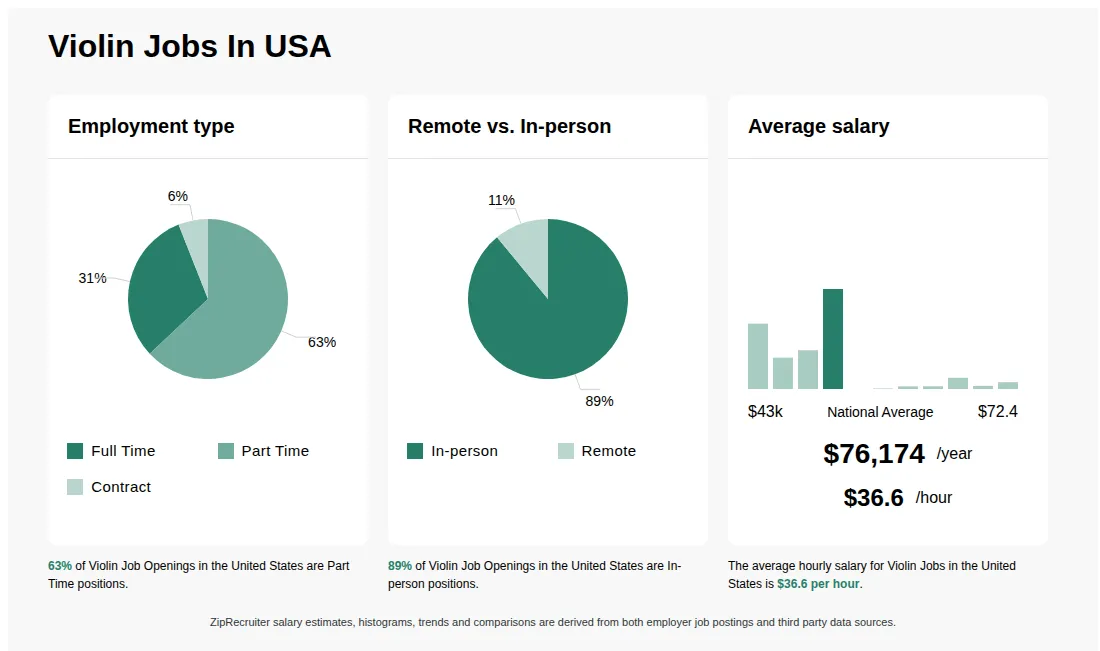
Violin information
See salary details
$25.32 is the 25th percentile. Wages below this are outliers.
$20.67 - $25.37
25% of jobs
$25.37 - $30.07
12% of jobs
The median wage is $34.26 / hr.
$30.07 - $34.77
15% of jobs
$37.52 is the 75th percentile. Wages above this are outliers.
$34.77 - $39.47
40% of jobs
$39.47 - $44.17
0% of jobs
$44.17 - $48.86
0% of jobs
$48.86 - $53.56
0% of jobs
$53.56 - $58.26
1% of jobs
$58.26 - $62.96
4% of jobs
$62.96 - $67.66
1% of jobs
$67.66 - $72.36
2% of jobs
$20
$36
$72
How much do violin jobs pay per hour?
As of Sep 3, 2026, the average hourly pay for violin in the United States is $36.62, according to ZipRecruiter salary data. Most workers in this role earn between $26.92 and $38.46 per hour, depending on experience, location, and employer.
What does a violinist do?
A violinist is a musician who plays the violin, a string instrument, either solo, as part of an orchestra, or in smaller ensembles such as string quartets. Their responsibilities include practicing regularly, learning new pieces, performing in concerts or recordings, and often collaborating with other musicians. Violinists may also teach students, participate in auditions, and maintain their instruments. The role requires a high level of skill, dedication, and musicality.
What are the qualifications to get a violin job?
The qualifications to get a violin job range from being self-taught to having a formal education in violin or music theory. To teach in a public school, you need to have a bachelor’s degree and a teaching license. For private student instruction, formal training is helpful, but it is not always necessary. To work as a concert violinist, you need a bachelor’s degree in performance from a music conservatory or college. Some orchestras may require a master’s degree or several years of string orchestra performing experience. Violin repair requires excellent mechanical and analytical skills.
What are the key skills and qualifications needed to thrive as a violinist, and why are they important?
To thrive as a Violinist, you need advanced musical proficiency, strong technical command of the instrument, and formal training, often supported by a music degree or conservatory experience. Familiarity with music notation software, performance equipment, and sometimes audio recording tools is beneficial. Attention to detail, perseverance, stage presence, and strong collaboration skills help violinists excel, especially in ensembles or orchestras. These skills are crucial for delivering high-quality performances, adapting to diverse musical settings, and maintaining a successful career in music.
What are some common challenges violinists face when performing as part of an orchestra, and how can they overcome them?
Violinists in orchestras often navigate challenges such as blending their sound with the section, following the conductor's cues, and maintaining synchronization with fellow musicians. Achieving a unified tone and timing requires strong listening skills, adaptability, and attention to detail. Regular sectional rehearsals, open communication with colleagues, and careful score study help violinists overcome these challenges and contribute effectively to the ensemble's overall performance.
What is the difference between Violin vs Viola?
| Aspect | Violin | Viola |
|---|---|---|
| Required Credentials | High school diploma or equivalent; specialized music training | High school diploma or equivalent; specialized music training |
| Work Environment | Orchestras, chamber groups, solo performances | Orchestras, chamber groups, solo performances |
| Industry Usage | Widely used in classical, jazz, and folk music | Used in classical, chamber, and some contemporary music |
The main difference between a Violin and a Viola lies in size, pitch, and sound. The Viola is larger, producing a deeper, warmer tone, while the Violin is smaller with a higher pitch. Both require similar credentials and are used in similar musical settings, but they serve different roles within ensembles.
Are violinists in demand?
Violinists are in demand in various settings such as orchestras, ensembles, and teaching roles. Employment opportunities depend on skill level, experience, and location, with competition often high for professional positions. Many violinists supplement income through private lessons or studio work.
More about Violin jobs
What cities are hiring for Violin jobs?
Cities with the most Violin job openings:
What are the most commonly searched types of Violin jobs?
The most popular types of Violin jobs are:
What states have the most Violin jobs?
States with the most job openings for Violin jobs include:
What job categories do people searching Violin jobs look for?
The top searched job categories for Violin jobs are:

Part-time
Re-posted 6 hours ago
Key responsibilities
Deliver high-quality violin instruction through private lessons, sectionals, ensemble rehearsals, and classroom teaching.
Support student development by coaching, assessing progress, and preparing students for performances and advanced musical opportunities.
Collaborate with conductors, faculty, and staff on repertoire, instructional strategies, and student growth.
Job description
Position: Teaching Artist - Violin
Department: Learning - YOLA
Status: Part-Time
Reports to: Associate Operations Director
Instrument Focus: Violin
Primary Work Location: Heart of Los Angeles (HOLA), Los Angeles, CA
FLSA Grade: Non-Exempt
About Learning at the LA Phil
Leading the LA Phil's strategic engagement with youth and education across Los Angeles, the Learning programs at the LA Phil champion the organization's investment in the larger arts ecosystem while providing thought leadership and advocacy for youth engagement program models that uplift and inspire.
About the YOLA Program
Mission Statement
YOLA provides transformational and equitable access to music education for young people from underserved communities, to support their personal development, their communities, and beyond.
The work of YOLA is focused in two areas:
YOLA Vision for Impact
By 2035, YOLA is serving well over 4,000 students across LA County. Thousands of alumni believe the transformative experience of playing music with the YOLA community contributed to their personal development, a path to excellence, and a deep and lasting love of music, motivating them to meaningfully contribute as adults to the creative industry ecosystem.
Program Summary
YOLA (Youth Orchestra Los Angeles) is LA Phil's signature education program, inspired by El Sistema and led by Gustavo Dudamel. YOLA provides over 1,700 students annually with access to instruments, high-quality music instruction, performance opportunities, and holistic support at no cost.
The work of YOLA focuses on:
About Heart of Los Angeles (HOLA)
Heart of Los Angeles (HOLA) provides underserved youth with exceptional programs in academics, arts, and athletics within a nurturing environment, empowering them to develop their potential, pursue their education, and strengthen their communities. HOLA's core values are Respect, Responsibility, Positive Communication, Inclusion, and Support.
As a long-standing YOLA partner site, HOLA supports students and families in the Rampart District through comprehensive youth development programming and access to high-quality music education opportunities.
Position Summary
The Violin Teaching Artist is a core member of YOLA's faculty, delivering high-quality, culturally responsive instruction at the Heart of Los Angeles (HOLA) site. This role includes private lessons, sectionals, ensemble rehearsals, and classroom instruction while fostering a supportive, inclusive, and student-centered musical environment.
The Teaching Artist brings strong artistic and pedagogical expertise in violin instruction, working with students across multiple skill levels. Instruction is primarily delivered after school during the academic year, with occasional evening and weekend rehearsals, performances, and community events.
YOLA's educational outcomes are grounded in:
Position Elements
Evaluation & Professional Growth
Mandated Reporter & Code of Conduct
As a Teaching Artist working with minors, this role is designated as a mandated reporter under California law. Responsibilities include:
Shared YOLA Values
Position Qualifications
Equal Opportunity Employer
The Los Angeles Philharmonic Association is committed to diversity and inclusion and does not discriminate on any legally protected basis. Reasonable accommodations are provided in accordance with applicable laws, including the Americans with Disabilities Act (ADA) and the California Fair Employment and Housing Act.
The Los Angeles Philharmonic Association will consider for employment qualified applicants with arrest or conviction records in accordance with the Los Angeles County Fair Chance Ordinance for Employers, the Los Angeles Fair Chance Initiative for Hiring Ordinance, and the California Fair Chance Act.
Equal Employment Opportunity Policy
The Los Angeles Philharmonic Association is committed to provide equal employment opportunity for all applicants and employees. The Association does not discriminate on the basis of race, color, religion, religious creed (including religious dress and religious grooming), sex (including pregnancy, perceived pregnancy, childbirth, breastfeeding, or related medical conditions), sexual orientation, national origin, ancestry, citizenship, age, physical or mental disability, legally protected medical condition or information, genetic information, marital status, gender, gender identity, gender expression, military status, veteran status, or any other basis protected by federal, state, or local law. Consistent with applicable law, the Association also provides reasonable accommodation for qualified individuals with disabilities and disabled veterans in job application procedures.
Department: Learning - YOLA
Status: Part-Time
Reports to: Associate Operations Director
Instrument Focus: Violin
Primary Work Location: Heart of Los Angeles (HOLA), Los Angeles, CA
FLSA Grade: Non-Exempt
About Learning at the LA Phil
Leading the LA Phil's strategic engagement with youth and education across Los Angeles, the Learning programs at the LA Phil champion the organization's investment in the larger arts ecosystem while providing thought leadership and advocacy for youth engagement program models that uplift and inspire.
About the YOLA Program
Mission Statement
YOLA provides transformational and equitable access to music education for young people from underserved communities, to support their personal development, their communities, and beyond.
The work of YOLA is focused in two areas:
- Local programs, which directly serve communities across Los Angeles.
- National programs, which provide opportunities for young musicians, teaching artists, program administrators, and other stakeholders to learn from and create community with one another.
YOLA Vision for Impact
By 2035, YOLA is serving well over 4,000 students across LA County. Thousands of alumni believe the transformative experience of playing music with the YOLA community contributed to their personal development, a path to excellence, and a deep and lasting love of music, motivating them to meaningfully contribute as adults to the creative industry ecosystem.
Program Summary
YOLA (Youth Orchestra Los Angeles) is LA Phil's signature education program, inspired by El Sistema and led by Gustavo Dudamel. YOLA provides over 1,700 students annually with access to instruments, high-quality music instruction, performance opportunities, and holistic support at no cost.
The work of YOLA focuses on:
- Local programs serving communities across Los Angeles
- National programs supporting musicians, educators, and administrators
About Heart of Los Angeles (HOLA)
Heart of Los Angeles (HOLA) provides underserved youth with exceptional programs in academics, arts, and athletics within a nurturing environment, empowering them to develop their potential, pursue their education, and strengthen their communities. HOLA's core values are Respect, Responsibility, Positive Communication, Inclusion, and Support.
As a long-standing YOLA partner site, HOLA supports students and families in the Rampart District through comprehensive youth development programming and access to high-quality music education opportunities.
Position Summary
The Violin Teaching Artist is a core member of YOLA's faculty, delivering high-quality, culturally responsive instruction at the Heart of Los Angeles (HOLA) site. This role includes private lessons, sectionals, ensemble rehearsals, and classroom instruction while fostering a supportive, inclusive, and student-centered musical environment.
The Teaching Artist brings strong artistic and pedagogical expertise in violin instruction, working with students across multiple skill levels. Instruction is primarily delivered after school during the academic year, with occasional evening and weekend rehearsals, performances, and community events.
YOLA's educational outcomes are grounded in:
- Artistic Formation
- Community & Life Skills
- Opportunity & Access
Position Elements
- Teach group classes, sectionals, private lessons, and ensemble coaching with a focus on violin technique, tone production, intonation, posture, bow control, shifting, vibrato, musicianship, and stylistic interpretation.
- Deliver culturally responsive, sequential instruction aligned with YOLA curriculum, benchmarks, and student learning outcomes.
- Develop foundational and advanced violin skills while fostering musical independence and ensemble awareness.
- Coach students toward measurable growth through juries, assessments, rehearsals, performances, and individualized learning goals.
- Support orchestra rehearsals by modeling and performing within the violin section as needed.
- Collaborate with conductors, faculty, and curriculum leads on repertoire selection, instructional strategies, and student development.
- Foster an inclusive, respectful classroom environment that builds confidence, belonging, creativity, and artistic identity.
- Promote leadership, accountability, discipline, and community engagement among students.
- Communicate proactively with families, site staff, and YOLA leadership regarding student progress, attendance, and engagement.
- Prepare students for auditions, honor orchestras, youth ensembles, summer programs, and other advanced musical opportunities.
- Identify and address barriers to participation, access, and student success.
- Participate in professional development, peer observations, training opportunities, and faculty meetings.
- Uphold YOLA's Code of Conduct and professional standards at all times.
- Support performances, concerts, family engagement activities, community events, and HOLA site-based programming.
- Collaborate with HOLA staff and YOLA leadership to support student recruitment, retention, and overall program success.
Evaluation & Professional Growth
- Set and track individualized professional goals.
- Participate in coaching, feedback cycles, and cross-site learning communities.
- Engage in structured evaluations including classroom observations and stakeholder feedback.
- Receive support and performance benchmarks when necessary.
- Incorporate feedback from observations, students, families, and leadership to continuously improve instructional practice.
Mandated Reporter & Code of Conduct
As a Teaching Artist working with minors, this role is designated as a mandated reporter under California law. Responsibilities include:
- Reporting suspected child abuse or neglect.
- Maintaining appropriate professional boundaries.
- Supporting a safe, inclusive, and respectful environment.
- Seeking guidance when concerns arise.
Shared YOLA Values
- Self-Respect and Respect for Community
- Safety (for Self and Community)
- Curiosity
- Inclusion
- Collaboration
- Creativity
Position Qualifications
- Bachelor's degree (or equivalent experience) in Music Performance, Music Education, or a related field with a focus on violin.
- Minimum two years of teaching experience in private lessons, classroom instruction, youth orchestras, or ensemble settings.
- Strong knowledge of violin pedagogy across beginner, intermediate, and advanced levels.
- Experience working with diverse student populations and fostering equitable learning environments.
- Commitment to culturally responsive, student-centered teaching practices.
- Strong classroom management skills and ability to adapt instruction to varying student needs and learning styles.
- Excellent communication, collaboration, organizational, and relationship-building skills.
- Experience working within youth development, community music, after-school, or El Sistema-inspired programming preferred.
- Bilingual Spanish/English preferred.
Equal Opportunity Employer
The Los Angeles Philharmonic Association is committed to diversity and inclusion and does not discriminate on any legally protected basis. Reasonable accommodations are provided in accordance with applicable laws, including the Americans with Disabilities Act (ADA) and the California Fair Employment and Housing Act.
The Los Angeles Philharmonic Association will consider for employment qualified applicants with arrest or conviction records in accordance with the Los Angeles County Fair Chance Ordinance for Employers, the Los Angeles Fair Chance Initiative for Hiring Ordinance, and the California Fair Chance Act.
Equal Employment Opportunity Policy
The Los Angeles Philharmonic Association is committed to provide equal employment opportunity for all applicants and employees. The Association does not discriminate on the basis of race, color, religion, religious creed (including religious dress and religious grooming), sex (including pregnancy, perceived pregnancy, childbirth, breastfeeding, or related medical conditions), sexual orientation, national origin, ancestry, citizenship, age, physical or mental disability, legally protected medical condition or information, genetic information, marital status, gender, gender identity, gender expression, military status, veteran status, or any other basis protected by federal, state, or local law. Consistent with applicable law, the Association also provides reasonable accommodation for qualified individuals with disabilities and disabled veterans in job application procedures.

About Los Angeles Philharmonic
Sourced by ZipRecruiter
Industry
Music bands and freelance musicians
Company size
201 - 500 Employees
Headquarters location
Los Angeles, CA, US
Year founded
1919