1

Veterinary Conservation Jobs (NOW HIRING)

Amphibian Conservation Keeper FLSA Status: Non-Exempt Classification: Full-time Hours: Thursday ... Expected to assist veterinarians and technicians during medical procedures and treatments. Keepers ...

Denver Zoo Conservation Alliance (DZCA) honors our animals, staff, and guests by conducting ... DZCA offers a 4-week zoological medicine externship for 4th-year veterinary students for the 2027 ...

Denver Zoo Conservation Alliance (DZCA) honors our animals, staff, and guests by conducting ... DZCA offers a 4-week zoological medicine externship for 4th-year veterinary students for the 2027 ...

next page

Showing results 1-20

Veterinary Conservation information

See salary details

$12

$21

$31

How much do veterinary conservation jobs pay per hour?

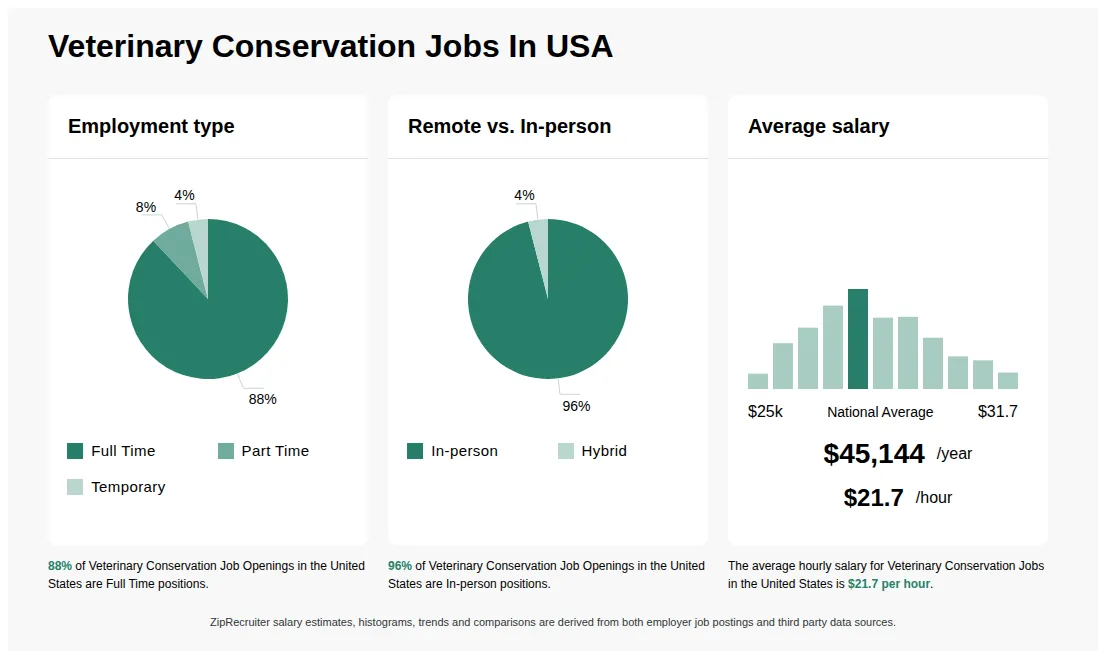
As of Jun 6, 2026, the average hourly pay for veterinary conservation in the United States is $21.70, according to ZipRecruiter salary data. Most workers in this role earn between $17.79 and $24.76 per hour, depending on experience, location, and employer.

What is veterinary conservation?

Veterinary conservation is a specialized field that combines veterinary medicine with wildlife conservation efforts. Professionals in this area work to protect and improve the health of wild animal populations, often focusing on endangered species and their habitats. They may be involved in disease monitoring, wildlife rehabilitation, research, and advising conservation strategies. Veterinary conservationists collaborate with ecologists, government agencies, and non-profit organizations to promote biodiversity and ecosystem health. This field is crucial for maintaining the delicate balance of natural environments and ensuring the survival of various species.

What are the key skills and qualifications needed to thrive as a Veterinary Conservationist, and why are they important?

To thrive as a Veterinary Conservationist, you need a veterinary degree (DVM or equivalent), expertise in wildlife health, and knowledge of conservation biology. Familiarity with field research tools, GPS tracking systems, and wildlife disease surveillance platforms is commonly required. Strong problem-solving abilities, communication skills, and cultural sensitivity help you collaborate with multidisciplinary teams and local communities. These skills ensure effective wildlife conservation interventions, promote ecosystem health, and support sustainable biodiversity management.

What is the difference between Veterinary Conservation vs Veterinary Technician?

AspectVeterinary ConservationVeterinary Technician
Required CredentialsVeterinary degree, specialized training in wildlife or conservationAssociate degree in veterinary technology, certification
Work EnvironmentWildlife reserves, conservation projects, zoosVeterinary clinics, animal hospitals, labs
Employer & Industry UsageEnvironmental agencies, conservation organizationsVeterinary clinics, animal care facilities

Veterinary Conservation professionals focus on wildlife health and conservation efforts, often working in outdoor or specialized settings. Veterinary Technicians assist in clinical settings with animal care and medical procedures. While both roles require animal health knowledge, Veterinary Conservation emphasizes wildlife and habitat preservation, whereas Veterinary Technicians support clinical veterinary practices.

How does a veterinary conservationist typically collaborate with other professionals in wildlife conservation projects?

Veterinary conservationists frequently work as part of interdisciplinary teams that include ecologists, biologists, park rangers, and government officials. Collaboration often involves coordinating fieldwork, sharing health data on wildlife populations, and developing strategies for disease prevention and habitat management. These professionals may also provide training to local staff and assist with community outreach to promote conservation goals. Effective communication and teamwork are essential, as the success of conservation initiatives depends on integrating veterinary expertise with broader environmental and policy efforts.
More about Veterinary Conservation jobs
What states have the most Veterinary Conservation jobs? States with the most job openings for Veterinary Conservation jobs include:
Infographic showing various Veterinary Conservation job openings in the United States as of May 2026, with employment types broken down into 87% Full Time, 12% Part Time, and 1% Contract. Highlights an 96% Physical, 1% Hybrid, and 3% Remote job distribution, with an average salary of $45,144 per year, or $21.7 per hour.

Keeper - Amphibian Conservation

OMAHA ZOO GROUP

Omaha, NE โ€ข On-site

$18.62/hr

Full-time

This job post hasย expired today.ย Applications are no longer accepted.


Job description

Job Title: Amphibian Conservation Keeper
FLSA Status: Non-Exempt
Classification: Full-time
Hours: Thursday - Monday or Friday - Tuesday
Pay Rate: Range starts at $18.62/hour
Summary:
Omaha's Henry Doorly Zoo & Aquarium is seeking an Amphibian Conservation Keeper that will be responsible for the animals in the Amphibian Conservation Area and will also be expected to offer assistance/advice for animals in the zoos amphibian collection that are maintained in other departments. This position reports directly to the Supervisor of Reptiles and Amphibians. The Amphibian Conservation Area (ACA) currently cares for ~1300 individual amphibian specimens in an off-exhibit, strict quarantine area. Most specimens in the collection are comprised of eight conservation species and are maintained in individual bio-secure isolation units.
The mission of the Amphibian Conservation Area is to address wild amphibian decline by continually advancing conservation efforts, through evolving welfare, reproduction, collaboration, and reintroduction.
Current conservation species of focus include Wyoming Toad, Boreal Toad, Puerto Rican Crested Toad, Dusky Gopher Frog, Frosted Flatwoods Salamander, Blue-spotted Salamander, Mountain Yellow-legged Frogs, and Panamanian Golden Frogs.. This is an ever-changing list, and this department can pick up new projects/species as they present themselves based on wild population assessments. This team also occasionally cares for other amphibian species, not listed, meant for zoological habitats.
This is an ever-changing list. This department can pick up new projects/species as they present themselves. We also work with amphibian species, not listed, meant for zoological habitats.
Duties and Responsibilities (included but not limited to):
  • Attends to all aspects of daily animal husbandry and enclosure maintenance while adhering to specific quarantine protocols for an intense amphibian collection of special conservation needs in a major AZA accredited institution.
  • Writes clear, concise reports and maintains accurate records on animals and aquatic systems.
  • Practices effective communication skills and has the capacity to work well with others while maintaining the ability to work effectively as an individual.
  • Must have the ability to compile research data and assist in preparing data for publication.
  • Reports potential issues or concerns promptly to the department supervisor.
  • Expected to assist veterinarians and technicians during medical procedures and treatments. Keepers may also be expected to assist other zoo personnel in making system/building repairs.
  • Participates in and helps develop educational presentations and Behind the Scenes Tours to enhance the Zoo Experience for our 1.7 million guests.
  • Participates in and supports collaborative efforts pertaining to the ACA Collection, such as reproduction of selected species, research, enrichment, training and conservation programs.
  • Responsible for daily care and reproduction of several insect species (fruit flies, crickets, roaches, firebrats, etc.).
  • Must be willing to work in confined/uncomfortable spaces and with potentially dangerous animals. Keepers are expected to demonstrate safe working practices at all times and learn effective time management skills.
  • This position may at times require intense public contact, requiring considerable interpersonal ability, and an appreciation for public speaking.
  • Required to create and deliver presentations in professional settings.
  • Other duties may be assigned.

Qualifications, Knowledge, Skills and Abilities Required:
  • Must be at least 18 years old.
  • Must be willing to work weekends, holidays, and/or extended hours.
  • Bachelors degree in Biology or related field is preferred.
  • Must have a working knowledge of Natural History, Biology, Captive Husbandry and Conservation Issues as they apply to amphibians and be individually and independently motivated to continue expanding their knowledge base as it applies to amphibians.
  • Previous experience with amphibians in an AZA institution is preferred.
  • Experience with amphibian conservation is preferred.
  • Experience with laboratory and/or quarantine procedures and aquatic life support systems is preferred.
  • Consideration will be given to an individuals past direct experience.

Candidates are required to pass a pre-employment background check, including a drug test, and possess a valid drivers license with a good driving history.
Working Conditions and Physical Effort:
  • Off-habitat quarantine space with several small isolation rooms.
  • Routine exposures to heat, cold, moisture and air pollution.
  • The position may involve exposure to chemical substances, certified PPE will be supplied.
  • Position may be afforded the opportunity to participate in In-situ conservation projects. Applicants must be willing to travel and able to work in strenuous field conditions.
  • Working in awkward positions
  • Ability to climb ladders
  • Ability to lift and/or move up to 50 to 75 pounds.

DISCLAIMER
The information presented indicates the general nature and level of work expected of employees in this classification. It is not designed to contain, nor is it to be interpreted as, a comprehensive inventory of all duties, responsibilities, qualifications and objectives required of employees assigned to this job.
Omaha's Henry Doorly Zoo & Aquarium is an Equal Employment Opportunity Employer as defined by the EEOC.